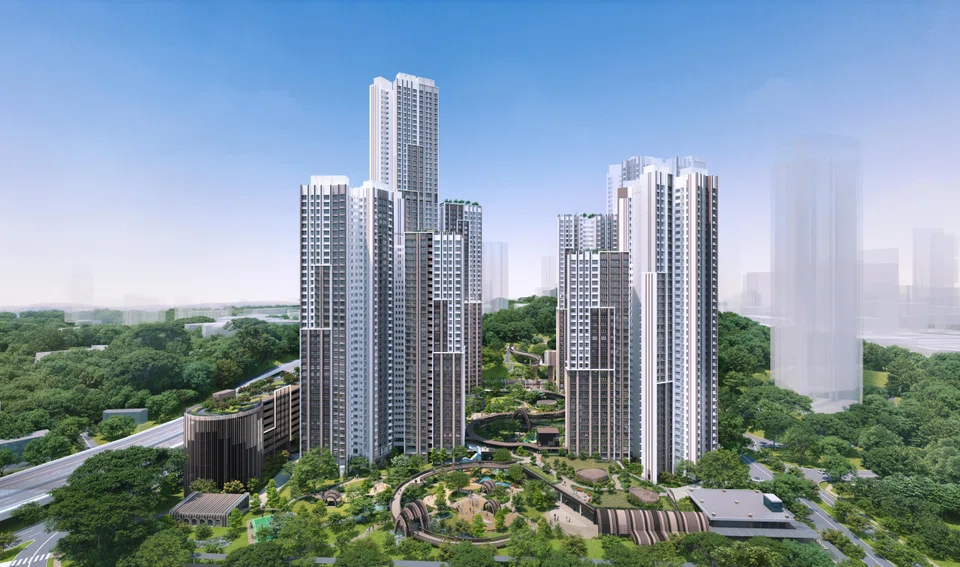
For most of Singapore's public housing history, "height" meant twelve storeys and a lift landing you could see from the playground. Then came the 40-storey point blocks, then Pinnacle@Duxton's 50 storeys in 2009 — and now, a number that would have sounded like a typo a decade ago: 60 storeys, and then some, for an HDB BTO project.
At Budget 2026, National Development Minister Chee Hong Tat announced that HDB will roll out 60-storey BTO blocks, starting with a project at Pearl's Hill in Outram that will exceed 60 storeys and become Singapore's tallest public housing development. The framing was deliberately blunt: build more, faster, higher. For a generation of young Singaporeans weighing BTO ballots against resale flats, the announcement raises a very practical set of questions — about lifts, amenities, maintenance costs, and whether a flat 55 floors up is a smart buy or a lifestyle gamble.
This is what the plan actually says, what taller HDB blocks change on the ground, and the factors worth checking before you apply.
Background: How HDB Learned to Build Up
Singapore's land constraint is not new, but the arithmetic has tightened. With a population that has grown while the island has not, the only direction left is vertical — and the state has been inching that way for two decades.
The numbers tell the story of a slow, deliberate ascent:
- In 2011, there were 46 HDB blocks of at least 40 storeys, spread across 7 projects.
- Today, that has grown to 119 such blocks across 35 projects — according to figures reported by The Straits Times.
- Pinnacle@Duxton, completed in 2009 at 50 storeys, remains the tallest HDB development in Singapore today.
Two things unlocked the next step. First, aviation height restrictions were revised in August 2025, allowing taller development in areas previously capped by flight paths. Second, HDB's engineering and construction capability — prefabrication, advanced lift systems, structural design — has caught up with the ambition.
The result is a policy shift with a clear slogan. As reported by Business Times, the push upwards begins with the Pearl's Hill BTO project, which HDB describes as a test case for constructing taller blocks wherever site conditions allow.
Why now? The supply-side logic
Three pressures converge:
- Land scarcity. Every hectare given to housing is a hectare not given to parks, water catchments, or industry.
- Demand concentration. Buyers want mature estates near MRT lines. Those estates have little empty land left — only airspace above existing stock.
- Construction timelines. A taller block on the same footprint delivers more units without a longer land acquisition and site preparation cycle.
The trade-off is that height is not free. Super-tall blocks carry higher construction costs, more complex maintenance, and site constraints that Minister Chee himself acknowledged make 60 storeys "unlikely to become the norm." That nuance matters for buyers: this is a targeted tool, not a universal new standard.
The Land Maths: What 50% More Flats Actually Means
The headline justification is simple. According to Minister Chee, a 60-storey block can provide about 50% more flats than a 40-storey block on the same site.
That is not a marginal gain. It is the difference between a project that pencils out and one that does not.
HDB Blocks of 40 Storeys or More
Consider what the extra 20 storeys buys in planning terms:
- More units per plot means a lower land cost per flat, which supports affordability even as construction costs rise.
- More residents per site means a larger catchment for amenities — a supermarket, childcare centre, or food court becomes viable when 1,700 households sit above it rather than 900.
- More efficient infrastructure — one MRT connection, one bus stop cluster, one drainage system serving twice the households.
But density also means contention. More households share the same lift cores, the same loading bay, the same playground at 6pm on a Saturday. How well a super-tall block ages depends less on the height itself than on how thoughtfully those shared systems are designed.
Pearl's Hill: Inside Singapore's Tallest HDB Project
The first 60-storey BTO is the clearest window into what buyers can expect. Announced in March 2026, the Pearl's Hill project sits at the base of Pearl's Hill in Outram Park, next to Outram Park MRT station — an interchange serving both the East-West and Thomson-East Coast lines.
| Feature | Detail |
|---|---|
| Location | Pearl's Hill, Outram Park |
| Maximum height | Over 60 storeys |
| Estimated units | About 1,700 |
| Flat types | Two-room Flexi, three-room, four-room |
| Rental component | Over 140 public rental units |
| Neighbouring amenity | Pearl's Hill City Park |
| Significance | First public housing in the area in over 40 years |
The design brief reportedly draws on traditional Chinese landscape artistry, with sky gardens and terraces intended to break up the vertical mass and give residents usable open space at height. A second major launch follows in October 2026: a 1,600-unit BTO project near Caldecott MRT station in Toa Payoh West, which will include 240 Community Care Apartments designed for seniors, along with a food court, supermarket, childcare centre, and a 1.1-hectare park.
Note the social mix. The inclusion of 140-plus rental units inside a landmark development is a deliberate policy choice — HDB has been integrating rental and sold flats within the same blocks and estates rather than segregating them, and a flagship project sets the tone for what "public housing" means for the next generation.
What 60 Storeys Actually Changes for Residents
Height is an abstract number until you are standing in the lobby at 8am. Here is where the practical differences show up.
Lift access: the real test of a super-tall block
If there is one operational metric that determines whether residents love or loathe a super-tall block, it is lift waiting time.
Existing high-rise HDB developments already show the strain. At Pinnacle@Duxton, residents have reported waits of up to five minutes, stretching to as long as ten minutes during maintenance periods, according to reporting by The Straits Times. Scale that to 60 storeys with more households per lift core, and the design of the lift system becomes as important as the view.
What to look for:
- Lift zoning. Tall blocks typically split lifts into zones (low, mid, high) so a lift does not stop at every floor. More zones mean faster journeys but potentially longer waits if your zone has few cars.
- Number of cars per lift core. This ratio matters more than the total number of lifts in the block.
- Maintenance regime. A single lift out of service in a 60-storey block is a much bigger disruption than in a 20-storey one.
- Backup and redundancy. Ask whether the design allows at least one lift per zone to remain in service during servicing.
For a household with young children, a stroller, or elderly parents, a five-minute wait at the lobby twice a day is a genuine quality-of-life factor — and one that is very hard to retrofit later.
Amenities and estate planning
Higher density changes the economics of amenities in the buyer's favour — up to a point.
- Retail viability improves. A supermarket inside a 1,700-unit development has a captive catchment. Smaller projects often cannot support one.
- Community facilities get prioritised. Childcare centres, residents' committee rooms, and community hubs are more likely to be co-located in larger developments.
- Green space becomes vertical. Sky gardens and terraces substitute for ground-level parks, which are finite on a dense site. The Pearl's Hill design explicitly leans on this, alongside proximity to Pearl's Hill City Park.
- Connectivity is planned around volume. A 1,700-unit block generates serious pedestrian flow, which strengthens the case for sheltered walkways, additional bus services, and MRT access improvements.
The counterpoint: shared spaces get shared by more people. A 25m pool or a 200sqm playground that feels generous in a 500-unit project feels tight in a 1,700-unit one. Estate planning has to scale amenity provision with population, not just with plot size.
Community, social mix, and the "vertical kampung"
Sociologically, Singaporeans have largely made peace with living high up. Professor Chua Beng Huat has observed a general acceptance of higher-floor living, with residents often valuing cleaner air and better views.
The open question is social cohesion. Some observers worry that extremely tall buildings — where neighbours may never share a lift lobby — could dilute the casual interactions that build community. Dr Tan Ern Ser, an Adjunct Principal Research Fellow, has emphasised that community-building initiatives and thoughtful architectural design are what create a sense of belonging in high-density environments, rather than height alone.
Practically, that means the atrium, the sky terrace, the void deck's replacement, and the residents' network matter more in a 60-storey block than in a five-storey walk-up. When evaluating a project, look at whether the design creates shared destinations — places people go on purpose rather than pass through.
The small print: fire safety, water pressure, and charges
Super-tall living brings a set of considerations that rarely make the brochure:
- Fire safety and evacuation. HDB buildings comply with stringent codes, but 60 storeys introduces complexity in evacuation strategy. Buyers should understand the evacuation routes and whether refuge floors are provided.
- Service and conservancy charges. Taller blocks cost more to run — more lifts, more pumps, more common area, more frequent servicing. For context, a four-room flat at Pinnacle@Duxton carries materially higher charges than a standard four-room unit elsewhere. Budget for this as a permanent monthly cost.
- Water pressure. Supply on upper floors depends on tanks and pumping systems. Minor variability at height is normal; persistent issues are not.
- Wind exposure. Upper-floor units can catch strong winds, which affects balcony usability and anything you plan to mount outside.
- Views and natural light. This is the upside. Ms Christine Sun, a property analyst, has noted that buyers may hope panoramic views command a price premium in the long run, or at least help retain value as leases depreciate.
The Market You're Buying Into
Timing matters as much as height. The 60-storey announcement landed in a market that has cooled considerably from its post-pandemic peak.
According to figures cited by Business Times, HDB resale prices rose 2.9% in 2025 — a sharp deceleration from the 12.7% gain in 2021 — and were down 0.1% as at mid-February 2026. Private residential prices have moderated similarly, posting their smallest increase since 2020.
HDB Resale Price Change (%)
In the most recent quarterly data, the median HDB resale price stood at about S$638,000, with Jurong West recording the highest transaction volume at 114 resale transactions, and Toa Payoh posting the highest median resale price at S$1,026 psf. That Toa Payoh figure is worth keeping in mind — the October 2026 Caldecott-area launch sits in precisely that price environment.
On the new-launch side, demand pressure has eased noticeably:
| Indicator | Reading |
|---|---|
| First-timer application rate, 2020 peak | Nearly 7 applicants per three-room-or-larger flat |
| First-timer application rate, 2025 | Between 1.1 and 1.9 |
| First-timer application rate, Feb 2026 | 0.9 |
| BTO flats planned for 2026 | About 19,600 |
| Two-room Flexi supply, 2026–2028 | Up almost 50% |
| Median EC price, 2025 | S$1,754 psf |
First-Timer Application Rates for Larger BTO Flats
The implication for a 60-storey applicant is straightforward: competition for a ballot is softer than it was five years ago, but the flats themselves are carrying more embedded cost — taller structures, more elaborate common areas, higher maintenance obligations. Sticker price is only part of the equation.
Policy changes that affect your application
Several rule changes are running in parallel with the height push:
- Third Child Priority Scheme (TCPS). From the June 2026 BTO exercise, the allocation quota rises from up to 5% to up to 10%, and families expecting a third child become eligible.
- Income ceiling and singles' age. The government is reviewing both the BTO income ceiling and the eligibility age for singles buying HDB flats — but has signalled that supply must come first.
- Voluntary Early Redevelopment Scheme (VERS). The first few sites are planned for the first half of the next decade, with scale-up from the late 2030s.
- Home Improvement Programme II (HIP II). Flats reaching the 60- to 70-year mark will get a more comprehensive second round of upgrading.
- 15-month wait-out period. The rule requiring private property owners to wait 15 months before buying a resale HDB flat remains under review, with removal contingent on market conditions.
For anyone weighing a 60-storey BTO against a resale flat, these policies shape both the ballot odds and the long-run value of the asset you end up holding.
A Practical Checklist Before You Apply
Super-tall living suits some households better than others. The decision is less about prestige and more about daily friction.
A short due-diligence list:
- Lift configuration. How many lifts serve your zone, and what is the car-to-unit ratio?
- Service and conservancy charges. Get the projected monthly figure for your flat type and compare it against a conventional block.
- Floor premium. Understand what you are paying for the view, and whether that premium is likely to hold at resale.
- Amenity scaling. Is the supermarket, childcare centre, or clinic sized for 1,700 households or for 500?
- Evacuation and safety. Familiarise yourself with refuge floors and evacuation routes.
- Estate trajectory. Look at the wider planning context — MRT upgrades, new schools, park connections — not just the block.
- Exit liquidity. Higher-floor units with unobstructed views tend to attract a narrower but keener buyer pool. That is a feature in a strong market and a drag in a weak one.
The counter-case worth hearing
Not everyone is convinced that taller is better. Critics have raised questions about whether owners in super-tall HDB blocks might eventually face tighter curbs as the lease decays and redevelopment becomes harder — a point flagged in regional coverage of the announcement. The concern is structural: a 60-storey block is expensive to demolish and rebuild, which could complicate future redevelopment or en-bloc-style outcomes for public housing.
Minister Chee's own framing — that 60 storeys will not become the norm due to construction costs and site constraints — is an acknowledgment that this is a scalpel, not a hammer. Buyers should read it the same way.
Food for Thought
- If a 60-storey block delivers 50% more flats on the same land, should the pricing reflect that efficiency — or does the view premium cancel it out?
- At what point does density stop being efficient and start being stressful? Is there a household count above which shared amenities and lift cores fail to keep pace?
- Will super-tall HDB flats hold value like their lower-rise counterparts, or will maintenance costs and redevelopment difficulty create a two-tier resale market within public housing?
- If 60 storeys is a test case, what does success look like in 10 years — waiting times, charges, community participation, or resale prices?
- Should the tallest public housing in Singapore sit next to an MRT interchange by default, or is height better deployed in lower-cost, lower-connectivity sites to stretch the supply gain further?
Conclusion
The move to 60-storey BTO blocks is Singapore's most visible answer yet to a question it has been quietly managing for decades: how do you house more people on the same small island without giving up the liveability that makes the island worth living on? The Pearl's Hill project, at over 60 storeys with roughly 1,700 units and a rental component woven in, is the first real test of whether that answer holds up in daily life.
For buyers, the practical takeaway is that height is a feature with a cost curve attached — in lift waits, in conservancy charges, in wind, and in the premium you pay for the view. Weighing those against softer ballot competition and a cooling resale market is the actual decision in front of you.
Sources and further reading
- Business Times — Budget 2026: HDB to roll out 60-storey BTO blocks in plan to 'build more, faster, higher'
- CNA — 60-storey flats in first BTO project at Pearl's Hill in over 40 years, as government intensifies land use; commentary on Singapore public housing
- The Straits Times — Building taller: The rise of HDB blocks above 40 storeys in land-scarce Singapore; 60-storey BTO project to be built in Pearl's Hill
- HDB — HDB Pulse: public housing data and flat supply updates, income ceiling changes
- Stacked Homes, Ohmyhome, HomeSwift — project analyses of the Pearl's Hill launch
- The Online Citizen — coverage of the March 2026 announcement