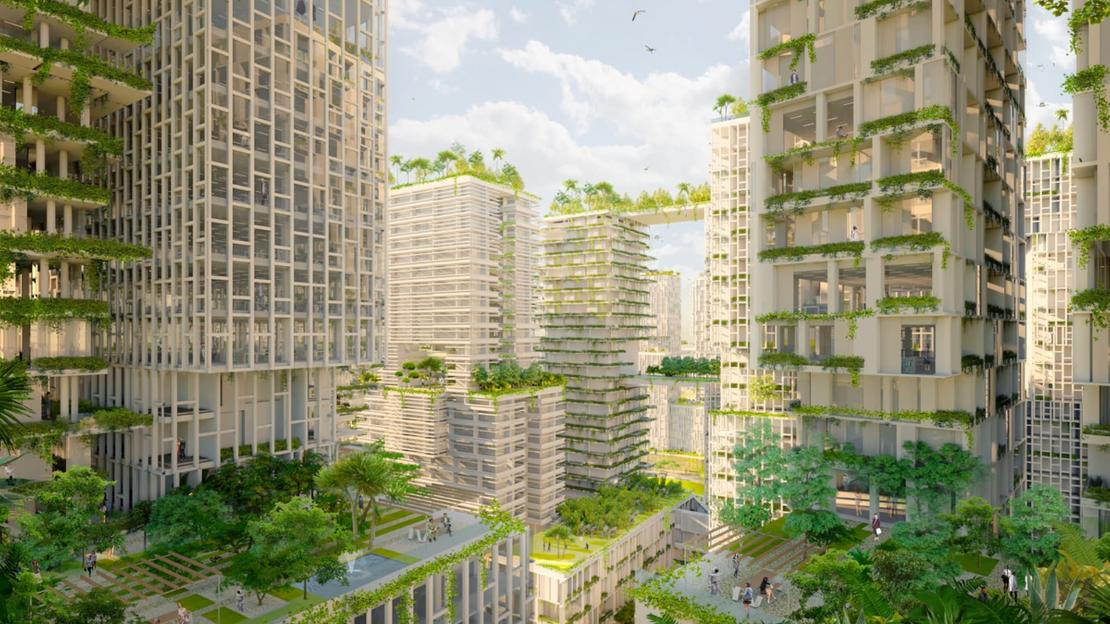
Two postal codes, two very different waiting rooms.
On one side sits Jurong Lake District — Singapore's long-running bid to grow a second business heartland in the west, already served by an MRT interchange, a hospital, three malls and a lakeside garden. On the other sits Tengah — a 700-hectare blank canvas being drawn into Singapore's first "forest town," where the first residents only started collecting keys in 2023 and where the MRT has not yet arrived.
For a young couple putting together a first home in Singapore, these two names get thrown around in the same breath far too often. They are not the same bet. One is a maturing urban centre where most of the convenience already exists and most of the upside is already priced in. The other is a greenfield BTO engine with a lower ticket price, a longer wait, and a payoff that depends entirely on whether you can stomach living on a construction site for the better part of a decade.
This comparison breaks down price, commute, amenities, future supply and timeline risk — the five things that actually determine whether a first home works out — and tries to be honest about where the data is solid and where it is still mostly projection.
Two Growth Stories Running on Very Different Clocks
Jurong Lake District: the second CBD that keeps getting closer
Jurong Lake District (JLD) is planned as Singapore's largest business district outside the central area, spanning roughly 360 hectares across the Jurong Gateway, Lakeside and Lakeside Gateway precincts. The long-range plan — typically quoted as a 2040 to 2050 horizon — targets about 100,000 new jobs and 20,000 new homes.
What makes JLD different from a pure aspiration is that a lot of the infrastructure already exists:
- Jurong East MRT interchange (East-West Line and North-South Line) is operational today
- Ng Teng Fong General Hospital anchors the medical cluster
- JEM, Westgate and IMM provide a mature retail base
- Jurong Lake Gardens delivers a genuine outdoor amenity, not a rendering
- The Jurong Region Line (JRL), opening in phases from 2027, will thicken intra-west connectivity, linking Jurong East to Boon Lay, Tengah and Choa Chu Kang
The pipeline is still moving. A major "White Site" tender in the district is expected to yield around 1,200 homes alongside office and retail space — the kind of mixed-use injection that converts a plan into a place. But JLD has also tasted reversal: the Kuala Lumpur–Singapore High-Speed Rail, which was supposed to terminate at Jurong East, was shelved in 2021. That episode is the single best argument for treating any 20-year master plan with professional scepticism.
Tengah: Singapore's newest HDB town, still in its first act
Tengah is a different animal entirely. It is a new town from scratch — about 42,000 homes planned across five districts, split roughly into 30,000 public and 12,000 private units. Its identity is built around greenery and a car-lite lifestyle: a car-free town centre, a 100-hectare Central Park, and a 5-kilometre forest corridor threading through the estate.
Progress so far:
- First residents moved in from 2023
- Plantation Plaza has been operating since 2024
- Parc Point, the town's next neighbourhood centre, was slated to come online around 2026, with a supermarket, food court and wellness trail anchoring the retail line-up
- More than 18,000 BTO flats have already been launched — over half of Tengah's planned public housing supply
- The JRL will eventually serve the town, with stations phased in from 2027 onwards
Here is the honest summary from the people who study new towns for a living. Professor Sing Tien Foo of NUS Business School has estimated that Tengah needs roughly 8 to 10 years to reach "critical mass" — the point where population, shops, schools and transport all reinforce each other.
That single sentence is the crux of this entire comparison. Buying in Tengah is not buying a flat. It is buying a dated option on a town.
Side-by-side at a glance
| Dimension | Jurong Lake District | Tengah |
|---|---|---|
| Planning status | Mature commercial node, mid-expansion | New town, early build-out |
| Scale | ~360 ha, ~100,000 jobs, ~20,000 homes (2040–2050 horizon) | ~42,000 homes (30,000 public, 12,000 private) |
| MRT today | Jurong East interchange (EWL/NSL) | None operational |
| MRT future | JRL from 2027 | JRL stations from 2027–2028 |
| Retail today | JEM, Westgate, IMM | Plantation Plaza; Parc Point around 2026 |
| Schools | Established catchment | Pioneer Primary (2026), new school (2028), ACS (Primary) co-ed campus (2030) |
| Green space | Jurong Lake Gardens | 100 ha Central Park, 5 km forest corridor |
| Dominant supply type | Infill, mixed-use, Plus/Prime-classified BTO | High-volume BTO, one EC (Copen Grand) |
| Key risk | Construction disruption over a long build-out | Delayed transport and amenity maturity |
Price: What Young Couples Actually Pay in JLD and Tengah
This is where the two areas diverge most sharply, and where a lot of online commentary gets sloppy. Let's separate the segments properly.
The resale and BTO picture
Around the established Jurong West areas adjacent to JLD, 4-room resale flats are transacting in the S$480,000 to S$580,000 range, at roughly S$580 to S$700 per square foot. These are older, larger flats in a mature estate with an existing MRT connection — you are paying for time already banked.
Newer BTO flats on the JLD periphery have been priced between S$390,000 and S$520,000.
Tengah's indicative BTO pricing for 2026 sits meaningfully lower:
| Flat type | Indicative price range | Median (Feb 2023 launches) |
|---|---|---|
| 3-room | from ~S$280,000 | — |
| 4-room | S$390,000 – S$440,000 | S$322,500 – S$354,500 |
| 5-room | S$520,000 – S$580,000 | S$438,500 – S$482,000 |
Notice the overlap trap: a 4-room Tengah BTO starting around S$390,000 is not dramatically cheaper than a JLD-periphery 4-room BTO at the same entry point. The gap widens when you compare like-for-like against resale in Jurong West, where a 4-room flat typically starts around S$480,000.
Indicative Entry Prices by Flat Type (S$'000)
The price-per-square-foot ladder
Looking at PSF rather than headline price tells a cleaner story about what you are actually buying at each rung of the west-side ladder.
Price per Square Foot Across West-Side Segments (S$/psf)
Two caveats matter here. First, the JLD private figures are projections for 2026-era launches, not settled transactions — treat them as a directional ceiling, not a valuation. Second, PSF comparisons across tenures and flat sizes are inherently imperfect; a large older 4-room flat and a compact new 4-room flat can carry very different PSF while offering similar liveability.
Copen Grand: Tengah's first real price signal
Tengah's inaugural Executive Condominium, Copen Grand, launched in 2022 and sold out all 639 units at an average of about S$1,300 psf. Resale eligibility is anticipated around 2027–2028 once the minimum occupation period clears.
That S$1,300 psf number is useful precisely because it is real. It tells you where the private market priced Tengah when the town was still mostly dust — roughly double the resale PSF of neighbouring Jurong West flats, and comfortably below the projected JLD private range. Whether that was prescient or premature will only be settled when those units start changing hands.
The Plus/Prime wrinkle nobody should ignore
Since the October 2024 BTO classification framework, flats in attractive locations can be designated Plus or Prime, carrying a 10-year minimum occupation period and subsidy clawback on resale. New JLD-area flats are strong candidates for these labels; Tengah flats, being in a non-mature town, have generally sat outside the tightest restrictions.
For a young couple, this is not a footnote. A 10-year MOP means:
- You cannot sell or rent out the whole flat for a decade
- Your upgrade path is effectively frozen through your early 30s and possibly into your 40s
- Any "paper gain" is locked in until the MOP expires
A cheaper flat with a 5-year MOP can be a better financial instrument than a better-located flat with a 10-year lock, depending on how mobile your career is.
Grants change the maths, not the ranking
Grants can be substantial — the Enhanced CPF Housing Grant (up to S$120,000), the CPF Housing Grant (Family) (up to S$80,000), and the Proximity Housing Grant (up to S$30,000) if you live near family. These reduce effective outlay meaningfully, especially on resale flats in Jurong West if parents are nearby. But they do not change the underlying trade-off: you are still choosing between paying for maturity or waiting for it.
Commute: The 25-Minute Benchmark and the 2027 Question
Commute is the most under-modelled variable in first-home decisions. Couples routinely optimise for price and then spend a decade resenting their journey to work.
Jurong Lake District: connectivity that already works
From Jurong East, the East-West Line delivers a direct ride to the CBD in roughly 25 minutes. That is a genuinely competitive number — better than many "central-ish" locations once you factor in transfers.
Road access is equally solid. The Ayer Rajah Expressway connects to the CBD and the west coast industrial belt, and Jurong is well positioned for anyone working in Tuas, Jurong Island, one-north, or the NUS/NTU corridor. If your career is anchored in the west, JLD is close to optimal.
The JRL, from 2027, will not shorten CBD commutes — the East-West Line already does that job. What it will do is make intra-west travel dramatically easier, connecting Jurong East to Boon Lay, Tengah and Choa Chu Kang without a trip through the city.
Tengah: a three-to-five-year transport gap
As of late 2026, Tengah has no operational MRT station. Residents rely on feeder buses. That is the reality you are buying into if you collect keys before the line opens.
The JRL changes this materially. Once the stations serving Tengah are running — phased from 2027, with the town-serving stretch expected around 2028 and the network maturing toward 2030–2031 — the estate connects to:
- Choa Chu Kang (North-South Line)
- Boon Lay (East-West Line)
- Jurong East (East-West Line, North-South Line)
Early estimates put Tengah to Jurong East at around 15 minutes by rail. From there, the CBD is another 25 minutes or so. That is a reasonable total journey — but it is a journey that does not exist yet.
The blunt version, echoed by buyer guides covering the estate: households heavily reliant on MRT connectivity for daily commutes should plan around the 2027–2028 window rather than assuming rail access from day one. Buyers with low tolerance for construction noise, dust and visual blight should probably wait until the estate matures further.
Amenities: Established Depth vs a Greenfield Ecosystem
JLD: convenience you do not have to imagine
The amenity list here is not a promise; it is an inventory. Three shopping centres, a general hospital, a lake garden, the Science Centre, and a dense surrounding residential base that supports hawker food, tuition centres and clinics. Depth matters more than checkboxes — a single mall serves a single mood, but a retail cluster serves a decade of changing needs.
The trade-off is that you will be living inside a construction zone for much of the next decade as the district fills out. That is the price of buying into an expansion rather than a finished product.
Tengah: the forest town concept, partially delivered
Tengah's amenity story is genuinely differentiated — no other HDB town offers a car-free town centre, a 100-hectare Central Park and a 5-kilometre forest corridor. If cycling paths and green corridors are central to how you want to live, nothing else in the HDB catalogue replicates this.
But the everyday conveniences are still arriving:
- Plantation Plaza has been open since 2024
- Parc Point brings a supermarket, food court and wellness trail around 2026
- Pioneer Primary School relocates into Tengah in 2026 as the town's first primary school
- A new primary school is anticipated around 2028
- ACS (Primary) is scheduled to open a co-educational campus in Tengah in 2030
Until the retail and F&B base fills in, many residents will drive or bus to neighbouring towns for a proper grocery run or a Saturday dinner. That is not a dealbreaker — but it is a real, recurring friction that shows up in daily life rather than in a brochure.
Rental Yields and the Investment Case
Here is where a lot of property content quietly invents numbers. Let's not.
Why yield data for Tengah is genuinely thin
Rental yield is a simple ratio — annual rent divided by purchase price — but both inputs are unstable in a new town:
- Owner-occupation dominates. With MOP restrictions on BTO flats and a population still moving in, the rental pool in Tengah is small and not yet representative.
- Supply is arriving in waves. Rents in a new estate are set by the next batch of completions, not by a settled market.
- Transaction prices are still mostly launch prices. Comparing a 2023 BTO launch price to a 2026 rent is not a yield; it is a coincidence.
The practical implication: any specific yield figure quoted for Tengah today should be treated as indicative at best. Hiva's rental tracking for the town will become genuinely useful as more units clear MOP and the tenancy base stabilises — which is a 2028-onwards story for most early blocks.
JLD and Jurong West: a more observable rental market
The established estates around JLD have the opposite problem — plenty of rental activity, but yields compressed by high capital values. Older, larger 4-room flats in Jurong West tend to rent to a working population tied to the western industrial belt, one-north and the hospitals. Newer, smaller units typically command higher rent per square foot but carry a higher entry price, which flattens the yield.
The pattern to watch rather than memorise: yield and capital appreciation pull in opposite directions in this corridor. Buying cheap in Tengah maximises the theoretical yield on cost; buying in JLD maximises liquidity and rentability today.
The EC as a middle path
Copen Grand sits in an interesting spot. Executive Condominiums are designed as a hybrid — subsidised entry, private facilities, and a five-year MOP before they can be sold to Singaporeans (and a further five before full privatisation). For couples who want condo-style living without the full private price, and who can wait out the MOP, the EC route in Tengah is arguably the most interesting product in the town today. It is also the one where early buyers have the most exposure to whether the surrounding town delivers on schedule.
Future Supply and Timeline Risk
How much is still coming
Tengah's pipeline is enormous and, critically, mostly public housing. That has two effects: it accelerates amenity provision (the state builds the school and the MRT when the population arrives), and it caps resale price growth (your future buyer has a fresh BTO alternative down the road).
Tengah's Housing Pipeline (units)
JLD's supply is different in character: infill sites, mixed-use tenders and high-density nodes, often under Plus/Prime rules. Less volume, higher price points, tighter restrictions. Supply here is a trickle of premium product rather than a flood of affordable product.
The three timeline risks that actually matter
1. Transport timing. The JRL is a real project with a published schedule, not a speculative one. But "phased from 2027" and "operational for your daily commute" are different claims. Build in a buffer of two to three years.
2. Amenity sequencing. Schools, clinics and supermarkets in new towns generally follow population, not precede it. If your plan involves a child within the next three years, check the Primary 1 registration timeline against the school opening dates — not against the town brochure.
3. Policy and project risk. The shelving of the Kuala Lumpur–Singapore High-Speed Rail in 2021 is the cleanest available case study. A headline infrastructure project can be deferred, and when it is, the properties that priced it in re-rate. JLD absorbed that shock reasonably well because its fundamentals never depended on the HSR alone — but the lesson stands.
What "buying early" actually means
Buying in Tengah before 2028 is not a passive investment. It is an operational commitment: longer commutes, fewer dinner options, construction noise, and a resale market that will be judged by buyers who can choose a newer block nearby.
The counterargument is equally real. Early BTO buyers in Tengah have already seen meaningful paper gains, and the town's eventual build-out — schools, community hubs, commercial nodes — is a known quantity in a way that most speculative bets are not. The state has committed to the plan; the question is only sequencing.
Which One Fits Your First Home?
There is no universal winner here, only a fit test.
Lean JLD if:
- Your workplace is in the CBD, one-north, Tuas or the NUS/NTU corridor
- You value a 25-minute commute today over a 15-minute one in 2029
- You want a mature school catchment without waiting on new builds
- You can absorb construction disruption and a potentially longer MOP
- You are buying resale and want rentability and liquidity from day one
Lean Tengah if:
- You are applying for a BTO and S$390,000–S$440,000 for a 4-room is the realistic ceiling
- You are comfortable with a feeder-bus commute until roughly 2028
- Green corridors, a car-free town centre and park connectors genuinely appeal to you
- Your horizon is 10+ years and you are not counting on resale liquidity before then
- You are considering the EC route and can wait out the MOP
Consider neither, yet, if:
- Your job is likely to move in the next three years
- You need a school place within two years
- You are relying on rental income to service the mortgage
Food for Thought
-
If the JRL slipped by two years, would your Tengah purchase still make sense? If the answer is no, you are buying the MRT, not the home — and you should price that risk accordingly.
-
What is a 25-minute commute actually worth to you per month? Convert it: 50 minutes a day, 250 working days a year, over a 10-year MOP. The number is usually larger than the price gap that pushed you west.
-
Are you optimising for the flat or for the town? A BTO flat is a 99-year lease; a town is a 20-year construction project. The flat is the thing you own, but the town is the thing you live in.
-
Does a 10-year MOP fit the life you are planning, or the life you have now? Plus/Prime classifications can quietly lock a young couple out of their own upgrade path during the exact decade when incomes and family size change fastest.
-
Who is your future buyer? In a town with 30,000 planned public flats, your eventual resale buyer will have a brand-new BTO alternative within walking distance. That is a structural ceiling on price growth that no amount of greenery changes.
The Bottom Line
Jurong Lake District and Tengah are not rivals so much as two different instruments with different maturity dates. JLD is a convenience play — you pay more, you get more today, and the upside comes from a business district filling in over the next two decades. Tengah is a patience play — you pay less, you endure more now, and the payoff depends on delivery of a transport line, a school cluster and a retail base that are all dated rather than speculative.
For a couple in their late 20s or early 30s, the deciding variable is rarely the price. It is the timeline of your own life — when you need the MRT, when you might have a child, when your career might move. Match the town's clock to yours, and the choice becomes obvious.