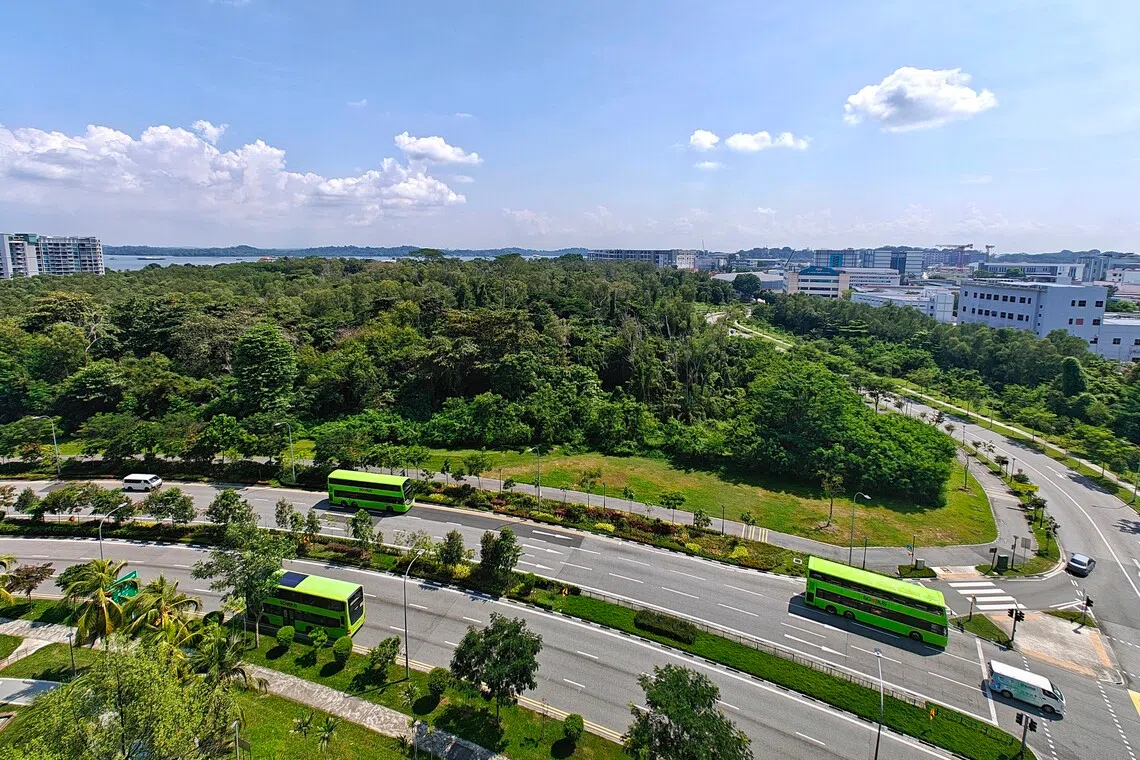
For anyone who has spent the last few years refreshing the HDB website at 8am on launch day, hoping for a flat in the east, Pasir Ris Drive 4 just became the most important stretch of road in Singapore's housing pipeline. In late November 2026, HDB unveiled plans for an entirely new neighbourhood at the eastern edge of Pasir Ris town — a site bounded by Pasir Ris Drive 3, Pasir Ris Drive 4, Jalan Loyang Besar and Sungei Loyang — carrying an estimated capacity of up to 3,000 HDB flats, alongside plans to retain roughly 13 hectares of coastal forested habitat.
It is a rare thing: a blank slate in an established town, wedged between an existing MRT line and a new one that has not even opened yet, with a mature shopping mall next door and mangroves on the doorstep. This article breaks down what we actually know, what we don't, and what first-timer families should do with the information.
The Site at a Glance
The parcel — designated Pasir Ris Neighbourhood 3 (N3) — is the most substantial public housing plan announced for the eastern region in years. Here are the headline numbers.
| Parameter | Detail |
|---|---|
| Neighbourhood name | Pasir Ris Neighbourhood 3 (N3) |
| Boundaries | Pasir Ris Drive 3, Pasir Ris Drive 4, Jalan Loyang Besar, Sungei Loyang |
| Total study area | About 36 hectares |
| Land for housing & amenities | About 20 hectares |
| Estimated HDB capacity | Up to 3,000 flats (Huttons Asia estimate) |
| Estimated private housing capacity | Up to 4,000 private homes (alternative scenario) |
| Height ceiling | Up to 24 storeys (analyst estimate) |
| Gross plot ratio | 2.1 |
| Greenery retained | About 13 hectares (8ha coastal + 5ha terrestrial) |
| Nearest MRT | Pasir Ris (East-West Line) and Loyang (Cross Island Line), both ~900m |
Sources: HDB announcement reported by The Business Times and The Straits Times, November 2026; analyst estimates from ERA Singapore and Huttons Asia.
The land has been earmarked for residential use since the 1980 Master Plan, a zoning intention reaffirmed through every subsequent five-year review. In other words, this is not a surprise rezoning rushed through in response to a hot market — it is a long-dormant parcel finally reaching the front of the queue.
Why Pasir Ris Drive 4, and Why Now
HDB's own reasoning is instructive, because it explains why this site — and not somewhere in Bukit Batok or Tengah — is being pushed forward.
The demand is demonstrably there. The last three BTO projects in Pasir Ris — Costa Grove in 2020, and Costa Riviera I and II in October 2024 — each recorded an application rate of 3.6 among first-timer families for four-room flats. That is a consistent, repeatable signal rather than a one-off spike.
The alternatives were assessed and rejected. HDB said it reviewed other brownfield sites and found none capable of delivering comparable housing capacity within the required timeframe. That is bureaucratic language for something quite significant: there is no Plan B of equivalent scale.
The infrastructure is already landing. The Cross Island Line's Loyang station (CR3) is slated for completion around 2030, the East-West Line is already running through Pasir Ris, and Pasir Ris Mall has matured into a genuine town-centre anchor. The site is arriving into a supporting ecosystem rather than waiting for one.
The land is doing double duty. Because the parcel is large and largely undeveloped, HDB can plan it as an integrated neighbourhood — housing, amenities, and a green buffer — rather than fitting blocks into leftover pockets.
What "Up to 3,000 HDB Flats" Actually Means in Practice
This is where most headlines get it slightly wrong, so it's worth being precise.
The number is a ceiling, not a promise
Lee Sze Teck, Senior Director of Data Analytics at Huttons Asia, estimated that the site could house up to 3,000 HDB flats — or up to 4,000 private homes. Those are alternative scenarios, not a combined total. The final configuration depends on whether the site goes to HDB for public housing, to the Government Land Sales programme for private development, or a mix of both.
Estimated Capacity Under Alternative Scenarios, Pasir Ris N3
The private-housing figure is larger because private units are typically smaller on average than HDB flats, allowing more units within the same gross floor area envelope. A mixed outcome — part public, part private — is entirely possible and would sit somewhere between the two.
The 24-storey ceiling and the 2.1 gross plot ratio, explained
These two figures are the planning DNA of the neighbourhood.
- Gross plot ratio (GPR) 2.1 means the total gross floor area of all buildings on the site can be about 2.1 times the site area. Applied across roughly 20 hectares of developable land, that implies on the order of 420,000 square metres of gross floor area to play with.
- Up to 24 storeys is what that density looks like in built form. It is a meaningful step up from the 12- to 16-storey blocks that dominate much of Pasir Ris's older stock, but it is well below the 40-plus storey towers in towns like Bidadari or Kallang/Whampoa.
Why does this matter to a buyer? Because the GPR and height ceiling together tell you the site will be genuinely dense — meaning a real, self-sustaining neighbourhood with enough population to support shops, a food court, a supermarket, and possibly a pre-school and other community facilities. High density is not automatically bad news for liveability; in Singapore it usually means better amenities per resident.
How many BTO launches is 3,000 flats?
A single BTO project typically delivers somewhere in the low thousands of units. If we use a rough rule of thumb of 1,000 to 1,500 flats per launch, 3,000 flats implies roughly two to three BTO exercises spread over several years.
That matters because it changes your ballot strategy. You are not waiting for one lottery — you are potentially waiting for a series of them, at least some of which will fall under priority schemes.
A word of caution on timing
HDB has been explicit that the final housing configuration and development timeline have yet to be confirmed. The EIA feedback, the prevailing housing needs, infrastructure requirements and technical feasibility studies will all shape the final plan. Treat every number above — our arithmetic included — as an estimate rather than a commitment.
The 13 Hectares HDB Is Keeping
The environmental dimension is arguably the most distinctive thing about Pasir Ris N3 — and the part most easily glossed over in a housing story.
HDB commissioned an Environmental Impact Assessment (EIA) by Tembusu Asia Consulting, and committed to retaining about 13 hectares of natural habitat within the development footprint: roughly 8 hectares of coastal ecosystems (intertidal zones, seagrass beds and mangroves) and 5 hectares of terrestrial greenery.
Land Allocation in the Pasir Ris N3 Study Area (hectares)
What the survey actually found
The EIA was not a box-ticking exercise. It recorded:
Ecological Survey Findings, Pasir Ris N3 EIA
- 254 fauna species, of which 25 are of conservation significance — including the Sunda pangolin and the greater mousedeer.
- 159 terrestrial plant species, including 26 mangrove species.
- A 15-metre-wide linear park along Sungei Loyang, which serves both as public recreation space and as an ecological corridor.
The 5-hectare terrestrial patch is deliberately positioned as a buffer between the housing and the mangroves and existing stream, preserving ecological connectivity rather than fencing nature off.
HDB has also put in place an Environmental Monitoring and Management Plan (EMMP) to govern construction activity and limit damage to sensitive areas.
The experts are not unanimous
Two voices are worth carrying forward, because they frame the live debate.
Marcus Chua, a mammal curator at the National University of Singapore's Lee Kong Chian Natural History Museum, has highlighted the site's ecological value stemming from its position along Singapore's northeastern coast and its proximity to Pulau Ubin, which allows threatened wildlife to move between habitats.
Lester Tan, a member of the Nature Society Singapore's conservation committee, has questioned whether the retained 5-hectare forest patch is large enough to sustain its wildlife populations over the long term.
Both can be true simultaneously: the site is ecologically valuable, and the retained fragment may still be smaller than ideal. What is clear is that HDB has committed to retaining greenery at a scale that would have been unusual in a public housing project twenty years ago.
Mapping Pasir Ris Drive 4 Against MRT, Mall and Roads
Connectivity is the strongest part of this site's story. The approximately 900-metre distance to both Pasir Ris MRT station on the East-West Line and the future Loyang MRT station on the Cross Island Line puts the neighbourhood within a genuine walk — roughly 11 to 13 minutes at an average pace — of two MRT lines.
This is the dual-line effect, and it is worth pausing on. Most HDB towns in Singapore are served by one line. Two lines within walking distance of the same block opens up route redundancy on disruption days, shortens journeys to the north-east and west, and typically shows up in resale pricing over time.
A quick connectivity comparison
| Destination | Approx. distance from site | Notes |
|---|---|---|
| Pasir Ris MRT (EWL) | ~900m | Operational today |
| Loyang MRT (CRL, CR3) | ~900m | Targeted around 2030 |
| Pasir Ris Mall | Short bus/bus-plus-walk ride | Town-centre anchor with F&B, retail, supermarket |
| Pasir Ris Bus Interchange | At Pasir Ris Mall | Refreshed interchange |
| Town centre core | Slightly further than the MRT | Offset by planned on-site commercial facilities |
One honest caveat: the site sits at the eastern edge of the town rather than in its core, so the walk to the existing town centre amenities is longer than the walk to the MRT. HDB's plan addresses this by designing commercial and community facilities into the neighbourhood itself, so residents are not entirely dependent on Pasir Ris Mall for daily needs.
For families with young children, that is often the more important metric. A 900m walk to the MRT is fine for a commute; a 200m walk to a supermarket is what determines how liveable a place feels on a Tuesday night.
The Demand Test: What Costa Grove, Costa Riviera and Coastal Cabana Tell Us
Past launches in the immediate vicinity give the clearest available read on how Pasir Ris N3 might be received.
| Project | Type | Launch | Key data point |
|---|---|---|---|
| Costa Grove | BTO | 2020 | Part of the consistent 3.6 first-timer application rate for 4-room flats in Pasir Ris |
| Costa Riviera I & II | BTO | Oct 2024 | 3.6× for 4-room; 6.7× for 5-room and 3Gen among first-timers |
| Coastal Cabana | Executive Condominium | Jan 2026 | Over 66% sold at launch; average S$1,734 psf |
First-Timer Application Rates, Costa Riviera I & II, October 2024
Three takeaways:
- Demand is structural, not cyclical. Three separate BTO exercises in Pasir Ris each produced 3.6× first-timer application rates for 4-room flats. That is not a fluke of one hot quarter.
- Bigger flats are where the squeeze is. The 6.7× application rate for 5-room and 3-generation flats in Costa Riviera is more than double the 4-room figure. If you are eyeing a larger unit at Pasir Ris N3, expect the fiercest competition to be there.
- Private demand is confident too. Coastal Cabana's launch performance at S$1,734 psf — selling over two-thirds of units at launch — tells you developers and buyers both see the eastern coastal corridor as a growth story, not a stale one.
That EC number also functions as a useful reference point. If a new EC in the area is clearing at S$1,734 psf, a future resale HDB flat two MRT stops away has a price anchor well above what Pasir Ris resale flats commanded a decade ago.
Timeline: What Happens Next
HDB has been careful not to commit to a BTO launch date, and it would be a mistake to assume one. Here is the sequence as it stands.
| Stage | Status / timing |
|---|---|
| Plans and EIA findings unveiled | November 2026 |
| Public feedback on the EIA | Closes 20 December 2026 |
| Detailed plans refined | Following feedback; no fixed date |
| Final housing configuration | Not yet confirmed |
| Site release / land sale | Not yet announced |
| BTO launch | Not yet announced |
| Construction and completion | Typically four to five years after launch |
The honest summary: we are at the very beginning of a long process. If you are 28 today, you will likely be in your thirties before keys are in hand at Pasir Ris N3. That is not a reason to dismiss it — but it is a decisive reason to plan around it rather than wait for it.
For anyone tracking the pipeline, the triggers to watch are: HDB's response to EIA feedback, any appearance of the site on the Government Land Sales confirmed or reserve list, and the town boundary appearing in a future BTO launch announcement.
How First-Timer Families Should Prepare for a Pasir Ris BTO
The single biggest mistake first-timers make is treating the BTO ballot as a pure luck exercise. It is not. A meaningful part of the outcome is determined by preparation done months in advance.
Step 1: Get your HFE letter early
The HDB Flat Eligibility (HFE) letter is the gateway to everything — it confirms your eligibility to buy a new flat, the grants you can receive, and the housing loan you can take. It is valid for a limited window, so the practical move is to understand your numbers now and apply when you are within roughly a year of intending to ballot.
Step 2: Understand what you can actually afford
Do the arithmetic before the emotion:
- Cash outlay — option fees, downpayment, renovation, and stamp duty.
- CPF Ordinary Account — how much can be used, and how much you want to leave untouched.
- HDB loan versus bank loan — the LTV limits, interest rate shape and stability differ meaningfully.
- CPF housing grants — Enhanced CPF Housing Grant and related schemes can be substantial for eligible first-timers, but they are income- and family-situation-dependent.
Step 3: Know your priority schemes
This is where most of the practical advantage sits. First-timers already receive a larger share of flat allocation and additional ballot chances, and several schemes stack on top:
- Family and Parenthood Priority Scheme (FPPS) — for married couples with children, or couples expecting a child.
- Parenthood Priority Scheme (PPS) — for first-timer parents.
- Married Child Priority Scheme (MCPS) — if you or your spouse are buying near your parents.
- Other schemes covering specific circumstances such as living near parents or specific employment situations.
Because Pasir Ris N3 is expected to be delivered across multiple launches, a family that qualifies for FPPS could reasonably expect several bites at the cherry rather than one.
Step 4: Decide on flat type with a clear head
The Costa Riviera data is the warning shot here: 5-room and 3Gen flats attracted 6.7× first-timer applications, versus 3.6× for 4-room. If you fixate on the largest flat type at the most desirable new site in the east, you are choosing the single most competitive lane on the track.
Step 5: Keep a live shortlist
The most resilient strategy is not to wait for Pasir Ris N3 in isolation. Keep a running shortlist across estates, understand which launches are coming, and be ready to ballot elsewhere if the numbers or timing do not work for you.
What It Means for Buyers, Investors and Tenants
The knock-on effects of Pasir Ris N3 extend beyond the people who eventually live in it.
For prospective buyers, it is straightforwardly good news: more supply in an established estate. It expands options for people who want the east, and gives first-timers a genuine alternative to the resale market. It does not, however, guarantee cheaper flats — HDB pricing is set by policy, not by local supply pressure alone.
For existing Pasir Ris owners, the picture is more nuanced. A large injection of new stock within walking distance of a new MRT line typically lifts the amenity baseline of a town. But it also means more competition for tenants and, eventually, more resale supply in the same district. The Cross Island Line is the more meaningful long-term variable.
For investors and tenants, the CRL effect is the centrepiece. Historically, MRT line openings in Singapore have been accompanied by measurable shifts in rental demand and resale pricing in the surrounding radius. A site 900m from a future CRL interchange-adjacent station is positioned for that.
For the wider market, this project illustrates the government's brownfield-first approach: develop land already served by infrastructure, avoid clearing new greenfield sites where possible, and — in this case — explicitly retain habitat while doing so. HDB's finding that no comparable alternative brownfield site existed within the required timeframe shows how tight Singapore's land options genuinely are.
Food for Thought
A few questions worth sitting with — whether you are a buyer, an owner, or just watching:
-
Is "900m from two MRT lines" actually walkable for a family with a toddler and a stroller? Distance on a map and distance in daily life are different things, especially in Singapore's heat and monsoon season. Will the planned connections be sheltered?
-
Can a 5-hectare forest fragment really sustain 25 species of conservation significance over fifty years? This is the heart of the Lester Tan critique, and the answer will only become clear through long-term monitoring under the EMMP.
-
If Pasir Ris N3 arrives in two or three BTO tranches, who gets the first tranche — and does the first tranche get the best locations within the site? Tranche sequencing is rarely discussed, and it matters enormously to buyers.
-
What happens to resale prices for older Pasir Ris flats like those along Pasir Ris Drive 4 itself, which will sit next door to brand-new stock? Proximity to a new neighbourhood can lift a block — or make an ageing one look dated by comparison.
-
Should you wait for a probable 2030s flat, or buy something you can live in by 2028? The arithmetic on renting in the interim is unforgiving, and the emotional arithmetic of waiting is worse.
The Bottom Line
Pasir Ris Neighbourhood 3 is a genuinely significant piece of Singapore's housing pipeline: a 36-hectare brownfield parcel, up to 3,000 HDB flats under one plausible scenario, a 24-storey height ceiling at a 2.1 gross plot ratio, 13 hectares of retained habitat, and dual-line MRT access within roughly 900 metres.
But it is also a plan, not a product. There is no launch date, no confirmed flat mix, and no final housing configuration. The public feedback period on the EIA closes on 20 December 2026, and everything after that is a sequence of decisions yet to be made. What first-timers can do now is unglamorous and effective: get your HFE letter, understand your grants, know which priority schemes you qualify for, and keep a shortlist that does not hinge on a single site.