Here's a question that catches most Singaporean homeowners off guard: what is the single number on your property tax bill that determines whether your household gets more or less government support each year? It isn't your salary. It isn't your flat type. It's the Annual Value (AV) of your home — and from 1 March 2027, the Annual Value threshold used across Singapore's social support schemes is being raised, which means a meaningful group of households will move into a more generous tier of support without doing anything at all.
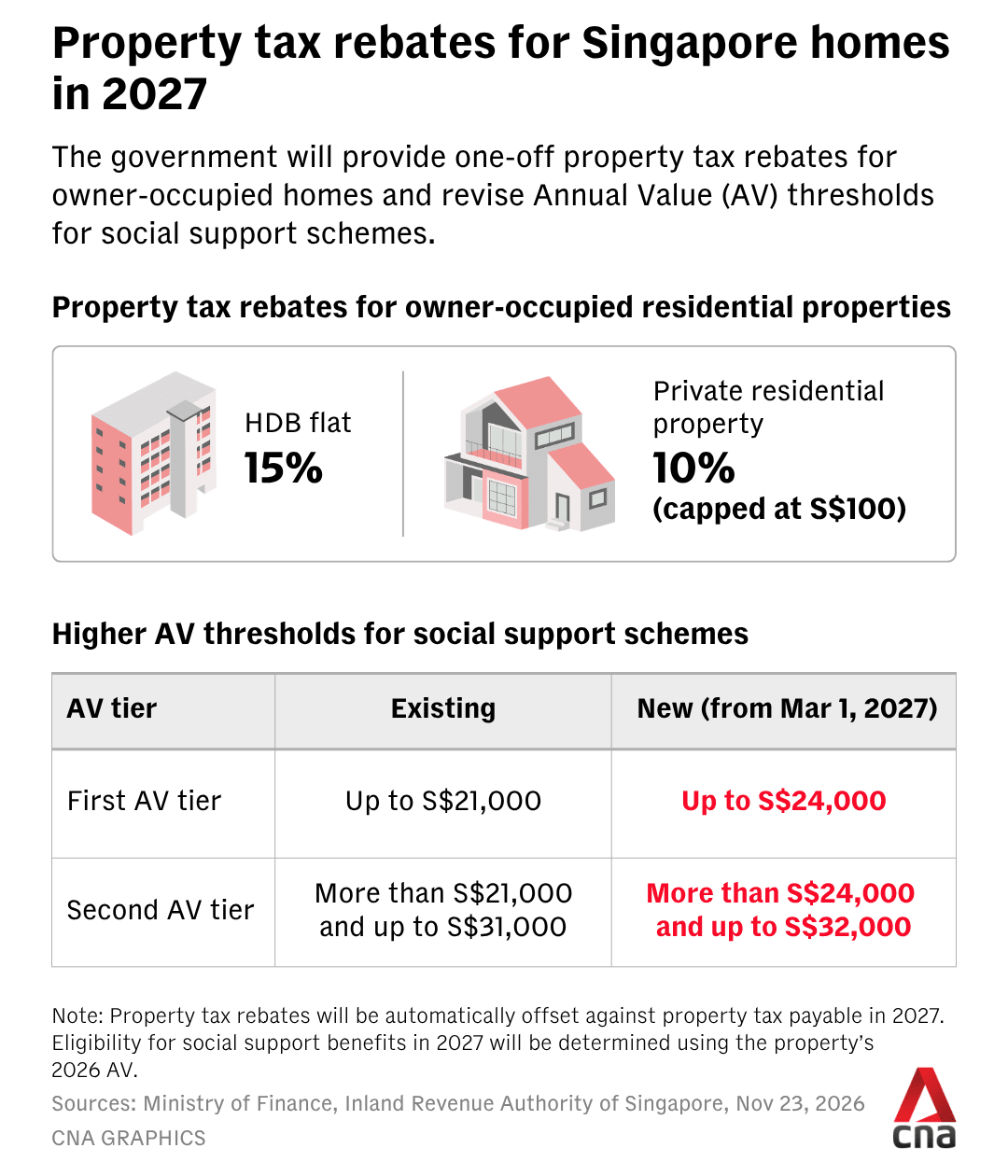
The Ministry of Finance announced that the first AV tier will rise from S$21,000 to S$24,000, while the upper limit of the second tier will climb from S$31,000 to S$32,000. For a household sitting at S$23,000 — a perfectly ordinary HDB flat in a mature estate — that single change is the difference between second-tier and first-tier support across a whole family of schemes, from GST Vouchers to MediShield Life premium subsidies.
So: are you one of the households that crosses the line? And more fundamentally — why does Singapore use the rental value of your home as a proxy for how much help you need? Let's unpack both.
What Just Changed, and Why the Government Did It
The adjustment takes effect 1 March 2027. According to the Ministry of Finance, the AV thresholds were last increased in 2025, and since then AVs for many residential properties have risen. That's the mechanical problem in a nutshell: when the market rental value of your home goes up, your AV goes up, and if the thresholds stay fixed, you gradually drift out of eligibility — not because your income changed, but because the property market around you did.
The Government's stated intent is to ensure that Singaporeans living in HDB flats and lower-value private properties remain eligible for social support notwithstanding updates to the AV of their homes.
Here's how the numbers move:
| AV Tier | Current threshold (to 28 Feb 2027) | Revised threshold (from 1 Mar 2027) | Change |
|---|---|---|---|
| First tier | Up to S$21,000 | Up to S$24,000 | +S$3,000 |
| Second tier | More than S$21,000 and up to S$31,000 | More than S$24,000 and up to S$32,000 | Ceiling +S$1,000 |
AV Thresholds for Social Support: Before vs From 1 March 2027 (S$)
Look closely at the two percentages, because they tell you something about the policy design.
Percentage Increase in AV Thresholds (%)
The first-tier cap moves up by 14.3%. The second-tier ceiling moves up by just 3.2%. That is not a uniform, inflation-matching nudge across the board — it is a deliberate tilt. The bottom of the ladder gets the bigger lift.
There is a second-order effect that almost nobody talks about. Because the first-tier cap rises by S$3,000 while the second-tier ceiling rises by only S$1,000, the width of the second tier actually shrinks — from a S$10,000 band to an S$8,000 band. The tiers remain contiguous (S$24,000 to S$24,001 with no gap), but the shape of the support structure changes.
Width of Each AV Support Band (S$)
What does that mean in plain English? Households clustered at the lower end of the AV distribution get pulled up into the top support tier. Households in the middle of the second tier keep their support but gain less headroom against future AV increases. And households at the very top edge of the second tier get a modest S$1,000 of extra runway before they fall out of AV-based support entirely.
What Exactly Is Annual Value — and Why Does It Decide Your Support?
Before you can work out whether you're affected, you need to know what the number actually is. And it is not what most people assume.
Annual Value is an estimate of the gross annual rent your property could command if it were rented out, unfurnished, with the landlord bearing maintenance costs. It is assessed by the Inland Revenue Authority of Singapore (IRAS), which looks at the prevailing market rentals of comparable properties — factoring in location, size, age, condition and surrounding amenities.
Three things follow from that definition, and all three surprise people:
- It is not your property's market price. A flat worth S$800,000 might have an AV of S$24,000. AV tracks rents, not sale prices, and the two markets move at different speeds.
- It applies even if you live in the flat and rent out nothing. AV is a hypothetical rental value, not your actual rental income. Owner-occupiers have an AV. Everyone with a residential property has one.
- It is not what you actually pay in rent. If you rent a unit for S$3,200 a month, your landlord's AV for that unit may be higher or lower than S$38,400 a year.
Here's how the number flows from assessment to your wallet:
That single assessed figure does two very different jobs at once. It is the tax base for property tax, and it is the means-test proxy for social support. The tax job is the one people know about. The support job is the one that quietly moves thousands of dollars a year in household cashflow.
AV vs. price vs. actual rent: a quick comparison
| Concept | What it measures | Who sets it | Typical use |
|---|---|---|---|
| Annual Value (AV) | Estimated gross annual rent, unfurnished, excluding maintenance | IRAS | Property tax bands; means-testing for social schemes |
| Market price | What a buyer would pay for the property | Buyer/seller negotiation | Stamp duties, loan quantum, CPF usage |
| Actual rent | What a tenant actually pays you | Tenancy agreement | Your real rental income |
| Household income | Monthly or per-capita income from work and other sources | Declared / assessed | Income-based means-testing |
The distinction between AV and income matters enormously, and we'll come to why in the next section.
Why Singapore Uses AV as a Proxy for Means-Testing
Singapore is unusual in the degree to which it leans on a property-based indicator of household wealth. Most countries means-test social support almost entirely on income. Singapore runs a hybrid: income tests (often per-capita household income, or PCHI) alongside a property indicator, of which AV is the most prominent.
The rationale holds up well under scrutiny.
Rental values are more stable than sale prices. Singapore's resale market can swing several percent in a quarter. Rents move more slowly, and AV assessments smooth the picture further. A means-test that swung with every en-bloc cycle would produce chaotic eligibility outcomes — households losing medical subsidies because their neighbour sold at a record price. AV avoids that.
Property is visible and hard to hide. You cannot offshore your flat or hold it in a shell structure while claiming need. AV is a proxy for wealth that is structurally difficult to game — which is precisely the property you want in an eligibility test.
It complements income data, which is noisy at the bottom of the distribution. A self-employed gig worker may report low declared income but hold substantial assets. A retiree may have genuinely low income but live in a fully paid-up private property. Income alone would misclassify both. Layering an asset-side indicator catches households whose lifestyle doesn't match their declared income.
It is administratively cheap. IRAS already assesses AV for property tax. Reusing it for social support costs the Government almost nothing extra — no separate application, no new means test, no additional bureaucracy.
Where the proxy gets uncomfortable
No proxy is perfect, and it's worth being honest about where AV strains.
- The asset-rich, income-poor retiree. A couple in their seventies living in a mortgage-free private apartment with an AV of S$30,000 may have very little cash income but a property-based indicator that says "comfortable." AV cannot see that their savings are locked in bricks.
- The rental market can decouple from sale prices. In periods when rentals run hot while resale prices flatten, AVs rise and households drift toward tier ceilings even though their circumstances haven't changed. This is exactly the drift the March 2027 adjustment is designed to correct.
- AV ignores financial assets. A household with a modest flat and S$2 million in equities looks identical, on AV, to a household with the same flat and no savings. The proxy is a proxy, not a profile.
- Location effects. Two identical flats in different districts can carry meaningfully different AVs because the rental markets differ. That's arguably fair, since rental value reflects locational advantage — but it does mean geographically identical living standards can produce different eligibility outcomes.
The policy response to the first and second points is precisely what we're seeing: periodic threshold adjustments. If AVs rise, the thresholds must rise with them, or the means test silently tightens.
Which Schemes Actually Use Annual Value?
The Ministry of Finance describes the thresholds as being applied across social support schemes, and the Government's framing is that they exist to ensure Singaporeans with greater needs continue to receive support. But which schemes, concretely?
Eligibility rules differ from scheme to scheme — some use AV as a hard gate (above the cut-off, you're out), others use AV as a tier determinant (the lower your AV band, the larger the payout). Here are the major ones.
GST Voucher Scheme
The most well-known AV-linked programme. The GST Voucher delivers relief through several components — Cash payouts, Medisave top-ups, U-Save rebates for utilities, and S&CC rebates for service and conservancy charges. The AV of your home is central to determining how much you receive, alongside income and property-ownership conditions. Households in the lowest AV band receive the most.
MediShield Life Premium Subsidies
MediShield Life is Singapore's national basic health insurance scheme, and premium subsidies are tiered by AV and other criteria. Households in a lower AV band receive a higher subsidy rate, which directly reduces the annual premium payable for the whole household. For a family with young children and older dependants, the cumulative difference across a household can be material — and it recurs every year.
Workfare Income Supplement (WIS)
WIS supplements the income of lower-wage workers, delivering cash payments plus additional CPF contributions. Property ownership and AV feature among the eligibility criteria — the scheme is aimed at lower-income workers who do not hold substantial property wealth. Crossing above the AV ceiling can disqualify a worker entirely, which makes the March 2027 adjustment especially consequential for self-employed and gig-economy workers relying on WIS.
Other social assistance programmes
Beyond the three headline schemes, AV functions as a general indicator of means across a wider set of government assistance programmes. Some education-related and household assistance measures reference the property's AV, often alongside per-capita household income. Because rules are scheme-specific, the practical advice is simple: if you think you might qualify for something, check that scheme's current criteria directly rather than assuming AV alone decides it.
The directional rule of thumb is consistent across all of them:
A lower AV means a higher level of support. A higher AV means less — or none.
Which is exactly why a threshold increase is such a big deal. It's not a new benefit. It's the same benefit, reaching households that would otherwise have quietly slipped out of range.
How the tiers will work from 1 March 2027
Worked Examples: Households That Cross the Line
Abstract thresholds are hard to feel. Let's put five households through the machinery and see who actually moves.
Household A — the biggest winners
A four-room HDB flat in a mature estate, reassessed at an AV of S$23,000.
- Under the current rules: S$23,000 sits above the S$21,000 first-tier cap, so this household is placed in the second tier.
- From 1 March 2027: S$23,000 now falls within the revised first tier (up to S$24,000). The household moves into first tier.
Impact: A higher quantum of benefits across GST Voucher components and MediShield Life premium subsidies. No application, no change in income, no change in address — just a reassessment exercise timing quirk that happens to fall on the right side of the new line.
Household B — protected by the buffer
A resale condominium with an AV of S$25,000.
- Under the current rules: Between S$21,001 and S$31,000 — second tier.
- From 1 March 2027: Between S$24,001 and S$32,000 — still second tier.
Impact: No change in tier today. But the S$1,000 lift in the ceiling means that if the property's AV creeps up in the next reassessment cycle, the household has more runway before losing second-tier support. This is the "drift protection" function of the policy — less visible, but arguably the more important structural fix.
Household C — newly brought into the fold
A private apartment with an AV of S$31,500.
- Under the current rules: Above the S$31,000 second-tier ceiling — outside AV-based support.
- From 1 March 2027: Within the revised S$32,000 ceiling — second tier.
Impact: This is the household that gains eligibility outright. For a family that had been receiving nothing from AV-linked schemes, that is a genuine change in annual household cashflow — and one that would have been invisible without reading the fine print.
Household D — still outside, and that's the point
A larger private property with an AV of S$32,500.
- Under the current rules: Above S$31,000 — outside.
- From 1 March 2027: Above S$32,000 — still outside.
Impact: None. The thresholds are not universal. The second-tier ceiling moved by only S$1,000, so the design deliberately excludes higher-AV properties. Anyone telling you "everyone gets more from March 2027" is overselling it.
Household E — the drift scenario the policy is built for
An HDB flat currently at an AV of S$21,000, with rentals in the estate rising. Suppose the 2027 reassessment lifts it to S$23,500.
- Under the current rules: S$23,500 would have pushed them from first tier into second tier — a downgrade caused entirely by market rents.
- From 1 March 2027: S$23,500 sits comfortably inside the revised first tier — no downgrade.
Impact: This is the cleanest illustration of why the Government acted. Without the change, a household whose income and circumstances were completely unchanged would have lost support because the rental market moved. The threshold increase is a ratchet against that.
Summary
| Household | AV | Tier to Feb 2027 | Tier from Mar 2027 | Outcome |
|---|---|---|---|---|
| A | S$23,000 | Second | First | Upgraded to highest support |
| B | S$25,000 | Second | Second | Same tier, more headroom |
| C | S$31,500 | None | Second | Newly eligible |
| D | S$32,500 | None | None | Unaffected |
| E | S$23,500 (from S$21,000) | Would drop to Second | First | Downgrade prevented |
Note what these examples have in common: none of them involved a change in income, employment or household composition. Every single movement was driven by a property valuation. That is both the efficiency and the peculiarity of AV-based means-testing.
How to Check Your Annual Value in Under Five Minutes
You don't need to guess. Your AV is on public record, accessible to you directly. Here's the process.
Step-by-step via the myTax Portal
- Go to mytax.iras.gov.sg — this is the IRAS portal, not a third-party site.
- Log in with Singpass. If you own multiple properties, you'll see each one listed.
- Navigate to the Property Tax section.
- Select "View Property Summary" or "View Property Tax Details."
- Read off your current AV — and note the year it applies to. Historic AVs are typically available for up to the past four years, which lets you see the direction of travel.
- Cross-check against the new thresholds. S$24,000 or below puts you in the first tier from March 2027. Above S$24,000 and up to S$32,000 puts you in the second.
Two other places to look
- Your property tax bill or IRAS notice. The AV is printed on the notice itself, alongside the year of assessment. If you've kept last year's bill, you can compare.
- My HDBPage for HDB flat owners. Flat owners can also view their property's AV through the HDB portal, which is convenient if you're already logged in for other transactions.
If you think the figure is wrong
IRAS allows property owners to object to the assessed Annual Value within the statutory window, with supporting evidence — for example, comparable rental transactions in your development or block that suggest the assessment is too high. This is worth doing if you believe your AV is materially overstated, because it affects both your property tax and your social support tier for as long as the assessment stands.
The Other Half of the Story: AV and Your Property Tax Bill
It's worth restating the dual role of this number, because the March 2027 announcement is fundamentally about the social support use of AV — but AV is also the base on which property tax is levied.
Owner-occupier property tax rates in Singapore are progressive: the higher your AV band, the higher the rate applied to the upper slices of that value. So a rising AV pushes you up both the tax schedule and, potentially, out of support tiers. That's a double squeeze, and it's the reason threshold adjustments are politically and economically significant.
Reports surrounding the announcement also pointed to a one-off property tax rebate for 2027. Because rebate design, quantum and eligibility conditions are set out in the Budget and IRAS publications, treat any specific figure you see circulating as provisional until you can verify it against the official IRAS or MOF material for your property type.
The practical upshot: your AV now has two distinct consequences for your household finances, and they pull in opposite directions. Higher AV means more property tax. Lower AV means more social support. Knowing where you sit between S$24,000 and S$32,000 is genuinely useful planning information.
What This Means for Buyers, Not Just Owners
Most coverage of this change will speak to existing homeowners. But if you're 25 to 40 and in the market — or thinking about it — AV is a lens you should be using alongside the usual price-per-square-foot conversation.
Two flats at the same price can carry very different AVs. A 99-year leasehold unit in a high-rental-demand location and a similarly priced unit in a quieter district may be assessed quite differently, because AV follows rentals, not sale prices. If you or your parents rely on AV-tested support, that difference is real money every year.
New launches don't have an AV until they're built. AV is assessed on an existing property. A unit bought off-plan will only receive an AV assessment after TOP and the first property tax bill — which means you cannot know your future AV at the point of purchase. Budget for uncertainty rather than assuming the flat next door's AV will apply to you.
AV rises with the rental market, and rentals can run ahead of prices. In a period where rents climb faster than resale prices, AVs drift upward and AV-tested households lose support without any change in income. The March 2027 adjustment buys time, but it is a periodic corrective, not a permanent guarantee.
For upgraders, there is a real eligibility cliff. Moving from an HDB flat with a S$23,000 AV into a private property with a S$30,000 AV is a change in tier as well as a change in address. That's a legitimate trade-off, but it should be a conscious one rather than an afterthought discovered at the next property tax bill.
For sellers, AV is a disclosure-adjacent detail. Buyers who understand AV will ask. Knowing your flat's AV — and whether it sits just under S$24,000 or just above S$32,000 — can be a genuine part of the value conversation, especially for buyers with elderly parents or lower-income household members affected by AV-tested schemes.
This is where per-project data discipline pays off. A price chart tells you what someone paid. It doesn't tell you what the property will be assessed at, what its rental yield profile looks like, or how it compares on the underlying factors — connectivity, amenities, district-level demand — that drive both rentals and resale value over a ten-year horizon. Those are different questions, and they deserve different data.
Food for Thought
1. Is rental value really a fair proxy for need — or just a convenient one? AV is administratively elegant and hard to game. But a retiree couple in a mortgage-free flat with a rising AV is treated as better-off than a young family renting a room with a higher income. If the goal is directing support to those with the greatest need, which measurement error do we prefer to tolerate?
2. Why is the second tier narrowing while the first tier widens? The first-tier cap moved 14.3%; the second-tier ceiling moved 3.2%. That's a deliberate tilt toward the lowest-AV households — but it also shrinks the second tier from S$10,000 of width to S$8,000. Is that a considered design choice about where need concentrates, or an artefact of round-number policy-making?
3. Should AV thresholds be indexed automatically? The thresholds were last raised in 2025 and are being raised again for 2027. Each adjustment requires a policy announcement, and in the gap households drift in and out of eligibility for reasons entirely outside their control. Would an automatic index — pegged to a published rental index — be fairer, and would it remove a useful lever from the Government?
4. What happens to the household at S$32,100? Policy thresholds always create edge cases. A household just above the second-tier ceiling gets nothing from AV-linked schemes while its neighbour just below gets support. Is a hard cliff the right design, or should support taper gradually so that crossing a threshold by S$100 doesn't cost thousands?
5. How many people actually know their own AV? This is arguably the most consequential number in a household's relationship with the state after income tax — and most people have never looked at it. If awareness is low, how much of the intended benefit of this change actually lands? Should AV appear on more than just a tax notice?
The Bottom Line
From 1 March 2027, the first AV tier rises to S$24,000 and the second-tier ceiling to S$32,000. If your home's Annual Value sits between S$21,001 and S$24,000, you gain a tier. If it sits between S$31,001 and S$32,000, you gain eligibility. If it sits above S$32,000, nothing changes.
The deeper point is structural. Singapore uses the estimated rental value of your home as a stand-in for household wealth, and that stand-in works well enough to be worth keeping — but it requires periodic recalibration, or the means test tightens by stealth as the rental market moves. The March 2027 adjustment is that recalibration. Whether it keeps pace with the next cycle of rental growth is the question that will define the next announcement.
The single most useful thing you can do this week is spend five minutes on the myTax Portal finding out what your AV actually is. It is the number that quietly decides both what you pay and what you receive.