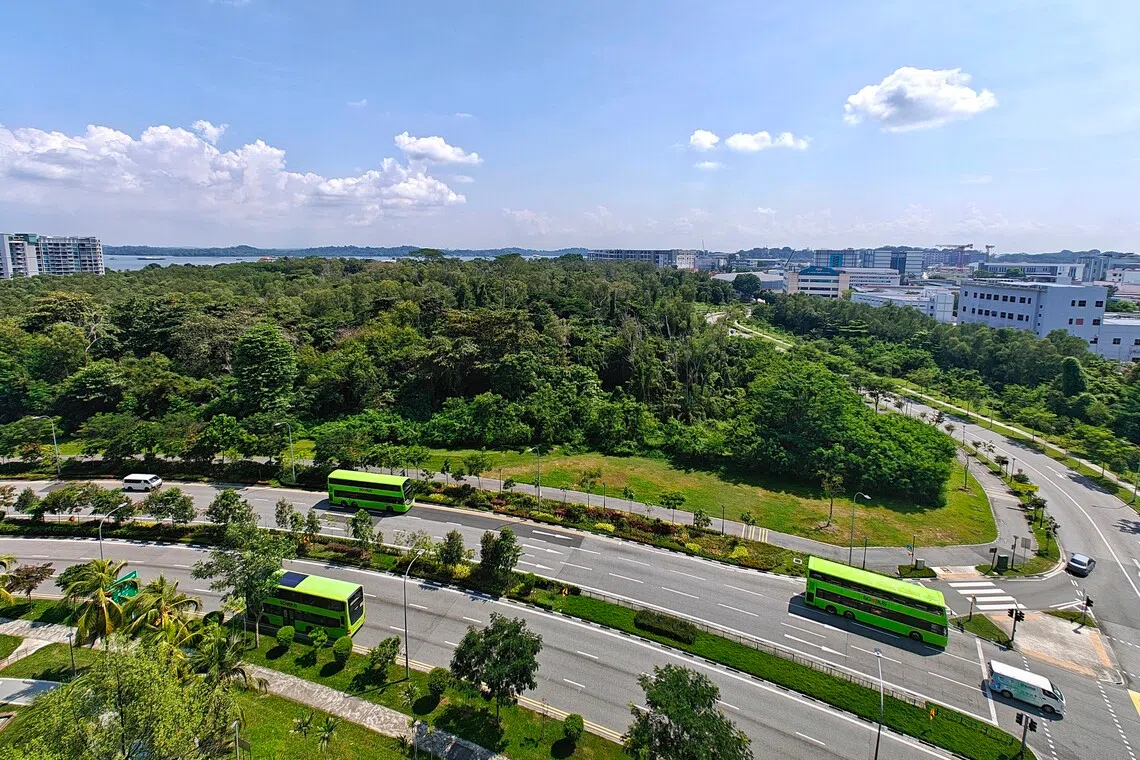
On 23 November 2026, the Housing and Development Board confirmed what many in the east had been waiting years to hear: a new mixed-use residential neighbourhood is coming to Pasir Ris Drive 4, carved out of a 36-hectare parcel that has sat zoned for housing since 1980 but never developed. For anyone holding a resale flat along Pasir Ris Street 21, a unit at Pasir Ris 8, or a terrace house off Pasir Ris Drive 3, the question is immediate and personal — does a few thousand new homes next door lift my property's value, or dilute it?
The honest answer is that Pasir Ris Drive 4 sets two opposing forces in motion at the same time. One is supply: up to 4,000 private homes or 3,000 HDB units, according to Huttons Asia's estimate, landing in a town of roughly 140,000 residents. The other is amenity: a commercial node, new green connections, and a second MRT line arriving via the upcoming Loyang station on the Cross Island Line. Which force wins depends on the segment you own, the horizon you hold, and how well the broader resale market absorbs a record wave of flats hitting their Minimum Occupation Period.
This is a breakdown of what is actually planned, what the Pasir Ris baseline looks like today, and how the new HDB town is likely to ripple through resale flats, private condos, and rents.
What Is Actually Planned at Pasir Ris Drive 4
The headline numbers first, because they anchor everything else.
| Parameter | Detail |
|---|---|
| Site area | 36 hectares |
| Preserved habitat | ~13 hectares of coastal forested habitat, per an Environmental Impact Assessment |
| Land use | Mixed-use residential — public and private housing with commercial amenities |
| Zoning history | Designated residential since 1980, never developed |
| Estimated yield (Huttons) | Up to 3,000 HDB units or 4,000 private homes |
| Gross plot ratio (ERA) | 2.1, supporting blocks of up to ~24 storeys |
| Distance to Pasir Ris MRT (EWL) | ~900 m |
| Distance to upcoming Loyang MRT (CRL) | ~900 m |
Two things stand out. First, the environmental commitment: keeping roughly 13 of 36 hectares as coastal forest means the built footprint is materially smaller than the headline land area suggests, which in turn caps how dense the neighbourhood can get. Second, the plot ratio of 2.1 is moderate by new-town standards — this is not a Punggol Northshore-style high-rise wall. Eugene Lim of ERA Singapore flagged the 24-storey ceiling as the practical outcome.
Pasir Ris Drive 4: 36-Hectare Site Allocation (hectares)
The 13-hectare preservation figure is not a rounding error — it is more than a third of the site, and it directly shapes what residents will pay for. Coastal frontage and mature greenery are exactly the attributes that have historically underpinned Pasir Ris pricing, and the plan protects rather than monetises them.
A Site 46 Years in the Making
Context matters here. The Pasir Ris Drive 4 parcel is not a surprise rezoning. It has been on the books since 1980, held in reserve as the town filled in around it. The 2005 Pasir Ris Town Design Guide already framed the town as a "Resort Town by the Sea", built around proximity to nature and recreational amenity rather than density. The new neighbourhood is the final major infill within that vision.
That long runway matters for pricing. Unlike a surprise announcement in a mature estate, the market has had decades to anticipate eventual development of this plot. The announcement compresses that anticipation into a timeline, but it does not create a new fact out of nothing.
Reading the Pasir Ris Baseline Before the Change
You cannot judge the impact of incoming supply without knowing the starting point. Pasir Ris today is a market with two very different personalities — a resale HDB segment that has been quietly setting records, and a private segment anchored by one integrated development trading at a sharp premium to the district average.
The HDB Resale Baseline
Pasir Ris has crossed a threshold that would have seemed improbable a decade ago. The town recorded its first million-dollar 5-room HDB resale transaction, and an executive maisonette changed hands at S$1.26 million — a benchmark for the estate. Recent transaction records in the area include flats at S$940,000, S$970,000, and S$850,000, with remaining leases in the 65- to 68-year range.
Reported market data indicates average resale prices were up 8.4% year-on-year in October 2026 versus October 2025. For 4-room flats, the working range has been roughly S$580,000 to S$750,000, and that appreciation trajectory has held reasonably steady since the cooling measures of 2022.
Pasir Ris HDB Price Benchmarks (S$)
What this chart shows is a market with genuine depth. Pasir Ris is no longer a discount town relative to the rest of the east — a S$1.26 million executive maisonette is comparable to what comparable stock commands in parts of Bedok and Tampines. That matters because it means the town has pricing power that a weaker estate would not have when new supply arrives.
The Private Condo Baseline
The private side of Pasir Ris is dominated by Pasir Ris 8, the integrated development sitting directly on the town centre and MRT. Its transaction data for the twelve months ending November 2026 shows a range of S$1,858 to S$2,200 psf, averaging S$2,047 psf. The project is expected to reach TOP around 30 June 2026, which means the first resale and rental supply from it will hit the market at almost exactly the moment the Drive 4 plans become concrete.
Against that, the wider district baseline is far lower. The median price for condominiums in Districts 17 and 18 stood at S$1,425,000, derived from 764 resale transactions over the period. That gap — an integrated, MRT-connected new build at S$2,047 psf against a district resale median of S$1.425 million — is the spread that the Drive 4 development will interact with most directly.
Pasir Ris 8 PSF Range vs District Median Price Benchmark
There is proof of capital appreciation in this segment too. One Pasir Ris condominium bought new in 2021 at S$1.25 million was resold this year at S$1.575 million — a gain of S$323,000 over roughly five years. A recent inter-terrace transaction in the area commanded S$3 million, evidence that the landed segment is also participating in the town's re-rating.
The Supply Channel: Does More Housing Mean Lower Prices?
Now to the crux. The single biggest reason to expect moderating rather than accelerating prices is arithmetic.
Singapore is in the middle of a large MOP wave. An estimated 13,400 HDB flats reach their Minimum Occupation Period across 2026. Those flats convert from owner-occupied to resale-eligible, and they land on the market at roughly the same time as buyers begin anticipating thousands of new units at Pasir Ris Drive 4.
Christine Sun, Chief Researcher and Strategist at Realion Group, expects this expanded pool of MOP-eligible flats to introduce "some downward pressure" on HDB resale prices, curbing significant surges. Luqman Hakim, Chief Data and Analytics Officer at 99.co, makes a parallel point: prices in heartland estates where a large number of flats reach MOP are likely to stabilise rather than climb.
Why Pasir Ris Is Exposed on Both Sides
Pasir Ris sits at the intersection of both supply channels. It is a mature estate with a large stock of flats approaching MOP age, and it is now also the site of a brand-new neighbourhood. For 4-room and 5-room resale sellers, that is a genuinely competitive backdrop over the next three to five years.
The practical implications:
- Buyers gain negotiating room. With more MOP-eligible stock and a visible pipeline of new units, urgency pricing weakens.
- Sellers of older leasehold flats face the hardest market. Flats with 60-odd years remaining compete directly against brand-new stock with 99-year leases and modern layouts.
- Large, well-located units retain pricing power. The executive maisonette record and the million-dollar 5-room sale both came from stock with attributes — size, location, rarity — that new supply does not replicate.
The Counterweight: Absorption Rate
Supply only pressures prices if it outruns demand. Huttons' estimate of up to 3,000 HDB units or 4,000 private homes is a ceiling, delivered in phases across a decade or more, not a single-release shock. Against a national BTO pipeline that regularly launches 8,000-plus flats per exercise, a phased 3,000-unit estate is meaningful locally but not overwhelming citywide.
The more important variable is the private-versus-public mix chosen. A plan weighted toward private housing at 4,000 units would add substantial competing inventory into District 18. A plan weighted toward HDB would add less direct competition to condos but more to resale flats. The eventual mix is the single most consequential unknown.
The diagram captures the central tension: the same announcement pushes near-term prices down through supply and long-term prices up through amenity. Most market commentary picks one and ignores the other. The realistic view is that both operate, and they operate on different time horizons.
The Amenity Channel: Connectivity Is the Durable Story
If supply is the short-term headwind, connectivity is the long-term tailwind — and in Singapore property, connectivity almost always wins eventually.
The Cross Island Line Changes the Map
The decisive piece of infrastructure is Loyang station on the Cross Island Line. The Drive 4 site sits roughly 900 metres from both the existing Pasir Ris MRT station on the East-West Line and the future Loyang station. That dual-line access is a genuinely rare configuration outside the city centre.
What it means in practice:
- Direct access to the eastern corridor. The CRL links Pasir Ris westward through Ang Mo Kio and onward, compressing journey times to employment nodes in the north and west.
- Reduced reliance on the EWL interchange. Pasir Ris residents today funnel through a single station; a second line reduces crowding and travel time variance.
- A second catchment for commercial activity. Stations generate footfall, and footfall generates retail, which generates the amenity that sustains residential demand.
The 900-metre radius is also right at the edge of what most buyers accept as walkable. That creates a genuine premium gradient within the new neighbourhood itself — blocks nearest the station and the commercial node will price meaningfully above those at the far end of the site.
Commercial Amenity and the Town Centre Effect
The plan is explicitly mixed-use, which means retail and community facilities integrated into the residential fabric rather than bolted on. For surrounding flats and condos, this is almost unambiguously positive. Pasir Ris 8 already demonstrated the model: an integrated development with direct MRT and mall access trades at S$2,047 psf average, a substantial premium to the broader District 17 and 18 resale stock.
The amenity gain spreads beyond the site boundary. Households in Pasir Ris Street 21, Drive 3, and the Loyang Rise area will all sit within a reasonable distance of the new commercial node. Historically, that proximity effect shows up in resale pricing within a two- to three-kilometre band, decaying with distance.
Public-Private Balance: What a Mixed Neighbourhood Does to Pricing
The brief explicitly asks about the balance of public and private housing, and this is where the analysis gets interesting because the outcome is genuinely two-sided.
The Case for Integration Lifting Values
Mixed-income, mixed-tenure neighbourhoods with good amenities and transit tend to outperform single-tenure, amenity-poor ones over long horizons. The mechanism is straightforward: private housing brings spending power that supports better retail and F&B; public housing brings the volume that justifies the transit and community infrastructure; together they create the density that makes a town centre viable.
Pasir Ris already has the ingredients — the "Resort Town by the Sea" identity, the coastal park, the downtown east cluster nearby. Adding an integrated mixed-use node strengthens the whole ecosystem.
The Case for Competition Compressing Premiums
The counterargument is about scarcity. Pasir Ris 8 currently enjoys something close to a monopoly on integrated, MRT-connected, mall-attached private living in the town. If the Drive 4 plan delivers a substantial private component — up to 4,000 homes under the Huttons ceiling — Pasir Ris 8's premium becomes contestable.
The evidence base for this is mixed but suggestive. Singapore's private home prices rose 1.4% in Q3 2026 to reach S$3,000 psf for launch pricing, while sales volume contracted 16.3% to 5,146 units in the same quarter. Price resilience alongside volume softening is the classic signature of a market where buyers have options and are taking their time.
Meanwhile, the government's land supply strategy is explicitly designed to anchor prices. The Ministry of National Development has consistently used Government Land Sales to keep the private pipeline calibrated, and the broader policy stance points the same direction. In June 2026, National Development Minister Chee Hong Tat indicated that resale prices are anticipated to moderate as pandemic-era BTO flats reach MOP — and that as the resale market stabilises, authorities may consider easing the 15-month wait-out period for private property owners purchasing resale flats.
That last point matters for the public-private balance question. If the wait-out period eases, some demand shifts from the private market back into resale HDB — reducing pressure on condos but adding competition for flats. The policy lever cuts both ways.
What It Means for Buyers, Investors, and Tenants
The impact is not uniform. It depends entirely on where you sit.
Prospective Homeowners
The immediate read is favourable. More supply plus a moderating resale market means better selection and less bidding pressure. First-time buyers gain from a visible pipeline that reduces the fear of missing out, and the MOP wave adds genuine alternatives to BTO balloting.
For upgraders, the calculation is subtler. A new private launch at Drive 4 with full amenity and rail access would be a direct competitor to Pasir Ris 8 resale units. Waiting for that launch may be rational; paying a premium for an existing unit assumes the new supply arrives late, prices high, or is weighted toward public housing.
Investors
This is where discipline matters most. The long-run case for Pasir Ris is strong — CRL connectivity, coastal amenity, protected green space, and a maturing town centre. The near- to medium-term case is more contested.
Key considerations:
- Rental yield compression risk. An integrated development reaching TOP, plus thousands of incoming units, means more competing rental stock. Pasir Ris 8's own TOP around 30 June 2026 releases a wave of units into the rental pool at the same time.
- Capital appreciation may be phased. The strongest uplift typically lands when infrastructure is announced and again when it opens — not necessarily in the intervening construction years.
- Differentiation beats the average. Units within 900 metres of the CRL station, with genuine size or view attributes, will hold value better than generic stock.
Tenants
The most straightforward beneficiary. Expanded housing supply, a maturing integrated development entering the rental pool, and moderating prices collectively point toward a more balanced rental market — more options, softer asking rents, and less of the lease-renewal squeeze that characterised 2023 and 2024.
Risks and the Case Against the Bullish Read
A balanced analysis has to acknowledge where this could go wrong.
Absorption risk. If both the HDB and private pipelines are released aggressively and market volumes continue contracting — Q3 2026 already saw a 16.3% decline to 5,146 units — price growth could stall for longer than the five-year horizon many buyers plan around.
Lease decay in the existing stock. Pasir Ris has a large base of flats from the late 1980s and 1990s. Flats with 60 to 68 years remaining face structural competition from brand-new 99-year stock in the same town. That discount widens over time regardless of what happens at Drive 4 — the new neighbourhood simply accelerates the repricing.
Execution and phasing. The 36-hectare site will take a decade or more to build out. Early buyers at premium prices may wait years for the amenity that justified their purchase.
Policy change. Moves on the 15-month wait-out period, ABSB rates, or LTV limits could shift demand between segments faster than any supply pipeline.
Food for Thought
1. Is a new neighbourhood always accretive to nearby resale value — or does it depend entirely on whether the new stock is public or private? Pasir Ris Drive 4 will answer this empirically over the next decade. Watch whether surrounding HDB resale prices dip when the first BTO launch lands, and whether condo prices move in the opposite direction.
2. What is dual-line MRT access actually worth in psf terms? Pasir Ris will soon be one of the few non-central towns with two lines within walking distance of a single residential node. The premium gradient between the 900-metre radius and the rest of the town is a live natural experiment.
3. Does protecting 13 hectares of coastal forest raise or lower the value of the homes built on the remaining 23? Environmental preservation limits yield — fewer units means less competing supply — while simultaneously enhancing the amenity premium. Which effect dominates is genuinely unclear.
4. When the MOP wave peaks and the new town pipeline overlaps, which sellers blink first? Sellers of older leasehold flats in mature estates have the least pricing power in that collision. Buyers should understand whether they are on the strong or weak side of that equation.
5. If the 15-month wait-out period is eased, does demand flow back into resale HDB and away from private condos — and does that change the calculus for the Drive 4 private component? Policy timing here could matter more than the development itself.
The Bottom Line
Pasir Ris Drive 4 does not have a single effect on property values. It has two, running in opposite directions on different clocks.
On the supply clock — the next three to five years — the town is entering a more competitive phase. A 13,400-flat MOP wave, an integrated development reaching TOP, and a visible new-town pipeline all point toward moderation rather than the record-breaking run that produced a million-dollar 5-room flat and a S$1.26 million executive maisonette.
On the amenity clock — the next ten to fifteen years — the town is being re-rated. Dual-line MRT access via the Cross Island Line's Loyang station, a protected coastline, a new commercial node, and a plot ratio that keeps density at a human scale add up to a materially better address than the one that existed in 2005 when the town was designated a "Resort Town by the Sea."
The gap between those two clocks is where opportunity and risk both live. Buyers with a ten-year horizon are buying into an improving town. Buyers with a three-year horizon are buying into a crowded market. Knowing which one you are is the entire decision.