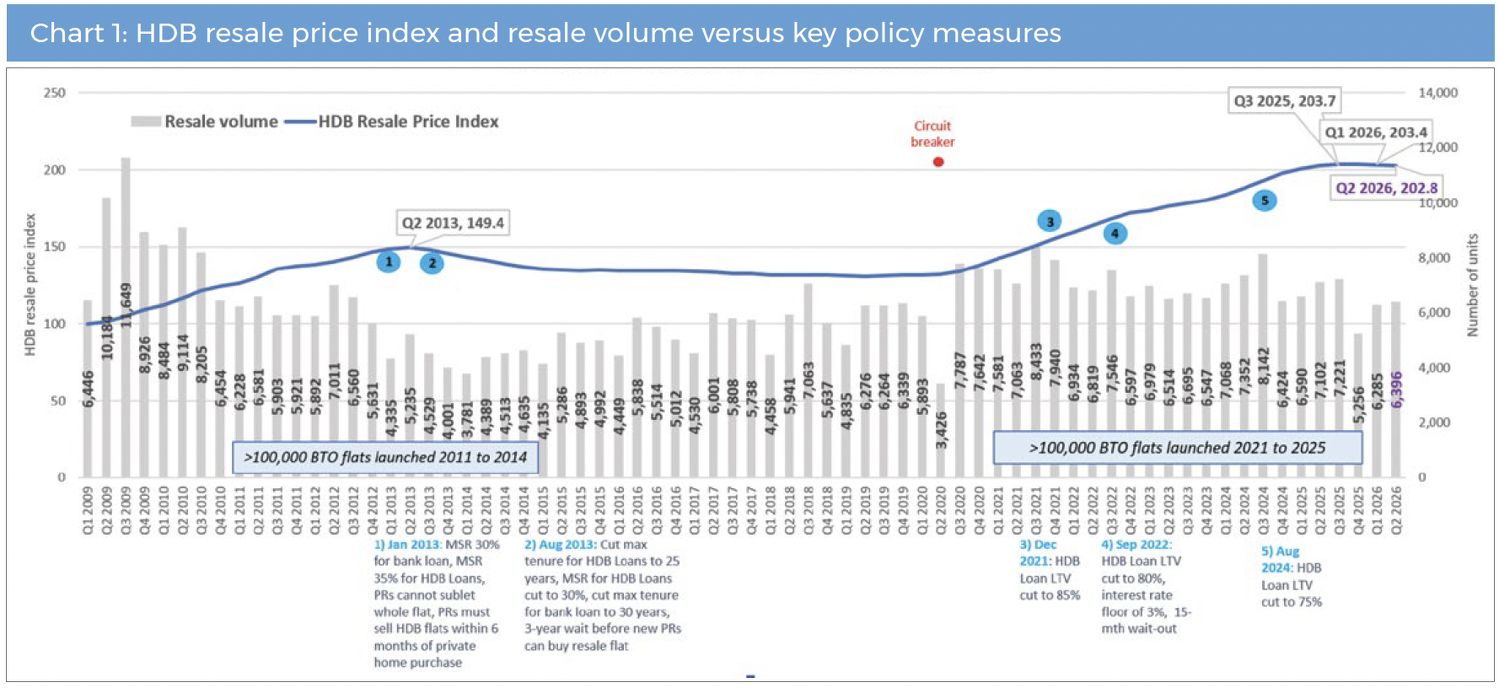
Mid-November is traditionally a quiet stretch for Singapore property — school holidays approaching, bonuses not yet paid, everyone waiting to see how the year closes. But the HDB resale market in November 2026 is anything but quiet. Resale volumes jumped 19.5% in the third quarter to 7,645 units, even as the Resale Price Index (RPI) slipped for a third consecutive quarter. That combination — more deals, softer prices — is the single most important thing to understand before you start shortlisting flats on Nov 19, 2026.
For buyers, this is a rare configuration. Prices are no longer sprinting, sellers are no longer setting the tone unilaterally, and the 13,500 flats reaching their Minimum Occupation Period (MOP) in 2026 are steadily adding to the pool of HDB resale listings across the island. But "more choice" is not evenly distributed. A buyer looking at Queenstown is shopping in a very different market from a buyer looking at Jurong West or Bukit Batok — different supply depth, different asking-price spreads, different negotiating dynamics, different speed at which listings appear and vanish.
This piece breaks down what the active HDB resale listings tell us about where supply is genuinely deep, what the asking prices imply, and what you should actually compare across Jurong West, Bukit Batok, Pasir Ris, Bidadari, Tampines, Queenstown and Sengkang.
The Q3 2026 Backdrop: Prices Slip While Volume Surges
Before looking at individual towns, it is worth pinning down the macro picture, because it sets the negotiating frame for every viewing you will attend this month.
According to HDB's Q3 2026 public housing data and subsequent reporting by Channel NewsAsia and The Straits Times, the headline numbers look like this:
| Indicator | Q3 2026 | Direction |
|---|---|---|
| HDB Resale Price Index | -0.1% q-o-q | Third consecutive quarterly decline |
| Resale transaction volume | 7,645 units | +19.5% q-o-q |
| Flats sold at S$1 million or more | 596 units | Record for a single quarter |
| Private residential price index | +1.4% q-o-q | Still rising |
| Private transaction volume | -30% q-o-q | Sharp contraction |
The headline RPI movement has been reported in slightly differing magnitudes across sources — some put the Q3 decline at 0.1%, others at 0.2%, with Q2 2026 cited at around -0.3%. Either way, the direction is unambiguous: three quarters of flat-to-slightly-negative movement after a long run of growth.
Q3 2026 Price Change: HDB Resale vs Private Residential (% q-o-q)
The divergence with the private market matters. Private home prices still rose 1.4% in Q3 2026, but private transaction volume collapsed by roughly 30%. HDB resale did the opposite: prices softened marginally while volume surged. In plain terms, HDB resale sellers are accepting that the price ceiling has been reached, and buyers are responding to that realism by transacting.
Why the volume surge isn't a contradiction
It looks paradoxical until you think about it the way a buyer does. When prices are rising fast, buyers hesitate — they fear overpaying, and sellers hold firm. When prices flatten, buyers gain confidence: the risk of buying at the top falls, the negotiation becomes two-sided, and the decision becomes easier to make. The 596 million-dollar resale flats in a single quarter shows that premium demand never went away — it simply became more selective.
The Straits Times reported that more resale units were sold in Q3 2026 following the lifting of a cooling measure, and trade coverage has since framed the shift as "bigger HDB flats are back in demand." That is a useful signal: buyers are not fleeing the market, they are reallocating within it — towards space, towards specific estates, towards units where the asking price finally makes sense.
The Supply Wave Nobody Can Ignore: 13,500 Flats Reaching MOP
If you only track one structural variable for the rest of this decade, track MOP completions. They are the single biggest determinant of how deep HDB resale listings will be in any given town.
Flats Reaching Minimum Occupation Period: 2025 vs 2026
Approximately 13,500 flats reach their MOP in 2026, up sharply from about 8,000 in 2025. That is a roughly 69% increase in newly eligible resale supply in a single year — and it lands in a market where prices are already flat to slightly negative.
The mechanics are simple and worth understanding properly:
The lag is enormous. A flat that reaches MOP in 2026 was launched around 2017–2019 and collected keys around 2021–2022. Which means the 2026 wave was locked in years ago and cannot be reversed by policy. The practical implication for a Nov 2026 buyer is that you are shopping during an expanding-supply phase, not a shrinking one — and that generally favours patience over urgency.
Not all 13,500 flats land in the same places. MOP waves are lumpy: they cluster in estates that had large BTO launches five years prior. Sengkang, Punggol, Tampines, Bukit Batok and Jurong West have historically absorbed big tranches of this. Which brings us to the seven estates in question.
Where HDB Resale Listings Are Deepest: Seven Estates Compared
The brief asks a specific question: where do buyers have more choice? Choice is a function of two things — the absolute number of active HDB resale listings in an area, and the spread of asking prices within that pool. A town with 500 listings all priced within a S$40,000 band gives you less real choice than a town with 300 listings spanning S$200,000.
Before the estate-by-estate breakdown, one honest caveat: live listing counts are a moving snapshot. A figure captured on Nov 19, 2026 will differ from the same measure a week later, and different portals count differently — some include duplicate agents' listings, some exclude units already under Option to Purchase (OTP). Treat any single listing count as directional, and always re-pull the data the week you actually intend to view.
With that said, here is how the seven estates stack up.
Jurong West: The Volume Play
Jurong West is the quintessential deep-supply HDB town — enormous flat stock, a wide span of flat types, and a resale market that has historically transacted at a discount to the national median.
The most concrete data point available: Jurong West's median resale flat price over the trailing twelve months was around S$560,000, roughly 12% below the national median. Working backwards from that gap, the implied national median sits in the region of S$635,000–S$640,000. That discount is the single most useful fact for a budget-conscious buyer.
On the listing side, property portals showed roughly 123 active listings for three-room flats in Jurong West in the recent period — a meaningful pool for a single flat type in a single town, and a sign that sellers there compete on price rather than scarcity.
What to watch in Jurong West:
- Flat-type mix: three-room and four-room dominate; five-room and Executive flats are available but thinner, so competition for larger units is stiffer than the headline listing count suggests.
- MRT proximity: the East-West Line spine (Boon Lay, Pioneer, Joo Koon) and the newer Jurong Region Line stations are not equally valuable. Two flats in the same block cluster can differ materially in price if one is a 5-minute walk and the other a 15-minute walk to a station entrance.
- Lease decay: a large share of Jurong West's stock is older. A 40-year-old flat with 59 years of lease left should be priced very differently from a 15-year-old flat — and in deep-supply towns, sellers are more likely to be pushed on this point.
Bukit Batok: The Widest Price Spread
Bukit Batok is where the data is sharpest. In November 2026, the town showed 589 active listings, with asking prices spanning from S$415,000 to S$790,000.
That is a spread of S$375,000 within a single town — close to the price of a small flat in itself. It tells you something important: Bukit Batok is not one market. It is at least three.
| Segment | Approximate asking range | Buyer profile |
|---|---|---|
| Older three-room stock | S$415,000 – S$500,000 | First-timers, single buyers, budget-led |
| Four-room, mid-vintage | S$520,000 – S$650,000 | Young families, upgraders from rental |
| Five-room / Executive, newer or high-floor | S$680,000 – S$790,000 | Second-time buyers, multi-gen households |
For buyers targeting a four-room flat under S$700,000, Bukit Batok East has been flagged alongside Choa Chu Kang West and Yew Tee as among the more accessible options in the west. That is a useful triangulation: when three adjacent areas all clear the same budget threshold, you have genuine substitutability — and substitutability is leverage.
What to watch in Bukit Batok:
- The 589 number is stock, not flow. A deep listing count with slow absorption means sellers are waiting. Waiting sellers negotiate.
- Bukit Batok East vs West: the eastern side generally sits closer to the North-South Line and major amenities; the western side trades cheaper for a reason. Know which side you are looking at before comparing PSF.
- West Plains and similar newer projects: newer Bukit Batok stock commands a clear premium. Compare against resale four-room flats two streets away before deciding the premium is worth it.
Pasir Ris: The Family-Sized Value Play
Pasir Ris rarely tops the PSF charts, and that is precisely the point. It is one of the few mature estates where a family can still buy real space — five-room and Executive flats — without crossing into seven figures routinely.
Its supply profile is driven by large, established HDB blocks with substantial flat sizes, plus newer stock in the Pasir Ris 8 / Pasir Ris Central vicinity. The trade-off is familiar: longer commutes to the CBD, thinner immediate amenity density in some pockets, but stronger per-square-foot value and a genuinely different lifestyle (beach, park, park connectors).
What to watch in Pasir Ris:
- PSF vs total price: Pasir Ris often looks expensive in absolute dollars because the flats are large. Divide by floor area. The PSF frequently tells a friendlier story than the headline price.
- Cross-island travel time: if you work in the west, Pasir Ris is a geographic penalty. If you work in the east or in Changi Business Park, it is a bargain.
- Cross-check against Tampines: Pasir Ris and Tampines are close substitutes for many buyers, and Tampines usually has deeper supply. Use that.
Bidadari: The Newest Estate in the Comparison
Bidadari is the outlier here — not a town in the traditional sense but an estate carved out of the old Bidadari cemetery land within the Toa Payoh/Kallang area. Its flats are the youngest in this comparison, which means lease-fresh units, modern layouts, and a design language that looks nothing like 1980s HDB blocks.
The consequence is straightforward: Bidadari resale flats command a premium, and buyers pay it for lease length, MRT access (Woodleigh on the North-East Line), and the fact that the estate is genuinely new. Trade coverage has noted that towns including Queenstown and Toa Payoh are seeing resale prices approaching those of new launch condominiums — and Bidadari, sitting within that orbit, rides the same wave.
What to watch in Bidadari:
- Premium for lease freshness: a 95-year-lease flat commands more than a 70-year one, but ask yourself how much of the premium you are paying for the label "new" versus actual utility.
- Limited depth: Bidadari is compact. Listing counts are inherently thinner than Jurong West or Tampines, which means less negotiating room and faster absorption of good units.
- Amenity ramp-up: some parts of the estate are still maturing. Visit at 8pm on a weekday, not 11am on a Saturday.
Tampines: The Balanced Giant
Tampines combines scale, maturity and connectivity in a way few estates can. It has a large HDB stock base, three MRT stations on the East-West Line (with the Downtown Line interchange at Tampines), major regional amenities, and a consistent turnover of resale flats.
The practical result is a deep but competitive market. Plenty of listings, but also plenty of buyers, because Tampines appeals across income bands.
What to watch in Tampines:
- Sub-location matters enormously: Tampines East, West, and the town centre are distinct micro-markets. A four-room flat near Tampines Mall and one 12 minutes' walk away can differ by a six-figure sum.
- The MOP tranche: Tampines has absorbed large BTO batches over the past decade, which means newer resale stock keeps arriving. In a soft market, new arrivals anchor the top of your comparison set downward.
- Compare against Pasir Ris deliberately: same region, different supply depth. Let the two towns bid against each other in your shortlist.
Queenstown: Where Supply Is Tight and Price Is Not
Queenstown is the counter-example to everything above. It is a mature, prime-adjacent estate with very little new supply coming online relative to demand. Listings are fewer, absorption is faster, and asking prices hold firm even while the national index slips.
The clearest evidence: Queenstown and Toa Payoh resale prices are reportedly approaching those of new launch condominiums — an extraordinary statement about the premium attached to central-ish HDB living.
What to watch in Queenstown:
- Do not expect seller capitulation: in a tight-supply town, the national RPI decline is an abstraction. Your specific seller may have five other viewings this weekend.
- Lease profile is uneven: Queenstown has everything from very old blocks to brand-new ones. The town-level median hides a huge internal range. Compare within flat type and lease band only.
- The premium question: the honest test is whether the Queenstown premium over, say, Bukit Batok or Jurong West is buying you something you actually value — commute time, school proximity, amenity density — or simply a postal code.
Sengkang: The MOP Engine
Sengkang is where the MOP wave is most visible. As a young estate built largely in the 2000s and 2010s, it has a structural pipeline of flats crossing the five-year threshold every year — and the 2026 wave of 13,500 MOP completions nationally flows disproportionately through estates like this.
Sengkang's appeal is consistent: North-East Line and Sengkang LRT connectivity, Compass One and the broader town centre, and a flat mix weighted towards four- and five-room units suited to families. Its weakness is also consistent: the long ride into the CBD.
What to watch in Sengkang:
- MOP clusters create micro-supply shocks: when several blocks in one precinct cross MOP together, a burst of near-identical listings appears at once. That is one of the few situations where you can genuinely play sellers off each other.
- LRT versus MRT: the LRT loop is a convenience, not a substitute. Price the walk to the actual MRT station precisely.
- Compare against Punggol: functionally similar, and the comparison sharpens your sense of what is fair.
Side-by-side summary
| Estate | Supply depth | Price positioning | Best suited to |
|---|---|---|---|
| Jurong West | Deep | ~12% below national median | Budget-led buyers, west-side workers |
| Bukit Batok | Very deep (589 active listings) | Wide spread, S$415k–S$790k | Buyers wanting maximum choice |
| Pasir Ris | Moderate | Large flats at favourable PSF | Families prioritising space |
| Bidadari | Thin | Premium, prime-adjacent | Buyers paying for newness and lease |
| Tampines | Deep | Mid-to-upper, sub-location driven | Balanced buyers, east-side workers |
| Queenstown | Tight | Approaching new-launch condo levels | Location-first buyers |
| Sengkang | Deepening | Mid, MOP-driven | Families, north-east corridor |
How Quickly Do Listings Appear — And Disappear?
This is the question most buyers ask and few data sources answer cleanly, because listing portals do not publish days-on-market. But you can build a workable proxy yourself.
The stock-versus-flow distinction
An active listing count measures stock. Monthly resale transactions measure flow. The ratio between them — expressed as months of supply — tells you how much leverage buyers have.
Nationally, 7,645 resale flats transacted in Q3 2026 works out to roughly 2,550 a month. If you knew a town's active listing count, dividing by that town's share of monthly transactions would give you a rough months-of-supply estimate. Most buyers never do this. Those who do tend to negotiate better.
What actually gets listings to move
In practice, four factors decide how fast a listing disappears:
- Price accuracy at launch. A flat priced within 2–3% of recent transacted PSF for comparable units in the same block moves within weeks. A flat priced 8% above gets re-listed, revised, or quietly withdrawn.
- Lease length. Flats below roughly 60 years remaining start to face financing friction — CPF usage restrictions and loan-to-value constraints tighten. These listings sit longer, and sellers eventually adjust.
- Photo quality and presentation. Unglamorous but real. Listings with proper photography and floorplans receive materially more enquiries in the first 14 days, which is when a listing's fate is largely decided.
- Sub-location genuineness. "Walk to MRT" that turns out to be 14 minutes in the rain kills momentum fast. Buyers self-disqualify, and the listing ages.
Reading a listing's age
If a property portal shows a listing's posting date, use it. A flat that has been live for 90 days in a market where comparable units are selling in 30 is telling you something — either the price is wrong or there is a defect you have not yet spotted. Both are worth investigating.
Rule of thumb for November 2026: in deep-supply towns like Bukit Batok, Jurong West and Sengkang, expect longer listing lifespans and more room to negotiate. In tight-supply towns like Queenstown and Bidadari, expect short lifespans and less room. Tampines and Pasir Ris sit in the middle, with variance driven almost entirely by sub-location.
What Buyers Should Compare Before Making an Offer
Given this much choice, the risk shifts from "not enough options" to "comparison fatigue." Here is a workable framework.
1. Asking price versus transacted PSF — not asking versus asking
The only price that matters is what comparable units actually transacted at. Pull recent resale transaction records for the same block or adjacent blocks, matched on flat type, floor band, and lease band. If the listing asks S$640,000 and three comparable units transacted at S$610,000–S$622,000 in the past six months, your opening position is clear.
2. Remaining lease as a hard filter
Remaining lease is not a soft preference. It affects CPF usage, loan quantum, and future resale liquidity. In an estate like Jurong West with a wide age mix, this should be your first filter, not your last.
3. Floor band and orientation
Two flats in the same block, same layout, can differ by a five-figure sum purely on floor level and whether the unit faces the afternoon sun or a refuse chute. In deep-supply towns you can afford to be picky about this. In Queenstown you often cannot.
4. The "hidden" cost stack
Stamp duty, legal fees, valuation gaps, renovation, and the renovation-overlay cost of an older unit all sit outside the headline price. A S$415,000 three-room in Bukit Batok with 55 years of lease and original 1980s condition is not necessarily cheaper than a S$520,000 unit requiring far less work.
5. Sub-location, measured not felt
Time the actual walk to the MRT at rush hour. Check the distance to the nearest supermarket, hawker centre and primary school. In deep-supply markets, these differentiators are the main legitimate reason to pay more for one unit than another.
Policy Watch: What Could Change the Choice Set
Three policy levers are actively in play and worth tracking, because each one changes how deep HDB resale listings will be in 2027.
Income ceiling adjustments. Discussions around raising the income ceiling for HDB eligibility would expand the buyer pool at the margin. More eligible buyers means more competition for the same stock — a headwind for buyers, a tailwind for sellers.
The 15-month wait-out period. The wait-out for private property owners downgrading into HDB resale has been a recurring subject of review. Any relaxation would inject additional demand into the resale market, particularly at the upper end — the segment where million-dollar transactions are already setting records.
The MOP supply pipeline. Not a policy lever in the short term, but a structural fact. Roughly 13,500 flats reach MOP in 2026, and forecasts point to continued elevated completions through 2027–2028. Analysts have explicitly framed this as a supply wave that should temper price growth — with forecasts of 0% to 1% price growth for 2026 and a modest 2% to 4% for 2027.
The long-run context
It helps to zoom out. Since 1990, HDB resale prices have appreciated at roughly 6.0% a year, ahead of the private market's approximately 4.7%. That is a striking long-run record — and a reminder that short-term flatness is not the same as structural weakness.
Long-Run Annual Price Growth Since 1990 (%)
What the long-run number should not do is lull anyone into the misconception of perpetual escalation. The current quarter is proof that the index can fall. Experts have been actively pushing back on the assumption that HDB resale prices only go up — and the data now supports that pushback.
Food for Thought
-
If 13,500 flats hit MOP in 2026 and more are coming, is "waiting one more year" actually a viable strategy — or does the savings get eaten by the units you wanted being taken first? Supply waves lower averages, not individual asking prices. The flat you want in Queenstown is not participating in the Jurong West supply wave.
-
Is the deep-supply advantage real, or does it just create more mediocre options? A town with 589 active listings offers leverage, but leverage only helps if you can distinguish a fairly priced unit from a stale one. Do you have the transaction data to do that?
-
Why does a flat in Queenstown command close to new-launch condo pricing while a similar-sized flat in Jurong West trades 12% below the national median? Is that gap compensating for commute, amenity, and scarcity — or is part of it simply habit and prestige?
-
What happens to the lease-decay conversation when the market softens? In a rising market, buyers ignore remaining lease. In a flat market, financing constraints on shorter leases become negotiating leverage. Are you pricing that in?
-
If income ceiling changes expand the buyer pool in 2027, does buying in late 2026 look smart or premature? Timing policy is hard; timing your own housing need is easier. Which one is actually driving your decision?
Conclusion
The HDB resale listings picture on Nov 19, 2026 is one of unusual buyer choice in specific places, and continued scarcity in others. Bukit Batok's 589 active listings and Jurong West's 12% discount to the national median represent genuine leverage. Queenstown and Bidadari represent the opposite: thin supply, firm prices, and limited negotiating room. Tampines, Pasir Ris and Sengkang sit in between, with depth that varies block by block.
The macro numbers support patience. Three consecutive quarters of flat-to-negative RPI movement, a record 596 million-dollar transactions showing demand is selective rather than indiscriminate, and a 13,500-flat MOP wave all point to a market where the balance of power has shifted — modestly, unevenly, but genuinely.