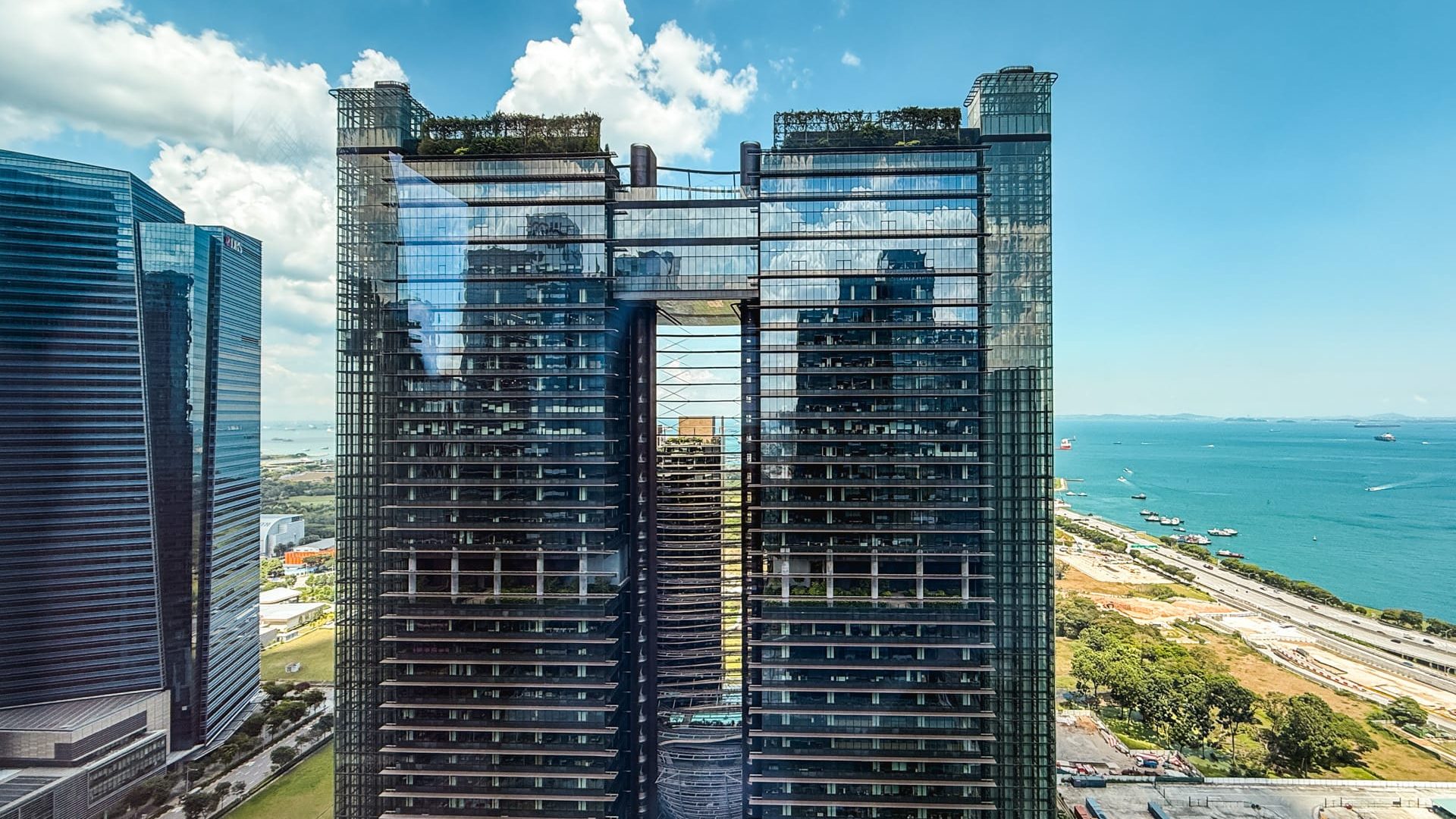
In Singapore property, "prime" is supposed to mean safe. Core Central Region, integrated development, a Marina Bay address, a train station underneath, offices and retail next door — on paper, Marina One Residences has every box ticked. Yet over the 12 months to October 2026, 45 of the 46 resale transactions recorded at the development sold below the price the seller originally paid. That is a loss rate of roughly 98%.
Read that again. Not 45% of sellers taking a hit. Not one in five, which is roughly the base rate for prime-region resales across the CCR. Nearly every single owner who sold in that window walked away with less money than they brought in.
This is not a story about a bad building. It is a story about how entry price, holding costs, rental yield, supply and exit liquidity collide — and what happens when a buyer pays for a narrative rather than a number. For anyone aged 25 to 40 who is thinking about parking serious money in a prime condo as a second property, an investment vehicle or a "sure thing" hedge, Marina One Residences is the case study you should read before you sign anything.
The Headline Numbers
| Metric | Figure |
|---|---|
| Resale transactions, 12 months to Oct 2026 | 46 |
| Transactions sold below purchase price | 45 (≈98%) |
| Median loss per transaction | ≈S$339,000 |
| Median loss as share of purchase price | 18.4% |
| Median resale price (latest 12 months) | S$1.46 million |
| Median resale PSF (latest 12 months) | S$1,902 psf |
| Average PSF across the development | S$2,088 psf |
| Change in average price, 2018 to 2025 | −19.9% |
| Project price peak | S$3,490 psf (March 2021) |
| Project price trough | S$1,680 psf (May 2026) |
| Median monthly rent | S$5,300–S$5,400 |
| Reported rental yield range | 2.6%–4.2% |
Sources: URA caveat-based resale analysis, EdgeProp project data, Straits Times reporting.
A median loss of S$339,000 is not a rounding error. It is a BTO flat's worth of capital, gone. And it happened in a period when Singapore's overall private residential prices were still rising — +1.4% in Q3 2026, with full-year growth forecast at 3% to 4%. That divergence is the whole point: a rising tide does not lift every boat, and in the prime segment it can quietly leave some boats stranded.
Setting the Scene: What Marina One Actually Is
Marina One Residences sits within Marina One, a mixed-use development in the Marina Bay area combining Grade A offices, a retail podium and residential towers above. It has the structural advantages that marketing brochures love: a CBD-adjacent location, direct access to the MRT network, and a design pedigree that made it a talking point at launch.
It also has three features that matter far more to an exit price than any of the above.
One: an investor-heavy, foreign-heavy owner base. Roughly 28.7% of buyers at the development were foreign, according to transaction data. That is a strength when capital is flowing in and a structural vulnerability when policy makes it expensive to flow in.
Two: a buyer pool that skews narrow. Analyses of the project's shortcomings have repeatedly pointed to the absence of schools within 1km, with only Cantonment Primary within 2km. For a family upgrading from a suburban condo — the deepest, most price-insensitive buyer pool in Singapore — Marina One is not on the shortlist. Remove families, and you are left competing for tenants and buyers among expatriates, singles, investors and the occasional downsizer.
Three: a price history shaped by a single euphoric window. The project's recorded high of S$3,490 psf in March 2021 came during a period of intense prime-market optimism. Anyone who transacted near that level and sold in 2026 was always going to struggle. The project's low of S$1,680 psf in May 2026 tells you how far the other end of the range stretches.
The Market It Was Selling Into
The macro backdrop was not hostile. It was simply selective.
- Singapore private home prices rose 1.4% in Q3 2026, with full-year growth forecast at 3%–4%.
- Yet one in five prime-region private home resale deals sold at a loss in the most recent quarter reported (Business Times). In the CCR, losses are not an anomaly — they are a fifth of the market.
- The launch pipeline is expected to climb to a 14-year high in 2027 (Straits Times), which means new-supply competition for buyer attention is about to intensify, not ease.
- Deal momentum was already expected to subside after a record 2026 as borrowing costs stayed higher for longer (Business Times).
So the question is not "why did Marina One underperform a booming market?" It is "why did Marina One underperform even the mediocre prime-market average by a factor of five?"
Why 45 of 46 Sellers Lost Money
There is no single villain here. There are five forces stacked on top of each other, and each one compounds the last.
1. Entry Price: The Loss Was Locked In at Purchase
The single most important determinant of whether a condo investment makes money is not the exit. It is the entry.
Marina One Residences was marketed and priced as a landmark. Buyers in and around the launch and completion period were paying for a vision of Marina Bay as Asia's next financial centre — a vision that was reasonable, but was already embedded in the price they paid. When you buy at a valuation that assumes everything goes right, you have no margin of safety left for the things that go wrong.
The data makes this concrete. The average price at the development fell 19.9% between 2018 and 2025. That is not a small correction; it is a repricing of what the market believes a square foot at this address is worth. For a seller who bought in 2018 and sold in 2026, a project-level decline of that magnitude plus transaction costs is enough to erase years of rental income.
Note the arithmetic in the median case: an 18.4% loss on purchase price. That is roughly consistent with buying into a project that subsequently repriced downward by around a fifth. In other words, the typical Marina One loss is not the result of a distressed, one-off fire sale. It is the result of the whole project finding a new, lower equilibrium — and the seller exiting at that new equilibrium.
Here is the uncomfortable implication for anyone buying prime property today at what feels like a "discounted" price: a decline from S$3,490 psf to S$1,680 psf is not a buying opportunity if the sustainable clearing level is S$1,900 psf. It is just a reminder that the top of a range is not a reference point.
Marina One Residences: PSF Extremes vs Current Levels
The gap between the development average of S$2,088 psf and the median resale of S$1,902 psf is worth pausing on. The averages include older, higher-priced transactions that will never trade again. What the market is actually paying today is the lower number. Any seller anchoring to the average is anchoring to history.
2. Holding Costs: The Slow, Silent Bleed
Owning a prime condo in Singapore is not a passive act. Every year you hold, the asset costs you money before a single dollar of capital gain or loss is counted.
The stack looks like this:
| Cost component | Nature |
|---|---|
| Buyer's Stamp Duty at purchase | Sunk, immediate, non-recoverable |
| Legal and financing fees | Sunk, immediate |
| Property tax | Annual, recurring |
| Maintenance and conservancy fees | Monthly, recurring, and higher at large integrated developments with extensive facilities |
| Mortgage interest | Monthly, and highly sensitive to rate cycles |
| Vacancy and tenant turnover | Periodic, unpredictable |
For a unit bought at S$1.83 million, as in the case we will examine shortly, the annual carry is not trivial. Maintenance fees at a development of Marina One's scale — multiple towers, extensive landscaping, concierge-grade facilities, lift lobbies serving office and retail components — sit at the higher end of the market. Property tax on a non-owner-occupied prime residential unit compounds the drag. And mortgage interest over an eight-year hold, even at moderate rates, is a four-to-six-figure cumulative line item.
The critical framing is this: holding costs are certain, capital appreciation is not. An investor who budgets for the yield but not the carry is doing half the maths.
3. Rental Yield: Respectable, But Not a Life Raft
Marina One's rental performance is, genuinely, one of its strengths. Median rents sit around S$5,300 to S$5,400 per month, with indicative rental rates in the range of S$5.2 to S$9.8 psf per month and an average of about S$6.7 psf per month (EdgeProp). Reported yields range from 2.6% to 4.2%, with an average in the region of 3.8% to 4%.
Those are decent numbers — better than many CCR peers, and supported by a genuinely prime location next to a major employment node.
Marina One Residences: Reported Rental Yield Range (%)
But here is where yield gets misunderstood. A gross yield of 3.8% is not a return. It is revenue before costs. Strip out property tax, maintenance fees, agent commissions on lease renewals, repairs and vacancy gaps, and the net yield on a prime condo is typically materially lower. Then subtract mortgage interest, and the cash-on-cash position for a leveraged buyer can be thin or negative in some years.
More importantly, yield cannot rescue a capital loss of this size. Consider the median seller: an 18.4% loss on purchase price. To offset that with a 3.8% gross yield, you would need roughly five years of entirely cost-free rental income — no tax, no maintenance, no interest, no vacancy. That has never existed.
Yield is a carry mechanism. It keeps the lights on while you wait for capital appreciation. It is not a substitute for it. When the capital appreciation never arrives, the yield simply makes the wait more comfortable on the way to a loss.
4. Supply and Exit Liquidity: The Queue at the Door
Illiquidity is the quiet killer of prime property investments, and it operates on two levels.
The micro level. The Marina Bay and Downtown Core area has absorbed a large amount of high-end residential supply over the past decade. When a buyer walks into the submarket, they are not choosing between Marina One and nothing. They are choosing between Marina One, Marina Bay Residences, One Marina Gardens, new launches, and a long tail of competing CCR stock. Every comparable unit on the market is a competitor for the same buyer. When your neighbour is a motivated seller, your price becomes their price.
The macro level. The launch pipeline is expected to reach a 14-year high in 2027 (Straits Times). New launches come with deferred payment schemes, showroom appeal, progressive payment structures and developer marketing budgets. For a resale seller in a project with a narrow buyer pool, that is not background noise. It is direct competition with a better-funded opponent.
Nowhere is this more visible than in the resale distribution itself. In a liquid market with a healthy spread of buyers, you would expect a broad distribution of outcomes — some gains, some losses, clustered near zero. What we see at Marina One is a compressed distribution almost entirely below the purchase price. That is the signature of a market where sellers set prices only marginally, and buyers set them decisively.
5. Policy: The Foreign-Buyer Tap Was Turned Off
Marina One's 28.7% foreign buyer share is the number that ties this whole story together. Prime CCR property is not primarily a domestic market. It is a market whose marginal buyer has historically been regional wealth — Indonesians, Chinese, Malaysians, Indians, family offices, expatriate executives converting rental into ownership.
Singapore's cooling measures hit exactly that buyer segment, and they hit it deliberately.
- Additional Buyer's Stamp Duty remains the single largest behavioural lever in the prime market, with rates for foreign purchasers sitting at the top of the schedule. For a buyer deciding between a Singapore condo and a London, Sydney or Dubai alternative, ABSD is not an inconvenience. It is a decider.
- Loan-to-Value limits cap how much leverage a buyer can deploy, which compresses the achievable price for any given unit of income.
- The Seller's Stamp Duty holding period was extended to four years for residential properties bought on or after 4 July 2025, raising the cost of a short-hold flip and pushing more sellers into exactly the multi-year wait that Marina One owners have already endured.
These measures have been described as freezing the top of the market — and the description is apt. They do not crash prices; they make the market thin. A thin market is one where the number of buyers at any given moment is small relative to the number of sellers who want out, which is precisely the condition that produces a 98% loss rate in a project with a high investor concentration.
The consequence is that policy risk is now a permanent line item in prime-property underwriting. If a quarter of your potential exit buyers can be removed by a policy announcement, your exit price is a policy variable, not a market one.
The Anatomy of a Single Deal
The aggregate numbers are stark. The individual case is starker.
| Item | Figure |
|---|---|
| Unit size | 710 sq ft |
| Purchase price (July 2018) | S$1.83 million |
| Sale price (August 2026) | S$1.25 million |
| Capital loss | S$580,000 |
| Loss as share of purchase price | ≈32% |
| Holding period | 8.1 years |
| Annualised loss | ≈4.6% per year |
Source: Straits Times, citing URA caveat data.
Read the annualised figure carefully: −4.6% per year, compounded, for 8.1 years. That is not a bad quarter. That is nearly a decade of disciplined saving, diligent tenant management and timely tax payments, ending in a seven-figure gross outlay returning 68 cents on the dollar.
And note the timing. The sale in August 2026 came only months after the project's trough of S$1,680 psf in May 2026. The seller did not transact at the absolute bottom, but they transacted in the shadow of it, when buyer confidence had been reset and every negotiation started from the most recent comparable on record.
What This Means for Buyers, Sellers and Tenants
For buyers. This is unambiguously the good news story in the data. There is prime CCR stock available at prices that would have looked implausible in 2021, and sellers who need to move are negotiable. But negotiate on the right axis. A unit at S$1,900 psf in a project with a narrow buyer pool and heavy nearby supply is not automatically a bargain just because it traded at S$3,490 psf five years ago. Ask what the sustainable clearing price is, not what the peak was.
For sellers. The owners who avoided a loss were, overwhelmingly, the ones whose holding period and entry price gave them room. If you are sitting on a unit bought at or near the project's high, and you do not need to sell, the maths on waiting is at least worth doing — but so is the maths on the opportunity cost of a decade of flat prices. The worst outcome is often the one where you neither sell nor commit, and simply pay the carry for another five years.
For tenants. Marina One's rental story remains strong, and that has not changed. Median rents of S$5,300 to S$5,400 for a prime, MRT-connected unit in the Marina Bay area reflect genuine, non-speculative demand from people who need to live near the CBD. A weak capital market and a healthy rental market can coexist — that is exactly what an investor-heavy development looks like when buyers retreat and occupiers stay.
The Wider Signal: Is It Marina One, or the CCR?
Marina One is an extreme case, not a unique one. In the same stretch, a penthouse at Marina Bay Residences sold for S$12 million, with the seller incurring a loss of about S$3.58 million after roughly 19 years of ownership (EdgeProp). Nineteen years. Through two full market cycles. Still a loss.
That tells you the issue is structural, not idiosyncratic. Analysts at Cushman & Wakefield have flagged that buyers are becoming more selective, with future resale performance expected to vary widely across developments — even within the same district, even within the same postcode.
The 2027 pipeline being a 14-year high sharpens the point. Every new launch competes for the same pool of prime buyers, and that pool has been structurally reduced by policy. Supply is going up; the marginal buyer is going down. That is not a recipe for the kind of double-digit capital appreciation that prime-property marketing typically assumes.
Share of Resale Deals Sold at a Loss (%)
Lessons for Buying Prime Condo Investments
Six rules, drawn directly from the data above.
1. The Entry Price Is the Investment. Everything Else Is Management.
If you buy at a fair clearing price, most other mistakes are survivable. If you buy at a peak price, no amount of good tenancy management will save you. Anchor your offer to recent resale PSF in the same project and the same stack — not to launch prices, not to the peak, not to the average.
2. Model the Full Carry, Not the Gross Yield
Gross yield is a marketing number. Net yield after property tax, maintenance fees, commission, vacancy and interest is the number that determines whether you can hold through a downturn. If the net position is negative in the early years, write that down and check whether you can genuinely fund it for eight to ten years.
3. Ask Who Your Buyer Will Be — Then Check They Still Exist
A prime unit near an MRT line and offices will always have tenants. That does not mean it will have buyers. If your exit depends on foreign capital, and foreign capital faces the highest stamp duty tier in the market, your exit price is exposed to policy. A broader buyer base — locals, families, upgraders — is a hedge against that.
4. Count the Competing Units Before You Count the Profits
Count the number of comparable units for sale in the same development, the same district and the upcoming pipeline within striking distance. That number is your real exit competition. High one in, high one out.
5. Use Commuting Distance, Not Prestige, as the Tiebreaker
The absence of schools within 1km is a real and durable reason why family buyers — the deepest pool in Singapore — have historically skipped Marina One. A development's buyer universe is defined by who can live there conveniently, not by how good the address sounds on a name card.
6. Assume Policy Can Move Against You in a Quarter
Stamp duties, LTV limits and holding-period rules have all been tightened in recent years without warning. Your underwriting should survive a scenario in which the buyer segment that pays the highest price becomes, overnight, the segment that pays the most tax.
Food for Thought
- If 98% of sellers at a prime, MRT-connected, integrated development lost money over eight years, what exactly is the "prime premium" supposed to pay for — and who is collecting it?
- How much of the Singapore new-launch and prime-resale market is currently being supported by buyers who are themselves expecting capital appreciation rather than rental yield? What happens when that expectation is tested for a decade, not three years?
- Does the extension of the Seller's Stamp Duty holding period to four years actually protect buyers, or does it just extend the period over which a bad entry price can compound?
- If you cannot rent a unit for enough to cover its costs, and you cannot sell it for what you paid, at what point does a "long-term hold" become a commitment rather than a strategy?
- With the launch pipeline heading for a 14-year high in 2027, is the bigger risk for today's prime buyer paying too much, or being unable to find a buyer at all when they eventually exit?
Conclusion
Marina One Residences is not a cautionary tale about one unlucky development. It is a clear, well-documented warning about the mechanics of prime property investing in a market that has been structurally reshaped by stamp duties, lending limits and a supply pipeline that keeps expanding. Entry price sets the ceiling on your return. Holding costs set the floor on your losses. Rental yield keeps you solvent while you wait. And exit liquidity — shaped by supply, buyer depth and policy — decides whether the wait was worth it.
The 45 sellers who took a loss did not necessarily get the timing wrong. Many of them got the entry price wrong, and then spent eight years paying for it.