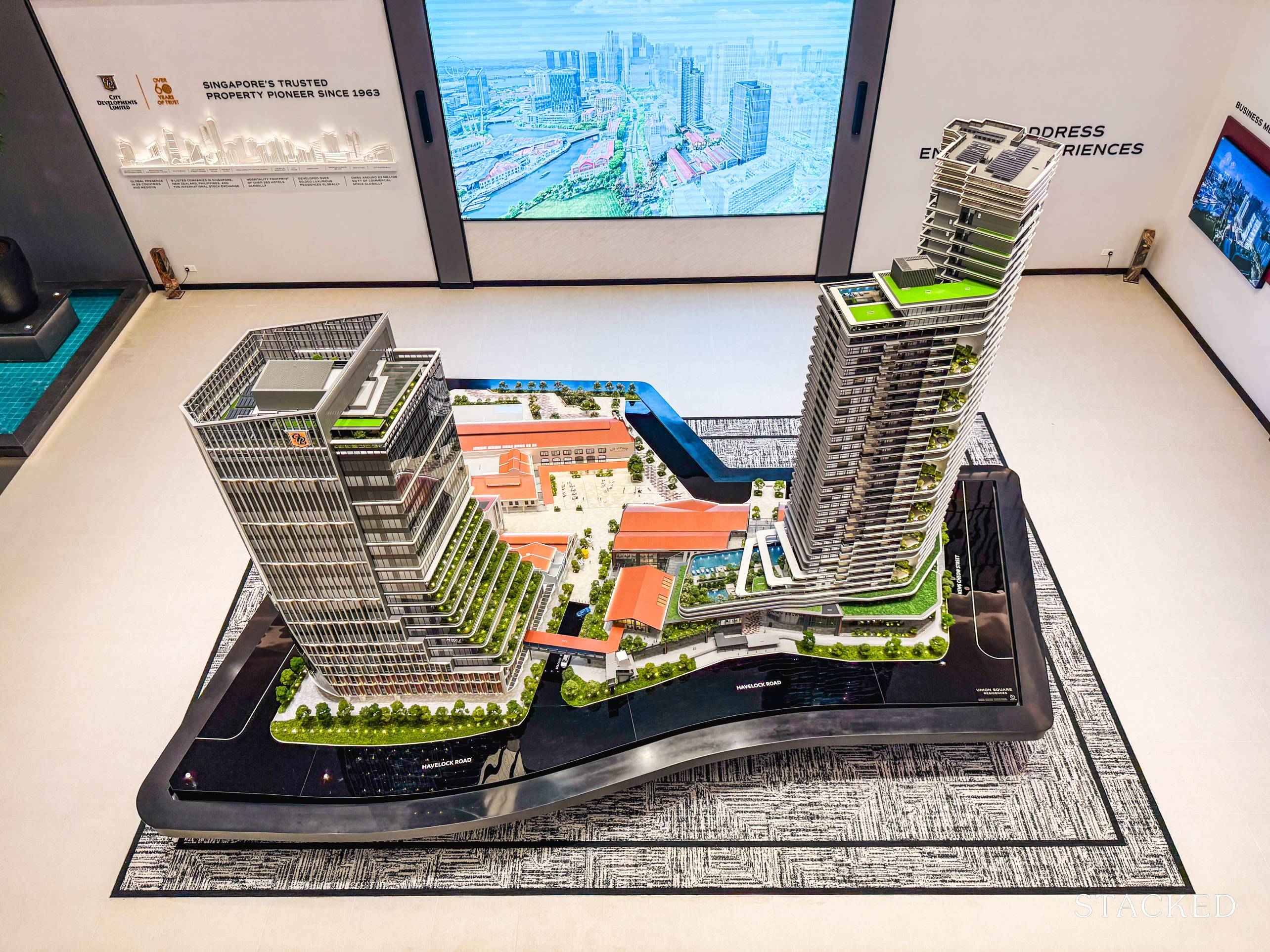
Three MRT lines. A park at the doorstep. A commercial podium underneath 366 apartments in a single 40-storey tower. On paper, Union Square Residences reads like the textbook answer to what a city-fringe buyer says they want — which is exactly why it deserves a harder look than the brochure invites.
This review takes the 99-year leasehold development at 28 Havelock Road apart piece by piece: the unit mix, the pricing that has actually been transacted, what Havelock MRT connectivity genuinely buys you in daily life, and — the part most launch reviews rush past — whether the numbers work differently for someone buying a home versus someone buying an asset with a Q1 2029 completion date stamped on it.
Because those two buyers are not asking the same question. The owner-occupier is asking whether S$1.28 million buys a life they want. The investor is asking whether S$1.28 million buys a yield that survives stamp duties, a four-year holding period and a 366-unit exit queue. Same building. Completely different maths.
The Project at a Glance
Union Square Residences is a mixed-use development that layers residential floors above a commercial podium, within walking distance of the Clarke Quay and Chinatown dining belts and the green expanse of Fort Canning Park.
| Attribute | Detail |
|---|---|
| Address | 28 Havelock Road (some project materials also reference 20 Havelock Road) |
| Tenure | 99-year leasehold |
| Storeys | 40 |
| Residential units | 366 |
| Unit types | 1-bedroom to 4-bedroom, plus sky suites and a penthouse |
| Commercial component | Retail and office podium |
| Nearest MRT | Fort Canning (Downtown Line), Clarke Quay (North East Line), Chinatown (North East Line & Downtown Line) |
| Indicative completion | Q1 2029 (some project materials cite later estimates — see risks) |
The scale matters. At 366 units, Union Square Residences sits in a middle band: large enough to support a full suite of facilities and a commercial podium that generates footfall, small enough that the development does not become a vertical township competing with itself on the resale market. Compare that to the 1,000-plus unit mega-launches that have defined parts of the Outside Central Region in recent cycles, and the difference in exit dynamics is real.
The tenure is the first thing to be clear-eyed about. Ninety-nine years is the standard for almost every new launch on leasehold land, and it is not a defect — but it is a live variable in a resale calculation thirty years out, particularly for a project whose appeal is heavily weighted toward location and rental demand rather than scarcity of land.
Havelock Road: Three MRT Lines and a Park
Location analysis in Singapore launch marketing usually degenerates into a station-count competition. Union Square Residences can play that game well, but the honest version is more interesting.
The three stations serving the address do different jobs:
- Fort Canning (Downtown Line) — the Downtown Line runs through the CBD spine via Bugis, Promenade and Downtown, then out to the eastern heartlands. Fort Canning is the station that makes the financial district genuinely walkable-to-commutable.
- Clarke Quay (North East Line) — the North East Line is the fast connection to Chinatown, Outram Park, HarbourFront and up through Serangoon to Punggol. It is also the line that ties the address to the rental catchment of the north-east corridor.
- Chinatown (North East Line & Downtown Line) — the interchange that effectively doubles the reachable network, including the Thomson-East Coast Line via a short hop.
What that combination produces is not just "near MRT". It is network redundancy — three separate ways into the system so a single line disruption does not strand you. For a buyer commuting to Raffles Place, Marina Bay or the Novena/Ochard corridor, that is a materially better daily experience than being 400 metres from one station on one line.
The other half of the location story is harder to price but easy to feel. Clarke Quay's dining and nightlife cluster sits close enough to be convenient and, depending on the unit's orientation and floor, far enough to be quiet. Fort Canning Park provides the thing central Singapore consistently undersupplies: green space you can actually use at 7am on a Saturday. Add the Singapore River walk and the rail corridor greenway and the address has a recreational footprint that is difficult to replicate in a denser CBD tower.
What "Connectivity" Is Actually Worth
A useful sanity check on the connectivity premium: new launches in the Core Central Region have been transacting around S$3,208 psf, against resale units in the same broad market at roughly S$2,215 to S$2,800 psf, according to market comparison data. That gap — call it a 10% to 20% new-launch premium — is partly the cost of new, partly developer margin, and partly the market's forward pricing of exactly the locational attributes described above.
The question a buyer should ask is not "is there a premium?" — there always is. It is "is this premium smaller or larger than the specific attributes justify?" A 366-unit leasehold tower on a busy arterial road, one stop from the CBD, with a commercial podium, sits in a category where the premium is defensible but not unlimited.
The Unit Mix, Decoded
The stack runs from compact one-bedders to a single penthouse, with sky suites occupying the upper tier. The transacted data tells you more about how the developer is positioning each segment than any floor plan will.
| Unit type | Typical size | Transacted quantum | Implied psf |
|---|---|---|---|
| 1-bedroom (lower floor) | ~463 sq ft | ~S$1.28m | ~S$2,765 |
| 1-bedroom (higher floor) | ~460–510 sq ft | ~S$1.52m | ~S$3,004 |
| 2-bedroom (lower floor) | ~700 sq ft | ~S$1.82m | ~S$2,603 |
| 2-bedroom (higher floor) | ~700 sq ft | ~S$2.07m | ~S$2,960 |
| 4-bedroom | ~1,518 sq ft | ~S$4.25m | ~S$2,802 |
| 5-bedroom (2,476 sq ft) | 2,476 sq ft | ~S$9.28m | ~S$3,752 |
| 5-bedroom sky suite | 4,833 sq ft | S$18.5m (listed Feb 2026) | ~S$3,828 |
Union Square Residences — Implied PSF by Unit Type (S$ psf)
Read that chart carefully, because it contains the single most useful insight in this review: the psf curve is not monotonic. The entry-level two-bedroom on a lower floor prices at roughly S$2,603 psf, while a one-bedroom on a high floor prices at roughly S$3,004 psf. The four-bedroom sits at S$2,802 psf — below both the high-floor one-bedder and well below the large-format upper-tier units.
Union Square Residences — Indicative Price Quantum (S$ million)
What does that mean in practice?
- Small units pay a psf premium. This is normal — compact units always carry the highest psf because the absolute quantum is what the market clears on. Buyers should not mistake high psf for a bad deal; they should recognise that they are paying for affordability of quantum, not for floor area efficiency.
- Floor level is worth roughly S$240 psf in the one-bedroom segment (S$2,765 to S$3,004). That is the price of a view, quiet, and a higher-floor address. Whether it is worth it depends entirely on how long you intend to hold — the higher-floor premium tends to compress in soft resale markets and widen in strong ones.
- The four-bedroom looks like the relative value in psf terms, at roughly S$2,802 psf for 1,518 sq ft. But the absolute quantum — S$4.25 million — puts it in a narrow buyer pool that is heavily exposed to Additional Buyer's Stamp Duty if the purchaser already owns property.
- The large-format upper tier (S$3,752 to S$3,828 psf) is a different market entirely. At S$9.28 million and S$18.5 million, these units are competing for a very small set of buyers who are choosing between this and a freehold bungalow, a Good Class Bungalow-adjacent plot, or a penthouse in a brand-name CCR development. The psf here is not a benchmark for the rest of the stack.
The practical takeaway: the sweet spot for most buyers is the two- and four-bedroom bands, where psf is most competitive relative to the building's own average. The one-bedders are the volume product and the most rentable, but they carry the highest psf per square foot of liveable area.
Pricing: Psf, Quantum, and the New-Launch Premium
Let's put the numbers side by side with the wider market, because a psf figure in isolation tells you nothing.
CCR New Launch vs Resale — Indicative PSF (S$)
Union Square Residences' transacted bands — roughly S$2,600 to S$3,000 psf across the mainstream unit types — sit at or slightly below the CCR new-launch benchmark of S$3,208 psf. That is a meaningful positioning choice. It suggests the developer has priced for absorption rather than for headline-grabbing psf records, which in a market where transaction volumes have been contracting is the commercially rational move.
What the Premium Actually Buys
Four things, in rough order of durability:
- The building itself — new finishes, modern layouts, a full facilities deck, a commercial podium. This depreciates fastest in perception and slowest in reality; the "new" premium is largely gone after the first resale cycle, but the layout efficiency advantage persists.
- The location — three MRT lines, walkable CBD fringe, park adjacency. This is the most durable component and the one that supports resale value over a 10–20 year horizon.
- The lease — a fresh 99-year term from TOP. Against a 20-year-old resale comparable, this is worth real money in financing terms because banks lend more comfortably against longer remaining lease, especially for younger buyers taking maximum tenure.
- The timing risk transfer — you are buying something that does not exist yet. In exchange for carrying construction risk, buyers historically expect a discount to completed stock. Whether that discount is currently adequate is the central question of any new-launch purchase.
The Progress Payment Angle
For buyers using a progressive payment scheme on an uncompleted project, the capital outlay is staged against construction milestones rather than paid upfront. That materially changes the cash-flow picture versus buying resale — but it also means the buyer's exposure grows precisely as interest rates and personal circumstances may change. Anyone modelling affordability on today's rates should stress-test at least 200 basis points higher before committing to a Q1 2029 completion.
The Market You're Buying Into
The macro backdrop matters more for a 2029-completion project than for a resale purchase, because you are underwriting three more years of market conditions before the keys arrive.
According to the Urban Redevelopment Authority's real estate statistics released on 23 October 2026, private residential prices rose 1.4% in Q3 2026, following a 0.5% rise in Q2 2026. Prices are therefore still climbing — but the composition of the market has shifted.
Developer Sales of Private Residential Units (ex-EC)
Developers sold 1,183 private residential units (excluding Executive Condominiums) in Q3 2026, down from 2,141 in Q2 2026. That is a substantial contraction in volume against a rising price index — the classic signature of a market where prices are being held by replacement cost and developer discipline while demand becomes more selective.
The rental side has been steadier. The private residential rental index rose 0.3% in Q1 2026, recovering from a 0.5% dip in Q4 2025, and gross rental yields for Singapore apartments averaged 3.06% in Q2 2026.
Three implications for a Union Square Residences buyer:
- Pricing power is with buyers, not developers, at the margin. A 366-unit project launching into a contracting-volume market has to compete for attention. That is leverage you should use — not on the headline price necessarily, but on unit selection, floor choice and payment terms.
- A 3% gross yield environment sets the investment hurdle. Any rental argument for this project has to clear roughly 3% gross before costs, which is a demanding bar once you net out property tax, maintenance, agent fees and vacancy.
- Rising prices plus falling volumes is not a crash signal. It is a selection signal. It rewards buyers who choose well-located, sensibly-priced, well-differentiated units and punishes those who chase.
The Policy Layer: What ABSD and SSD Do to This Purchase
You cannot evaluate a Singapore launch in 2026 without the stamp duty framework sitting in the middle of the spreadsheet. Three moving parts matter here.
Additional Buyer's Stamp Duty (ABSD)
ABSD is the single largest swing factor between the own-stay and investment cases. Rates for second and subsequent properties can run from 17% to 25% depending on the buyer's residency profile and ownership history — a cost that can exceed the entire new-launch premium being paid for the building itself.
Practical consequences:
- First-time Singaporean owner-occupiers are largely insulated and should treat this as a home purchase first.
- Anyone buying a second property should model ABSD as a sunk cost, not as something that will be recovered. It is not recoverable.
- The common workarounds — decoupling via a 99:1 ownership structure, or selling an existing property before exercising the option on the new one — carry their own legal, financing and sequencing risks. They are structuring decisions, not loopholes, and they need professional advice.
Seller's Stamp Duty (SSD)
Rules effective 4 July 2025 extended the SSD holding period to four years, with rates starting at 16% for disposals in the first year and tapering to 4% for sales in the third-to-fourth year.
The implication for Union Square Residences buyers is a seven-to-eight year minimum efficient holding period: roughly four years of construction to Q1 2029, plus up to four years of SSD exposure after purchase. Anyone buying with a two- or three-year flip thesis is fighting the policy framework directly. The maths only works if you underwrite this as a long-hold asset.
Developer ABSD Remission Timelines
Changes taking effect for residential land acquired on or after 29 July 2026 give developers of larger projects extended timelines — reportedly up to six or seven years for large and mega sites — to meet ABSD remission conditions, while introducing safeguards to ensure units are released to market in a timely manner, as reported by Channel NewsAsia.
For buyers, this is a double-edged policy. It reduces the risk of fire-sale pricing if a large development struggles to clear stock, which supports price stability. But it also removes some of the urgency incentive that previously pushed developers to discount aggressively near the deadline. Do not assume a developer will be forced into a discount window on your preferred unit type.
Own-Stay or Investment? A Framework
The two buyer profiles pull in genuinely different directions on almost every decision — floor, layout, psf tolerance, holding period.
If You're Buying to Live In
Union Square Residences is, on balance, a strong owner-occupier proposition, and the reasons are not the ones in the marketing copy.
- The commute is genuinely good. Three lines and a walkable CBD fringe mean the address works even if your job changes twice in the next decade — a real risk in a market where the average young professional changes employer more often than they change homes.
- The podium earns its keep. A commercial component means groceries, coffee and dinner without a car trip. For a couple working CBD hours, that is worth more in weekly quality of life than a slightly larger living room.
- The unit mix protects you from a monoculture. A building that is all one-beds becomes a rental tower. A building that runs from one-beds to penthouses has a more stable owner-occupier core, which typically correlates with better maintenance culture and a better-reserved sinking fund over time.
- Layout efficiency beats psf. A 700 sq ft two-bedroom at S$1.82 million with a proper kitchen and an efficient living-dining overlap is a better home than a larger unit with wasted corridor. Look at the plans, not the psf.
The owner-occupier's main risk is paying a high-floor psf premium for a view that is not guaranteed — the surrounding Havelock Road and Clarke Quay corridor has redevelopment potential. Before paying up for a high floor, check what is zoned around the site and what could rise in front of you.
If You're Buying to Invest
This is where the review should be bluntest.
The arithmetic. At a 3.06% gross yield market average, a unit at S$1.38 million would need roughly S$3,500 per month in gross rent to hit the average; a S$1.82 million two-bedroom would need roughly S$4,640 per month. Those are achievable numbers for the Clarke Quay/Chinatown catchment — the area has deep tenant demand from CBD professionals — but they are gross figures. Net of property tax, maintenance fees (which are typically higher in a full-facility, mixed-use development), agent commissions and vacancy, the net yield lands materially lower.
The duty drag. If ABSD applies at all — and for a second property it very likely does — the return calculation deteriorates sharply. A buyer paying a high-teens-to-mid-20s percentage stamp duty on a S$1.8 million unit is starting the investment several hundred thousand dollars in the hole. Reverse-engineering a return that justifies that requires both strong rental growth and meaningful capital appreciation over a decade-plus.
The exit queue. With 366 units, the resale market for this development will at any given time have competing listings with identical layouts. Differentiation comes from floor, view, renovation and lease length — and in a soft volume market, the lowest-ask identical unit sets your ceiling. Large-format units at S$9 million and above face an even thinner buyer pool.
The verdict for investors: the case rests on long-term capital preservation and rental income in a prime fringe location, not on short-term appreciation. Anyone underwriting a three-year flip should not be buying here.
The Risks Nobody Puts on the Brochure
Every launch has them. Here are the ones specific to this project.
- Completion date ambiguity. Project materials cite a Q1 2029 completion, while some sources reference later estimates. Construction timelines in Singapore have improved since 2022, but a two-year slip materially changes a progressive payment schedule and any rental-income start date. Ask for the form of contract and the expected TOP and CSC dates in writing.
- Arterial road exposure. Havelock Road and the surrounding corridor carry real traffic. Lower-floor units facing the road will hear it. Check the site plan orientation before signing, and visit the actual location at rush hour — not just the showflat.
- Mixed-use friction. A commercial podium brings convenience and footfall, but also service vehicle access, refuse handling and, in some schemes, shared management cost allocation between residential and commercial strata. Understand how the MCST is structured.
- Construction-era noise. The surrounding Havelock Road area has ongoing development activity. Early residents of a Q1 2029 completion may move into a precinct still under construction, which affects both liveability and rental appeal in the first two years.
- Absorption risk at scale. 366 units is manageable but not trivial. If absorption is slower than expected, later buyers may find better units at better terms — a reason not to overpay in the first phase.
- Leasehold financing over time. A 99-year lease bought in 2029 still has roughly 96 years remaining by TOP. That is comfortably financeable. But buyers planning to hold 25–30 years should model how CPF usage and bank loan-to-value rules tighten as the lease shortens.
Food for Thought
-
If the psf curve is not monotonic — a four-bedroom at S$2,802 psf against a high-floor one-bedder at S$3,004 psf — which of these is the developer telling you is the harder sell? And what does that imply about the price you should be negotiating for?
-
The 3% gross yield benchmark is a market average across Singapore. Clarke Quay and Chinatown command better rents than the average, but also carry a tenant profile that turns over faster. What vacancy rate are you assuming — and would you still buy at 6% vacancy rather than 2%?
-
If the efficient holding period is seven to eight years because of a four-year construction timeline plus a four-year SSD window, does that still count as an investment thesis — or is it functionally a bet on Singapore's long-run urban core?
-
Three MRT lines is the headline. But what actually makes a location resilient over 20 years is the mix of uses within a 10-minute walk. Walk the Havelock Road corridor at 9pm on a Tuesday. Would you live there? Would your tenant?
-
The extended developer ABSD remission timelines reduce the chance of a forced discount at the end of the sales period. If a fire-sale window is now less likely, what is your fallback strategy for negotiating on a unit you actually want?
The Bottom Line
Union Square Residences is a well-considered, sensibly-priced launch in a location that does most of the heavy lifting. Its transacted psf bands sit at or below the CCR new-launch benchmark, its connectivity is genuinely multi-line rather than marketing-single-line, and its unit mix spans enough formats to avoid becoming a vertical rental block. At S$2,600 to S$3,000 psf across the mainstream units, with entry pricing around S$1.28 million, it is accessible by city-fringe standards and defensible on location alone.
But it is not a shortcut. The policy framework — a four-year SSD window, ABSD on any second property, and a Q1 2029 completion that pushes any meaningful return into the 2030s — makes this a long-hold purchase in either scenario. Buy it as a home you will live in for a decade, or as a core-city asset you intend to hold through a full cycle. Do not buy it as a trade.