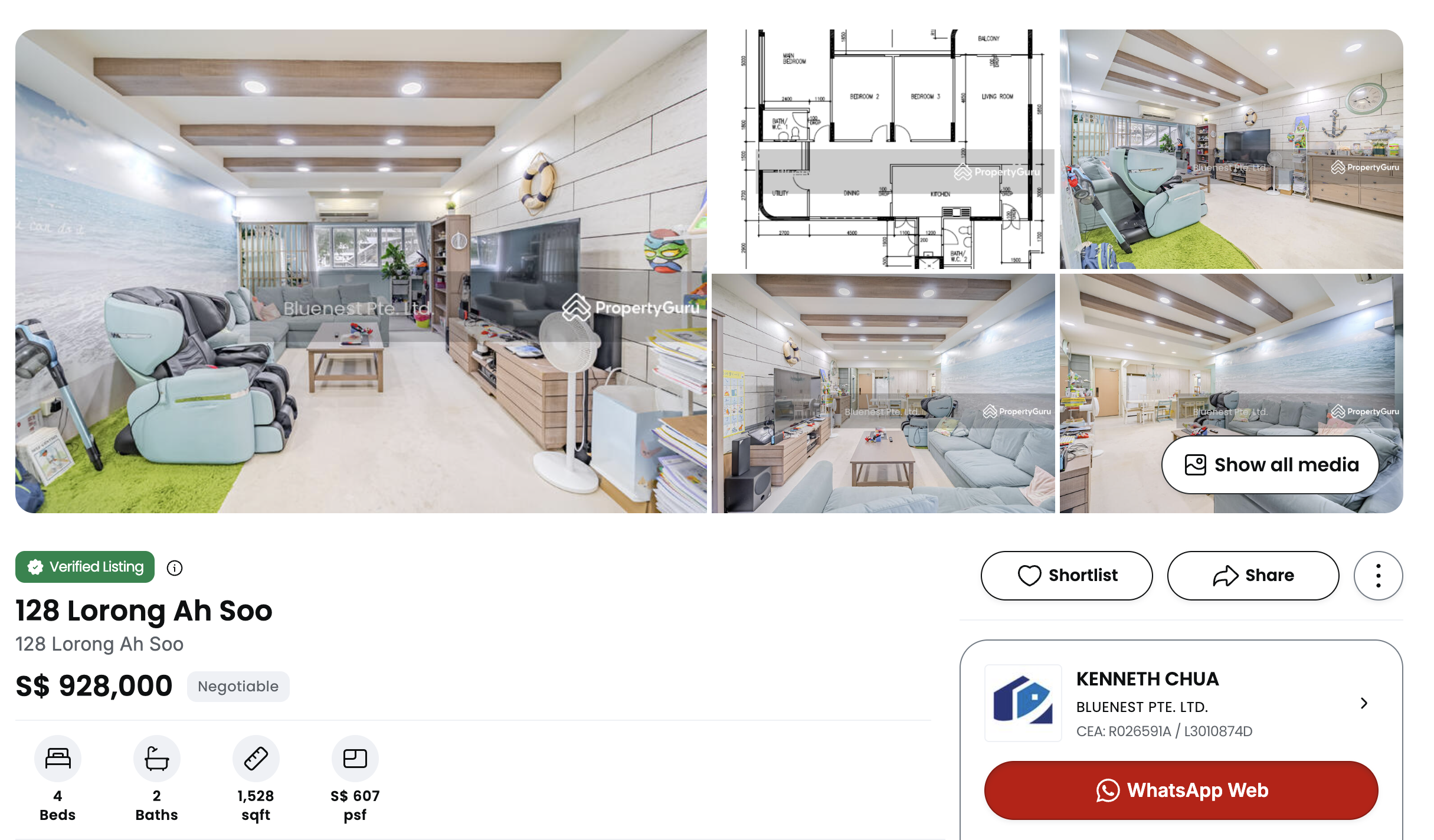
If you are shopping for a 4-room HDB resale flat in 2026, you are staring at a market that is simultaneously cooling and breaking records. Prices, on the official index, have drifted down for three straight quarters. Transaction volumes, meanwhile, have surged to a two-year high. And in the Central region, the median price for a four-roomer has landed at S$928,000 — a figure that would have sounded like an outlier five years ago and now reads as a routine line in the transaction data.
That gap between a national median and a regional median is the single most important thing a buyer needs to understand about this market. It is not simply "central is expensive." It is a precise, measurable spread — roughly S$300,000 on the headline number — and it is being paid by 1,550 households in a nine-month window. Understanding what sits behind that spread is the difference between buying well and buying expensively.
Here is what the January-to-September 2026 data actually says, and how to use it.
The Market in Context: Cooling Prices, Hot Volumes
Before looking at the Central region premium, you need to understand the macro picture, because it defines your negotiating leverage.
According to market data tracking the HDB resale market, Q3 2026 resale prices edged down 0.1% to 0.2%, marking the third consecutive quarter of price moderation. Transaction volumes, in the same quarter, jumped by roughly 17.7% to 19.5%, reaching a two-year high.
That combination — softer prices, higher volume — is unusual and instructive. It tells you the market has not lost demand. It has found a clearing price. Buyers who were waiting on the sidelines through 2024 and 2025 have decided that a flat 0.2% quarterly drift is not worth another year of waiting. Sellers, in turn, have stopped testing the ceiling.
The long arc matters too. The HDB Resale Price Index rose from 24.3 in Q1 1990 to 202.8 in Q2 2026 — a multiple of about 8.3 times — outpacing non-landed private property price growth over the same 36-year stretch. Against that backdrop, a few quarters of 0.1% declines look less like a correction and more like a pause.
Quarterly data points worth holding in your head:
- Q1 2026 marked the first quarterly decline in the resale price index since Q2 2019 — a seven-year run ended.
- Q3 2026 was the third consecutive quarterly dip.
- Despite that, 596 flats transacted at S$1 million or more in Q3 2026 alone.
- The share of 4-room flats selling below S$500,000 has collapsed from roughly 80% to about 7% over the past several years.
The market is not falling. It is bifurcating. The mass-market segment is softening slightly while the premium segment keeps printing record prices. Which brings us back to the S$928,000.
Reading the 8,646 Transactions: A Regional Breakdown
Between January and September 2026, 8,646 four-room HDB flats changed hands in the resale market. Four-room flats are the workhorse of Singapore's resale ecosystem — large enough for a family, small enough to be financeable — so their transaction distribution is effectively a map of where demand is concentrating.
Here is how the regions that were broken out in the data compare:
| Region | Median Price (4-Room HDB) | Resale Transactions (4-Room) |
|---|---|---|
| Central | S$928,000 | 1,550 |
| North-East | S$650,000 | 2,177 |
| East | S$650,000 | 1,387 |
| Overall (all regions, Q3 2026) | S$628,000 | — |
| Total, Jan–Sep 2026 (all regions) | — | 8,646 |
Median 4-Room HDB Resale Price by Region, Jan-Sep 2026 (S$)
Three observations jump out immediately.
First, the Central premium is enormous. At S$928,000, the Central region median sits S$278,000 above the North-East and East medians, and S$300,000 above the overall four-room median of S$628,000 recorded in Q3 2026. That is not a rounding difference; it is roughly the price of a second flat in some towns.
Second, the Central region is not the volume leader. It accounts for 1,550 of the 8,646 transactions — around 18% — trailing the North-East's 2,177. Non-central towns are where the majority of Singaporeans are actually transacting.
Third, the Central median is being held up by a narrow slice of the market. The most expensive town-level medians now sit in the million-dollar range, and 596 flats crossed the S$1 million mark in a single quarter. A median of S$928,000 across 1,550 deals is entirely consistent with a distribution that includes a meaningful tail of seven-figure transactions.
4-Room HDB Resale Transactions by Region, Jan-Sep 2026
The East and North-East both printing a S$650,000 median is itself a useful anchor. It suggests that in 2026, a well-located, reasonably-sized four-room flat in a mature non-central town — Punggol, Sengkang, Tampines, Bedok, Pasir Ris — clears at around S$650,000. Everything above that is being paid for specificity: exact location, exact lease, exact proximity to a station, exact floor.
What Actually Drives the S$300,000 Gap
The Central premium is not a single variable. It is the compound result of four factors that buyers consistently underprice when they walk into a viewing.
1. MRT Access: Worth Up to 10% — But It Compounds
The cleanest quantified premium in the data: four-room flats within 500 metres of an MRT station commanded resale prices up to 10% higher than comparable flats further away.
Ten percent sounds modest. On a S$650,000 base, it is S$65,000. But here is the part that matters: the MRT premium does not exist in isolation. It multiplies against everything else. A central flat that is also near an interchange, also near a mall, also near a hospital, is stacking premiums.
Ten percent of S$928,000 is S$92,800. The same feature that adds S$65,000 in a non-central town adds nearly S$93,000 in the Central region — because the premium is calculated on a larger base. This is the mechanics of why the gap widens rather than narrows.
Central Singapore also delivers something a single MRT line cannot: network density. Being within walking distance of two or three lines, or an interchange that puts the whole island within one transfer, changes the calculus of where you can work. Buyers pay for optionality, not just minutes.
2. Flat Age and Remaining Lease: The Factor That Quietly Kills Deals
Remaining lease has moved from a footnote to a headline in how buyers assess HDB resale flats, and for good reason — it interacts directly with your financing.
- CPF usage is affected. When a flat's remaining lease does not cover the youngest buyer to age 95, CPF Ordinary Account usage for the purchase is prorated. Flats with very short remaining leases — under 20 years — cannot be bought with CPF at all.
- Loan quantum is affected. HDB housing loans require the remaining lease to cover the youngest buyer to age 95. Buyers using bank loans have more flexibility, but lenders apply their own lease-based curtailment.
- Resale liquidity is affected. A flat that is hard for you to finance will be hard for your eventual buyer to finance too.
Inside the Central region, this plays out unevenly. Some central estates are dominated by older blocks with leases that have already crossed the half-century mark; others have newer supply. A central flat with a short remaining lease can, counterintuitively, sell below a non-central flat with a fresh 99-year lease — because the buyer pool for the former is structurally smaller.
The rule of thumb: the Central median of S$928,000 is a blend. It includes newer central flats pushing the number up and older central flats dragging it down. Where any individual unit sits within that blend depends heavily on the lease clock.
3. Amenities: The Compound Effect
Amenities are the least quantified and most durable driver. Schools, hawker centres, polyclinics, supermarkets, parks, and — crucially in 2026 — established town centres create a self-reinforcing cycle. Good amenities attract families. Families sustain demand for amenities. Demand raises prices. Higher prices fund better-maintained surroundings.
Central region flats typically sit inside or adjacent to mature estates where this cycle has been running for decades. The practical test for a buyer is not "is there a mall nearby" but "how many of my daily needs are met within a 10-minute walk." A flat that scores well on that question in 2026 will score well again in 2046, which is what makes the premium sticky.
4. Unit-Level Specifics: Floor, Facing, and Renovation State
A regional median tells you nothing about the specific flat you are standing in. Within the same Central block, you can find a S$150,000 spread between a low-floor, west-facing, original-condition unit and a high-floor, unblocked, recently renovated one. This is not noise. It is the market pricing what the median cannot capture.
The practical implication: when a seller tells you "the median in this area is S$928,000," they are quoting an aggregate that may be entirely irrelevant to their unit. And when a buyer quotes the same number to argue for a discount on a premium unit, they are making the mirror-image error.
The Million-Dollar Question: Is the Central Premium Worth It?
Let's stop speaking in medians and speak in mortgage payments. Here is an illustrative comparison for a household using an HDB loan at 75% LTV over 25 years at 2.6% — the LTV cap having been reduced from 80% to 75% to encourage prudent borrowing.
| Metric | Central Region (S$928,000) | North-East / East (S$650,000) | Overall 4-Room Median (S$628,000) |
|---|---|---|---|
| Loan quantum (75%) | S$696,000 | S$487,500 | S$471,000 |
| CPF/cash downpayment (25%) | S$232,000 | S$162,500 | S$157,000 |
| Estimated monthly instalment | ~S$3,158 | ~S$2,212 | ~S$2,137 |
| Gross income needed at 30% MSR | ~S$10,526/mo | ~S$7,373/mo | ~S$7,123/mo |
| Buyer's Stamp Duty (approx.) | ~S$22,440 | ~S$14,100 | ~S$13,440 |
| Conveyancing (approx.) | ~S$2,000 | ~S$2,000 | ~S$2,000 |
Figures are illustrative and rounded; BSD is based on prevailing tiered residential rates.
The gap is not S$278,000. The gap is roughly S$946 a month, plus an extra S$70,000 of downpayment, plus S$8,000 more in stamp duty. That is the true cost of the Central address.
Whether it is worth it depends on a question the median cannot answer for you: how many hours a week does the Central location give back to you? If the answer is five hours of commuting, and you value your time at S$40 an hour, that is roughly S$850 a month of recovered time — which is close to a wash. If the answer is "I work from home three days a week," the calculation deteriorates quickly.
A Note on Cash Over Valuation
In a market moving through 8,646 transactions in nine months, Cash Over Valuation (COV) remains the least predictable part of the budget. COV must be paid in cash, cannot be financed by an HDB loan, and cannot be paid from CPF. In high-demand central locations, COV is most likely to appear and least likely to be negotiable.
The discipline is straightforward: know your HDB valuation before you commit to a price. Make an offer you can support with a valuation report. If the valuation comes in lower than your offer price, you are funding the difference in cash.
Policy Watch: The Rules That Reshape the Maths
Three regulatory changes are actively shaping how the 2026 resale market behaves.
The LTV reduction. Lowering the HDB loan LTV from 80% to 75% raised the cash-or-CPF downpayment requirement by five percentage points. On a S$928,000 flat, that is an additional S$46,400 of upfront capital compared to the old rules. The policy intent — prudent borrowing — has a direct, measurable effect on who can realistically bid for the Central median.
The Resale Flat Listing (RFL) service. Launched in May 2024, the RFL service lets sellers list flats independently on the HDB Flat Portal. Critically, it includes an automatic pricing prompt that flags listings priced significantly above the highest transacted price of nearby comparable units in the past six months. Access to the full suite requires a valid Intent to Sell for sellers and a valid HFE letter for buyers — which means listings are genuine and buyers are transaction-ready. For buyers, this is a transparency upgrade: the listing platform itself now provides a sanity check on asking prices.
The HDB Flat Eligibility (HFE) letter. Eligibility for a flat purchase, grants, and an HDB loan now sits in a single document. You cannot meaningfully begin a resale purchase without it, and you cannot access the full RFL feature set without it. Get it early — it takes time and it gates everything downstream.
Also worth flagging for mature central estates: Ethnic Integration Policy (EIP) and Singapore Permanent Resident quota limits apply at block and neighbourhood level. In popular central blocks, these quotas can bind before price does — meaning a flat may be listed and affordable, but not purchasable by your household. Always check the quota for the specific block before you fall in love with a unit.
Buyer Checklist for Negotiating in a High-Volume Market
High volume is not automatically good news for buyers. It means more competition for the good units and more noise in the price signals. Here is how to operate.
Before You View Anything
- Secure your HFE letter. Everything — loan quantum, grant eligibility, RFL access — depends on it. Do not view a single flat without it.
- Build a total budget, not a purchase budget. Include the downpayment, BSD (roughly S$22,400 on a S$928,000 flat), conveyancing (around S$2,000), renovation, and a COV reserve. A budget that only accounts for the flat price is not a budget.
- Stress-test your income against MSR. The Mortgage Servicing Ratio caps your HDB loan repayment at 30% of gross monthly income. At S$928,000, you need roughly S$10,500 a month of household income before TDSR is even considered.
- Pull the transaction data yourself. HDB publishes resale transaction records. Look at the last six to twelve months of comparable units — same block, same flat type, similar floor band. This is your single best defence against overpaying.
When You View
- Check the remaining lease against your age. If the lease does not cover the youngest buyer to age 95, expect prorated CPF usage and a smaller buyer pool when you eventually sell.
- Verify the walk to the MRT. Not "near MRT" — actually walk it. The 500-metre premium is real, but so is a 12-minute walk in the rain.
- Test the amenity radius. Ten minutes on foot to a hawker centre, a supermarket, and a clinic is worth more than a mall two bus stops away.
- Look past the renovation. A S$60,000 renovation is not a S$60,000 premium; it is a S$60,000 discount you are being asked to pay for someone else's taste.
- Check EIP and SPR quota for the block. In mature central estates, this is often the binding constraint.
At the Negotiating Table
- Anchor on transacted data, not asking prices. Asking prices in a high-volume market drift above reality. Transacted prices do not.
- Ask about the seller's timeline. A seller who has already committed to a next purchase has less room to hold out. Timing is leverage.
- Negotiate terms, not just price. Completion date, vacant possession, whether the appliances stay, whether minor defects get fixed — all of these have real value and cost the seller less than a price cut does.
- Protect your COV position. If you are paying above valuation, know by how much and be ready to fund it in cash. Do not let a S$30,000 COV emerge as a surprise at the valuation stage.
- Set a ceiling and write it down. In a market with 8,646 transactions a year, there will always be another flat. There will not always be another S$50,000.
- Read the Option to Purchase before you sign it. The OTP is a legally binding contract. The option fee, the option period, and the exercise terms all matter.
Food for Thought
1. If the Central median is S$928,000 and the East and North-East medians are S$650,000, what exactly are you buying with the extra S$278,000 — and can you name it out loud? If the answer is "prestige," ask yourself whether prestige has a resale value you can defend to a valuer in 2040.
2. The share of 4-room flats under S$500,000 fell from 80% to about 7%. Where did the affordable four-roomer go — and is the answer new supply, resale pricing, or both?
3. Prices have fallen for three consecutive quarters while volumes hit a two-year high. Which of those two signals is the real market, and which one is noise?
4. With the LTV cap now at 75%, an extra S$46,400 of upfront capital is required on a S$928,000 flat. How many of the 1,550 Central transactions in 2026 would have happened under the old 80% rule?
5. If a 10% MRT premium applies to both a S$650,000 flat and a S$928,000 flat, does proximity to the MRT effectively become more valuable as the market rises — and does that make central connectivity a compounding asset or a compounding cost?
The Bottom Line
The Q3 2026 numbers tell a coherent story once you stack them correctly. 8,646 four-room resale transactions in nine months. A national four-room median of S$628,000. A Central region median of S$928,000 across 1,550 deals. Prices easing by a fraction of a percent per quarter while volumes climb by nearly a fifth.
The Central premium is not irrational — it is the price of MRT density, lease quality, amenity saturation, and unit-level specificity, all compounding on top of each other. But it is also a number that flatters aggregates and punishes buyers who treat a median as a valuation. The S$928,000 is an average of very different flats, and the only number that matters is the one attached to the unit you are standing in.