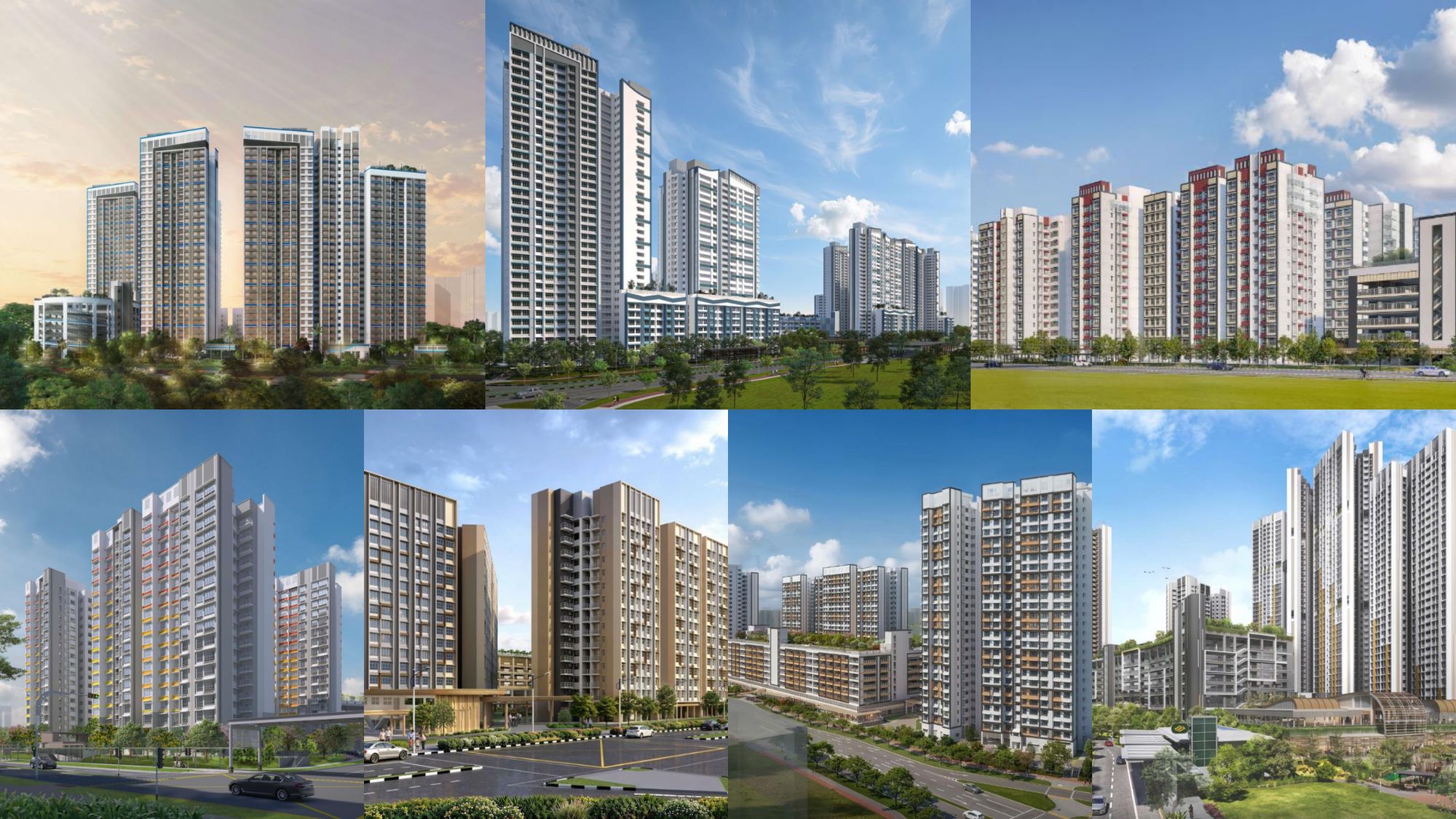
Every BTO cycle produces the same 11pm group chat panic. Someone screenshots a Straits Times headline, someone else asks "wait, do we need the HFE thing first?", and a third person insists their cousin got a queue number in three days. By the time the actual sales brochure drops, half the group has already made an irreversible decision on incomplete information.
The November 2026 BTO exercise — reportedly around 7,960 flats spread across six towns — is the next big one on the calendar. Six towns means six very different competition profiles. A launch that big sounds generous until you realise the flats are not distributed evenly, the towns are not equally desirable, and every household in Singapore is fishing from the same pond with the same one-application-per-exercise rule.
This BTO preparation guide is built on a simple premise: the work that decides your outcome happens before the sales details are published, not after. Eligibility, the HFE letter, budget modelling, and a project comparison framework can all be done now. What you cannot do now is look at a price list — and that is precisely why the rest matters more.
The November 2026 BTO launch at a glance
Here is what is broadly known, and what is not.
| Item | Status |
|---|---|
| Flat supply | Reportedly around 7,960 units |
| Number of towns | Six |
| Standard / Plus / Prime mix | Not yet confirmed by project |
| Unit mix by flat type | Not yet confirmed |
| Indicative pricing and PSF | Not yet released |
| Site plans and floor layouts | Not yet released |
| Estimated completion dates | Not yet released |
| Application window | Typically about one week; exact dates to be confirmed |
The critical unknown is the classification mix. Since HDB introduced the Standard / Plus / Prime framework, two projects in neighbouring towns can carry wildly different rules — different MOP lengths, different subsidy clawback treatment, different resale restrictions. A project that looks like a bargain on PSF can be a materially worse asset than the one next door.
That is why a BTO preparation plan built purely around "which town do I like" is fragile. You need a framework that survives whatever the brochure actually says.
Why the run-up matters more than the launch itself
Three structural reasons.
1. The application window is short, and it is not when you think. HDB's sales exercises typically open for roughly a week. Eligibility problems, missing documents, and unresolved family nucleus questions do not get solved in seven days — especially not when half of Singapore is refreshing the same portal.
2. The HFE letter is a gate, not a formality. Since the Housing Eligibility (HFE) letter became mandatory for flat applications, no household gets into the ballot without one. It also determines your flat type eligibility, your HDB loan eligibility, and your Enhanced CPF Housing Grant (EHG) amount — three things you genuinely need to know before you can budget properly.
3. Ballot outcomes are decided before you see the showflat. By the time pricing and layouts are released, your queue number is already a function of application rates in projects you chose blind. The only lever you control is which project you apply for — and that decision benefits enormously from preparation done in advance.
Section 1: BTO eligibility — get the unglamorous gates right first
Before anything else, confirm you clear the gates. Most failed applications are not unlucky; they are ineligible in a way that was checkable months earlier.
Gate 1: Citizenship and family nucleus
The core requirement is a Singapore Citizen in the application, forming a recognised family nucleus. Common configurations:
- Citizen + Citizen / PR spouse (including fiancé/fiancée under the Fiancé/Fiancée Scheme)
- Citizen + non-resident spouse (with additional conditions)
- Citizen children with aged parents (multi-generation arrangements)
- Single Singapore Citizens aged 35 and above applying for 2-room Flexi flats
- Divorced, widowed, or orphaned applicants under specific schemes
Family nucleus questions are where applicants most often discover a problem late. If your parents hold a flat and you intend to list them under a multi-generation arrangement, check the ownership and occupancy rules early — not in launch week.
Gate 2: The income ceiling
This is assessed on gross monthly household income, averaged over the assessment period (typically the 12 months preceding the application for variable income; latest payslips for fixed salaried employment).
| Applicant profile | Gross monthly income ceiling |
|---|---|
| Families / couples | S$14,000 |
| Singles (2-room Flexi) | S$7,000 |
| Extended / multi-generation families | Higher threshold applies — verify against current HDB rules |
The ceiling has moved meaningfully over the past fifteen years:
HDB BTO Income Ceiling for Families Over Time (S$)
Two practical notes. First, income is assessed on the household, so adding an earning occupier to strengthen your family nucleus can push you over the ceiling. Second, if you are close to the ceiling, timing matters: a mid-year bonus or a promotion in the assessment window can disqualify an otherwise eligible household. Model this now.
Gate 3: Private property
Applicants generally must not own private residential property, and must not have disposed of one within the relevant look-back period before applying. If you or a co-applicant owns a private home, or sold one recently, this is a hard stop that needs professional advice long before launch week.
Gate 4: Previous HDB benefits and the resale levy
If you are a second-timer, expect two things: a resale levy payable on your second subsidised flat purchase, and a much smaller allocation of flats set aside for second-timers in each project. The resale levy amount depends on your first flat type and is best confirmed against current HDB tables rather than memory.
The eligibility decision flow
Section 2: The HFE letter — your actual ticket to the ballot
The HFE letter is the single most important administrative step in this entire BTO preparation process, and it is the one most often left to the last fortnight.
What the HFE letter actually does
It is not just a pass/fail check. An approved HFE letter gives you:
- Confirmation of flat type eligibility — which matters because Plus and Prime projects can carry tighter restrictions
- HDB loan eligibility and an indicative loan amount
- Enhanced CPF Housing Grant (EHG) quantum — up to S$120,000 for eligible families, and up to half that for eligible singles
- Proximity Housing Grant (PHG) eligibility where relevant to your family arrangement
In other words, the HFE letter is your budget input, not just your entry ticket. Trying to model affordability before you have it is guesswork.
Validity and timing
An HFE letter is generally valid for nine months from approval, and HDB advises applying at least one month before the sales exercise you intend to join. Processing is not instant, and incomplete submissions reset the clock.
The documents you should gather this week
- NRIC for all applicants and occupiers
- Payslips — typically the last 3 months for fixed salaried applicants
- CPF contribution history (available via MyCPF)
- Employment letter confirming tenure and salary for variable-income applicants, plus 12 months of income records
- Marriage certificate, or a statutory declaration of marital status where applicable
- Birth certificates for children in the household
- Divorce or death certificates where relevant
The HFE-to-keys timeline
Deferred income assessment
If you or your co-applicant are still studying or serving national service, the Deferred Income Assessment lets you apply before your income is fully established, with assessment deferred to nearer key collection. It is designed for exactly the 25-to-30 age band, and it is worth checking whether you qualify before you assume you are priced out.
Section 3: Budget modelling that survives contact with reality
This is where most BTO preparation quietly fails. People model the purchase price and forget that the purchase price is not the cost.
The three constraints that actually bind
Mortgage Servicing Ratio (MSR) — for an HDB loan, your monthly repayment cannot exceed 30% of gross monthly household income. This is the binding constraint for the vast majority of BTO buyers, and it is stricter than the TDSR.
Total Debt Servicing Ratio (TDSR) — total monthly debt obligations cannot exceed 55% of gross monthly income. Car loans, student loans, and credit card minimum payments all count against this.
Loan-to-Value (LTV) — for HDB loans, LTV is 75%, meaning a 25% downpayment. For HDB loans, that downpayment can generally be met from CPF Ordinary Account balances and/or cash, subject to sufficient OA savings — there is no mandatory minimum cash component the way there is for bank loans.
Here is what the MSR constraint translates into, assuming the prevailing HDB loan rate of 2.6% per annum and a 25-year tenure:
Illustrative Maximum HDB Loan by Household Income (MSR 30%, 2.6% p.a., 25 years)
Read that chart carefully, because it explains a lot of BTO behaviour. A household earning S$8,000 a month supports roughly S$529,000 of HDB loan — which, at 75% LTV, implies a flat price of about S$705,000. At S$6,000 a month, the ceiling is around S$397,000 of loan, or roughly a S$529,000 flat.
The chart is illustrative and ignores other debts, CPF OA balances, and grant offsets. But it tells you something useful: most BTO households are constrained by MSR, not by the price list. That is why grants matter so much — every dollar of EHG reduces the loan you need, and therefore the income you need.
A worked budget
Take a household earning S$7,500 a month, buying a S$420,000 flat.
| Line item | Amount | Notes |
|---|---|---|
| Purchase price | S$420,000 | Illustrative |
| Downpayment (25%) | S$105,000 | Can be met from CPF OA and/or cash |
| HDB loan (75%) | S$315,000 | Subject to MSR and TDSR |
| Estimated monthly instalment | ≈ S$1,429 | 2.6% p.a., 25 years |
| MSR headroom at S$7,500 income | S$2,250 | Comfortably within limit |
| Buyer's Stamp Duty | ≈ S$7,000 | Payable within 14 days of signing AGL |
| Legal / conveyancing | A few hundred dollars | HDB conveyancing |
| Option fee at selection | Cash | Varies by flat type |
| Renovation and furnishings | S$30,000–S$60,000 | The forgotten line |
Two things jump out. First, the monthly instalment is rarely the problem — a 30% MSR ceiling gives most households meaningful headroom at BTO prices. Second, the cash requirement at key collection is the real constraint. Renovation, movers, appliances, and the downpayment top-up all land in the same six-month window.
The three-bucket model
Model your finances in three separate buckets rather than one lump sum:
- CPF Ordinary Account — downpayment, stamp duty, legal fees, and monthly instalments
- Cash at key collection — renovation, furnishings, contingency
- Post-key monthly cashflow — instalment plus conservancy charges plus utilities, tested against a realistic budget
Applicants routinely discover that bucket 1 is healthy and bucket 2 is not.
Grants: the EHG and the subsidy clawback question
The Enhanced CPF Housing Grant can go up to S$120,000 for eligible families and up to S$60,000 for eligible singles, tiered by income. It is credited into CPF OA and applied to your flat purchase. Your exact quantum comes with your HFE letter — which is another reason not to guess.
But understand the trade-off embedded in the new framework. Plus and Prime projects carry a subsidy clawback when you eventually sell, because they are priced with a deeper discount and come with tighter conditions. A larger upfront grant plus a deeper price discount is not automatically the better deal — it depends on your hold period and exit assumptions. Model both.
The stress test
Before launch week, run this: what happens if the instalment is 20% higher than modelled? HDB loan rates have been stable, but CPF OA rates and policy settings are not permanent. If a 20% increase would break your budget, your buffer is too thin — either buy smaller, or build more contingency.
Section 4: How to compare projects once the sales details drop
When the brochure lands, you will have roughly a week and a flood of information. Here is the framework to apply in that window.
Step 1: Price benchmark, not price reaction
Do not evaluate the price against your feelings. Evaluate it against two references:
- Nearby HDB resale PSF for comparable flat types and remaining lease
- Previous BTO launch prices in the same or adjacent town
A BTO price at a meaningful discount to nearby resale is the normal case — subsidies exist. What matters is how much discount, and whether the project's conditions (MOP length, clawback, resale restrictions) justify a narrower gap.
Step 2: Location scoring, done coldly
Score each project on the factors that actually move resale value later:
| Factor | Why it matters |
|---|---|
| Walking distance to MRT/LRT | The single most durable price driver in HDB resale |
| Bus connectivity and interchanges | Matters more than people admit for non-CBD commutes |
| Amenities within 500m | Supermarket, hawker centre, clinic, polyclinic |
| Primary school proximity | Balloting risk for young families |
| Job nodes and expressway access | Affects rental demand and resale pool |
| Future pipeline | New MRT lines, but also future BTO supply nearby |
Score each on a simple 1-to-5 scale and add them up. It feels mechanical. It is also far more reliable than the group chat.
Step 3: Understand what classification does to your exit
| Standard | Plus | Prime | |
|---|---|---|---|
| Location | Outside city centre, non-mature and mature | Close to MRT, town centres | City centre and surroundings |
| Pricing | Standard subsidy | Deeper subsidy | Deepest subsidy |
| MOP | 5 years | 10 years | 10 years |
| Subsidy clawback on resale | No | Yes | Yes |
| Renting out whole flat | Allowed after MOP, with approval | Not allowed | Not allowed |
| Resale buyer eligibility | Broader | Income ceiling and other conditions apply | Income ceiling and other conditions apply |
The practical implication: Plus and Prime flats are cheaper to enter and narrower to exit. If you plan to upgrade within ten years, a Standard flat in a well-connected town may serve you better than a Prime flat you cannot sell freely.
Step 4: Read the floor plan, not the brochure photo
Layout efficiency is underrated. Compare:
- Internal floor area vs marketed size — bay windows and air-conditioner ledges eat usable space
- Corridor width and wasted circulation
- Kitchen and service yard configuration
- Structural walls — load-bearing walls limit renovation options
- Orientation and sun exposure
A 4-room flat with an efficient layout can outperform a nominally larger one with dead space.
Step 5: Wait time is a real cost
Completion dates differ by project. A two-year difference in waiting time is two years of rent, two years of deferred family plans, and two years of interest on a decision. Factor it in explicitly.
BTO vs SBF vs resale
Section 5: Launch-week tactics and what happens after
One application per household
You may submit one application per sales exercise as a household. That single choice is your entire strategy. Applications carry a modest administrative fee (around S$10), but the real cost of a poorly chosen application is a lost cycle.
Understand what application rates tell you
HDB publishes application rates by project and flat type during the exercise. A rate of 1.0x means applications roughly equal supply; anything above that means a ballot. The strategic insight is simple and consistently underused:
Applying to an oversubscribed project with a marginally better location can be worse than applying to a well-located project that is undersubscribed.
Rate data is visible during the window. Check it before you finalise, not after.
Queue numbers and the non-selection penalty
If you are invited to select a flat and decline, nothing happens the first time. Decline twice within a 12-month period and you face a one-year bar from applying for a new flat. If your queue number is far beyond the flat supply, you will generally not be invited and the penalty will not apply — but the mechanics are worth confirming against current HDB rules for your specific situation.
Preparing for the selection appointment
If you get a queue number, the appointment moves fast. Have ready:
- A ranked shortlist of units — typically 15 to 20, with fallback options
- Your HFE letter and all supporting documents
- The option fee in cash
- A clear view on which flat type tiers you will accept
Applicants who arrive without a ranked list routinely freeze — and in a fast-moving selection room, freezing means losing the unit.
Section 6: Your 90-day BTO preparation plan
The common mistakes, in order of frequency
- Applying for the HFE letter too late, then missing the exercise entirely
- Modelling price instead of total cost — renovation and cash-at-keys are consistently underestimated
- Ignoring classification rules until after the queue number arrives
- Applying to the most oversubscribed project because it looked best on paper
- No ranked unit shortlist at the selection appointment
- Assuming grants are automatic rather than HFE-assessed
- Not checking income timing — a bonus landing inside the assessment window
Food for Thought
1. If you are constrained by MSR rather than by the price list, is "cheaper town" really your lever — or is "larger grant plus smaller flat" the better one?
2. A Prime flat is cheaper to enter and harder to exit. At what hold period does the deeper subsidy stop compensating for the tighter resale rules?
3. If 7,960 flats are spread across six towns, the real competition is not national — it is within a kilometre of an MRT station. How much of your shortlist is actually driven by transport access versus familiarity?
4. Would you rather have a queue number for your third-choice project, or no number at all for your first choice? Most people answer this differently before and after the ballot results.
5. How much of your BTO decision is a housing decision, and how much is an asset decision? The two have different optimal answers, and the framework above only resolves one of them.
Conclusion
The November 2026 BTO exercise will be decided in the details: whether your HFE letter was approved in time, whether your income sits comfortably inside the ceiling, whether your budget accounted for renovation cash at key collection, and whether your single application went to a project where your queue number actually meant something.
None of that requires the sales brochure. All of it can be done in the next 90 days.