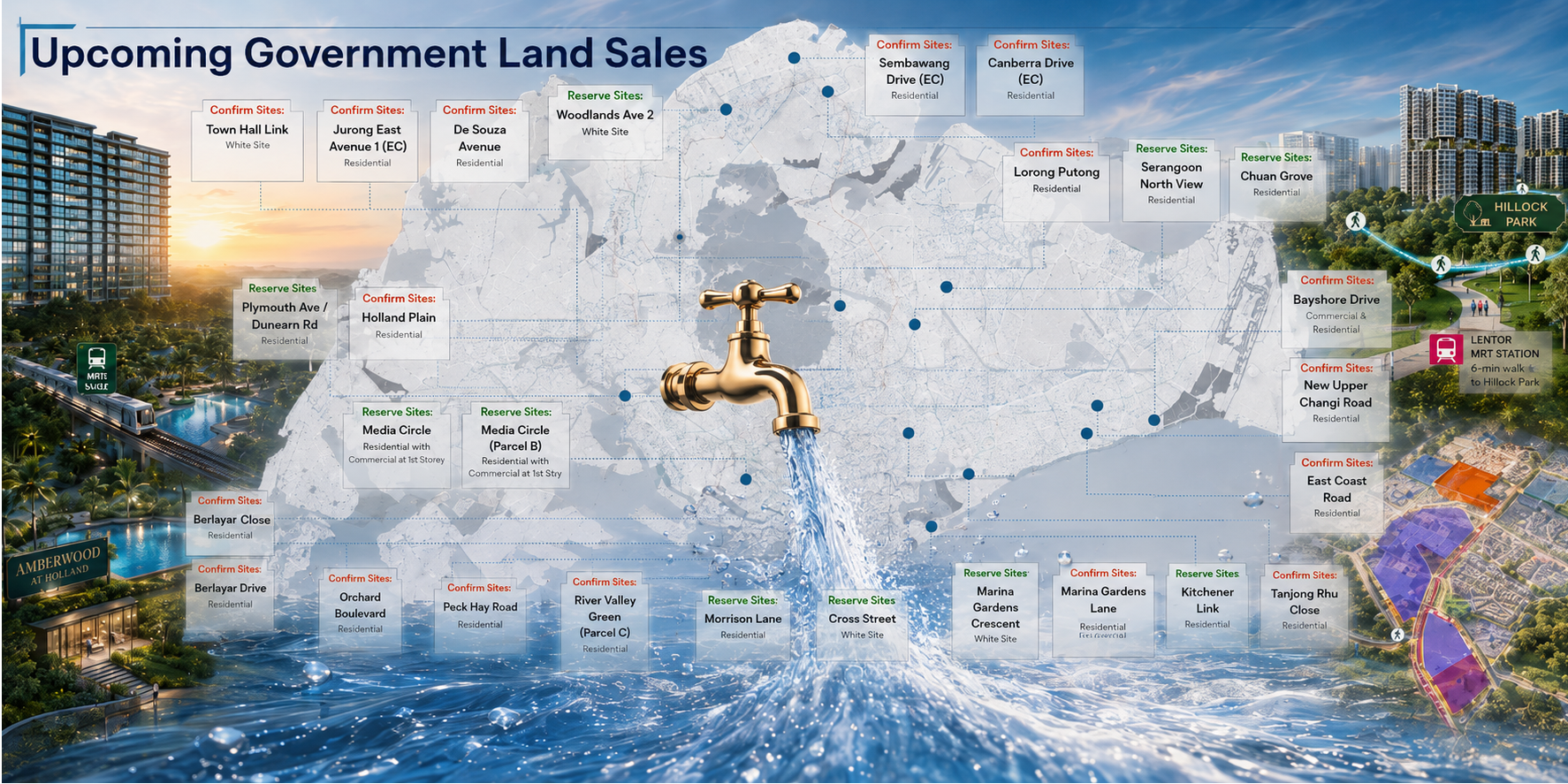
In the same quarter, in the same city, one new launch sold out 100% of its 863 units while another moved just 15% of 20. That gap — between Tengah Garden Residences and Duet @ Emily — is the single most useful thing to understand about the new launch condo market in Singapore as 2026 draws to a close. It is not a story about the market being hot or cold. It is a story about a market that has become extraordinarily selective, where location, tenure, quantum and timing each pull in different directions, and where "average PSF" can flatter or damn a project depending on what you actually get for it.
If you are shopping for new launch condos in Singapore for 2026 and 2027, the pipeline is the fullest it has been in years. But the pricing is also the most fragmented. This guide pulls together the latest launch listings, the indicative developer price bands, and the supply and policy backdrop, so you can compare projects on the four things that actually matter: location, tenure, unit mix and entry quantum.
The Market Backdrop: Prices Up, Volume Down
The first thing to internalise is that headline prices and transaction activity have decoupled.
URA's flash estimates, released on 1 October 2026, showed private residential prices rising 1.4% quarter-on-quarter in Q3 2026, roughly triple the 0.5% recorded in Q2. That acceleration was not broad-based. It was carried almost entirely by two segments.
Private Residential Price Change by Segment, Q3 2026 (% QoQ)
The detail matters:
- Landed property rose 2.8%, building on a 2.5% gain the previous quarter.
- The Outside Central Region (OCR) jumped 2.2%, a sharp reversal from a 0.1% dip in Q2.
- The Rest of Central Region (RCR) managed 0.2%.
- The Core Central Region (CCR) slipped 0.1%.
Cumulatively, private residential prices are up 2.8% in the first nine months of 2026 — marginally ahead of the 2.7% recorded over the same period in 2025. So the market is not booming. It is grinding higher, and the grinding is being done in the suburbs.
Meanwhile, volumes have fallen away. Private residential transactions fell roughly 30% quarter-on-quarter in Q3 2026, with about 4,296 deals recorded as of mid-September. Year-to-date, transactions are down nearly 20% to 15,857 units. A chunk of that was calendar-driven — the Hungry Ghost Festival period traditionally starves the launch calendar — but not all of it.
The contrast with public housing is instructive. HDB resale volume rose 17.7% to 7,528 units by 29 September 2026, even as resale prices dipped a further 0.2% — the third consecutive quarterly decline.
Read that pairing again: private prices up on thin volume, HDB prices down on strong volume. That is the signature of a market where affordability is being stretched at the entry level while capital continues to concentrate in the segment that can absorb higher quantums.
The 2026 Launch Class: Who Sold, Who Stalled
Here is the state of play across the launches already in the market, according to EdgeProp's new launch listings as of October–November 2026.
| Project | District | Tenure | Avg PSF | % Sold | Total Units | Launch |
|---|---|---|---|---|---|---|
| Thomson Reserve | D20 Bishan / Ang Mo Kio | 99 yrs | $2,882 | 91% | 1,268 | Oct-26 |
| The Serra Residences | D11 Novena / Thomson | Freehold | $3,359 | 20% | 133 | Oct-26 |
| Amberwood At Holland | D10 Holland / Tanglin | 99 yrs | $3,015 | 17% | 212 | Sep-26 |
| Lucerne Grand | D22 Jurong | 99 yrs | $2,492 | 73% | 570 | Sep-26 |
| Dunearn House | D11 Novena / Thomson | 99 yrs | $3,110 | 72% | 380 | Jul-26 |
| Lentor Gardens Residences | D26 Upper Thomson | 99 yrs | $2,361 | 67% | 499 | Jul-26 |
| Duet @ Emily | D9 Orchard / River Valley | Freehold | $2,541 | 15% | 20 | Jul-26 |
| Hudson Place Residences | D5 Pasir Panjang | 99 yrs | $2,494 | 74% | 327 | May-26 |
| Vela Bay | D16 Bedok / Upper East Coast | 99 yrs | $2,870 | 76% | 515 | Apr-26 |
| Tengah Garden Residences | D24 Tengah | 99 yrs | $2,104 | 100% | 863 | Apr-26 |
| Pinery Residences | D16 Bedok / Upper East Coast | 99 yrs | $2,551 | 94% | 588 | Mar-26 |
| Rivelle Tampines | D18 Tampines / Pasir Ris | 99 yrs | $1,933 | 97% | 572 | Mar-26 |
| River Modern | D9 Orchard / River Valley | 99 yrs | $3,250 | 95% | 455 | Mar-26 |
The Absorption Divide
Plot those absorption rates and three distinct groups emerge.
The fast movers — Tengah Garden Residences (100%), Rivelle Tampines (97%), River Modern (95%), Pinery Residences (94%), Thomson Reserve (91%) — share one trait: they are large projects that launched with a quantum story. Tengah at $2,104 PSF and Rivelle at $1,933 PSF are the two cheapest entry points in the entire 2026 cohort. Thomson Reserve, at $2,882 PSF, is not cheap on a per-square-foot basis, but it moved 91% of 1,268 units — a genuinely exceptional result that speaks to Bishan/Ang Mo Kio's status as one of Singapore's deepest owner-occupier catchments.
The middle band — Vela Bay (76%), Hudson Place (74%), Lucerne Grand (73%), Dunearn House (72%), Lentor Gardens (67%) — represents the market's steady state. These projects are selling, but they are selling at a pace that requires patience, and developers will be managing remaining stock carefully over the next 12–18 months.
The slow starters — Duet @ Emily (15% of 20 units), Amberwood At Holland (17% of 212), The Serra Residences (20% of 133).
Read Absorption Rates Against Time on Market
This is where most buyers misread the data. The Serra Residences and Amberwood At Holland launched in October and September 2026 respectively. Their 20% and 17% figures reflect roughly one to two months of selling, not a verdict. A 133-unit freehold project in Novena clearing a fifth of its stack in its first month is a perfectly respectable outcome.
By contrast, Duet @ Emily launched in July 2026 — 15% of 20 units means three units sold in about four months. That is a boutique project finding its price. Small freehold developments with 20-odd units are a different asset class: they appeal to a narrow buyer, they often carry larger formats and higher quantums, and their absorption curves are lumpy by nature. They are not a thermometer for the wider market.
PSF Is Not the Same as Price
Look at this chart and then ask yourself whether PSF alone tells you anything useful.
Average PSF of 2026 New Launch Projects
Two anomalies jump out.
First, Duet @ Emily. A freehold project in District 9 at $2,541 PSF sits below 99-year Dunearn House in District 11 at $3,110 PSF and well below The Serra Residences' freehold $3,359 PSF. Freehold in a prime district trading at a discount to leasehold elsewhere is not a bargain signal — it is a product signal. Twenty units on a small site, likely with larger formats, means the quantum is high even if the PSF is not. PSF and cheque size are two different numbers, and developers price to the cheque.
Second, River Modern. A District 9 leasehold project at $3,250 PSF clearing 95% of 455 units demonstrates that prime district demand is alive when the product is right and the launch timing is right. It launched in March 2026, giving it roughly eight months of absorption. Compare that to the CCR's -0.1% quarterly price move and you can see the divergence is not regional — it is project-specific.
The 2027 Pipeline: Smaller, More Diverse, Less Predictable
The forward calendar looks quite different from the 2026 class. Where 2026 brought a wave of large leasehold condominiums, the upcoming pipeline skews toward executive condominiums, landed housing and boutique apartments.
| Project | District | Location | Type | Units | Est. Completion |
|---|---|---|---|---|---|
| Wynwood Grand | D25 Kranji / Woodgrove | Woodlands Drive 17 | Executive Condominium | 430 | 2030 |
| Solano Grand | D23 Hillview / Bukit Panjang | Senja Close | Executive Condominium | 302 | 2030 |
| Luxus Hills, The Estate | D28 Seletar | 98 Luxus Hills Heights | Landed | 156 | 2028 |
| The Island Residence | D4 Telok Blangah / Harbourfront | Keppel Bay Vista | Condominium | 84 | 2030 |
| Stamford Place | D6 High Street / Beach Road | Stamford Road | Apartment | 44 | — |
| Sophia Meadow | D9 Orchard / River Valley | Sophia Road | Apartment | 41 | 2027 |
| USR Junction | D19 Serangoon Garden / Hougang | Upper Serangoon Road | Apartment | 28 | — |
| 87 Marshall | D15 Katong / Joo Chiat | Marshall Road | Apartment | 23 | — |
| Penridge | D24 Lim Chu Kang / Tengah | Tengah Garden Avenue | Condominium | Not stated in listing data | — |
Several things stand out.
The EC window is 2026's most underrated story. Wynwood Grand (430 units) and Solano Grand (302 units) both point to 2030 completions. If they launch in 2027, that is a three-year wait — normal for an EC, but a real commitment. For households under the EC income ceiling who can wait, these are typically the best value-per-square-foot new build on the island.
The boutique segment is having a moment. Stamford Place (44 units), Sophia Meadow (41), USR Junction (28) and 87 Marshall (23) are all sub-50-unit developments. These are projects that will never move a market index, but they appeal to buyers who want a specific address and are willing to trade amenities and scale for it.
The Island Residence is the one to watch. Just 84 units on Keppel Bay Vista in District 4, completing around 2030. Waterfront-adjacent, tiny, and almost certainly targeted at the upper end. Given the scarcity of the site type, expect the PSF to sit well above the district average. Tenure and unit mix are not confirmed in listing data and should be verified.
Landed is back on the menu. Luxus Hills, The Estate offers 156 landed units in Seletar with a 2028 completion — an unusually large landed release, and one that lands right as landed prices are running hottest (up 2.8% in Q3 2026 alone).
What the 2027 Pipeline Does to Pricing
Here is the structural point: most of the 2027 pipeline is small. With the exception of the two ECs, the projects above are in the tens of units, not the hundreds. Small projects do not set district benchmarks — they follow them. That means pricing power in 2027 will be concentrated in whichever large leasehold condominium launches happen to land in the first half of the year, and much of the market will simply take its cue from there.
Comparing Location, Tenure, Unit Mix and Indicative Pricing
Now to the practical part: how do you actually compare these projects?
Location: A Three-Tier PSF Map
Sorting the 2026 cohort by district tier reveals a much wider spread than the headline averages suggest.
| Tier | Representative Projects | PSF Range | Observation |
|---|---|---|---|
| Outer (OCR) | Rivelle Tampines, Tengah Garden Residences, Lentor Gardens Residences | $1,933 – $2,361 | The volume engine of the market |
| Mid-outer (OCR) | Lucerne Grand, Hudson Place Residences, Pinery Residences, Vela Bay, Thomson Reserve | $2,492 – $2,882 | Wide dispersion within a single tier |
| City fringe (RCR) | Dunearn House, The Serra Residences | $3,110 – $3,359 | Freehold commands the top of this band |
| Core (CCR) | Duet @ Emily, River Modern | $2,541 – $3,250 | Product-driven, not district-driven |
The lesson is that district tier explains less than it used to. Hudson Place Residences in District 5 (Pasir Panjang) at $2,494 PSF trades within $2 of Lucerne Grand in District 22 (Jurong) at $2,492 PSF. You are no longer paying a simple radial premium from the CBD — you are paying for MRT proximity, school catchments, and the specific character of the development.
Tenure: Freehold Is Not Automatically a Premium
Only two projects in the 2026 launch class are freehold: The Serra Residences and Duet @ Emily. Everything else is 99-year leasehold. The cleanest comparison is within District 11:
- The Serra Residences (freehold): $3,359 PSF
- Dunearn House (99-year): $3,110 PSF
That is roughly an 8% freehold premium for projects in the same district neighbourhood. That is a reasonable number to hold in your head, and it is far lower than the 15–20% premiums often assumed.
But Duet @ Emily blows up the rule entirely: a freehold District 9 project at $2,541 PSF, below both. The explanation is almost certainly format and site scale rather than a market verdict. A 20-unit project loses out on facilities, has a smaller buyer pool, and may carry a different unit size profile that pushes total quantum up even as PSF comes down.
Practical takeaway: do not buy freehold for its own sake. Buy freehold if you intend to hold beyond 20–25 years, are sensitive to lease decay, or value the scarcity narrative at resale. For a 10-year horizon, a well-located 99-year project with superior access and amenities will usually out-return a poorly located freehold one.
Unit Mix and Entry Quantum
The indicative developer pricing across the 2026–2027 pipeline follows a fairly consistent ladder:
| Unit Type | Indicative Starting Price | Approx. Size at $2,000 PSF | Approx. Size at $2,800 PSF |
|---|---|---|---|
| 2-bedroom | from ~S$1.3 million | ~650 sqft | ~465 sqft |
| 3-bedroom | from ~S$1.8 million | ~900 sqft | ~640 sqft |
| 4-bedroom | from ~S$2.3 million | ~1,150 sqft | ~820 sqft |
| 5-bedroom | from ~S$2.8 million | ~1,400 sqft | ~1,000 sqft |
(Source: indicative ranges reported for 2026 new launches; sizes are illustrative arithmetic at the bottom of the range, not published project data.)
This table is the single most clarifying tool in the entire article, because it explains the absorption patterns above.
- At $1,933 PSF (Rivelle Tampines), a 3-bedroom at $1.8 million buys roughly 930 sqft — a family-sized flat at an affordable cheque. That is why it sold 97% of 572 units.
- At $3,359 PSF (The Serra Residences), the same $1.8 million buys roughly 536 sqft — functionally a compact two-bedder. The cheque is the same; the product is not.
This is what "quantum compression" looks like in practice. As PSF rises, developers shrink formats to keep the entry cheque palatable. The result is that the same budget buys dramatically different amounts of space depending on district, and that is before you account for the fact that unit mix schedules vary widely between projects.
Before shortlisting anything, ask for the full unit mix schedule — how many of each bedroom type, what the size bands are, and how many of the smallest format are stacked in a single stack. A project with 200 two-bedders and 50 three-bedders behaves very differently at resale than one with a balanced mix.
Indicative Versus Actual Developer Pricing
One caution. The figures above and in the launch table are average PSFs and indicative starting prices, not direct developer price lists. Actual pricing at launch typically includes:
- Early-bird or star-buy discounts on selected stacks, often 3–8% off the list price
- Progressive payment schemes for buyers who qualify, which change the cash-flow profile substantially
- Reimbursement or absorption arrangements on stamp duty for selected units
- Price increases after each sales tranche — a project that opened at $2,400 PSF may be transacting at $2,650 PSF by its fourth tranche
This is precisely why two projects with similar "average PSF" can offer very different value depending on when you buy into them. The published average blends early and late tranches together.
Supply, Completions and the Oversupply Question
Every new launch conversation eventually reaches the same worry: are we building too much?
The numbers say: not yet.
- Private residential completions are projected at 6,623 units in 2026 (excluding ECs), an 8.2% increase.
- In 2027, completions are projected to rise a further 27.4% to 8,440 units.
That sounds like a wave. But look at the other side of the ledger.
Projected Private Residential Completions, Excluding ECs
Unsold inventory with planning approval fell 7.2% quarter-on-quarter to 15,057 units at the end of Q2 2026. According to market analysis, that is roughly 45% below the historical average since 2008.
In other words, the increase in completions in 2027 is arriving into a pipeline that has been drained, not one that is overflowing. Developers have been selling faster than they have been replenishing land bank. The 2027 supply bump is more accurately described as restocking than as a glut.
That said, there is a second-order effect worth watching. Completions are the primary driver of rental supply. A 27% jump in completions in 2027 will add meaningfully to the rental stock in the districts where those projects sit — and rental yields were already at around 3.06% gross in Q2 2026. Landlords in high-completion districts (Tengah, Tampines, Bedok, Jurong) should expect competition.
Policy and Cost: What's Shaping the Buying Decision
Three policy levers matter most for anyone buying a new launch in 2026–2027.
1. Additional Buyer's Stamp Duty
| Buyer Profile | ABSD Rate |
|---|---|
| Singapore Citizen, 2nd residential property | 20% |
| Singapore Citizen, 3rd and subsequent | 30% |
| Permanent Resident, 1st residential property | 5% |
(Rates in force since 27 April 2023.)
For a young Singaporean couple buying their first home, ABSD is a non-issue — but it becomes decisive the moment you consider keeping the HDB flat and buying a condo. On a $1.8 million unit, a 20% ABSD is $360,000 in cash or CPF. That single number reshapes most upgrade decisions, and it is why so many buyers in the 25–40 bracket end up selling the flat to buy the condo rather than holding both.
2. The Developer Deadline
Developers are bound by a 5.5-year deadline to complete and sell their units, with penalties for non-compliance. This is the single best explanation for developer pricing behaviour in Singapore: they are not price-takers, but they are time-constrained. Projects approaching their deadline become materially more negotiable. Projects in their first tranche are not.
3. The HDB Waiting Period Change
A significant shift: the 15-month waiting period for private property owners buying non-subsidised HDB resale flats has been removed. Analysts expect this to subtly influence demand in the HDB resale segment — and, by extension, to make the downgrade path from private to public housing smoother. If you are considering a "sell condo, buy resale flat" exit in later life, this changes the sequencing.
Financing Costs
The Singapore Overnight Rate Average has rebounded to 1.39%. That is still low by historical standards, and household balance sheets are strong: aggregate resident household net worth stood at S$3.34 trillion as of 31 March 2026, up 67.5% from pre-pandemic levels. Most buyers can absorb current borrowing costs — but stress-test at least 2 percentage points above your quoted rate before committing to a 25-year loan on a $2 million unit.
What to Expect in 2027
Pulling the forecast data together:
- Private residential price growth of 1% to 3% in 2027, with some analyses pointing to an annual increase of around 2.6%.
- The Residential Property Price Index trending around 241.00 points in 2027 and 250.00 points in 2028.
- Market size expanding from an estimated USD 56.15 billion in 2026 to USD 70.4 billion by 2031, a CAGR of 4.63%.
- GDP growth of 4.5% to 5.5% in 2026, per the Ministry of Trade and Industry's upgraded forecast, driven by AI-related exports and technology demand.
The picture that emerges is moderate, supply-supported, and highly project-specific. There is no crash signal in the data, and there is no boom signal either. What there is, is a market that will reward buyers who do the arithmetic on quantum rather than getting anchored on PSF.
Three things to watch through 2027:
- The first-half launch calendar. If two or three large leasehold condominiums land in D18, D20 or D23 in the first half, they will set the reference price for everything else that year.
- EC pricing. Wynwood Grand and Solano Grand will tell us whether the EC-condo price gap is widening or narrowing. A narrowing gap pushes more buyers into ECs and cools mass-market condo demand.
- Rental softness in completion-heavy districts. A 27% rise in completions has to go somewhere. Watch D24, D18, D16 and D22 rental listings in the second half of 2027.
Food for Thought
1. If the same $1.8 million buys 930 sqft in Tampines and 536 sqft in Novena, what exactly are you paying the premium for — and is that premium resaleable? Location premiums are real, but they are also the first thing that compresses in a downturn. Space is a use-value you enjoy every day; a district name is a story you sell later.
2. The 2026 launch cohort is almost entirely 99-year leasehold. Where does that leave the freehold scarcity argument? If freehold supply is genuinely constrained, the premium should widen over time. If it is simply a marketing narrative applied to small, illiquid sites, it will not. Watch resale spreads between The Serra Residences and Dunearn House over the next five years — that will be the cleanest natural experiment in the market.
3. When a developer is bound by a 5.5-year completion and sale deadline, who actually holds the negotiating power at year three? Buyers who understand this deadline have historically found the best entry points in the fourth and fifth years of a project's life, not at launch. The trade-off is that you lose the best stacks and the earliest price tranches.
4. The HDB resale market is softening on rising volume while private prices firm on falling volume. What happens when the two curves cross? If HDB resale values keep drifting down, the upgrade quantum to a mass-market condo widens — which could cool OCR demand, or push more buyers toward ECs. Neither outcome is priced in yet.
5. Unsold inventory is 45% below its post-2008 average while completions are rising. Is the market genuinely undersupplied, or is the "unsold" metric simply lagging a wave of projects still in planning? The distinction matters enormously for anyone buying a 2030-completion unit today. Planning approvals can be granted quickly; concrete cannot be poured quickly.
Conclusion
The 2026–2027 new launch market is not a market you can navigate on vibes. Prices are up 2.8% year-to-date, volumes are down 20%, and absorption rates range from 100% to 15% within the same six-month window. The difference between a good buy and a bad one is no longer district or tenure alone — it is the interplay of entry quantum, unit format, launch timing and the developer's own deadline pressure.
For buyers in the 25–40 bracket, that argues for a disciplined process: fix your loan ceiling first, work out what quantum that supports, then compare projects on PSF and size and remaining stock and months since launch. A project at 17% sold two months in is a different proposition from one at 17% sold six months in — and a $2,541 PSF freehold in District 9 may cost you more per unit than a $3,110 PSF leasehold in District 11.