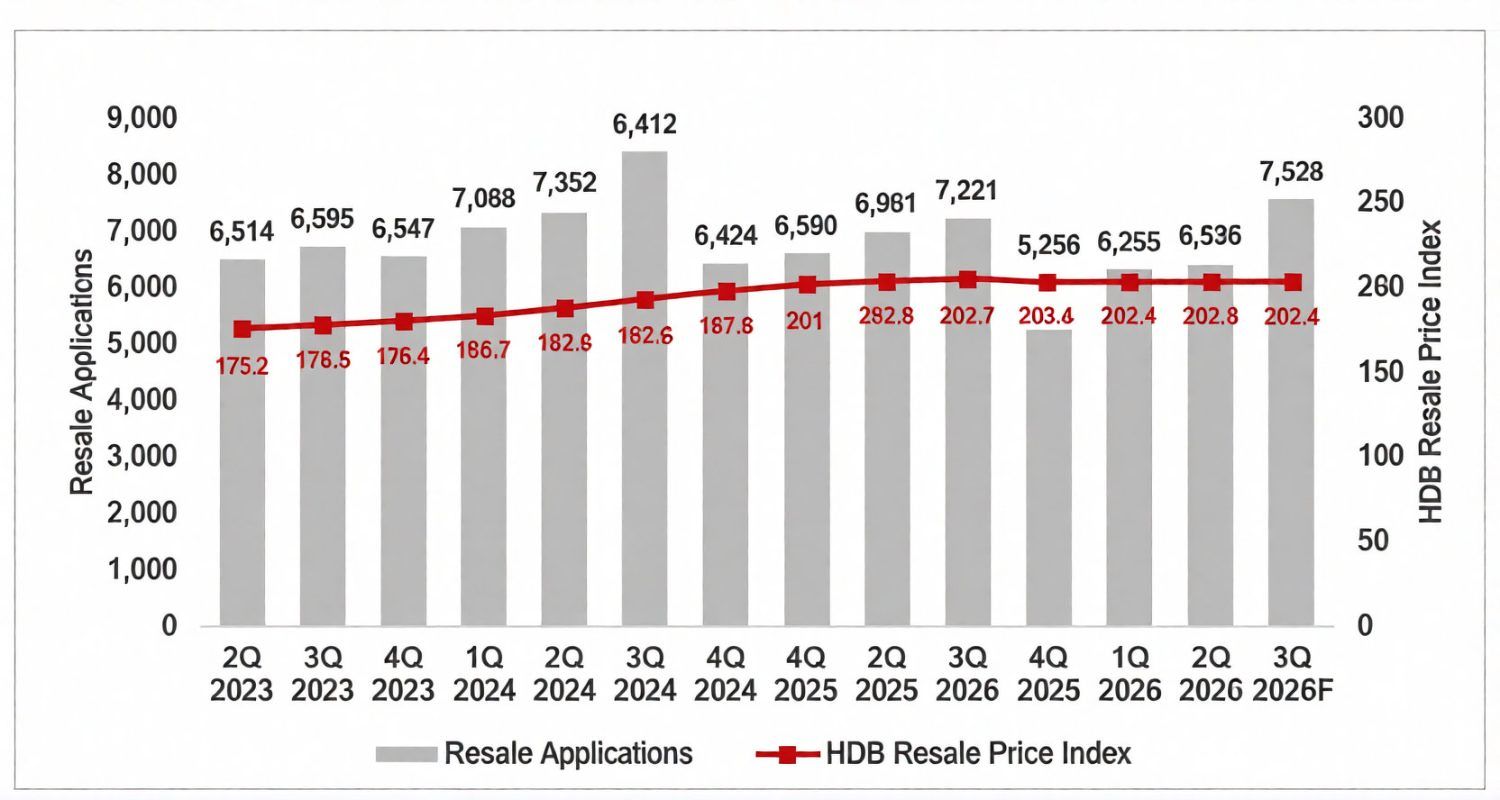
On 1 October 2026, HDB's flash estimates landed with a headline that reads like a contradiction in terms: HDB resale prices dipped 0.2% in Q3 2026 — the third consecutive quarterly decline — even as resale transaction volume climbed sharply, with one read of the numbers putting the quarter-on-quarter jump in deal volume at 17.7%. Prices down, activity up. For anyone who has spent the last few years watching the resale market grind relentlessly higher, that combination looks strange. It shouldn't.
A softening price index paired with a surging transaction count is not a glitch. It is what a market looks like when supply finally catches up with demand at the same moment that a policy gate opens. Roughly 13,480 flats are estimated to have reached their Minimum Occupation Period (MOP) across 2026. The 15-month wait-out period for private property owners buying HDB resale flats was lifted on 28 July 2026. And in August, the Prime Minister announced a raise in the BTO income ceiling. Three separate levers, pulled in three different directions, all landing in the same quarter.
Here is what actually happened — and what it means if you are buying or selling in the next six to twelve months.
The Numbers Behind the Headline
Start with the price index. The moderation did not begin in Q3; Q3 is simply the third instalment.
| Quarter | HDB Resale Price Index change (q-o-q) | Context |
|---|---|---|
| Q1 2026 | −0.1% | First quarterly decline in roughly seven years |
| Q2 2026 | −0.3% | Steepest fall of the current run |
| Q3 2026 (flash) | −0.2% | Third straight decline |
HDB Resale Price Index: Quarterly Change, 2026
Three quarters of decline sounds dramatic until you add up the damage: roughly −0.6% cumulatively. Against a run-up of approximately 55.0% since the Q2 2019 trough, the entire correction so far has given back somewhere in the region of one per cent of the prior gains. This is not a crash, a correction, or even a meaningful repricing. It is a market that has stopped sprinting and started walking.
Now the volume side.
| Period | Resale transactions | Change |
|---|---|---|
| Q3 2025 | 7,157 | — |
| Q3 2026 | 7,528 | +371 (+5.2%) |
HDB Resale Transactions: Q3 2025 vs Q3 2026
The two volume figures circulating — +5.2% year-on-year and +17.7% quarter-on-quarter — are both correct and both tell you something. The year-on-year comparison is the more honest measure of underlying demand: 7,528 flats changed hands, a solid if unspectacular quarter. The quarter-on-quarter number is larger because Q2 2026 was itself a soft quarter, and because the wait-out period was lifted mid-way through Q3, compressing a wave of newly eligible buyers into roughly nine weeks of transaction activity.
The key takeaway: this is a volume-led market, not a price-led one. Buyers are showing up. They are simply no longer willing — or able — to bid prices up.
Why HDB Resale Prices Fell While Transactions Surged
Three forces converged on Q3 2026. Understanding how they interact explains the entire puzzle.
Supply: the MOP wave
The single most underrated number in the Q3 story is 13,480 — the estimated count of HDB flats reaching MOP during 2026. Eugene Lim, Key Executive Officer of ERA Singapore, has pointed squarely at this: demand may be rising, but supply is rising alongside it, and that is what keeps a lid on prices. A flat that has just completed MOP is a flat whose owner can now sell. Multiply that by five figures in a single calendar year and you have a structurally more competitive resale market than Singapore has seen in most of the last decade.
This matters because MOP supply is concentrated by design. Flats built in the same BTO project complete MOP in the same window, in the same town, with the same floor plans and often the same facing. Sellers in these clusters are not competing against the market in the abstract — they are competing against their own neighbours, down the same corridor, listing near-identical units in the same month. That is a recipe for price discipline.
Policy: the wait-out period ends
On 28 July 2026, the 15-month wait-out period for private property owners purchasing HDB resale flats was lifted. The measure had been introduced as a cooling tool; removing it re-opened a pool of well-capitalised buyers who had previously been locked out of the resale market for over a year after selling their private homes.
That pool shows up immediately in the transaction count — and much less so in the price index. HDB has stated that it has not observed a significant increase in either prices or the number of resale flats purchased by private property downgraders following the lifting. That is a striking admission, and it is the crux of the quarter: the extra demand was real, but it was absorbed by the extra supply rather than bidding prices higher.
Christine Sun, Chief Researcher and Strategist at Realion (OrangeTee & ETC) Group, has cautioned that the full effect may not yet be visible in the data at all, because resale transactions take time to complete. In other words, part of the downgrader wave is still in the pipeline. Watch Q4 2026 and Q1 2027 for the truer picture.
Demand diverted: the BTO income ceiling
In August 2026, Prime Minister Lawrence Wong announced that the BTO income ceiling would rise from $14,000 to $16,000 for families and from $7,000 to $8,000 for singles, widening access to subsidised public housing.
For the resale market, this is a quiet demand siphon. Households earning between the old and new ceilings — previously shut out of BTO and therefore forced into resale — now have a subsidised option. BTO flats come with grants, a fresh 99-year lease, and a known price. Every household that shifts from resale to BTO is one fewer bidder in the resale market. The effect is not enormous in a single quarter, but it operates precisely on the income band that drives resale demand for mid-priced four-room flats in non-mature estates.
Which Flat Types Are Moving
Not all segments responded equally. The divergence is where the interesting signals live.
The mass market: four-room flats do the volume
Four-room flats remain the workhorse of the resale market — the configuration most first-time resale buyers can actually afford, and the one that dominates MOP supply. With more of them available, buyers gained negotiating room, and Cash Over Valuation (COV) expectations began to compress. This is the segment where the price dip is most visible and where a buyer's bargaining power has improved most.
The premium segment: five-room and larger
Here the story inverts. Million-dollar HDB transactions hit a new quarterly high of 597 in Q3 2026, up from 491 in Q2, bringing the cumulative count for the first nine months of 2026 to 1,499.
| Million-dollar segment | Q2 2026 | Q3 2026 |
|---|---|---|
| Total million-dollar resale deals | 491 | 597 |
| Of which five-room and larger | 277 | 353 |
| Share of all resale transactions | 7.7% (up from 6.5% in Q1) | approx. 7.9% of 7,528 deals |
Million-Dollar HDB Resale Transactions
The jump in five-room and larger units — 277 to 353 in a single quarter — is the tell. Lee Sze Teck, Senior Director of Data Analytics at Huttons Asia, attributes this to private home downgraders. It is a coherent story: a household selling a condominium and buying a large flat in a mature estate is not shopping on price per square foot alone. They are shopping on absolute quantum, on location, and on size. They can clear a million dollars without flinching, and they are competing for a thin slice of stock.
Leonard Tay, Research Head at Knight Frank Singapore, extends the same logic to retirees in landed property, who may now be incentivised to right-size into a large HDB flat without the 15-month delay.
The result is a genuinely two-speed market. Ordinary four-room flats in non-mature estates are seeing softer prices and more choice. Large flats in mature estates are seeing bidding contests. Treating "the HDB resale market" as a single entity in Q3 2026 will lead you to the wrong conclusion about your own situation.
Which Towns Are Moving
Geography explains almost as much as flat type.
Where the volume is
In Q2 2026, five towns — Jurong West, Punggol, Sengkang, Tampines and Woodlands — collectively accounted for 35.7% of all resale transactions. That is more than a third of the entire market in five non-mature or suburban estates.
| Town cluster | Role in the market |
|---|---|
| Jurong West, Punggol, Sengkang, Tampines, Woodlands | Volume engines — 35.7% of resale transactions in Q2 2026 |
| Toa Payoh, Queenstown, Bukit Merah | Premium engines — top towns for million-dollar deals in Q3 2026 |
| Central Area, Queenstown, Toa Payoh | Recorded million-dollar median resale prices in Q2 2026, all in the four-room category |
That second row is worth pausing on. It is one thing for a five-room flat in Toa Payoh to cross a million dollars. It is another for an entire town's median four-room resale price to do so. When the median crosses, the premium is no longer an outlier — it is the market.
Where the price level sits
Regionally, price per square foot in 2025 illustrates how wide Singapore's spread has become.
Average HDB Resale Price by Region (2025, $PSF)
The central region at $736 psf commands a 35% premium over the west at $544 psf. That gap is the market's price for MRT connectivity, established amenities, mature town centres and — crucially — scarcity of resale stock. It also explains why the million-dollar concentration sits where it does.
For a buyer weighing options, the practical read is this: the softening is happening in the volume towns, and the firmness is happening in the premium towns. If you are shopping in Jurong West or Sengkang, you have leverage. If you are shopping in Toa Payoh or Bukit Merah, you have competition.
The Wider Divergence: HDB vs Private
One of the more notable features of Singapore's mid-2026 property market is that HDB resale prices and private property prices have been moving in opposite directions. Private prices have been edging up while the HDB resale index retreats.
This has practical consequences for a specific and growing group: upgraders. A household sitting on an HDB flat that is no longer appreciating strongly, while private prices rise, faces a widening affordability gap — the classic "sell low, buy high" squeeze. Conversely, downgraders from private property into resale HDB are enjoying exactly the opposite trade, which is almost certainly part of why the million-dollar five-room segment is running hot.
There is a second divergence worth watching. Marcus Chu, Chief Executive of ERA Singapore, expects the private market to pick up in Q4 2026 on the back of new condominium launches. If that happens, the en-bloc and downgrader pipeline into HDB resale could thicken further — again pushing volume rather than price, so long as MOP supply holds up.
What It Means for HDB Resale Buyers
If you are buying, Q3 2026 gave you something you have not had in years: time.
- You have more stock to look at. The 13,480 MOP completions across 2026 are not a forecast — they are flats whose owners can now list. Choice is leverage.
- COV expectations are softening. Three consecutive quarters of index decline changes the psychology of a negotiation. Sellers who priced on 2024 assumptions are now the ones whose flats sit unsold.
- Do not expect a discount in premium towns. Toa Payoh, Queenstown and Bukit Merah are still clearing at record volumes above a million dollars. The national index decline tells you almost nothing about a specific five-room flat opposite an MRT interchange.
- Run the numbers on BTO first if you can wait. With the income ceiling now at $16,000 for families, more households qualify than ever. The trade-off between three to four years of waiting and a guaranteed new flat is worth costing out properly.
- Remember grants exist. Resale grants for eligible first-timers materially change the affordability equation, and they are frequently ignored in the excitement of viewing flats.
The honest framing: this is a balanced market, not a buyer's market. Prices are flat, not falling meaningfully. Supply is better, not abundant. If you are waiting for a 10% correction before you buy, the index suggests you may be waiting a long while.
What It Means for HDB Resale Sellers
Sellers face the harder adjustment, because the market has changed under them and the change is psychological rather than numerical.
- Price realistically, and price early. In a flat market, the first two weeks of a listing do most of the work. Overpricing at launch and cutting later costs you more than pricing correctly at the start.
- Avoid stretching for COV. The era of buyers routinely paying significant cash over valuation is decelerating. An aggressive ask in a town with heavy MOP supply simply routes buyers to the unit two floors down.
- Your flat type matters more than the national index. Large flats in mature estates are in a different market from four-room flats in non-mature estates, and should be priced accordingly.
- MOP clusters are your real competition. If you are selling in a project where dozens of neighbours completed MOP at the same time, differentiate on condition, renovation, floor, facing and view — not on price hope.
- The downgrader buyer is real, and worth targeting. Larger flats in well-located estates are attracting private-property sellers who value quantum and location. Present your flat for that buyer.
Eugene Lim's read on the softening is worth taking seriously rather than treating as spin: further price moderation, whether through slower growth or a series of gentle corrections, could pave the way for a more sustainable HDB market in the longer run. A market that rises 55% in seven years and then flattens is healthier than one that keeps climbing until it breaks.
The Policy Backdrop
The regulatory calendar in 2026 was unusually active, and the sequencing mattered.
Both HDB and the Urban Redevelopment Authority have continued to emphasise that the macroeconomic outlook remains highly uncertain, and have advised households to exercise prudence when purchasing property and taking on mortgage loans. That is standard language, but it is not empty. The current moderation is happening against a backdrop of softer hiring conditions — and a housing market supported by strong employment can turn quickly if employment weakens.
The government has also reiterated its commitment to monitoring the market and adjusting policy as needed. Given how quickly the wait-out period removal moved the volume needle, that monitoring is worth watching closely. Any further recalibration — on grants, on loan limits, on supply — would land on a market that is already digesting three simultaneous changes.
Food for Thought
1. If supply is the real story, what happens when the MOP wave recedes? Roughly 13,480 flats reached MOP across 2026. That pipeline is not infinite. When the volume of newly eligible resale stock thins out — and it will — does the price index resume climbing, with all the affordability pressure that implies? Or has demand permanently reset?
2. Is a flat price index actually useful to an individual buyer? The national index fell 0.2%. Median four-room resale prices in three towns are at or above a million dollars. Which number describes your decision? How should buyers and sellers weight a national average against the specific town, block, flat type and lease balance they are actually dealing with?
3. Why is HDB softening while private property firms up — and who pays for that gap? Upgraders sell into a flat market and buy into a rising one. Is the current divergence a temporary dislocation, or a structural feature of a market where public and private housing are increasingly decoupled?
4. Did the wait-out period removal do what it was supposed to do? Volume surged. Prices did not. HDB says it has not seen a significant increase in downgrader purchases. If the policy's goal was liquidity without inflation, that is arguably a success — but is it too early to tell, given the lag in transaction completions that analysts have flagged?
5. What does "sustainable" actually mean for a household balance sheet? A flat HDB resale market is good for affordability and bad for anyone counting on their flat as an appreciating asset. Where does the balance sit for a 30-year-old buying their first resale flat today with a 25-year loan?
The Bottom Line
Q3 2026 was not a turning point. It was the third instalment of a slow, orderly recalibration that began in Q1 — one in which prices have given back roughly 0.6% of a 55% run-up, and in which transactions have kept flowing because supply, policy and demand all loosened at once.
The practical read for anyone in the market: stop watching the index and start watching your segment. Four-room flats in Jurong West and Sengkang are in a different market from five-room flats in Toa Payoh. The first is softening and negotiable. The second is still setting records. Confusing the two is how buyers overpay and sellers languish.