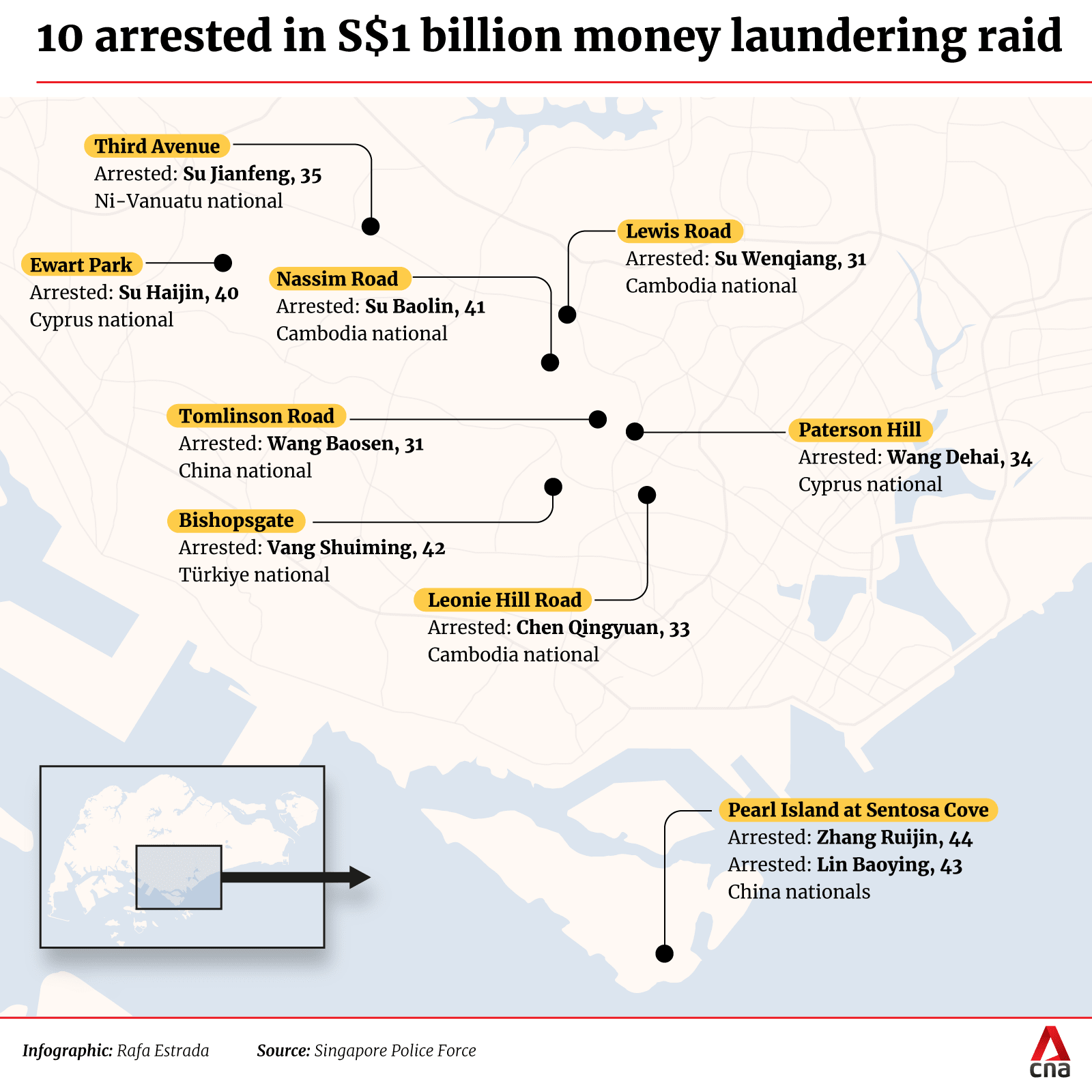
The asset list from Singapore's largest money-laundering probe reads less like a court document and more like a luxury catalogue: more than 80 properties, a fleet of supercars, rare Hermès handbags, high-end watches, and an ornate crystal grand piano. But behind the glamour is a far more sober story — one about how illicit money tries to find a respectable resting place, and why anti-money laundering checks in Singapore property have moved from back-office box-ticking to front-and-centre scrutiny.
For a generation of Singaporeans aged 25 to 40 who are either hunting for a first home, upgrading to a condo, or watching the resale market with a mixture of hope and dread, the Wang Shuiming case might feel remote. It isn't. The compliance architecture built in its wake shapes how long your transaction takes, what documents your agent will ask you for, and — in some segments — how prices behave. This piece unpacks the case as a news hook, then walks through how the checks actually work, who enforces them, and why buyers and agents should take them seriously. Nothing here prejudges any legal outcome; the case is used only as context for the system it helped reshape.
Background: The Case That Reset the Conversation
What happened
In 2023, Singapore authorities uncovered a sprawling network of individuals allegedly laundering proceeds derived from illicit online gambling and other criminal enterprises. The operation became widely known as the S$3 billion money laundering case — the largest in Singapore's history. Wang Shuiming emerged as a pivotal figure within that network.
According to reporting by CNA Insider, Wang received a sentence of 13 months and six weeks, ultimately serving approximately 9.5 months. His account of how he accumulated his wealth — property investments and casino winnings in the Philippines — was met with forgery charges. The state's recovery efforts yielded approximately S$199 million in assets linked to him, his wife, and their associated companies.
The scale of recovery
To put that in context:
| Metric | Figure |
|---|---|
| Overall case value (widely reported) | ~S$3 billion |
| Total assets recovered across the case | ~S$2.8 billion |
| Assets linked to Wang Shuiming, his wife and companies | ~S$199 million |
| Sentence handed to Wang Shuiming | 13 months and 6 weeks |
| Time reportedly served | ~9.5 months |
| Properties seized across the case | More than 80 |
Recovered Assets: Wang Shuiming-Linked vs Rest of Case (S$ million)
The chart above makes the proportions plain: Wang's linked assets were a meaningful slice, but the broader network accounted for the overwhelming majority of recovered value.
Why property was central
Property is the classic vehicle for laundering because it is large-ticket, relatively stable, and — crucially — it converts "dirty" cash into an asset with an apparently legitimatepaper trail. A bank account holding unexplained millions is a red flag; a condominium held through a company is, superficially, just real estate.
The aftermath offered a live experiment in market appetite. Auctions of seized luxury properties produced a mixed reception, with several high-value units failing to attract buyers. That is a signal worth noting: Singapore's buyer pool is not indifferent to provenance. Assets tainted by scandal can carry a discount — or simply sit unsold.
How Anti-Money Laundering Checks Actually Work in a Property Deal
If you have bought or sold property in Singapore in the last two years, you have already touched this system — perhaps without realising how structured it is. The framework rests on four pillars: Customer Due Diligence (CDD), Enhanced Due Diligence (EDD), Source of Funds / Source of Wealth (SOF/SOW) verification, and Suspicious Transaction Reporting (STR).
Pillar 1: Customer Due Diligence (CDD)
CDD is the identity and context layer. Real estate agents and developers are legally required to conduct it before engaging in business with a purchaser — or whenever they suspect a purchaser is involved in money laundering or terrorism financing, or has provided fake or inadequate information.
For an individual buyer, this typically means collecting:
- Full name and any aliases
- Date of birth
- Nationality and tax residency
- Identification number (NRIC or passport)
- Occupation
- Contact details and residential address
For a corporate purchaser, the net widens considerably:
- Incorporation details and jurisdiction
- Nature of business
- Ownership and control structure
- Identity of the beneficial owner — the human being who ultimately benefits
Records must be properly maintained for at least five years after the business relationship ceases. This is not an administrative nicety; it is the evidentiary backbone of the entire regime.
Pillar 2: Enhanced Due Diligence (EDD)
Not every buyer is treated identically — and that is by design, not discrimination. EDD kicks in for higher-risk clients or transactions. The classic triggers include:
- Politically exposed persons (PEPs) — individuals entrusted with prominent public functions, and their close associates and family members
- Buyers connected to high-risk jurisdictions
- Complex ownership structures that obscure the beneficial owner
- Transactions where the funding story doesn't hold together
- Unusual urgency, unusual payment methods, or unusual intermediaries
Under EDD, the institution must establish not just identity but the definitive identity of the ultimate purchaser, and — critically — their source of wealth and source of funds. This is where most of the friction in a high-value deal actually arises.
Pillar 3: Source of Funds and Source of Wealth
These two terms are often used interchangeably in casual conversation. They shouldn't be.
| Concept | What it asks | Typical evidence |
|---|---|---|
| Source of Funds (SOF) | Where did the money for this specific purchase come from? | Bank statements, sale proceeds of another asset, approved loan facility, dividends, documented gift or inheritance |
| Source of Wealth (SOW) | How did you accumulate your overall wealth? | Financial statements, employment records, business documentation, professional references |
The consistent theme, as practitioners put it, is a documented, unbroken chain. Each tranche of money should be traceable to a legitimate, evidenced origin. Cash of unclear provenance, or funds routed through accounts that cannot be explained, is precisely what stalls a deal.
Buyers should anticipate providing:
- Identity and residency documents — passport or NRIC, proof of address, confirmation of tax residency
- Source of purchase funds — bank statements showing the funds, plus records tracing their provenance: proceeds from selling another property, business income or dividends, a documented inheritance or gift, or an approved loan
- Source of wealth narrative — for larger or higher-risk transactions, this can extend to financial statements, employment history, business records, or professional references
Pillar 4: Suspicious Transaction Reporting (STR)
This is the sharp end of the framework. Real estate professionals are legally obligated to report any knowledge or suspicion — arising in the course of their professional activities — that property or a transaction may be linked to criminal conduct. Reports go to the Suspicious Transaction Reporting Office (STRO) within the Commercial Affairs Department.
Two features matter enormously:
- Confidentiality protection: the identity of the filer is safeguarded by law. An agent who files an STR is not expected to announce it to the client.
- Criminal liability for failure: not filing when reasonable grounds for suspicion exist is a criminal offence under the Corruption, Drug Trafficking and Other Serious Crimes (Confiscation of Benefits) Act (CDSA), carrying substantial penalties.
Note what an STR is not. It is not an accusation, and it is not a finding of guilt. It is a disclosure of suspicion to the authorities, who then decide what — if anything — to do. A transaction that generates an STR may well turn out to be entirely legitimate. The system is designed to surface patterns, not to convict individuals at the counter.
Who Enforces What: URA, CEA and STRO
Singapore's AML regime for property is not a single rulebook. It is a layered structure with different regulators owning different parts of the value chain. Understanding the division helps explain why your agent and your developer may ask for different things.
The Council for Estate Agencies (CEA)
CEA governs estate agents (EAs) and salespersons (RESs) under the Estate Agents (Prevention of Money Laundering, Proliferation Financing and Terrorism Financing) Regulations 2021. The obligations run in two directions:
On the agency side (EA):
- Conduct a firm-wide risk assessment
- Implement internal policies, procedures and controls (IPPCs)
- Appoint a Compliance Officer
- Provide continuous training to salespersons
On the individual side (RES):
- Conduct CDD on clients
- Conduct Unrepresented Counterparty Due Diligence (UCPDD) on parties not represented by an agent
- Screen against sanctions lists
- Report suspicions upward to the EA for STR filing
That UCPDD requirement is easy to overlook but important: if you are buying directly from a seller with no agent on the other side, your own agent still has a duty to look at who that counterparty is.
The Urban Redevelopment Authority (URA)
URA regulates housing developers. Through Circular COH25-01, effective 1 July 2025, developers of projects with more than four units carry enhanced AML/CFT obligations. These include:
- Performing customer due diligence
- Screening for politically exposed persons
- Refraining from proceeding with a transaction they suspect would facilitate money laundering
The Anti-Money Laundering and Other Matters (Estate Agents and Developers) Act 2025 further cements these requirements in statute, tightening the legislative footing beneath the circular.
The practical effect for a new launch buyer is straightforward: the showflat experience now includes a compliance layer. Booking a unit is no longer just a cheque and an option form.
STRO and the Commercial Affairs Department
STRO sits within CAD and functions as Singapore's financial intelligence unit. It receives STRs, analyses them, and disseminates intelligence to law enforcement agencies. It does not approve or reject property transactions — that is not its role — but it is the node through which suspicion becomes actionable intelligence.
Penalties at a glance
| Party | Regulator | Key obligation | Illustrative penalty exposure |
|---|---|---|---|
| Salesperson (RES) | CEA | CDD, UCPDD, sanctions screening, escalate suspicions | Disciplinary action, suspension or revocation of registration |
| Estate agent (EA) | CEA | Risk assessment, IPPCs, Compliance Officer, training, STR filing | Fines, licence action, reputational damage |
| Housing developer | URA | CDD, PEP screening, refrain from suspicious transactions | Fines reported at up to S$100,000 |
| Any person with suspicion | STRO / CAD | File STR where reasonable grounds exist | Criminal offence under CDSA |
What This Means for Buyers: A Practical Checklist
Here is the uncomfortable truth: the burden of proof has quietly shifted toward the buyer. Not in a legal sense — you are innocent until proven otherwise — but in a procedural sense. The faster you can produce a clean, documented funding story, the faster your deal closes.
Before you start viewing
- Assemble your identity pack: NRIC or passport, proof of residential address, tax residency confirmation
- Map your funding sources in advance. If part of the downpayment comes from a gift, get the gift documented. If it comes from selling shares, keep the contract notes.
- Know your CPF and loan position — an approved loan facility (IPA) is itself a clean, verifiable source of funds and simplifies the conversation considerably
- If you are buying through a company or trust, prepare the ownership chart and be ready to identify the beneficial owner
Documents that keep a deal moving
| Funding source | What to prepare |
|---|---|
| Salary and savings | Bank statements (typically several months), CPF statements, employment letter |
| Sale of existing property | Option to purchase, completion statement, conveyancing records |
| Investment proceeds | Brokerage statements, contract notes, dividend records |
| Business income | Financial statements, ACRA records, tax filings |
| Gift or inheritance | Letter of gift, will or probate documents, donor's source documentation |
| Loan | In-principle approval or facility letter |
Red flags to avoid — even innocently
Some situations raise questions not because you have done anything wrong, but because they look unusual on paper:
- Third-party payments: someone other than the buyer funding the purchase without explanation
- Unexplained cash components or funds from accounts with no visible history
- Rapid layering — money moving through multiple accounts before landing in the conveyancing account
- Reluctance to identify a beneficial owner behind a corporate purchaser
- Pressure for unusual speed combined with unusual payment routes
The uncomfortable scenario worth naming
There is a scenario that legitimate buyers rarely consider: you can become a money-laundering statistic without intending to. If a family member offers to "help" with funding from an unexplained source, or a business partner routes payment through an unfamiliar entity, the compliance questions land on the transaction — and on you. Being able to explain your own money is not just a regulatory requirement; it is self-protection.
Key takeaway: AML checks are not an obstacle to buying property. They are the reason your title can be relied on later. A clean chain of funds today is what makes your eventual sale straightforward tomorrow.
What This Means for Agents and Developers
For property professionals, the shift from "nice to have" to "licence-critical" has been rapid.
For salespersons
The daily reality is documentation discipline. That means:
- Conducting CDD before substantive engagement, not after the option is exercised
- Running UCPDD on unrepresented counterparties — including sellers
- Screening clients and counterparties against sanctions lists
- Recognising PEP status and escalating for EDD rather than treating it as a formality
- Escalating suspicions to the agency's Compliance Officer rather than handling them quietly
- Keeping records for the required five years post-relationship
The temptation, particularly in a competitive market, is to treat compliance as paperwork to be completed at the end. That sequencing is exactly backwards — and it is where careers get damaged.
For developers
Under URA's framework, developers of larger projects now operate a genuine compliance function:
- CDD before business with any purchaser
- PEP screening embedded in the sales process
- Refusal to proceed where money laundering is suspected
- Record retention for at least five years after the relationship ends
- Documented policies capable of withstanding supervisory review
Fines reported at up to S$100,000 per breach concentrate the mind, but the reputational dimension is arguably larger. A developer named in a laundering investigation faces a harder road with lenders, joint-venture partners, and buyers than any single penalty would suggest.
The reputational economy
Singapore's property market runs on trust — in title, in financing, in the credibility of the developer's track record. The Wang Shuiming case demonstrated that a single high-profile breach can generate years of headlines. For professionals, the calculus is simple: the cost of robust compliance is measured in hours; the cost of a compliance failure is measured in careers.
Market Impact: Prices, Auctions and the Friction Premium
So did any of this actually move the market? The honest answer is: at the margin, yes — and unevenly.
Prices have held up
Despite the regulatory tightening, Singapore's private residential market has continued to demonstrate resilience. According to the latest URA figures, private home prices rose 1.4% in Q3 2026, with suburban condominiums up 2.3% and landed properties up 2.9%.
Singapore Private Residential Price Change, Q3 2026 (%)
Two observations follow. First, compliance friction has not derailed the market. Second, the segments most exposed to cross-border and high-net-worth capital flows — landed and prime — have not collapsed either. AML is a filter, not a dam.
Auctions tell a more nuanced story
The seized-asset auctions are the most direct read on how provenance affects pricing. Several high-value units failed to attract buyers. That is not a market failure; it is price discovery working with an additional variable attached — stigma.
Buyers of tainted assets face real questions:
- Will the provenance create future resale friction?
- Will lenders treat the asset differently?
- Will the address carry a media shadow for years?
For most Singaporean buyers, the answer is "not worth the discount." That is a healthy signal about market maturity.
The shophouse and complex-structure segment
Market observers have noted a deceleration in transaction volumes in certain segments — notably shophouses — attributable to more rigorous due diligence. This makes intuitive sense: shophouse deals frequently involve corporate vehicles, consortia, and cross-border capital, which are precisely the fact patterns that trigger EDD.
The trade-off is worth stating plainly:
| Benefit of stricter AML | Cost of stricter AML |
|---|---|
| Cleaner market, stronger reputation | Longer transaction timelines |
| Reduced exposure to tainted capital | Higher compliance cost per deal |
| Better title certainty for future buyers | Friction for legitimate complex structures |
| Deterrent effect on illicit capital | Documentation burden on ordinary buyers |
The compliance industry is scaling fast
One measurable consequence is the growth of the AML solutions market itself. Singapore's AML solutions market is projected to expand from S$90.5 million in 2025 to S$217.3 million by 2030 — a striking trajectory that reflects genuine institutional demand rather than mere regulatory theatre.
Singapore AML Solutions Market Size (S$ million)
For young professionals entering the market, this has a practical implication: the compliance layer is now a permanent cost of transacting. Budget time for it. Ask your agent early what documentation will be needed. The buyers who sail through are the ones who prepared.
Food for Thought
1. If compliance costs are rising, who ultimately pays for them? Every additional check adds billable hours somewhere in the chain — conveyancing, agency, developer sales, bank onboarding. Is AML friction simply absorbed in margins, or does it quietly become a transaction cost borne by buyers? And if the latter, does that disproportionately affect first-time buyers with thinner documentation histories?
2. Is "stigma" a rational pricing factor or a market inefficiency? Seized luxury units failing to sell suggests buyers apply a discount for provenance even when the asset's physical qualities are unchanged. Is that rational risk management — reflecting future resale friction and lender caution — or an emotional overreaction that creates opportunity for buyers willing to look past the headline?
3. Does Singapore's documentation-first approach disadvantage legitimate buyers with unconventional wealth histories? A salaried professional has a clean paper trail. A business owner with 15 years of reinvested profits, an inheritor with family assets held informally, or a returning Singaporean with overseas income may have perfectly legitimate wealth that is harder to document. How should the system distinguish between opacity and complexity?
4. Where should the line sit between surveillance and inconvenience? The STR regime is confidential and suspicion-based, which is proportionate. But as data-sharing expands across agencies, what safeguards ensure that ordinary buyers are not caught in pattern-matching that mistakes unfamiliarity for suspicion?
5. Would a public register of beneficial ownership change anything? Much laundering risk concentrates in corporate structures that obscure who really owns what. A transparent beneficial ownership register would reduce that opacity — but at a cost to privacy and, potentially, to legitimate structuring. Is the trade worth making?
Conclusion
The Wang Shuiming case was, in the end, less a story about one individual than a stress test of a system. Singapore's property market passed the test — but the pass came with an upgrade. The compliance architecture that now sits around every significant transaction, from a suburban resale flat with an unrepresented counterparty to a nine-figure landed purchase routed through a corporate vehicle, is the direct product of lessons learned.
For buyers, the message is practical rather than moralistic: prepare your documentation early, understand your own funding chain, and treat compliance questions as a service rather than an insult. For agents and developers, the message is starker — the obligation is legal, the penalty is real, and the reputational consequences outlast any fine.
Money laundering headlines will keep coming. The question for anyone transacting in Singapore property is whether they will be a spectator to the story, or an inadvertent participant in it.