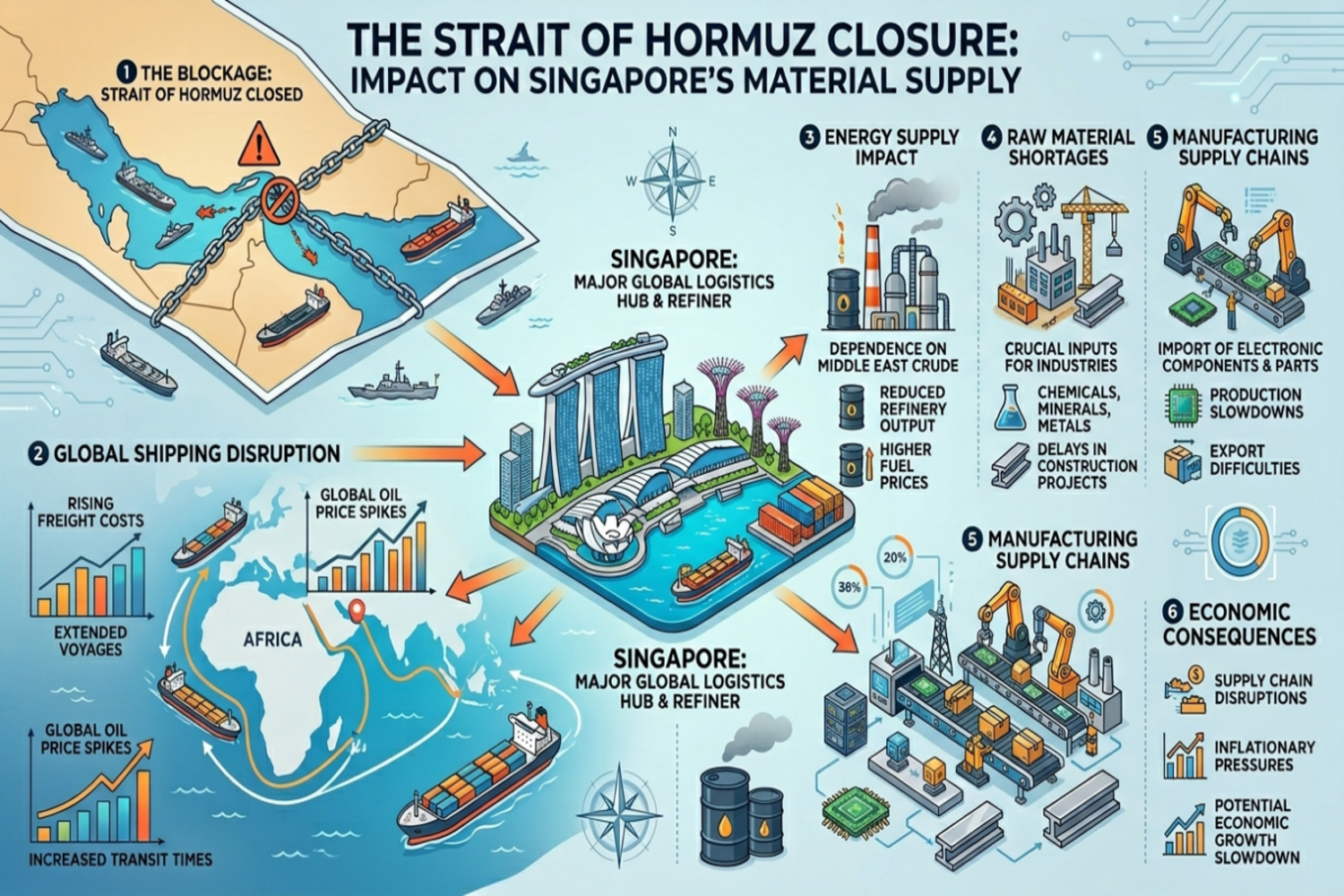
Somewhere in the Indian Ocean, a container vessel is taking a longer route than it planned to. It is carrying rebar, ceramic tiles, aluminium extrusions, or sanitaryware destined for a construction site in Tengah or Bidadari. That detour — a few thousand extra nautical miles, a few more days of fuel burn, a higher insurance premium — is one of the small, unglamorous links in a chain that ends at the date stamped on your BTO key collection letter.
For young Singaporean couples waiting on a Build-To-Order flat, the conversation about construction costs and BTO timelines usually arrives in fragments: a headline about freight rates, a contractor's warning about steel, a neighbour's renovation quote that came in higher than expected. What is rarely spelled out is how these pieces connect — and, more importantly, what a buyer can actually do about any of it.
This piece connects those dots. Not with alarmist forecasts of prices doubling, but with the numbers as they stand, a clear-eyed look at how shipping and logistics shocks transmit into Singapore's construction sector, and a practical playbook for protecting your timeline and your renovation budget against the uncertainty that remains.
The Chain Reaction: How a Shipping Lane Shapes a Singapore Flat
Singapore builds almost nothing from its own ground. The island imports the overwhelming majority of its construction materials — steel reinforcement bars, cement, granite aggregates, sand, tiles, glass, aluminium, timber, and the fittings that go into a finished flat. That reliance is the single most important fact in this entire story, and it is why the country is unusually exposed to global price movements.
As Shweta Choudhari, Director of Work Dynamics Research for Asia-Pacific at JLL, put it: Singapore is particularly exposed to global price movements because of its near-total reliance on imported construction materials.
The transmission mechanism runs roughly like this:
None of these steps is instantaneous, and none is dramatic on its own. A vessel re-routed around a conflict zone adds days to a voyage. Congestion at a transshipment hub adds a week. A container shortage pushes up spot rates. A steel mill in the region raises its export price. Each of these is absorbed, partially, by the contractor, then by the developer or HDB, then — eventually, partially — by the buyer or the renovation budget. The cumulative effect is what shows up in tender prices and completion dates eighteen months later.
Industry estimates have put the annual global economic toll of major maritime route diversions at around US$14 billion — a figure that captures fuel, insurance, crew time, and the working capital locked up in goods that arrive later than planned. Singapore, as one of the world's busiest transshipment hubs, sits directly in the path of both the disruption and the cost.
Why 2026 Is Not a Repeat of 2021 — But Isn't Clear Either
The pandemic years gave the construction sector a brutal stress test: site closures, dormitory lockdowns, and a global materials crunch. The current environment is different in character but not necessarily kinder in effect. Where 2021 was a demand shock combined with a labour shock, the present cycle is driven by geopolitical friction, trade policy, and routing risk.
The United States' tariff regime and the broader trade realignment have added a layer of unpredictability to procurement decisions. Suppliers who previously sourced from a single country now diversify — which improves resilience over the long run but raises costs in the short run, because diversification means smaller order volumes, more suppliers, and more logistics complexity.
For a BTO buyer, the takeaway is not "expect 2021 again." It is "expect volatility to be a permanent feature of the cost base, rather than a temporary aberration."
Construction Costs in 2026: The Numbers Behind the Noise
Singapore's construction costs are expected to rise by somewhere between 2% and 8% in 2026, depending on which cost consultancy you ask and which segment of the market you look at. That's a wide band, and the width itself is informative — it reflects genuine uncertainty about energy prices, freight, and material availability.
At the global level, JLL has forecast construction cost growth of 3.1% to 4.2% in 2027, following an estimated 3.5% to 4.7% increase in 2026. SJ Group's Singapore-specific estimate for 2026 sits lower, at around 2.5%.
| Source | Scope | 2026 forecast | 2027 forecast |
|---|---|---|---|
| JLL | Global construction costs | +3.5% to +4.7% | +3.1% to +4.2% |
| SJ Group | Singapore construction costs | ~+2.5% | — |
| Market range | Singapore construction costs | +2% to +8% | — |
These are not catastrophic numbers. A 2.5% to 5% annual rise in construction costs is roughly in line with historical norms for a mature market. What makes the current cycle uncomfortable is not the magnitude of the increase but its composition: it is being driven by inputs — energy, freight, raw materials — that are volatile and outside anyone's control.
The Material-Level Picture
Zoom in from the aggregate to individual commodities, and the story sharpens.
Material Price Increase Since January 2021 (%)
- Steel reinforcement bars are up roughly 25% since January 2021.
- Concreting materials — cement, aggregates, and related inputs — are up around 15% over the same period.
- Granite and cement have continued their upward march through 2026, with no sustained reversal in sight.
Steel is the material that matters most for structural frames, and it is also the most globally traded — which makes it the most sensitive to shipping costs and tariff shifts. HDB has previously introduced steel price protection measures for its contractors precisely because fluctuations in rebar pricing can destabilise a project's cost model mid-build.
Choudhari's framing is worth quoting in full because it captures the mechanics better than any forecast table: "Energy price volatility, transportation disruption and base materials costs all feed directly into regional tender prices."
The consequence, as she and her colleagues at JLL note, is that contractors are now pricing geopolitical uncertainty into their bids not as a temporary contingency but as a permanent risk premium. That is a structural shift. It means the baseline cost of building a flat in Singapore is now higher than it was in a lower-friction world, and it is unlikely to fully revert.
Daniel Malacchini, Head of Cost Advisory and Cost Management for Asia-Pacific at JLL, offers advice aimed at developers that translates neatly for buyers: "Test project feasibility against live cost data and reassess it at each design and procurement gate." In other words, don't set a budget once and walk away. Re-check it as circumstances move.
BTO Timelines: The Improvement Is Real, But So Is the Tail Risk
Here is where the story gets more encouraging — with an important caveat.
At the height of the pandemic disruption, more than 90% of BTO projects were running late. By early 2023, that figure had fallen to approximately 40%. That is a genuine and substantial improvement, achieved through a combination of contractor support, supply chain diversification, and a deliberate push to accelerate site progress.
Share of BTO Projects Running Late (%)
HDB has disbursed over S$430 million in financial assistance to contractors to help them absorb cost shocks and keep works moving. It has also monitored supply chains closely and stepped in with measures like steel price protection. The result: HDB has stated that all buyers of the last two pandemic-delayed BTO projects have been scheduled to collect their keys — a milestone that effectively closes the book on the pandemic-era backlog.
But "the backlog is cleared" is not the same as "delays are impossible." For projects that did slip, the typical overrun was 6 to 12 months beyond the original estimated completion date. That range is the number to internalise, because it defines the realistic tail risk for any project currently under construction.
What "On Schedule" Actually Means
A BTO flat's completion date is a projection, not a guarantee. The estimated completion date published at launch is built on assumptions about tender prices, contractor capacity, and material availability at that moment. When those assumptions shift — as they have repeatedly since 2020 — the date moves.
Three factors determine whether a given project slips:
- Contractor financial health. A contractor squeezed by rising steel and cement costs has less buffer to absorb further shocks. HDB's financial assistance exists precisely to prevent this from becoming a stoppage.
- Material delivery sequencing. Structural works need rebar and concrete on time; finishes need tiles, sanitaryware, and joinery. A single late shipment of a critical finish can hold up an entire block's handover.
- Labour availability. Less acute than in 2020–2021, but still a constraint in a sector that relies heavily on imported workers.
The honest assessment: the probability of a significant delay is materially lower than it was three years ago, but it is not zero, and the cost environment means the tail is fatter than in a stable-market decade.
The Renovation Budget: Where Shipping Costs Land Last
The renovation stage is where global shipping risk becomes personal — and where most buyers are least prepared.
A typical BTO renovation takes 6 to 10 weeks of on-site work once it begins. That timeline is itself sensitive to material deliveries; a delayed shipment of tiles or a custom joinery order can add weeks. But the bigger exposure is cost.
What Renovation Actually Costs
| Flat type | Typical renovation cost range |
|---|---|
| 3-room BTO | S$30,000 – S$55,000 |
| 4-room BTO | S$40,000 – S$75,000 |
| 5-room resale (comparison) | S$78,600 – S$93,500 |
One structural advantage BTO buyers hold: BTO renovations are generally 20–30% cheaper than equivalent resale renovations. A new flat comes with fresh flooring, new windows, new bathroom fittings, and no need for demolition or hacking of legacy structures. That discount is real money — on a 4-room flat, it can be the difference between a S$50,000 and a S$70,000 project.
But within that range, the variance is enormous, and the variance is driven by choices rather than by shipping rates. Two real examples illustrate the spread:
- A modern Nordic-style 4-room BTO renovation came in at S$123,000, of which roughly S$60,000 went to carpentry and built-in fixtures alone.
- A 5-room BTO renovation was completed for just over S$20,000 by prioritising essential works and using in-house labour arrangements.
Both are legitimate outcomes. The point is that carpentry and built-ins are the swing factor — and they are also the renovation category most exposed to material cost movements, because they depend on plywood, laminates, veneers, and hardware, much of it imported.
The Materials Most Exposed to Shipping Risk
If you want to understand where your renovation quote is vulnerable, look at what crosses a border:
- Tiles and slabs — largely imported from Italy, Spain, India, and China; heavy, bulky, and freight-sensitive.
- Sanitaryware and fittings — often European or Chinese; container-dependent.
- Glass and aluminium — energy-intensive to produce, and priced off energy costs.
- Engineered wood and laminates — sourced from Malaysia, Indonesia, and Europe.
- Hardware and accessories — small, high-value, and frequently affected by container availability.
Conversely, wet works (tiling labour, plastering, plumbing, electrical) are dominated by local labour costs and are far less exposed to global freight. A renovation that leans heavily on wet works and locally sourced materials is structurally more insulated than one built around imported finishes and extensive custom joinery.
A Contingency Playbook for BTO Buyers
Here is the practical core of this piece. Rather than trying to predict where freight rates will be in eighteen months — nobody can — build a plan that survives a range of outcomes.
Before Key Collection: Budget With a Buffer
The single most important number in this article is 10–15%. That is the contingency buffer you should hold on top of your renovation budget, and it is not optional in a market where material prices are still climbing.
On a S$55,000 4-room renovation, a 15% buffer is S$8,250. That is the difference between absorbing a mid-project price revision calmly and having to cut scope or borrow.
Practical steps:
- Get three itemised quotes, not three lump sums. Itemisation lets you see which categories are driving cost and where you can substitute.
- Ask explicitly about price validity. How long is the quoted price held? What happens if tile prices rise between signing and delivery? Is there a price adjustment clause, and what triggers it?
- Separate labour from materials where possible. Material costs are the volatile component; a quote that clearly delineates them is easier to renegotiate if conditions change.
- Do not lock in a contractor before you have a confirmed key collection date, but do start the conversation early. Good IDs have queues, and being six weeks behind the market is more expensive than being six weeks early.
During the Waiting Period: Protect Your Housing Flexibility
If your project is running late, the cost isn't only financial — it's the extra months of rent, or the extra months in your parents' spare room.
- Track HDB's official updates on your project's completion date rather than relying on forum speculation.
- If you are renting, understand your lease break clause and the cost of extending month-to-month versus signing a new term.
- Budget for the delay scenario the same way you budget for renovation. If a six-month delay would cost you S$12,000 in additional rent, that is a real number that belongs in your financial plan.
- If you are selling an existing flat to fund the BTO, sequence carefully. A delay on the BTO side while you have already committed to a sale creates a gap you will need to bridge.
When You Get Your Keys: Sequence to Reduce Exposure
- Do the wet works first. Tiling, plastering, plumbing, and electrical are labour-heavy and less exposed to import price swings. Getting these done early locks in their cost.
- Order imported finishes early — tiles, sanitaryware, and any custom joinery — so that a shipping delay does not stall the site.
- Keep a decision buffer. Every change order after work begins costs more than the same decision made upfront.
- Consider phased renovation if budget is tight. Moving in with essential works complete and adding built-ins later spreads the cash flow and lets you observe actual prices rather than committing to a quote made eighteen months earlier.
For buyers who want hard data rather than anecdotes, the Building and Construction Authority (BCA) publishes construction demand, tender price, and material market price data. It is dry reading, but it is the same data the industry uses.
The Wider Market: Why Construction Inflation Isn't Crashing Demand
It would be reasonable to assume that rising construction costs would dent the property market. The data suggests otherwise — at least so far.
In Q1 2026, private residential property prices rose 0.3%, easing from a 0.6% increase in Q4 2025, even as sales volume fell by nearly 40%. By Q3 2026, prices had climbed 1.4% quarter-on-quarter, accelerating from a 0.5% rise in Q2.
Private Residential Price Change, Quarter-on-Quarter (%)
That pattern — volume down, prices up — is the signature of a market constrained by supply and supported by underlying demand, rather than one in distress. Construction cost inflation is one of the forces keeping prices elevated, because replacement cost sets a floor under new supply pricing.
Meanwhile, Singapore's construction sector itself is projected to expand by 6.2% in real terms in 2026, supported by export activity and investment. Annual construction demand is expected to remain strong at S$30 billion to S$36 billion from 2026 onwards, with public sector projects — including BTO — as the primary driver.
The implication for a BTO buyer is reassuring in one sense and cautionary in another. Reassuring: the pipeline is large and well-funded, and the government has both the means and the demonstrated willingness to support contractors through cost shocks. Cautionary: a market running at S$30–36 billion of annual demand puts sustained pressure on contractors, labour, and materials — which is exactly the environment in which costs drift upward.
Food for Thought
-
If a 6–12 month delay is a realistic tail outcome, should BTO buyers treat the published completion date as a planning assumption or a best-case scenario? What would change about your financial plan if you assumed the later date from day one?
-
Is a 10–15% renovation contingency genuinely sufficient, or is it a rule of thumb inherited from a lower-volatility era? If imported finishes are the volatile component, should the buffer be sized by material exposure rather than as a flat percentage?
-
Singapore imports nearly all its construction materials — is that a vulnerability to be managed, or a structural feature to be designed around? What would a genuinely diversified material supply chain look like, and who should pay for the resilience?
-
Contractors now price geopolitical uncertainty as a permanent risk premium. If that premium is permanent, does it ever get competed away — or does it become the new baseline for public housing costs?
-
When sales volume falls 40% while prices rise, who is actually transacting? If the marginal buyer is less price-sensitive than the median buyer, what does that mean for affordability at the entry level?
The Bottom Line
Global shipping risk does not determine the price of your BTO flat, and it will not decide whether your renovation costs S$40,000 or S$70,000. What it does is tilt the odds: it makes cost overruns more likely, delays more probable, and quotes more time-sensitive. The correct response is not to panic about freight rates but to build a plan that can absorb a wider range of outcomes — a buffer in the budget, flexibility in the housing timeline, and itemised quotes with clear price validity.