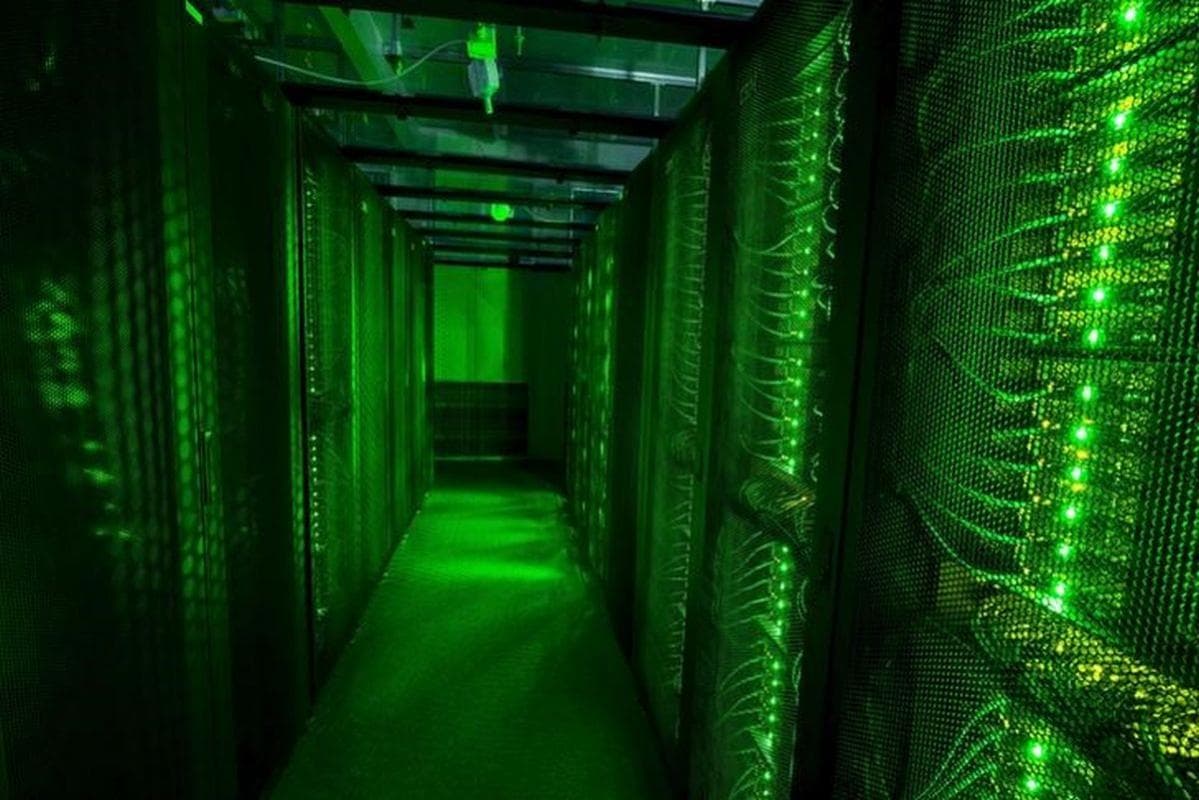
When Jensen Huang tells a packed arena that the more you buy, the more you save, he is talking about GPUs. But every one of those GPUs has to sit somewhere — on a rack, inside a hall, drawing power from a grid, on land that Singapore does not have a lot of. That is where the AI story quietly stops being a technology story and becomes a property story.
Singapore currently hosts more than 70 operational data centres that together consume over 7% of the nation's electricity, according to industry tracking cited in recent market coverage. On an island of roughly 728 km², that is a remarkable concentration of energy-intensive floor space. And the demand curve is not flattening — the Singapore AI data centre market is projected to grow from USD 0.89 billion in 2026 to USD 1.47 billion by 2030, a CAGR of 10.41%, according to Mordor Intelligence.
What follows is an attempt to connect the dots: Nvidia's AI demand, Singapore's data centre capacity, the squeeze on industrial land and power, and what all of this is doing to industrial rents, data centre REITs, and the next generation of specialised facilities. Not as stock advice — as a map of how a technology cycle is repricing physical space.
The AI Boom Is a Property Story in Disguise
It is easy to read the AI headlines as a semiconductor narrative: chip designs, foundry capacity, export controls, valuations. But a GPU cluster is an industrial asset with a very specific real estate profile:
- High power density. A traditional data hall might run at a handful of kilowatts per rack. AI training racks are an order of magnitude denser, which changes cooling design, floor loading, ceiling height and substation requirements.
- Long lead times. Substations, transmission connections and cooling plants are not things you can conjure in a quarter.
- Land-hungry, water-hungry. Keppel CEO Loh Chin Hua put it plainly in October 2025: "Finding land with the right connectivity and access to water to build data centres is becoming increasingly challenging."
- Sticky tenants. Once a hyperscaler or AI cloud provider is installed, it does not churn casually. That matters for lease duration, reversionary rents and asset valuation.
In other words, the AI capex boom shows up in Singapore not just as imports of servers, but as competition for industrial land, grid capacity and specialised building specifications. That competition is the mechanism through which a Silicon Valley product cycle becomes a Singapore rent cheque.
Just How Big Is the Demand? The Numbers Behind the Hype
Before talking about constraints, it is worth sizing the wave. The projections coming out of the major research houses are unusually large by historical data centre standards.
Singapore AI Data Centre Market Size (USD billion)
At the city-state level, that is the topline. But Singapore's market is a small slice of a much bigger global pie, and the global numbers explain why the pressure on Singapore is so intense even though its own market is measured in the hundreds of millions rather than tens of billions.
McKinsey forecasts that AI-related demand will multiply roughly 3.5 times, from about 44 GW to 155 GW — equivalent to around 70% of total data centre demand. ABI Research similarly projects that active data centre capacity dedicated to AI workloads will climb from 11.5 GW in 2026 to 43.6 GW by 2031.
Global AI-Related Data Centre Demand (GW)
Those gigawatts have to land somewhere, and the list of acceptable somewheres is short. It needs to be:
- Connected — low-latency links to regional enterprise and financial clients.
- Legally stable — data sovereignty, contract enforceability, security regimes.
- Powered — and ideally with credible access to low-carbon electricity.
- Close to customers — which, for Southeast Asia, increasingly means Singapore or its immediate hinterland.
Singapore scores well on three of those four. The fourth — power — is exactly where the story gets complicated. The Energy Market Authority's Low Xin Wei framed the challenge diplomatically: "grid-planning for a future economy enabled by AI requires a new paradigm."
The physical consequences are already visible in the energy statistics. Singapore's electricity demand from data centres is projected to nearly triple between 2025 and 2030, a direct consequence of AI-driven expansion, according to reporting on the sector. A market that was already consuming more than 7% of national electricity is on track to consume a materially larger share within five years.
Singapore's Constraints: 728 km², One Grid, and 70 Facilities
Here is the structural tension in one sentence: Singapore is the region's most attractive data centre location precisely because it is dense, connected and reliable — and density, connectivity and reliability are exactly what make land and power scarce.
Land: the binding constraint nobody can rezone away
Singapore's industrial land is planned, not discovered. Data centres are classified as e-business activities permissible within specific industrial zones — a planning decision that effectively decides, in advance, how much of the island's floor space can ever be used for compute. You cannot simply convert a warehouse or an office block into a hyperscale hall; the power, loading and cooling requirements rule most of it out.
The Fitch Ratings analysis on Singapore's capacity constraints notes that the city-state currently maintains approximately 1.4 GW of operational capacity, with growth steered abroad by exactly this land and power bottleneck.
Power: the constraint with a political dimension
Power is harder still, because it is not just an engineering question but an emissions one. Singapore has committed to balancing digital growth with environmental stewardship, and data centres are among the most electricity-intensive assets an economy can host. Keppel's Loh noted that "the grids are really very congested" — and that congestion has pushed developers toward workarounds such as "power banking" (essentially treating spare capacity as a tradeable asset) and building more efficient, higher-density data centre parks rather than sprawling low-density campuses.
Water and cooling: the quiet third constraint
Because AI racks are hot, they demand more cooling per square metre, which in a tropical climate traditionally means more chilled water. That is why liquid cooling has moved from a niche engineering preference to a mainstream procurement question. The global data centre cooling market is projected to grow from USD 21.0 billion in 2026 to USD 54.4 billion by 2034, a CAGR of 12.6%.
Global Data Centre Cooling Market (USD billion)
That chart is not a property chart on its face. But every dollar of it is spent inside a building, and the buildings that can accommodate it command a different rent from the ones that cannot. The gap between "generic industrial" and "AI-ready" is now a pricing gap as much as a technical one.
Policy: From Moratorium to Managed Allocation
Singapore did not stumble into this. It regulated its way here, in stages, and understanding the sequence explains why the current market looks the way it does.
The 2019 moratorium
The moratorium on new data centre construction was introduced to balance digital growth against environmental sustainability. It paused the sector at a moment when it was expanding fastest — and, perhaps unintentionally, handed an advantage to neighbouring Malaysia by pushing new capacity across the Causeway.
The 2024 Green Data Centre Roadmap
The roadmap replaced the blunt instrument of a moratorium with a managed one: growth is permitted, but on sustainability terms. Among the requirements, the latest capacity allocation round — which reportedly concluded on 31 March 2026 — mandates that new facilities derive at least 50% of their power from low-carbon sources.
Alongside this, Singapore has signalled plans to expand data centre capacity by at least one-third, underpinned by binding efficiency rules, with a proposed licensing regime intended to enforce security and disaster recovery standards. Sustainability grants and incentives are being used to push operators toward energy efficiency and decarbonisation.
The AI carve-out
One detail worth flagging for property watchers: for a period of roughly two years, the appetite for new data centres not directly supporting AI was deliberately restrained, in order to relieve pressure on national resources. The policy logic is straightforward — if you are going to spend scarce land and scarce megawatts, spend them on the highest-value workload available. That is the definition of an AI-led allocation regime.
Jurong Island as a bet
The most striking physical expression of this strategy is the plan to transform Jurong Island into an "AI-ready data centre hub", with ambitions to set a global benchmark for sustainable, AI-scale digital infrastructure. Jurong Island already has what a data centre needs and what most brownfield sites lack: heavy industrial zoning, existing energy infrastructure, and distance from residential areas. Repositioning an energy and chemicals hub into a compute hub is a bet that the AI economy will reward infrastructure clusters that are purpose-built rather than retrofitted.
Industrial Rents, REITs and the Repricing of Floor Space
Now to the money. The AI narrative shows up in industrial property data in three places: rents, reversions, and capital flows.
Rents are climbing, modestly but persistently
Cushman & Wakefield's Industrial MarketBeat Report for Q3 2026 recorded a 0.6% quarter-on-quarter rise in conventional factory rents and a 0.3% QoQ increase in high-tech rents, both against a backdrop of declining vacancy rates.
Singapore Industrial Rent Growth, Q3 2026 (QoQ %)
Those are not spectacular numbers in isolation. But three things matter about them:
- Direction. Both segments are rising, with vacancy falling. In an industrial market, that combination is a textbook signal of tightening supply.
- Persistence. A 0.3–0.6% quarterly grind compounds to roughly 1–2.5% annually, which is meaningful for landlords holding long-WALE industrial assets.
- The high-tech divergence. High-tech space — the category that includes data centre-adjacent and specialised facilities — is growing more slowly in headline rent terms, but that is likely a function of lease structure and new supply being signed at pre-agreed escalations rather than a lack of demand.
JLL's Global Market Perspectives, published 4 November 2026, adds the macro frame: global office leasing rose 5% year-over-year in Q3 2026, with Asia Pacific leading, logistics take-up accelerating across all regions, and data centre demand reaching "unprecedented levels." The Urban Redevelopment Authority's latest data release on 13 November 2026 provides the official snapshot of ongoing activity for those who want to track the granular series.
The shorter-lease complication
One structural change deserves emphasis: shortening lease tenures are increasingly influencing demand and transaction activity in Singapore's industrial sector. This cuts both ways.
- For landlords, shorter leases mean more frequent mark-to-market — good in a rising market, uncomfortable in a falling one.
- For tenants, especially AI-adjacent operators with uncertain long-run power requirements, shorter leases preserve flexibility.
- For valuers, shorter income streams compress capitalisation assumptions, which is why headline rent growth and asset price growth do not always move in lockstep.
Data centre REITs: the reported performance
The demand narrative has translated into reported operational strength. Data centre S-REITs posted high occupancy and double-digit rental reversions in the first half of 2026, with dividend yields reportedly in the range of roughly 4.75% to 8%. Names in the space include Keppel DC REIT, Digital Core REIT and NTT DC REIT.
| REIT (as named in market coverage) | Reported characteristic | What property watchers watch |
|---|---|---|
| Keppel DC REIT | Diversified data centre portfolio across Asia-Pacific and Europe | Occupancy, power procurement costs, asset enhancement pipeline |
| Digital Core REIT | US-focused data centre exposure, sponsor-backed pipeline | Tenant concentration, US power market exposure, gearing |
| NTT DC REIT | Backed by a global telecom and data centre operator | Sponsor pipeline, lease structures, development yield |
Analysts remain constructive. Joel Phua of FSM Global pointed to "robust 25 per cent rental reversions" and maintained a "buy" rating on Digital Core REIT with a US$0.70 target price.
A necessary caveat: high occupancy and strong reversions are backward-looking operating metrics, not forecasts. The forward risks that matter in this sector are well documented and mostly non-property in nature — rising interest rates, refinancing costs, tenant concentration, and the possibility that power procurement costs rise faster than rents can be reset.
The diagram above is deliberately a loop rather than an arrow. AI demand helps the top line and hurts the cost line simultaneously. Which effect wins depends on lease structure — specifically, whether the lease passes power costs through to the tenant.
The Next Wave: Liquid Cooling, AI-Ready Parks, and Purpose-Built Facilities
The most interesting property development in this cycle is not more of the same space. It is a new asset class emerging within industrial real estate.
From "data centre" to "AI-optimised facility"
The requirements of an AI-optimised facility differ materially from a conventional colocation site:
- Higher power density per rack, which changes floor plates, structural loading and substation sizing.
- Liquid cooling readiness — coolant distribution units, rear-door heat exchangers, or direct-to-chip systems, all of which need plant space and plumbing that legacy buildings lack.
- Power redundancy rethought, not just with diesel gensets but with grid-interactive designs and "power banking" arrangements.
- Water efficiency, given Singapore's climate and the reputational cost of high potable water use.
- Security and resilience, consistent with the proposed licensing regime's emphasis on disaster recovery.
The efficiency mandate reshapes design
The requirement that new facilities source at least 50% of power from low-carbon sources is not just an energy procurement issue — it is a design and site-selection issue. It favours:
- Sites with access to regional renewable energy imports via grid arrangements.
- Operators with portfolio-level power purchase agreements.
- Developments with on-site generation or waste-heat reuse potential, which pushes toward industrial clusters like Jurong Island.
What this means for rents
The spillover into general industrial rents runs through a simple channel: AI-adjacent operators compete for a small pool of suitably powered, suitably zoned space. Business Times coverage in Q3 2026 framed it directly — AI-related demand is powering prices and rents in Singapore's industrial space. Landlords who can supply high-spec, high-power space are effectively in a different market from landlords holding 1990s flatted factories.
It is worth qualifying that the granular PSF pricing and transaction volume data for the industrial data centre segment sits in specialised commercial reports rather than public headline series, and the URA's public datasets are weighted toward residential. Anyone making an investment case on industrial PSF should be working from transaction-level comparables, not headline indices.
Malaysia: The Release Valve
No analysis of Singapore's data centre property market is complete without the Johor side of the story.
Singapore's 2019 moratorium, combined with its status as one of the world's most expensive data centre markets, created a competitive advantage for Malaysia. Johor Bahru emerged as Southeast Asia's fastest-growing data centre market in 2024, driven by:
- Cost efficiency — Kuala Lumpur pricing sits at approximately USD 11.37 per watt, well below Singapore.
- Land availability — large parcels with room for phased hyperscale campuses.
- Latency proximity — close enough to Singapore that certain workloads can serve Singapore-based customers from across the border.
- Investment momentum — Malaysia has attracted over USD 24 billion in approved data centre investments, per Fitch Ratings' August 2026 analysis.
The regional division of labour that is emerging looks roughly like this:
| Dimension | Singapore | Johor / Malaysia |
|---|---|---|
| Available land | Scarce, planned, expensive | Abundant and cheaper |
| Power | Constrained, congestion flagged by industry | Growing capacity, faster approvals |
| Water and renewables | Managed, with low-carbon thresholds | More land for solar and on-site generation |
| Connectivity | Best-in-region | Good and improving, Singapore-adjacent |
| Typical workload | High-value, latency-sensitive, AI inference and enterprise | Hyperscale training, batch, cost-sensitive capacity |
| Operating capacity | ~1.4 GW | Expanding rapidly |
This is not purely a zero-sum story. A JB campus serving regional workloads still plugs into Singapore's fibre ecosystem and financial services demand. But it does mean Singapore's data centre property market is structurally premium-only — the low-density, cost-driven segment is being competed away, and what remains is high-specification, high-rent, high-value space.
For property investors, that is arguably a healthier long-term position than competing on cost. For tenants, it means the cheapest way to run a large AI training cluster in this region is increasingly not in Singapore at all.
What It Means for Buyers, Investors and Tenants
Pulling the threads together, the AI-driven data centre cycle has distinct implications depending on where you sit.
For industrial property buyers
- Specification is now a price driver. Power capacity, ceiling height and cooling readiness are becoming underwriting criteria, not footnotes. A building that can host high-density compute is a different asset from one that cannot.
- Zoning determines optionality. Data centres being classified as e-business uses within specific industrial zones means the addressable supply is capped by planning, not just by market appetite.
- Lease duration matters more than ever. With shortening tenures influencing transaction activity, buyers should be especially attentive to WALE and to whether rents are indexed or reversionary.
- Beware of the "AI-adjacent" label. Industrial assets near data centre clusters benefit from spillover demand, but the correlation is not one-to-one. A logistics shed in the west is not a data centre.
For REIT and equity investors
- Reported fundamentals are strong, with high occupancy, double-digit reversions in H1 2026, and yields in the ~4.75%–8% band across the listed data centre names.
- The key swing factors are non-property: cost of debt, refinancing schedules, tenant concentration, and the trajectory of power prices.
- Reversion strength is not the same as earnings growth. If power and cooling capex per square metre rises faster than rents, net property income can lag gross rent momentum.
For tenants and enterprise occupiers
- Power is the new negotiating chip. In a congested grid, the ability to bring a low-carbon power arrangement to the table changes the conversation with landlords.
- Consider the two-tier strategy. Latency-sensitive inference in Singapore, cost-sensitive training capacity in Johor, with data movement designed in from day one.
- Lock in efficiency, not just space. Under the proposed licensing regime, resilience and disaster recovery standards will influence operating costs for the whole lease term.
For the broader Singapore property market
Singapore's overall real estate market is forecast to grow from roughly USD 56.15 billion in 2026 to USD 70.4 billion by 2031, a CAGR of 4.63% on the definitions used by that research. Data centres are a small share of that total, but they punch far above their weight in two ways: they consume industrial land that would otherwise house logistics and manufacturing, and they set the specification benchmark that other industrial assets are increasingly measured against.
The office market is also being touched, if indirectly. Accelerating AI adoption is changing corporate real estate strategy — business investment patterns, workforce composition, and space utilisation. Singapore's broader property sector has already begun using AI operationally too, from drone-based building inspections to portfolio analytics, as Straits Times coverage has noted.
Food for Thought
- If Singapore can only add capacity in high-spec, high-cost increments, does the AI boom actually raise industrial rents broadly — or does it simply widen the gap between AI-ready assets and everything else?
- What is the true economic life of a building designed for today's AI rack density? Cooling technology is evolving faster than typical 15–20 year lease terms. Are we underwriting obsolescence risk correctly?
- When the grid, not the land, is the binding constraint, who should decide which projects get connected — the market, the regulator, or a capacity allocation mechanism that favours AI workloads over general compute?
- Is the Johor–Singapore split a sustainable regional division of labour, or a temporary arbitrage that closes once Malaysian power costs normalise and grid congestion moves north?
- For a 30-something Singaporean building a property portfolio, does data centre exposure belong in the REIT sleeve or the industrial allocation — and does that answer change if the leases are getting shorter?
The Bottom Line
The AI boom is not a speculative overlay on Singapore's property market; it is a physical force acting on a fixed supply of land and power. Jensen Huang's demand for more compute translates, eventually and inevitably, into demand for more megawatts, more cooling, and more industrial floor space with very particular specifications. Singapore's response — a moratorium, then a roadmap, then managed allocation, then Jurong Island — is an unusually deliberate attempt to capture the high-value end of that demand while importing the low-value end from across the Causeway.
The result is a two-speed industrial market: modest, persistent rent growth in the headline indices, and a much sharper repricing underneath for assets that can actually host AI-scale workloads. That gap is where the interesting analysis sits — and it is not visible in an index print.