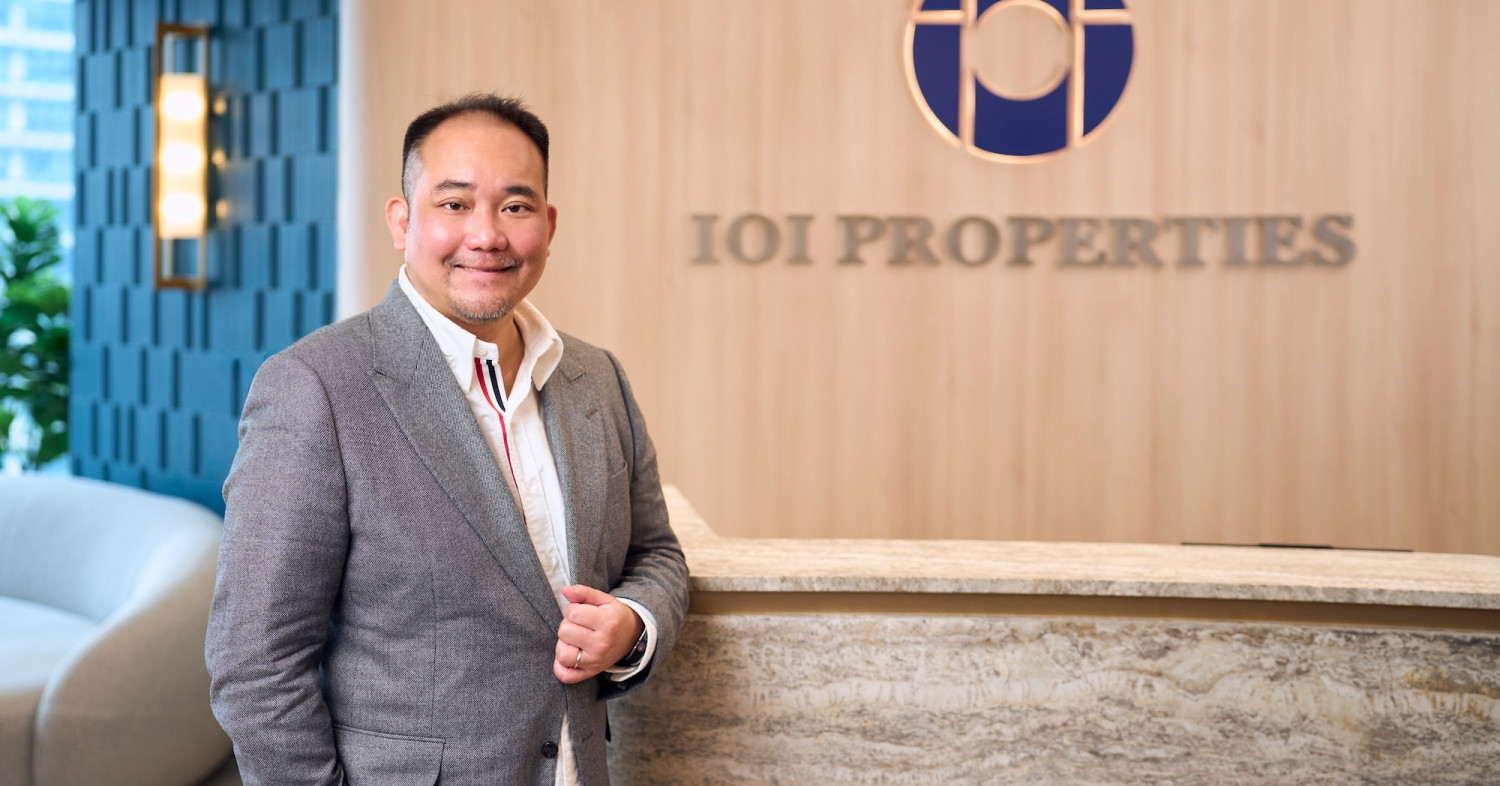
When a Malaysian developer quietly accumulates close to S$10 billion of Singapore real estate — prime Grade A offices, an integrated Marina Bay hotel-and-residences tower, and a pipeline that reportedly includes One Raffles Place, Chijmes and a Capitol Kempinski hotel — Singapore buyers should pay attention. That developer is IOI Properties Group Berhad, and the person driving the strategy is Lee Yeow Seng, its Group Chief Executive Officer and Vice Chairman.
Unlike the household names of Singapore's property pantheon, IOI has kept a deliberately low profile here. It does not plaster MRT pillars with glossy ads for mass-market condos. It buys buildings, not billboards. Yet over three decades it has moved from joint-venture bit-part player to one of the largest owners of CBD office space in the city.
This article breaks down who Lee Yeow Seng is, what IOI actually owns in Singapore, what is coming next, how the group's delivery track record stacks up, and — most importantly — what all of this means if you are buying a home, hunting for yield, or signing a commercial lease.
Who Is Lee Yeow Seng?
Lee Yeow Seng is the younger son of the late Lee Shin Cheng, the founder of the IOI Group, one of Malaysia's largest plantation-and-property conglomerates. He inherited a significant stake in the business and formally took the helm of the property arm in 2019, becoming Group CEO while also holding the Vice Chairman role.
His public profile is unusually restrained for someone writing cheques in the billions. But his capital allocation has been anything but quiet.
The thesis in his own words
Lee's stated view of Singapore rests on three pillars:
- Singapore as a safe haven for high-net-worth individuals, which sustains demand for prime offices, luxury homes and high-end hotels.
- Controlled land supply as an investment moat — scarcity, in his framing, is a feature rather than a bug.
- An "underserved" ultra-luxury segment, which he explicitly wants IOI to serve with "best-in-class" product.
Two quotes capture the philosophy. On location: "If you want to invest in properties, location is always the most important overriding consideration… There's no better address and location than Marina Bay." On pricing mechanics: "When land prices are high, there's no way developers can underprice their products. The next launch will always be higher than the earlier launches."
That second line is worth sitting with. It is an honest description of how land bidding feeds through to launch prices — and a signal of where Lee thinks the market is headed.
IOI Properties at a glance
| Item | Detail |
|---|---|
| Position | Group CEO and Vice Chairman, IOI Properties Group Berhad |
| Took over property arm | 2019 |
| Family background | Son of late IOI Group founder Lee Shin Cheng |
| Singapore assets under management | Reportedly approximately S$10 billion |
| Prime office portfolio value | Reportedly close to S$12 billion worth of prime office space across the group's holdings |
| Stated positioning | Ultra-luxury residential, Grade A CBD office, high-end hospitality |
| Geographic focus | Malaysia (core), Singapore (growth), China |
The Singapore Portfolio: From Joint Ventures to CBD Landlord
IOI's Singapore story began in 1996 through joint ventures — a tentative entry compared with the local dynasties that had been building here for generations. Lee has acknowledged the late start, framing the current phase as an effort to "catch up with the rest."
The catch-up has been expensive and fast.
Commercial: the core bet
The commercial book is where the real money sits, and it is overwhelmingly concentrated in the Downtown Core and Marina Bay.
| Asset | Status | Reported scale | Notes |
|---|---|---|---|
| IOI Central Boulevard Towers | Owned and stabilised | Grade A office; rents close to S$18 psf | Built from scratch after the site was acquired in 2016; nearly fully occupied by end-2025 |
| South Beach | Fully owned since Sept 2025 | ~S$835 million for CDL's 50.1% stake | Mixed-use: South Beach Tower offices plus JW Marriott hotel |
| Asia Square Tower 2 | Acquired April 2026 | ~S$2.5 billion | Renewals reportedly at S$13–14 psf, up from about S$11 psf |
| One Raffles Place (potential) | Reported exclusive talks | ~S$2.3–2.4 billion for a 50% stake | Jointly pursued with CapitaLand Investment; OUE REIT confirmed an indirect interest via OUB Centre |
| Chijmes + Capitol Kempinski (potential) | Reported exclusive talks | Chijmes valued ~S$379 million at end-2025; hotel marketed at ~S$600 million | Would deepen the hospitality and lifestyle footprint |
| Shenton House (redevelopment) | Acquired from Lee Yeow Seng personally for S$1 | ~S$217.06 million in shareholder advances to be repaid | Redevelopment expected from 2027, reportedly including ~200 hotel rooms |
Three observations jump out.
First, the rental trajectory is the story. IOI Central Boulevard Towers commanding close to S$18 psf is not a marginal achievement — it places the building among the most expensive office addresses in the city. The Asia Square Tower 2 renewals moving from roughly S$11 psf to S$13–14 psf show the group is not just buying yield; it is actively re-pricing it.
Second, the asset mix is shifting toward hospitality. Shenton House with ~200 rooms, the JW Marriott at South Beach, and the potential Capitol Kempinski all point in the same direction. Lee's read is that Singapore's hotel and lifestyle segment benefits from the same safe-haven flows that support luxury residential.
Third, governance deserves a flag. The Shenton House transaction — acquired from Lee in his personal capacity for S$1, with IOI agreeing to repay S$217.06 million in shareholder advances — is a related-party deal. Such structures are legal and not unusual in family-controlled groups, but investors should read the circulars carefully rather than skim them.
Residential: deliberately selective
Here is where Singapore homebuyers may find IOI's stance surprising. Despite owning some of the most valuable land in the region, the group is not chasing new CBD residential sites.
The reason is policy. With 60% Additional Buyer's Stamp Duty on foreign purchasers, the economics of building ultra-luxury homes for an international buyer pool have changed. Lee has said residential development is a lower priority for new CBD sites — a rare case of a developer publicly conceding that a tax measure has reshaped strategy.
That does not mean there is no residential product. W Residences Marina View — reportedly 683 units integrated with a W hotel of roughly 360 rooms — is the flagship. It leans hard into the branded-residence playbook: hotel services such as housekeeping and dedicated butlers, aimed squarely at high-net-worth owner-occupiers and investors who value service over square footage.
Reported Office Rents: IOI's Singapore Assets (S$ psf)
The pattern is consistent: buy or build at the top of the market, then push rents above the prior benchmark. Whether that is prudent capital allocation or peak-cycle enthusiasm is the question every buyer should be asking.
Upcoming Projects and the Capital Recycling Machine
The most consequential thing happening at IOI is not a building. It is the financial engineering around the buildings.
The REIT and fund roadmap
According to reporting and the group's own updates, IOI is working on a three-pronged capital plan:
- A Malaysian REIT listing, with a prospectus launch reportedly expected in Q4 2026.
- A Singapore-listed REIT, targeted around 2027, backed by a portfolio reportedly in the region of US$1.8 billion, with potential asset values across the REIT vehicles cited at up to S$8.2 billion.
- A private real estate fund in Singapore, reportedly sized around S$6 billion.
IOI Central Boulevard Towers and South Beach Tower have both been identified as candidate assets for the Singapore REIT.
There is also talk of a secondary listing targeted for early 2027 — a move that would broaden the investor base beyond Bursa Malaysia and give Singapore investors a more direct route into the story.
Why this matters more than any single acquisition
IOI's net debt reportedly reached 85% of equity as of end-June 2026, with management targeting a reduction to the 30%–50% range over three to five years. That is not a small gap.
REITs and private funds are the mechanism to close it. Sell stabilised assets into a vehicle, retain a sponsor stake and management fees, recycle the proceeds into the next acquisition, and repeat.
On paper, this is textbook. In practice, it depends on three things going right: IPO windows staying open, office valuations holding, and rents continuing to climb. Any one of those slipping changes the maths considerably.
For Singapore buyers and investors, the practical implication is that the group's financial health is now tied to capital markets in a way it was not five years ago. If the Singapore REIT lists well, gearing falls and the group has more room to manoeuvre. If listing conditions sour, the debt reduction timeline stretches.
Track Record and Delivery History: What's Proven, What's Pending
IOI Properties Group Berhad is one of Malaysia's largest and most established developers, with a track record spanning nearly four decades and a strong reputation for integrated townships across Malaysia, Singapore and China.
What the Singapore record actually demonstrates
Large-scale commercial execution. IOI Central Boulevard Towers was built from scratch after the site was secured in 2016. Delivering a Grade A tower of that scale, in that location, and then leasing it to near-full occupancy by end-2025 — with tenants reportedly including global technology companies and leading professional services firms — is a genuine execution achievement.
Asset management capability. Achieving close to S$18 psf on a new tower and driving Asia Square Tower 2 renewals from about S$11 psf to S$13–14 psf suggests the leasing team knows how to hold pricing power.
Willingness to transact at scale. The South Beach buyout, the Asia Square Tower 2 acquisition, and the reported One Raffles Place discussions show a group comfortable writing multi-billion-dollar cheques in a market where it is not the incumbent.
Where the record is thinner
- Singapore residential delivery at scale. The group's local residential track record is far shorter than its Malaysian township history or its Singapore office history. W Residences Marina View will be a test of whether the branded-residence model translates into resale performance.
- Hospitality operations. A ~200-room Shenton House hotel, the JW Marriott at South Beach, and a potential Capitol Kempinski would make IOI a meaningful hotel operator in Singapore. That is a different competency from office leasing.
- Cycle timing. Nearly every major Singapore acquisition has landed at what looks like a strong point in the office cycle. That is either conviction or complacency, and only the next downturn will tell.
How the group is viewed by the market
Analyst sentiment has been broadly constructive, with a consensus skewing toward 'buy' calls and a 12-month target price cited around MYR 4.48. The proposed REIT listings are widely framed as catalysts — unlocking value, accelerating capital recycling, and providing market-based valuations for investment properties, all of which supports debt reduction.
That said, a constructive consensus is not the same as a risk-free story. Leverage at 85% net debt to equity is the number that keeps appearing in the fine print.
What This Means for Buyers, Investors and Tenants
Different readers are exposed to IOI in completely different ways. Here is the breakdown.
If you are buying a home
IOI's residential footprint is narrow and high-end. The practical takeaways:
- Branded residences come with service charges to match. Hotel-style amenities and butler services are real operating costs, and they recur for the life of the building.
- Ultra-luxury is a thin market. Your buyer pool at resale is small, often foreign, and highly sensitive to ABSD settings. Liquidity in this segment behaves very differently from a mass-market 3-bedder in the suburbs.
- Limited new supply from this developer is a double-edged sword. Scarcity supports prices; it also means fewer comparables when you eventually sell.
- IOI's land bidding affects you indirectly. Aggressive bids for prime sites set benchmarks that filter into surrounding pricing. Lee's own comment — that each launch will be priced above the last — is a reminder that developer land cost is a floor under new-launch pricing, not a ceiling.
If you are an investor
IOI's Singapore story is increasingly a capital markets story, and there are now several routes in:
- Direct property gives you leverage and control, but concentrates risk in a single unit in a narrow segment.
- Group shares give you diversification across the portfolio, but expose you to MYR movements and to a balance sheet carrying substantial debt.
- The future REIT would offer a purer, Singapore-dollar play on prime CBD office income — with the usual caveat that IPO pricing matters enormously to first-year returns.
If you are a commercial tenant
IOI's office buildings are genuinely well positioned: prime addresses, Grade A specifications, and the amenity draw of Marina Bay and the Downtown Core. But tenants should go in with eyes open:
- Rents are trending up, not sideways. The repricing from roughly S$11 psf to S$13–14 psf at Asia Square Tower 2 is a direct signal for anyone renewing in the vicinity.
- Vacancy is tight. Core CBD vacancy reportedly fell to 2.6% in Q3 2026 from 3.3% the previous quarter. In a tight market, a landlord with a well-leased building has little incentive to discount.
- Know your escalation clauses. With CBRE expecting prime office rents to climb by more than 5% in 2026 and to keep rising on limited new supply through 2027, your lease structure in year one determines a lot about years two to five.
Summary table
| Stakeholder | The opportunity | The risk to manage |
|---|---|---|
| Homebuyer | Ultra-luxury integrated product in Marina Bay | Thin resale pool; high recurring service costs; ABSD sensitivity |
| Property investor | Branded residence prestige and scarcity value | Liquidity risk; single-asset concentration |
| Equity investor | Diversified portfolio; REIT catalysts | 85% net debt to equity; FX exposure; listing-window dependent |
| Office tenant | Prime Grade A space with strong amenity | Rising rents; tight vacancy; escalation clauses |
| REIT investor | Pure Singapore-dollar prime office income | IPO pricing; concentration in a single submarket |
The Market Backdrop: Singapore Office Is Tightening
IOI's aggressive positioning only makes sense against the office market fundamentals, and those fundamentals are currently supportive.
Grade A office: the numbers
According to property consultancy CBRE, in Q3 2026:
- Grade A office rents in the core CBD gained 2.0% quarter-on-quarter — the strongest quarterly increase since Q3 2022.
- Rents are up 3.7% year-to-date.
- The vacancy rate fell to 2.6%, down from 3.3% in the previous quarter, as healthy net absorption took up space.
- CBRE expects prime office rents to climb by more than 5% in 2026 — which would be the strongest annual growth since 2022 — and to continue rising on limited new supply through 2027.
That combination — sub-3% vacancy and constrained new supply — is precisely the environment in which a landlord can reprice leases upward. It explains the Asia Square Tower 2 renewals. It also explains why IOI is comfortable paying up for One Raffles Place and Chijmes.
Transaction volumes: recovered, but not euphoric
The broader property market has also normalised. Annual transaction volume recovered from 296,000 units in 2020 to 420,500 units in 2024 — cumulative growth of about 42% over four years.
Annual Property Transaction Volume Recovery
Volume recovery matters for developers because it supports absorption. It does not, by itself, support price growth — that depends on supply, which in Singapore remains tightly controlled.
IOI's own financial momentum
At the group level, earnings have swung hard:
- Profit before tax rose more than fourfold to RM1.95 billion for 9M FY2026, up from RM431 million in 9M FY2025.
- Unbilled sales reportedly reached a record RM2.1 billion.
IOI Properties Profit Before Tax: 9M FY2025 vs 9M FY2026 (RM billion)
A fourfold jump in pre-tax profit is a strong headline. As always with property developers, the quality of that profit matters as much as the size — revaluation gains and one-off disposals behave very differently from recurring rental income. Buyers and investors should look at the composition, not just the total.
Risks and Things to Watch
No developer profile is complete without the counter-case. Here is what deserves scrutiny.
1. Leverage. Net debt at 85% of equity is high for a listed developer, even one with a prime asset base. The target of 30%–50% over three to five years is credible only if the REIT and fund plans execute. Capital recycling is a plan, not a guarantee.
2. Concentration. IOI's Singapore exposure is heavily weighted to one submarket: the Downtown Core and Marina Bay. That is a high-conviction bet. It is also a single-point-of-failure bet on CBD office demand holding up against hybrid work and decentralisation.
3. Decentralisation policy. Government efforts to spread jobs beyond the CBD are long-running and deliberate. IOI remains bullish — the view being that companies and employees still value a prestigious downtown address — but a structural shift in workplace norms is the kind of risk that shows up slowly and then all at once.
4. Residential constraints. With 60% ABSD on foreign purchasers, the ultra-luxury residential segment IOI wants to serve is structurally smaller than it was a decade ago. Lee has publicly flagged this. It limits how much of the portfolio can be residential.
5. Related-party transactions. The Shenton House acquisition structure — S$1 from the CEO personally, plus repayment of S$217.06 million in advances — is the kind of deal that is perfectly legitimate but demands careful reading. Independent shareholders should scrutinise valuations and the independent financial adviser's opinion.
6. Cycle timing. Almost every major Singapore acquisition has happened during a period of rising rents and falling vacancy. That is momentum, but momentum is not the same as a margin of safety.
7. Land bidding and policy commentary. Lee has called for a review of how government land is awarded, arguing the competitive bidding process pushes land — and therefore home — prices upward. That is a developer's perspective, and it is worth weighing against the counter-argument that competitive land sales are precisely what keeps the market transparent and supply responsive.
Food for Thought
-
If a developer says each launch will be priced above the last, what does that tell you about the floor under your purchase price — and the ceiling above it? Land cost sets a floor, but resale demand sets your exit price. Those two curves do not always move together.
-
Is a 2.6% CBD vacancy rate a landlord's market, or a warning that supply is about to respond? Tight markets invite new supply. The question is whether Singapore's pipeline through 2027 can actually deliver it, or whether the constraint is structural.
-
What does IOI's pivot away from CBD residential tell you about ABSD as policy? When a developer with the best-placed land in the city decides homes are the less attractive use, the incentive structure is doing real work on supply.
-
Would you rather own a unit in an ultra-luxury branded residence, or a slice of a REIT holding the office towers next door? One gives control and leverage; the other gives liquidity and diversification. The right answer depends on your horizon, not your taste.
-
How much of IOI's Singapore story is property, and how much is financial engineering? A developer whose debt-reduction plan depends on REIT listing windows is partly a capital markets business. Understanding which part you are investing in changes how you underwrite it.
The Bottom Line
IOI Properties, under Lee Yeow Seng, has done something genuinely difficult: it has become a major Singapore CBD landlord in under three decades, from a standing start, against incumbents with generational advantages. The office portfolio is real, the rents are real, and the execution at IOI Central Boulevard Towers is a legitimate achievement.
What comes next — the Malaysian REIT in 2026, the Singapore REIT around 2027, the reported One Raffles Place and Chijmes discussions, and a still-unproven ultra-luxury residential arm — is where the story gets more interesting and less certain. The leverage is high, the concentration is real, and the plan depends on markets staying friendly.
For Singapore buyers, the practical takeaway is this: IOI is a developer whose commercial conviction shapes the market you buy, rent and lease in, even if you never purchase one of its units.