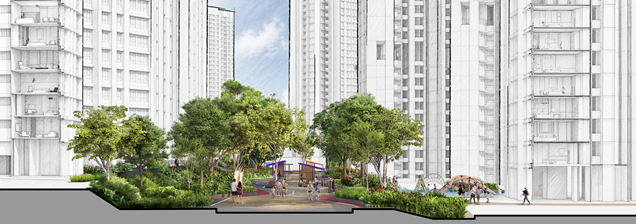
Toa Payoh West is the rare Singapore neighbourhood that can claim a front-row seat to the country's entire public housing story. It sits inside Toa Payoh — the first satellite town HDB ever built, the estate Queen Elizabeth II toured in 1972, the place where the Housing Board chose to plant its own headquarters. Today, the western quadrant of that town is the focus of a fresh round of planning: new rail interchanges, a major transport corridor taking shape, a healthcare and community hub in the pipeline, and an ageing flat stock that is forcing hard questions about lease decay and redevelopment.
For anyone living in Toa Payoh West — or thinking about buying into it — the master plan is not an abstract planning document. It determines how long your commute takes, whether your block gets a lift upgrade or a redevelopment letter, how much your flat might be worth in five years, and what kind of neighbourhood your children grow up in.
This is a resident's guide to the Toa Payoh West HDB master plan: what is actually planned, what has already been delivered, what is still up in the air, and how to read the whole thing without falling for the hype.
Why Toa Payoh West Deserves a Closer Look
Toa Payoh occupies a strange position in Singapore's property psyche. It is old, dense, and utterly central — roughly 5 to 7 kilometres from the CBD depending on where you measure from — yet it is rarely the town that dominates cocktail-party property talk the way Bishan, Tampines or Punggol do.
That may be changing.
Three things are converging on the western side of the town:
- Rail access has quietly tripled. What used to be a single North-South Line corridor through Toa Payoh and Braddell is now supplemented by the Circle Line and Thomson-East Coast Line at Caldecott, plus the North East Line just across the boundary at Potong Pasir and Woodleigh.
- A major road project is under construction. The North-South Corridor — Singapore's first integrated expressway with dedicated bus lanes and a cycling trunk route — runs through the Toa Payoh area and is intended to reshape north-south travel.
- The flat stock is ageing into a policy question. Large numbers of Toa Payoh flats were built in the late 1960s and 1970s. Their remaining leases, their eligibility for upgrading programmes, and their redevelopment prospects are now central to how the estate evolves.
Layer on top the adjacency to Bidadari — the new estate built on the former cemetery grounds, which has brought thousands of new homes, a park, and a new bus interchange to the eastern edge of the area — and you have a neighbourhood in transition.
What a Master Plan Actually Is (And What It Isn't)
Before dissecting the specifics, it is worth being precise about vocabulary, because "master plan" gets used loosely in property marketing.
Singapore's planning system works in layers. The URA Master Plan is the statutory land-use plan, reviewed roughly every five years, that zones every parcel of land for a purpose — residential, commercial, industrial, green space — and sets a gross plot ratio that caps how intensively it can be built. The Concept Plan sits above it, setting the 40-to-50-year strategic direction. Below both sit implementation tools: HDB town and estate plans, the Remaking Our Heartland programme for mature estates, the Neighbourhood Renewal Programme, and block-level upgrading schemes.
Here is the critical distinction for residents: a master plan is a statement of intent, not a construction schedule. Zoning a site for higher-density residential use tells you what could happen. It does not tell you when, or by whom, or at what price.
| Document | Who publishes it | What it tells you | What it does NOT tell you |
|---|---|---|---|
| Concept Plan | URA | Long-term strategic direction for land and transport | Anything site-specific |
| Master Plan | URA | Zoning and gross plot ratio for each parcel | The development timeline |
| Remaking Our Heartland | HDB | Estate-level improvement plans | Firm completion dates for every item |
| HIP / EASE | HDB | Whether your block qualifies for upgrading | Whether your flat will be redeveloped |
| SERS / VERS | HDB | Selected redevelopment | Future selections |
Toa Payoh's estate-level planning has run through Remaking Our Heartland, the programme HDB rolled out for mature estates from the late 2000s onwards, in which Toa Payoh was included in an early batch announced in the early 2010s. The programme's typical deliverables — improved town centres, better connectivity, new community spaces, refreshed parks — are exactly the sorts of things that show up in Toa Payoh West today.
Pillar One: Transport — Three Rail Lines and a New Corridor
If you only track one variable in Toa Payoh West, track connectivity. It is the single most defensible driver of long-run housing demand, and it is the part of the master plan most clearly already delivered.
The rail build-out, in dates
When Rail Reached the Toa Payoh West Area
The chart tells a simple story: a neighbourhood that spent its first two decades with a single rail line now sits within reach of four.
- Toa Payoh and Braddell on the North-South Line remain the workhorses — direct, no-interchange rides to City Hall, Raffles Place and Marina Bay, with journeys to the CBD in the region of 15 to 20 minutes.
- Caldecott, an interchange between the Circle Line and the Thomson-East Coast Line, changed the geometry of the area when the TEL platforms opened in 2021. The Circle Line gives a one-hop route to the one-north and Buona Vista corridor; the TEL adds a second north-south spine linking to the Thomson area, Orchard, Marina Bay and eventually the East Coast.
- Potong Pasir and Woodleigh on the North East Line put the western and eastern fringes within reach of the north-east corridor and HarbourFront.
For residents in the Lorong 1 and Lorong 2 area, the practical effect is redundancy. When one line has a fault — and Singaporeans know the feeling — there is usually a second option. That kind of resilience is hard to price but easy to feel.
The North-South Corridor
The bigger medium-term change is the North-South Corridor, an expressway-plus-transit project running from Woodlands in the north down through estates including Toa Payoh towards the city.
What makes the NSC different from a conventional expressway is what it bundles together:
- Dedicated express bus lanes along the corridor, aimed at cutting bus journey times for commuters who are not near an MRT station.
- A cycling trunk route, tying into the wider island cycling network — a genuine change for a town where cycling has historically meant sharing narrow roads with cars.
- Expressway capacity for the remaining car traffic, intended to pull through-traffic off local roads.
Publicly stated timelines have pointed to completion in stages from the late 2020s, though major infrastructure projects in Singapore have slipped before (the Thomson-East Coast Line itself opened in stages across several years). Residents should treat any specific completion year as indicative rather than contractual.
The last-mile problem
Rail and expressways are the headline items, but the master plan's quality-of-life impact usually comes from the unglamorous stuff:
- Sheltered walkways linking blocks to transport nodes and markets — underrated in a country that gets 2,000-plus millimetres of rain a year.
- Barrier-free accessibility at older blocks, tied to lift upgrading.
- Bus service density, which determines whether a 400-metre walk to an MRT station is genuinely viable for an elderly resident.
Pillar Two: Amenities — Health, Learning and Community Under One Roof
The most consequential amenity decision in Toa Payoh's recent planning history is the move towards an integrated development in the town centre — a single complex co-locating a polyclinic, a library, sports and community facilities, rather than scattering them across separate sites.
The concept, as publicly announced, bundles together:
- A new polyclinic, expanding primary healthcare capacity in a town with a large and ageing resident population.
- A library, replacing or supplementing existing library provision.
- Sports and community facilities, including a community club component.
- Retail and community spaces at ground level, keeping the town centre commercially alive.
This is a meaningful shift in how HDB estates are planned. Older towns were built around separate, single-purpose buildings — a community centre here, a library there, a sports hall somewhere else. The integrated model, which has appeared in newer towns and in redeveloped mature estates, reduces the number of trips a resident needs to make and keeps footfall concentrated, which in turn supports the shops.
For Toa Payoh West residents specifically, the town-centre complex is a short bus ride or a 10-to-15-minute walk from most of the western blocks. The benefit lands in three places: eldercare (a polyclinic within the town is a genuine difference-maker for residents in their 70s and 80s), young families (library plus indoor play plus healthcare in one trip), and property fundamentals (a well-maintained town centre with public amenities sustains foot traffic and resale demand).
Beyond the headline project
The everyday amenity layer of Toa Payoh West is already strong and is the reason many long-time residents resist moving:
| Amenity type | What the area offers | Why it matters for residents |
|---|---|---|
| Hawker food | Neighbourhood markets and food centres, including the well-known Toa Payoh West market and food centre cluster | Affordable daily meals; a genuine social anchor |
| Community | Toa Payoh West Community Club and network of Residents' Committee spaces | Programmes, courses, void-deck activities |
| Sports and recreation | Town-centre sports facilities, swimming complex, stadium, SAFRA Toa Payoh | Something for every age band |
| Green space | Toa Payoh Town Park and smaller neighbourhood pockets; Bidadari Park nearby | Shade, exercise, family time |
| Healthcare | Existing polyclinic network plus the planned integrated facility | Primary care without a trip to the city |
| Education | A dense cluster of primary and secondary schools within and around the town | Shorter commutes for families with children |
| Food and retail heritage | Adjacency to Balestier and Whampoa's shophouse and makan belt | Character that newer towns cannot replicate |
That last row is not sentimental filler. Neighbourhood character is a real housing attribute. Estates with genuine street life, mature trees, and a food culture retain resale demand even when the flats themselves are old — something developers and buyers both understand.
Pillar Three: Housing — Renewal Without Wholesale Relocation
This is the part of the master plan that generates the most anxiety and the most speculation.
The lease decay question
Toa Payoh's earliest flats date to the mid-1960s. Even a flat completed in 1975 is now roughly 50 years into its 99-year lease, leaving around 49 years. A flat from 1968 has about 42 years left. That sounds like a long time — and for a 35-year-old buyer, it may well be — but it triggers real financing mechanics that every buyer should understand before signing anything.
The general rules of thumb, which apply across Singapore's HDB resale market:
- CPF usage is restricted when a flat's remaining lease does not cover the youngest buyer up to age 95. If the remaining lease covers the buyer to at least age 95, full CPF usage applies. If it covers the buyer to at least age 20 but falls short of 95, CPF usage is pro-rated. If the remaining lease is under 20 years, CPF cannot be used at all.
- HDB loan eligibility generally requires a remaining lease of at least 20 years.
- Bank financing becomes progressively harder and the loan quantum tighter as the remaining lease shortens, because the property's collateral value decays.
The practical consequence: a 40-year-old buying a Toa Payoh flat with 45 years left on the lease is in a very different financing position from a 40-year-old buying one with 80 years left. The master plan does not change that arithmetic. What it can change is whether the block gets selected for redevelopment, upgraded in place, or left to run down its lease.
The four renewal pathways
- HIP (Home Improvement Programme) upgrades older flats in place — structural repairs, bathroom and toilet refurbishment, and optional improvement items. It has been the main tool for keeping 1970s and 1980s stock liveable.
- EASE (Enhancement for Active Seniors) retrofits lifts, ramps and grab bars — critical in a town where a large share of residents are elderly.
- SERS (Selective En bloc Redevelopment Scheme) redevelops specific sites, rehousing residents nearby with compensation and a replacement flat. It is selective by design and has become rarer over time.
- VERS (Voluntary Early Redevelopment Scheme), announced at the 2018 National Day Rally, is intended for older flats approaching the 70-year mark. It is voluntary in principle, subject to collective agreement and — crucially — to fiscal resources and sequencing. No resident should plan their finances around a VERS announcement that has not happened.
The honest read for Toa Payoh West: a mix of all four outcomes is likely, block by block. Some blocks will be upgraded and left to age. A small number may be selected for redevelopment. Most will simply continue, with prices gradually reflecting shortening leases.
New supply on the doorstep
Housing supply in the immediate area has also expanded through Bidadari, the new estate developed on the former cemetery grounds to the east of Toa Payoh. Launched progressively from 2015, Bidadari added a substantial tranche of new BTO flats with fresh 99-year leases, plus a park with a lake, and a new neighbourhood centre with a bus interchange.
Bidadari matters to Toa Payoh West in two ways:
- Competition. A buyer choosing between a 50-year-old Toa Payoh flat and a 5-year-old Bidadari flat with a full lease is weighing price against lease against location. Bidadari's supply has given buyers a genuine alternative within the same general area.
- Complementarity. The new estate brings amenities, transport improvements and retail that Toa Payoh West residents also use. New supply is not purely a threat; it upgrades the shared infrastructure.
What It Means for Current Residents
If you already live in Toa Payoh West, the master plan's effects break down into short-term disruption and long-term gain.
The gains:
- Better rail redundancy as the Caldecott interchange matures and TEL services settle into full operation.
- Faster bus journeys once the North-South Corridor's dedicated bus lanes come online.
- A materially better healthcare and community offer once the integrated town-centre development is built.
- Continued lift and accessibility upgrades under EASE and HIP, which disproportionately improve life for older residents.
The costs:
- Construction noise and dust. Corridor works and any new development bring years of it. Residents near worksites should expect this and cannot negotiate it away.
- Disruption to familiar routes. Bus stop relocations, temporary road diversions and closed pedestrian links are standard during major infrastructure builds.
- Uncertainty about your own block. The single most stressful part of living in a mature estate is not knowing whether your block will be upgraded, selected for redevelopment, or neither. HDB does not publish a redevelopment queue, and it would be misleading to pretend otherwise.
The pragmatic advice for existing residents is unglamorous: participate in the consultations that do happen (town-level engagement exercises, NRP and HIP polling), keep your flat in good repair because upgrading programmes reward well-maintained blocks, and do not make irreversible financial decisions based on rumoured redevelopment.
What It Means for Future Residents and Buyers
For the 25-to-40 crowd weighing up a Toa Payoh West purchase, the master plan cuts both ways.
The case for buying in
- Location is genuinely central. Very few HDB towns offer this combination of proximity to the CBD, three-plus rail lines, mature amenities and established food culture.
- Supply is constrained. Toa Payoh is a built-up mature estate. There is limited room for large new BTO launches within the town itself, which supports resale demand over time.
- Infrastructure is improving, not deteriorating. The direction of travel on transport and amenities is positive.
- Rental demand is deep. Central mature estates with good rail access attract a broad tenant pool, which matters if you plan to rent out after MOP.
The case for caution
- Lease decay is real and priced in — imperfectly. Older flats in the town carry meaningfully shorter leases. Buyers who pay a "central location" premium without discounting for lease can end up overpaying relative to a newer flat further out.
- Financing constraints bite earlier than most people expect. Run the CPF and loan maths on the remaining lease, not the original 99 years.
- Upgrading is not guaranteed at the block level. HIP coverage has been extended over time but is not universal, and EASE depends on block configuration.
- You are buying into a construction zone for a while. Corridor works and town-centre redevelopment mean several years of inconvenience before the payoff.
A useful discipline: compare any Toa Payoh West flat against a newer alternative within a comparable commute — Bidadari, Bishan, Potong Pasir, or further out along the TEL or NEL. If the Toa Payoh flat still wins on total cost of ownership after adjusting for lease, renovation, and financing, buy it. If it only wins on vibes, think harder.
The Risks and Realities Nobody Puts in the Brochure
A responsible reading of the master plan has to include the caveats.
Timelines slip. The Thomson-East Coast Line opened in stages across roughly four years. The North-South Corridor's completion has been publicly discussed in terms of staged delivery from the late 2020s. Any resident planning their life around a stated completion date should build in a buffer.
Zoning is not a promise. A site zoned for higher-density residential use may sit undeveloped for a decade. White sites — parcels with flexible zoning — can become anything from offices to homes. Treat the URA Master Plan as a map of possibilities, not a construction calendar.
Redevelopment is selective. SERS has become less frequent over the years, and VERS is explicitly contingent on fiscal resources. The expectation that "old estate equals en bloc" is a generational misunderstanding that has cost some buyers dearly.
Amenity improvements are shared, not private. A better town centre lifts the whole neighbourhood. It does not create a windfall for any single block. Owners who buy expecting a personalised uplift from a new library are likely to be disappointed.
Market cycles still dominate. Between 2021 and 2023, HDB resale prices rose sharply across the board before cooling measures and rising interest rates dampened momentum. Estate-level plans do not immunise any town against the cycle. Anyone buying in 2025 should assume normal market risk.
Food for Thought
-
If a flat has 45 years of lease left, what are you actually buying — a home, or a 45-year rental with a resale option? How would your answer change if you plan to live there for 30 years versus 10?
-
How much of Toa Payoh West's premium is location, and how much is nostalgia? Mature estates command a premium for character and food culture — but character does not pay your mortgage when the lease is half gone.
-
Would you rather have a bigger flat in a newer town with 95 years left, or a smaller flat in Toa Payoh West with 50? Be honest about which you would actually choose versus which sounds better in conversation.
-
What happens to a mature estate when the first generation of residents ages out? Toa Payoh's demographics are shifting. Does the master plan's emphasis on healthcare and accessibility reflect who will live there in 2040, or who lives there today?
-
If the government announced VERS for your block tomorrow, would you take it? The compensation and replacement flat trade-off is rarely as generous as residents imagine, and the decision is collective rather than individual.
The Bottom Line
The Toa Payoh West HDB master plan is best understood not as a single document but as a stack of intentions: statutory zoning from URA, estate-level improvement from HDB, block-level upgrading, and a transport programme that has been delivering in stages for close to four decades. The direction is clearly positive — more rail, better buses, a modern healthcare and community hub, and continued investment in an estate that could easily have been left behind.
But the plan's benefits are unevenly distributed across time and across blocks. The resident who benefits most from Toa Payoh West's next decade is the one who reads the details: who checks the remaining lease before falling in love with a renovated unit, who understands that HIP is an upgrade and not a redevelopment promise, and who treats a completion date on a slide as an aspiration rather than a certainty.