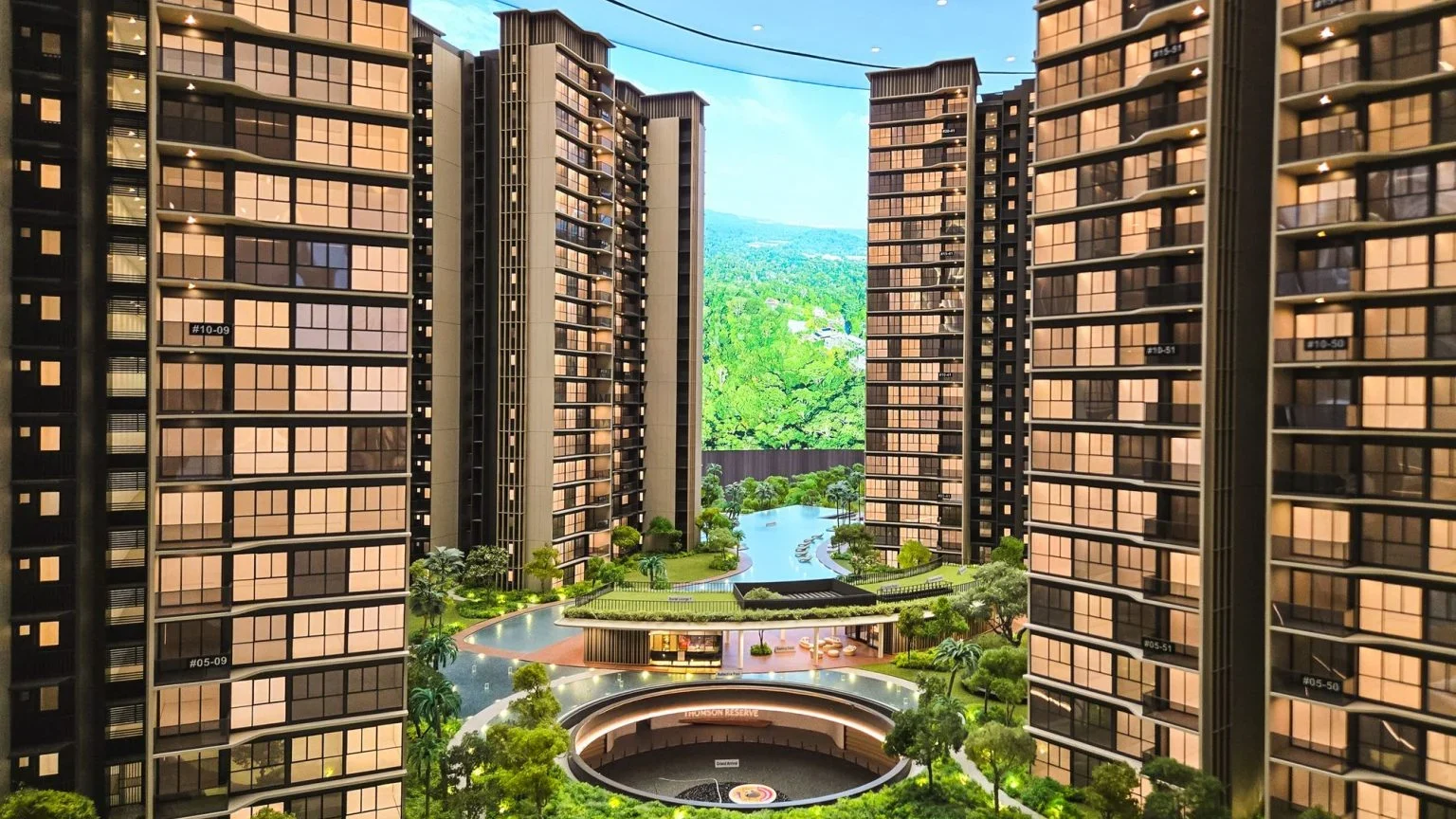
In Singapore's new launch market, a project's entire reputation is decided in about 48 hours. The first weekend of sales — the queue photographs, the sold-out stickers, the caveats that appear on URA's database a fortnight later — becomes the number that agents quote for the next three years, and the anchor against which every subsequent buyer negotiates.
For the Thomson corridor, 2026 is the year that ritual returns. Thomson Reserve arrives into a stretch of Singapore that has spent most of the past decade starved of new supply, sandwiched between the mature private enclaves of Bishan and Ang Mo Kio and the newer, louder launch cluster up at Lentor. That scarcity is the whole investment case in one sentence. But scarcity alone does not clear a launch — pricing, unit mix, tenure, financing conditions and the shadow of nearby competition all decide whether a project sells 70 per cent of its units on day one or 30 per cent.
This is a breakdown of the Thomson Reserve launch sales picture for 2026: what the pricing says relative to the corridor's benchmarks, what the take-up numbers reveal about genuine buyer appetite versus pent-up curiosity, and what both mean for anyone weighing a purchase — or simply trying to read where the Singapore property market is heading next.
A note on method: launch-weekend figures for comparable projects below are as reported in URA caveats and contemporaneous coverage at the time of each launch, and median psf figures are indicative rather than exact. Buyers should verify live caveats before committing to anything.
The Thomson Corridor's Supply Story
To understand why Thomson Reserve matters, you first need to understand how little has happened along this road.
The Thomson corridor's modern launch cycle ran roughly from 2012 to 2018. That wave produced the projects that now form the area's resale backbone — Thomson Three, Thomson Impressions, Thomson Grand, and a scattering of boutique freehold blocks further south towards Novena. Since then, the corridor has been largely quiet, with new supply concentrated instead at Lentor, roughly three MRT stops north, where a cluster of government land sale sites has produced a rolling pipeline of launches since 2022.
That gap matters because demand never stopped. Upgraders from Ang Mo Kio, Bishan and Toa Payoh — many sitting on substantial HDB gains — have had to look either north to Lentor, south to the city fringe, or sideways into ageing resale stock. A new project with a fresh 99-year lease, modern layouts and a full suite of facilities is not competing against ten identical projects. In the immediate catchment, it is competing against almost nothing.
The infrastructure backdrop has shifted too:
- Thomson-East Coast Line Stage 2 opened in August 2021, bringing Upper Thomson, Bright Hill, Mayflower, Lentor and Springleaf stations online. The corridor went from bus-dependent to rail-connected in a single phase.
- Bright Hill will become an interchange when Cross Island Line Phase 1 opens — currently targeted around 2030 — giving the area a direct link eastwards towards Ang Mo Kio, Hougang, Pasir Ris and the aviation cluster at Changi.
- The North-South Corridor, the expressway-plus-transit-priority spine running down through the north of Singapore, continues to progress, with completion expected later this decade.
Put simply: the corridor's transport connectivity is being upgraded after the housing stock was built, not before. That is the opposite of what happened at Lentor, where the MRT arrived into what was then a relatively empty landscape, and where the launch cluster followed the tracks. Thomson's existing residents get the windfall; Thomson Reserve gets to sell into it.
Reading a Launch: The Four Numbers That Actually Matter
Most launch coverage reduces to a single headline — "X per cent sold on day one". That number is useful but incomplete. When analysts and repeat buyers assess a launch, four figures carry most of the signal.
1. Launch-weekend take-up rate
The share of total units sold in the first weekend. This is a measure of how well the developer read the market. A high take-up at a high price suggests genuine pricing power; a high take-up at a low price suggests the developer left money on the table but secured a clean sell-out. Both are informative, but they mean opposite things for later buyers.
2. Median psf against the corridor
A launch price only means something relative to what is already trading nearby. A project that prices 10 per cent above the most recent comparable launch is making a bet on the corridor's upward trajectory. A project that prices at or slightly below the comparable is buying market share.
3. Unit-mix absorption
Total take-up hides the detail. If the two- and three-bedroom stacks clear while the one-bedroom plus study units sit, that tells you the buyer pool is upgraders and families, not investors. If the small units move first, the opposite. This distinction shapes what the project looks like as a rental market three years later.
4. The absorption curve after week one
Launch weekend is theatre; the following eight weeks are the real market. A project that sells 70 per cent in a weekend and then 3 per cent a month for the next quarter has found its clearing price. One that keeps trickling in at a steady 5 per cent a month may have been underpriced.
The important insight for buyers: the launch price becomes the project's resale floor for years. Early buyers set the benchmark, and no subsequent seller wants to be the first to transact below it. That is why launch pricing — not launch hype — is the number worth studying.
Thomson Reserve Price Trends: Where the Launch Sits on the Corridor Ladder
Singapore's private residential market entered 2026 in a much calmer phase than the post-pandemic surge. The Urban Redevelopment Authority's private residential price index has decelerated steadily since the 2021 peak, when the market rose 10.6 per cent in a single year.
URA Private Residential Price Index: Annual Change (%)
That deceleration is not a crash — it is a normalisation. Prices are still rising, just at a pace closer to household income growth than to speculative momentum. For a launch like Thomson Reserve, this is arguably the ideal backdrop: enough confidence in the market for buyers to commit, not so much froth that every unit is chased by five parties and the developer can afford to price aggressively.
The corridor benchmark
To place Thomson Reserve's pricing, you need a ladder. Here is how recent 99-year leasehold launches in the surrounding corridors have been reported:
| Project | Locality | Tenure | Units | Launch | Reported launch-weekend take-up | Reported median psf at launch |
|---|---|---|---|---|---|---|
| Chuan Park | Lorong Chuan | 99-year | 916 | Nov 2024 | ~74% | ~$2,580 |
| Lentor Mansion | Lentor | 99-year | 533 | Mar 2024 | ~75% | ~$2,280 |
| Lentor Modern | Lentor | 99-year | 605 | Sep 2022 | ~84% | ~$2,080 |
| AMO Residence | Ang Mo Kio | 99-year | 372 | Jul 2022 | ~98% | ~$2,110 |
Reported Median psf at Launch (Indicative)
Three things jump out of that table.
First, Chuan Park reset the ceiling. At roughly $2,580 psf median in November 2024, the Lorong Chuan project — a 916-unit, 99-year leasehold development on a former en bloc site — priced well above the Lentor cluster and, crucially, still sold about three-quarters of its units on launch weekend. That combination of price and absorption is the strongest evidence in recent years that well-located, mid-sized-suburban supply in the Thomson-to-Serangoon band has deeper demand than the market expected.
Second, the Lentor premium is real but capped. Lentor Modern launched at roughly $2,080 psf in 2022 and Lentor Mansion at around $2,280 psf in 2024 — a meaningful step up in eighteen months, tracking construction cost inflation and the corridor's growing amenity base. But Lentor sits further from the established Bishan/AMK family catchment, and its own pipeline is deep. Buyers there are paying for a new precinct, not for scarcity.
Third, AMO Residence is the closest thing to a scarcity proof. Ang Mo Kio had effectively no new private supply for years; when 372 units launched at around $2,110 psf, almost the entire project cleared on day one. That was not a price story — it was a supply story.
Where does that leave Thomson Reserve?
Thomson Reserve's launch pricing should be read against that ladder rather than in isolation. The corridor's 99-year leasehold band has, in reported terms, run from roughly $2,100 psf in the Lentor core to about $2,580 psf at the Lorong Chuan peak, with the Thomson stretch sitting logically between them — closer to the family catchments of Bishan and AMK than Lentor, but without the immediate regeneration story of Chuan Park.
Two structural factors shape how buyers will judge the number:
Tenure composition of the corridor. Along Thomson Road itself, a substantial share of the older stock is freehold or very long leasehold boutique development — smaller blocks from the 1990s and 2000s. That freehold premium is a genuine competitor. A 99-year leasehold launch has to justify itself on layout efficiency, facilities, financing headroom on a new build, and deferred payment of major repair costs, because it will never win the tenure argument outright.
The age gap. The 2012–2018 wave of Thomson projects is now roughly eight to fourteen years old — old enough to be "resale" in buyers' minds, young enough that condition is not a problem. That is the direct competition, and it trades at a discount. The question every buyer should ask is whether the new-launch premium is buying something real: better layouts, lower maintenance risk, a fresh 99-year clock, and the intangible benefit of being first into a building rather than the fifth owner of a unit.
Buyer Demand: What the Sales Numbers Say
Take-up rates across the corridor's recent launches tell a consistent story about what Singapore buyers reward.
Reported Launch-Weekend Take-Up (%)
The pattern is not "cheaper sells better" — Lentor Mansion at roughly $2,280 psf moved a similar share of its units as Lentor Modern at roughly $2,080 psf. Nor is it "expensive fails" — Chuan Park at the corridor's top price still cleared nearly three-quarters of 916 units, which in absolute terms is around 680 households committing in a weekend.
What the data actually rewards is a clear value proposition relative to the immediately available alternative. AMO Residence's near sell-out reflected a catchment with no alternative. Lentor Modern's strong launch reflected a genuinely new precinct coming online with an MRT station attached. Chuan Park's performance reflected a large, well-known site within walking distance of an MRT interchange and established schools.
The demand signal dashboard
Rather than reading a single number, here is how to interpret the signals that emerge in the weeks after a launch.
| Signal | Strong appetite | Weak appetite | What it implies |
|---|---|---|---|
| Launch-weekend take-up | Above ~70% of total units | Below ~40% | Developer's price read was accurate vs over-optimistic |
| Absorption by bedroom type | 2BR and 3BR clear first | 1BR and small formats clear first | Family upgraders vs investor-led demand |
| Price movement post-launch | Developer holds or trims discounts | Developer quietly adds rebates, absorbs stamp duty | Real demand below headline |
| Subsequent phase pricing | Later phases priced higher | Later phases priced flat or lower | Confidence in the corridor |
| Sub-sale and rental listings within 24 months | Few listings | Heavy early listing volume | Investor-heavy buyer pool, potential rental pressure |
| Caveat volume in weeks 2–8 | Steady trickle | Drop-off to near zero | Launch weekend was pull-forward, not sustained demand |
For Thomson Reserve specifically, the most telling indicator will be which unit types disappear first. If the three-bedroom family stacks clear while the compact units linger, the project has found its natural buyer — upgraders from the surrounding HDB estates — and the resale market for those units in five to eight years will be deep and family-driven. If the small units lead, the buyer pool is investor-weighted, and the project's rental performance will matter far more to its long-term value than its own amenity offering.
The financing tailwind
The other variable that has changed since the 2021–2022 launch boom is the cost of money. Singapore mortgage rates, which spiked through 2023 and 2024, softened considerably through 2025 as global rate expectations eased. Fixed-rate packages reportedly settled in the region of 2 per cent for well-qualified borrowers, with SORA-pegged floats tracking lower as the benchmark rate fell.
That matters more than most buyers realise, because TDSR at 55 per cent governs how much a household can borrow, and the stress-test floor used by banks does not move down as quickly as headline rates. A buyer who could comfortably service a $2.2 million loan at 2 per cent may find their maximum loan quantum unchanged even as their monthly instalment falls — but their cash flow improves meaningfully, which is what allows them to stretch from a two-bedroom to a three-bedroom.
Lower rates also do something subtler: they widen the pool of buyers who can clear the 20 per cent ABSD on a second property. That group — existing homeowners upgrading without selling first — is a significant slice of the new launch market, and it is highly sensitive to both rate levels and their own equity gains.
The Demand Drivers Behind Thomson in 2026
Demand for a project is never just about the project. Here is what is genuinely pulling buyers towards this stretch of Singapore.
Schools, and the quiet power of the 1km rule
The Thomson–Bishan–Ang Mo Kio belt contains one of the densest concentrations of sought-after schools in Singapore. Ai Tong School, Catholic High School, CHIJ St Nicholas Girls' and Raffles Institution all sit within a short drive, and primary school registration under the 1km priority phase remains one of the most reliable demand generators in the resale market.
For families with young children — precisely the 30-to-40 age band that drives three-bedroom demand — proximity to a preferred primary school can be worth more than a view or a facilities deck. It is also the single most durable driver of resale liquidity a project can have.
The HDB upgrader pipeline
The surrounding estates have seen significant HDB resale price growth over the past five years, and a meaningful cohort of flat owners now hold sale proceeds that comfortably cover a private downpayment. With the Loan-to-Value limit at 75 per cent for a first housing loan, a household selling an HDB flat in Ang Mo Kio or Bishan and buying a private unit typically needs to fund roughly a quarter of the price in cash and CPF.
That is the core buyer for Thomson Reserve. They are not yield-chasing investors; they are households trading a flat for a condominium in the same general area, close to parents, schools and familiarity. Their decision is driven by layout, price per square foot relative to what their flat sale realised, and whether the monthly instalment fits comfortably.
The Lentor spillover — and the competitive threat
Here is the double-edged part of the story. The Lentor cluster's success has validated the whole northern corridor, drawing attention and infrastructure investment. But it has also created a deep pipeline of competing 99-year leasehold supply just a few MRT stops away, much of it at lower psf.
A buyer comparing Thomson Reserve against a Lentor project is really comparing two different bets:
The honest framing is this: Thomson Reserve's advantage is scarcity in an established location. Lentor's advantage is price and a coordinated new town plan. Both are legitimate; they suit different buyers.
Lifestyle and the Upper Thomson effect
You cannot analyse this corridor purely on spreadsheets. Upper Thomson Road has one of the more distinctive food and lifestyle strips in Singapore — the Casuarina curry houses, the Springleaf prata establishments, the old-school shophouse stretch near Upper Thomson MRT. For younger buyers in the 25-to-35 bracket, that texture is a genuine pull factor that no Lentor masterplan can replicate quickly, and it takes years to build organically.
Risks: What Could Flatten the Curve
No launch analysis is complete without the downside case. Here is what could suppress Thomson Reserve's absorption.
- A deeper supply pipeline than the headline suggests. If multiple GLS sites in the broader north region are triggered and launched within the same 18-month window, buyers gain leverage and developers compete on price rather than amenity.
- Rate reversal. Mortgage rates have softened, but they remain sensitive to global conditions. A renewed upward move in SORA would compress affordability quickly, particularly for buyers already stretching to a three-bedroom.
- Policy risk. The cooling measures regime has been tightened repeatedly over the past five years, and the current ABSD structure — 20 per cent for a citizen's second property, 30 per cent for the third and beyond, 60 per cent for foreigners — has already removed a large slice of investor demand. Any further tightening would hit sentiment first and prices second.
- SSD discipline. Seller's stamp duty still bites for anyone exiting within the first few years. Buyers who over-leverage into a launch expecting a quick flip are the ones most exposed if the market flattens.
- Resale competition from within the corridor. The 2012–2018 projects will be 10 to 15 years old in the early 2030s. They will trade at a discount to Thomson Reserve, and they will absorb a portion of the same buyer pool at exit.
What This Means for Resale and for Buyers
Launch data has a second life. It sets expectations.
If Thomson Reserve clears a strong majority of its units at launch, three things follow. First, the developer gains the confidence to hold prices firm on remaining units rather than discounting quietly — which supports the project's resale floor. Second, the surrounding resale market gets a psychological lift: owners of older Thomson stock will point to the new benchmark when negotiating. Third, land banking sentiment in the corridor strengthens, making future GLS sites in the area more competitive and, eventually, more expensive to develop.
If absorption is slower — say, under half the units in the first weekend — the opposite occurs. Discounts appear as "star buys" and "developer's ABSD absorption". Early buyers watch their purchase price get undercut by their own developer. And the resale market simply ignores the launch as a benchmarking event.
For an individual buyer, the practical decision tree looks like this:
The single most useful habit: compare the launch psf against the resale psf of an equivalent, well-maintained project two streets away, then ask what the difference buys you. If the answer is "a fresh lease, better layout, a pool deck and no renovation", it may be worth it. If the answer is "a newer lobby", it probably is not.
Food for Thought
1. Is scarcity genuinely priced in, or is it a story developers tell? The Thomson corridor has little new supply today — but the GLS pipeline and the Lentor cluster mean buyers have alternatives within a 10-minute drive. How much of a premium should a truly scarce location command in a market where a competing new town exists nearby?
2. Who is actually buying — and does it matter? A launch dominated by owner-occupier upgraders behaves very differently from one dominated by investors. Owner-occupiers hold; investors list. If the small units move first at Thomson Reserve, what does that tell you about the rental market in 2030 when several hundred units in the same building come off their minimum occupation period?
3. Does the CRL interchange premium arrive before or after you need to sell? Bright Hill's transformation into an interchange is targeted around 2030. Buyers with a five-year horizon may be selling into a market that has already priced the announcement but not yet delivered the service. Where in that gap is the value?
4. Are interest rates doing the heavy lifting? A meaningful part of current affordability comes from mortgage rates near 2 per cent rather than from incomes rising. If rates normalise upward by a percentage point, which buyer segment exits the market first — and does that change the clearing price for a three-bedroom unit?
5. What happens to the 2012–2018 stock? The Thomson corridor's own resale supply will hit its 15-to-20-year mark just as newer projects mature. Do those older units become the value option for the next generation of upgraders, or do they become the corridor's stranded assets as buyers concentrate on newer leasehold?
Conclusion
Thomson Reserve's 2026 launch is best understood not as a standalone event but as the corridor's first real test in nearly a decade. The benchmarks are clear: Chen Park demonstrated that mid-$2,000s psf is achievable in this band of Singapore when location and scale are right; AMO Residence demonstrated that a supply-starved catchment will absorb almost anything decently priced; Lentor demonstrated what happens when you build an entire precinct at once.
The demand drivers behind this launch — TEL connectivity, the coming CRL interchange at Bright Hill, school catchments, a deep HDB upgrader pipeline and softening mortgage rates — are as strong as any suburban corridor in Singapore can offer. The risks — competing supply, policy tightening, rate reversal, and the eventual resale competition from the corridor's own ageing stock — are equally real.
What separates a good launch from a great one is rarely the marketing. It is whether the developer priced into the market rather than above it, and whether the unit mix reflects who actually lives in the neighbourhood.