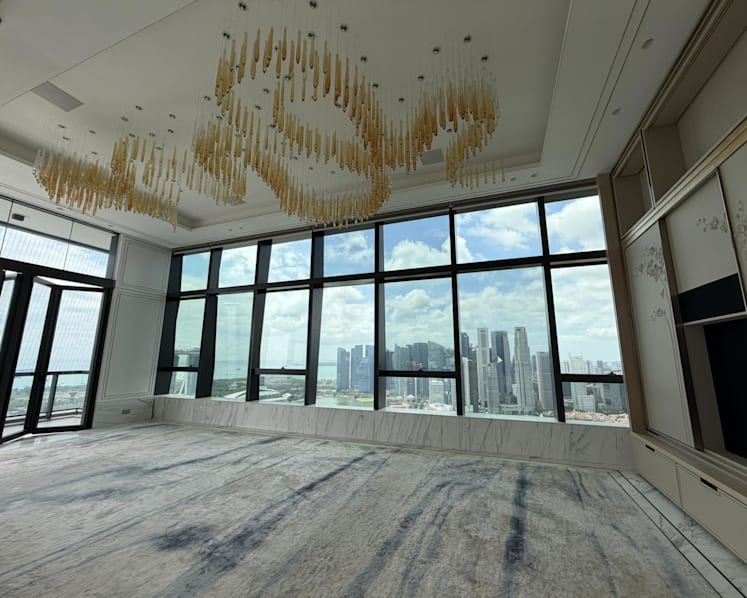
When Singapore police revealed in August 2023 that they had frozen and seized assets worth billions of dollars in what became one of the world's largest money-laundering probes, the headlines were dominated by the glamorous stuff: rows of designer handbags, stacks of gold bars, luxury cars wrapped in evidence tape, and — most intriguingly for anyone who follows the property market — bungalows in Sentosa Cove and Good Class Bungalow plots in prime districts.
Almost immediately, a very Singaporean question surfaced in WhatsApp groups and forums: so when do these houses go on sale, and how cheap can I get one?
It is a fair question. Seized property auctions in Singapore, mortgagee sales, and bank-repossession listings all carry the same seductive promise: assets sold under duress, by sellers who are not negotiating for the best price. For a young buyer priced out of the resale market, the idea of picking up a discounted home from a "forced sale" is irresistible.
The reality is more complicated, and considerably more interesting. Seized property rarely reaches a public auction hall in the way most people imagine, the discounts are often measured against the wrong benchmark, and the gap between the hammer price and your true cost can swallow most of the headline saving. This guide walks through how seized and distressed property actually reaches the market in Singapore, what kinds of homes are involved, and what you need to know — legally, financially and practically — before you raise a paddle.
The S$3 Billion Case That Put Seized Property on the Map
On 15 August 2023, officers from the Singapore Police Force conducted simultaneous raids across the island and arrested ten foreign nationals in connection with a massive money-laundering operation. According to police statements and subsequent press reporting, the assets seized or placed under prohibition of disposal orders ran into the billions of dollars — a scale of financial crime Singapore had not previously seen.
The asset list reported at the time read like a luxury inventory: hundreds of properties, dozens of vehicles, handbags, watches, gold bars, cryptocurrency, and even bottles of duty-unpaid liquor. Several of the arrested individuals were subsequently convicted, sentenced to jail terms, and deported, and barred from re-entering Singapore.
For the property market, three things mattered:
- The properties were not "repossessed" in the normal sense. They were subject to Prohibition of Disposal Orders (PDOs) — legal instruments that prevent the owner from selling, transferring or dealing with the asset while investigations and proceedings are ongoing.
- Many were held through companies, trusts or nominee arrangements, not directly in the name of the accused. Untangling ownership added months to the process.
- Disposal was not automatic. Only after conviction, confiscation proceedings, or a negotiated resolution could the state realise the assets — and even then, the mechanism is usually a tender or an appointed marketing agent, not a dramatic open-outcry auction.
The case also triggered a broader policy response. An inter-ministerial committee on anti-money laundering published a national strategy, and the reporting obligations on dealers in precious stones and metals, corporate service providers and real estate professionals were tightened. In other words, the same case that made "seized property" a household phrase also made buying such property more scrutinised, not less.
How Seized Property Auctions in Singapore Actually Work
Here is where expectations collide with reality. In cities like Australia, the UK or Hong Kong, distressed and repossessed property moves through a well-oiled auction circuit with public viewing days and a visible crowd. Singapore has an auction circuit too — but the flow of a criminally seized asset through it is rare, slow and heavily intermediated.
The key takeaway from that flow: between "police seize house" and "buyer collects keys", there are at least three gates — the criminal case, the confiscation process, and the property transaction itself. Each can stall independently.
There are several distinct legal routes that end with a property being sold against the owner's wishes:
- Criminal Procedure Code (CPC) seizure and PDOs. The police can seize property and the Public Prosecutor can obtain orders preventing disposal. Where the asset is not needed as evidence, the state may eventually seek to realise it, but only after the underlying proceedings are resolved or the order is varied.
- Confiscation under the Corruption, Drug Trafficking and Other Serious Crimes (Confiscation of Benefits) Act (CDSA). The court can make confiscation orders against the benefits of crime; realising those benefits can involve selling property.
- Insolvency and receivership. A bank appoints a receiver over a mortgaged property, or a liquidator sells company assets. This is the most common source of "forced sale" residential stock in Singapore.
- Bankruptcy. The Insolvency and Public Trustee's Office can deal with a bankrupt's share of property, subject to the interests of co-owners and the family home rules.
- Mortgagee sales. The bank, as mortgagee, exercises its power of sale after default. This is the classic "auction property" most Singapore buyers actually encounter.
What this means practically: if you see a listing advertised as a "seized property" or a "money-laundering-linked home", it is almost certainly being marketed either (a) by an agent appointed by the police or the state, (b) through a tender exercise, or (c) by private treaty after the legal order has been discharged. The dramatic auction-hammer moment is the exception, not the rule.
The Four Kinds of Property Auctions in Singapore (Only One Is Truly "Seized")
If you want to buy distress property in Singapore, you need to know which sale you are walking into, because the rules, warranties and risks differ enormously.
| Type | Who is selling | Why it happens | Typical stock | Key risk for buyers |
|---|---|---|---|---|
| Mortgagee sale | The bank, via auction or tender | Borrower defaulted on the loan | Private condos, landed homes, occasionally HDB flats, commercial units | Sold "as is where is"; occupant may still be in place; limited inspection |
| Receiver / liquidator sale | Receiver or liquidator of a company | Company insolvency or secured creditor enforcement | Commercial buildings, shophouses, industrial units, en-bloc sites | Title and tenancy complexity; arrears and tax exposure |
| Owner / estate sale | Owner, estate executor or administrator | Urgency, divorce, inheritance, relocation | Wide range, from HDB flats to prime landed | Seller sets a reserve price close to market; discounts are thin |
| State or PDO-linked disposal | Police-appointed agent, state, or court-directed sale | Asset confiscated or being realised after criminal proceedings | Prime landed property, Sentosa Cove bungalows, high-end condos, luxury cars | Extended timeline; clearance from prosecutor or court required before completion |
A few practical notes on each:
Mortgagee sales: the most common route
This is what most people mean by a "bank auction". The bank's power of sale arises from the mortgage documents, and the sale is usually conducted through an auctioneer under conditions of sale drafted by the bank's lawyers.
- The property is almost always sold on an "as is, where is" basis, with no warranty as to condition, tenancy or defects.
- Viewings are often limited or entirely unavailable — especially where the premises are occupied.
- The bank does not need to obtain the best possible price, only to act in good faith and take reasonable steps to obtain a proper price. That is a lower bar than a private seller's negotiating instinct.
- Crucially, a mortgagee sale does not clear every encumbrance. Existing tenancies, easements, and certain statutory charges can survive the sale. Your lawyer must check what runs with the land.
Receiver and liquidator sales
When a property-owning company fails, the receiver sells the asset to repay the secured creditor. These sales frequently involve shophouses, strata commercial units, industrial space and small en-bloc sites rather than homes.
The complications here are commercial: existing leases with below-market rents, arrears of property tax, management corporation contributions, and sometimes unapproved renovations. The due diligence burden is heavier, but so is the potential upside if you understand the asset class.
Owner and estate sales
These make up the bulk of lots at Singapore auction houses such as Edmund Tie, Knight Frank, SLP International and JLL. Many are not distressed at all — they are owners testing the market with a reserve price, using the auction as a marketing showcase. If bidding fails to reach the reserve, the property typically returns to the market as a private treaty sale.
A guide price is not a reserve price. The guide is marketing; the reserve is the seller's floor. Confusing the two is the single most common cause of auction disappointment.
State-linked disposals
These are the rarest and the most newsworthy. Where assets linked to a criminal case are realised, the process tends to run through:
- A court order or prosecutor's clearance permitting disposal.
- An appointed marketing agent or a tender exercise.
- Extended due diligence by the buyer's lawyers, including checks on caveats, charges and any residual orders.
- Completion only after all clearances are in place.
That last point matters more than anything else in this article. The legal encumbrance is the product feature, not a bug — and it is precisely why these properties can be priced below comparable stock.
What Kinds of Homes Come Under the Hammer
Looking at both the recent money-laundering disposals and the broader distressed-sale market, the stock profile is fairly consistent:
- Prime freehold landed property. Sentosa Cove bungalows, Good Class Bungalows in districts 10 and 11, and semi-detached houses in established estates. These are the lots that generate headlines and the ones least likely to be a genuine bargain, because the buyer pool — while small — is extremely well capitalised and well advised.
- High-end condominium units. Districts 9, 10, 11 and 15 feature heavily, alongside Sentosa and Marina Bay addresses. Individually, these are the most accessible entry point for a buyer with a normal mortgage — though "accessible" here still means seven figures.
- Shophouses and commercial strata units. Common in liquidator and receiver sales. Attractive to investors who understand tenancy schedules and conservation rules.
- Industrial and office units. Often sold with sitting tenants at rents negotiated years ago; the yield on paper can look excellent until you mark it to market.
- HDB flats. Rare, but they do appear in mortgagee sales. If you are buying one, HDB eligibility rules, the Minimum Occupation Period, the Ethnic Integration Policy and HDB's consent requirements all still apply. A mortgagee sale is not a shortcut around public housing rules.
- Overseas and luxury non-property assets. Cars, watches, handbags and wine are frequently sold in separate exercises, sometimes via specialist auctioneers.
One structural point that young buyers should internalise: the distressed market is not a discount supermarket for entry-level homes. The properties that reach auction tend to be either high-value assets with complex ownership, or ordinary homes whose owners hit financial trouble — and the latter are usually sold quietly to avoid the stigma and the low clearance rates of the auction room.
Why the Headline Discount Is Usually an Illusion
Now to the heart of it. A reported "30 per cent below market" or "S$5 million below valuation" sounds extraordinary. In practice, several mechanisms systematically inflate the apparent discount.
The reference-price trap
Discounts are calculated against a reference point, and that reference point is often wrong:
- Stale valuations. A valuation obtained eighteen months ago in a rising market understates today's value — or overstates it in a falling one.
- Asking prices, not transacted prices. "20 per cent below asking" is meaningless if the asking price was aspirational.
- A guide price well below the reserve. Auctioneers publish low guide prices to generate turnout. The property may never actually sell at that level.
- Apples-to-oranges comparables. A tenanted, unrenovated unit with an expiring lease is not comparable to a vacant, renovated unit on a high floor, even in the same block.
The only valid comparison is a recent transacted price for a genuinely comparable unit, adjusted for condition, floor, facing, tenancy and timing.
The liquidity discount
Seized and distressed properties are, by definition, harder to buy. That difficulty is a real cost, and it is priced in:
- You may not be able to view the interior.
- You cannot insert a "subject to loan" or "subject to valuation" clause in most auction sales.
- You must complete on a fixed date regardless of whether your financing lands.
- You may inherit occupants, arrears or disputes.
A rational buyer demands compensation for that. The "discount" is often exactly that compensation — not free money.
The cost stack nobody advertises
The gap between the hammer price and your true cost is where bargains go to die.
| Cost item | What to expect | Notes |
|---|---|---|
| Buyer's stamp duty (BSD) | Up to 6% on the portion above S$3 million for residential property | Applies to the purchase price or market value, whichever is higher |
| Additional buyer's stamp duty (ABSD) | Up to 60% for foreigners; 20% for a citizen's second home | Depends on your residency profile and existing property count |
| Legal fees | Typically low four figures for a straightforward private purchase | Higher for complex title or caveat work |
| Auctioneer's commission / buyer's premium | Varies by house and sale | Confirm in writing whether the buyer pays |
| Outstanding maintenance and sinking fund | Can run to five figures for neglected units | The management corporation will pursue the new owner |
| Property tax arrears and utility bills | Varies | Check with IRAS and the utility provider |
| Repairs and renovation | Often substantial; seized units may be stripped or damaged | Budget for the worst case until you can inspect |
| Vacancy carry | Every month empty costs you mortgage interest | The real cost of an occupied unit you cannot repossess quickly |
| Exit costs | Seller's stamp duty of 12/8/4% if you resell within three years | Relevant if you plan a quick flip |
Additional Buyer's Stamp Duty Rates in Singapore (from 27 April 2023)
That chart explains something important about distressed auctions in prime districts: the winning bidder is often someone for whom ABSD is zero or irrelevant — a first-time citizen buyer, or an entity structuring the purchase differently. If you are a PR buying your second property, a "discount" of 15 per cent is instantly erased by a 30 per cent ABSD bill.
A worked example (illustrative figures)
To make this concrete, here is a hypothetical scenario with round numbers. Nothing below reflects a specific real transaction.
- A 1,200 sq ft District 15 condominium unit. Recent comparable transactions: S$1,600 psf, implying a market value of roughly S$1.92 million.
- Auction guide price: S$1.70 million — a headline discount of about 11 per cent.
- Winning bid: S$1.72 million.
Now the true cost:
| Item | Amount |
|---|---|
| Hammer price | S$1,720,000 |
| BSD | ~S$54,600 |
| Legal and disbursements | ~S$3,500 |
| Renovation and repairs (occupied, dated condition) | ~S$70,000 |
| Outstanding maintenance arrears | ~S$6,000 |
| Vacancy carry (4 months before you can move in or rent out) | ~S$24,000 |
| Effective all-in cost | ~S$1,878,000 |
Against a market value of S$1.92 million, your real discount has compressed from 11 per cent to roughly 2 per cent — and you took on execution risk, legal risk and a property you may only have inspected from the corridor.
That is the arithmetic that separates a bargain from a headline.
Due Diligence: The Checklist That Separates Buyers From Spectators
If you are serious about bidding, the work happens before the auction, not in the room. Here is what to run through.
1. Title and legal encumbrances
- Conduct a title search at the Singapore Land Authority's Land Titles Registry. Your lawyer will do this, but you should understand the output.
- Look for mortgages, charges, caveats, easements and restrictions on the title. A caveat lodged by a third party can delay or block registration.
- For state-linked disposals, confirm the status of any prohibition of disposal order and obtain written confirmation of the clearance mechanism and timing.
- Check whether the property is held on freehold, 99-year, 999-year or estate-in-fee terms, and confirm the remaining lease if leasehold. Lease decay is a genuine pricing factor and is often ignored in "discount" comparisons.
- Check for URA zoning, conservation status, plot ratio and any outstanding enforcement action.
- For strata units, review the latest management corporation accounts — special levies for major works can land on your doorstep.
2. Physical condition and occupancy
- Assume you cannot inspect. If the seller permits a viewing, take it, and bring a contractor.
- Ask directly whether the property is owner-occupied, tenanted or vacant. A sitting tenancy may be binding on you as the new owner, with the rent and tenure set by a contract you did not negotiate.
- If the premises are occupied by the former owner or their family, securing vacant possession may require legal proceedings, which take time and money.
- Check for unauthorised renovations — a common issue in seized and repossessed units where the owner had stopped maintaining standards.
3. Money: arrears, taxes and fees
- Confirm property tax arrears with IRAS.
- Obtain a status report from the management corporation on outstanding contributions.
- Check utility accounts and any outstanding bills attached to the property.
- Confirm whether GST applies. Residential property sales are generally exempt, but commercial and industrial units may attract GST at 9 per cent, which can be a six-figure swing on a large asset.
4. Financing before you bid
This is the single most common point of failure. In a standard private resale, you sign an Option to Purchase, pay a deposit, and have roughly two weeks to exercise — during which you can arrange a loan and a valuation. In an auction sale, the contract is binding the moment the hammer falls. There is no option period, no cooling-off, no loan contingency unless the conditions of sale explicitly provide for one (they almost never do).
Financing an Auction Purchase in Singapore: The Timeline Trap
Even if you win at a sensible price, a financing misstep can cost you your deposit. Here is the sequence to plan for.
Key points:
- The deposit is typically around 10 per cent and is payable immediately. If you fail to complete, you generally forfeit it — and may face further claims.
- Completion is usually six to ten weeks from the contract date, depending on the conditions of sale. Compare that to the 8-10 weeks a normal private resale gives you after exercising the option, and you can see the crunch.
- The bank lends against valuation, not price. If your winning bid exceeds the valuation, the shortfall is your cash problem.
- Total debt servicing ratio (TDSR) caps your monthly repayments at 55 per cent of gross monthly income, and the loan tenure and age limits apply as usual.
- Loan-to-value limits constrain how much you can borrow.
Maximum Loan-to-Value Limits by Outstanding Housing Loan
Two additional traps worth flagging:
- Cash over valuation is not a thing in the way buyers expect. If your bid is above valuation, the excess must come from cash or CPF, subject to CPF withdrawal limits based on the property's remaining lease and valuation.
- CPF usage rules apply to leasehold properties with insufficient remaining lease, which can force an all-cash purchase on an older leasehold asset. A 40-year-old leasehold condo bought at auction may look cheap until you discover the CPF restrictions.
The Legal Layer: PDOs, Confiscation Orders and Stalled Completions
The money-laundering-linked properties add a layer that ordinary mortgagee sales do not have: the criminal process runs in parallel with the property transaction, and the property transaction cannot complete until the criminal process permits it.
Practical consequences:
- Timelines are unknowable at the point of bidding. If you are told "completion within three months", treat it as an aspiration, not a term. Build in contingency.
- The seller may not be the registered owner. If the property is held by a company whose shares are subject to orders, or by a trustee, the transfer mechanics become significantly more involved.
- Third-party claims can surface. Other creditors, spouses, or business partners may assert interests. Caveats may be lodged.
- Financing a property with a live legal order is harder. Some banks will simply decline. Others will require the order to be discharged before issuing the letter of offer, which pushes the interest-rate risk onto you at the worst moment.
- Legal fees are higher. Budget for more than the standard conveyancing quote.
For a young buyer with a normal mortgage and a five-year horizon, this is usually a reason to stay away — not because the asset is bad, but because the timing risk is unbounded. For a cash-rich buyer with patient capital and good legal counsel, the same complexity is precisely what generates the return.
So Can You Really Grab a Bargain?
The honest answer is: sometimes, but rarely in the way the headlines suggest, and almost never on your first bid.
When the discount is real
- The property needs significant capital expenditure and the market is pricing it in. If you have a contractor you trust and can manage a renovation, this is the most reliable source of genuine value.
- The asset is in an unloved segment — an awkward layout, a low floor, a noisy facing, a short remaining lease, or a commercial unit with a difficult tenancy. Illiquidity is where discount lives.
- The legal complexity is resolvable within your risk tolerance. If everyone else is scared off by a caveat that your lawyer can clear in six weeks, you have an edge.
- You are a cash buyer for whom the financing timeline is irrelevant.
- You have genuinely comparable, recent transaction data showing the price is below fair value — not below asking.
When it is a trap
- Prime freehold landed property with a clean title. The buyer pool is small but extremely sophisticated. You will not outbid them on a bargain.
- Anything you cannot inspect and cannot value independently.
- Properties where the "discount" is measured against a valuation from a different market phase.
- Anything with a live legal order and no confirmed clearance date.
- HDB flats where you assume normal resale rules do not apply. They do.
- Any purchase where your financing is not pre-approved.
Food for Thought
-
If a property is genuinely worth S$2 million and sells for S$1.7 million, why didn't a professional buyer with cash and a lawyer already take it? What do they know that you don't — and is it something you can actually bear?
-
Are you buying an asset, or buying a legal process? In seized-property transactions, the process is the product. Would you still want the property if completion took twelve months?
-
What is your real holding period? Auction bargains often require you to hold through a period of uncertainty. If your plan depends on selling within three years, seller's stamp duty and transaction costs may wipe out the discount entirely.
-
How would you finance a shortfall between your bid and the bank's valuation, at short notice, without a loan contingency? If the answer is "I'd figure it out", the answer is no.
-
Would you buy the same unit at the same price if it were sold by a normal owner through a normal agent? If not, the discount was never real — it was compensation for friction you are about to absorb.
The Bottom Line
Singapore's seized property market is a genuine, functioning segment of the real estate landscape — but it is a specialist's market, not a bargain hunter's playground. The money-laundering case that put seized assets on the front pages did not open a discount pipeline for first-time buyers. It revealed a slow, legally intricate process in which the state realises assets carefully, through appointed agents and tenders, with completion gated by courts and prosecutors.
The discounts that do exist are real, but they are compensation for something: for illiquidity, for uncertainty, for repairs, for occupancy risk, for a lease that is running down, or for a legal knot that needs untying. The buyer who understands exactly which of those they are being paid for is the buyer who does well. Everyone else is buying a headline.
If you are going to bid, do it with a hard ceiling, pre-approved financing, a lawyer on speed dial, and recent transacted comparables in front of you. And if the numbers do not work after the full cost stack, the most profitable decision you can make in the auction room is to keep your paddle down.