Somewhere in Singapore right now, a couple in their late twenties is staring at a spreadsheet trying to work out whether they should ballot for a Build-To-Order flat in Tengah, stretch for a resale unit in Bedok, or simply keep renting and hope the market softens. A single 36-year-old is doing the same maths alone, wondering whether a two-room Flexi unit is worth the ten-year commitment. And both of them are probably working off rules that changed two or three times since they last checked.
That's the trap. Between 2022 and 2025, Singapore's public housing framework went through its biggest structural overhaul in a generation. The familiar mature-versus-non-mature distinction was retired. A brand-new classification — Standard, Plus and Prime — took its place. Grants were recalibrated. The loan limits moved. A single document, the HDB Flat Eligibility letter, became the gatekeeper to almost everything.
This HDB 2026 buyer's guide is an attempt to put the whole picture in one place: how the BTO and resale pathways differ in 2026, what the new flat classification actually does to your exit strategy, how the grants stack, where the wait-out rules bite, and what affordability looks like for three realistic Singaporean households.
One caveat before we begin. Policy parameters in this guide reflect the framework in place at the time of writing. HDB revises grant quantums, income ceilings and eligibility criteria from time to time, so treat every number here as a planning figure and verify against HDB's official pages or an HFE application before you commit a single dollar.
Why 2026 Feels Like a Different Market
If you last looked at HDB rules before 2023, almost nothing you remember is quite right anymore. Here's the compressed version of what changed.
- The Standard/Plus/Prime framework (from the October 2024 launch) replaced the mature/non-mature estate dichotomy for new BTO flats. Classification is now based on locational attributes — proximity to MRT stations, town centres, amenities — rather than an estate-wide label.
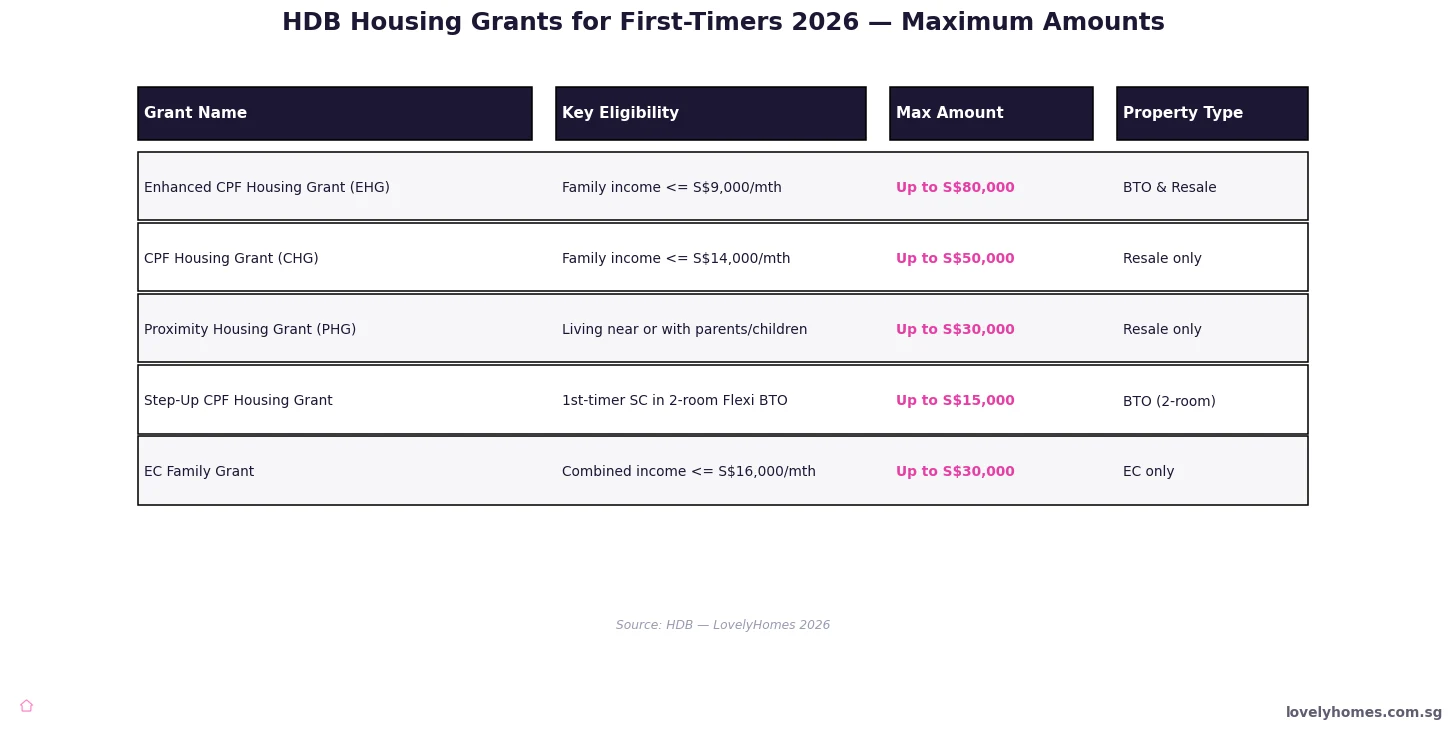
- Grants were raised substantially in August 2024. The Enhanced CPF Housing Grant (EHG) ceiling went up to $120,000 for families and $60,000 for singles. The CPF Housing Grant for resale flats — the Family Grant — rose to $80,000 for a four-room or smaller resale flat.
- The loan limit for HDB loans was cut to 75% of the lower of the purchase price or valuation, aligning HDB loans with bank loans.
- The HDB Flat Eligibility (HFE) letter became mandatory. You cannot submit a BTO application or exercise an Option to Purchase on a resale flat without one, and it covers your grant eligibility, loan eligibility and purchase eligibility in a single assessment.
- Wait-out periods introduced in September 2022 for private property owners and ex-owners remain part of the landscape for resale HDB purchases.
The net effect: the decision is no longer just "BTO or resale." It's "which classification of BTO, with which MOP and which clawback, versus which resale flat, with which grants, funded by which loan, subject to which wait-out." That's more complexity — but also more room to optimise.
The Three Lanes: BTO, Balance Flats and Resale
Before diving into classification, it helps to be clear about the lanes themselves, because they're not as binary as the BTO-versus-resale framing suggests.
Lane 1: Build-To-Order
New flats sold before construction, allocated by ballot. You apply during a launch window, wait for a queue number, then select a unit if your number falls within the supply available. Waiting times from application to key collection have typically run three to four years, though this varies by project and estate.
Lane 2: Balance flats and open booking
Sale of Balance Flats exercises have historically run alongside BTO launches, offering units that were not taken up in earlier exercises, returned units, or flats from other schemes. In more recent years HDB has also introduced channels allowing remaining flats to be booked outside of a ballot, subject to availability. These are worth watching if your priority is speed rather than choice of stack or floor.
Lane 3: Resale
Immediate occupancy, full choice of location, size and age, and — crucially — access to the Family Grant or Singles Grant, which BTO buyers don't get. The trade-off is price: you are buying at whatever the open market clears at, and you may be paying for someone else's renovation and lease decay at the same time.
| BTO | Balance / Open Booking | Resale | |
|---|---|---|---|
| Speed to keys | 3–4 years typically | Weeks to a few years | 8–10 weeks from OTP |
| Choice of location | Fixed to launch sites | Limited to leftovers | Full island |
| Purchase price | Below market, subsidised | Subsidised | Open market |
| Grants available | EHG only | EHG only | EHG + Family/Singles Grant + PHG |
| MOP | 5 years (Standard) / 10 years (Plus, Prime) | Follows project classification | Already served or partially served |
BTO Classification in 2026: What Standard, Plus and Prime Actually Mean
This is the part of the HDB 2026 buyer's guide that matters most for anyone planning a ballot, because classification determines your exit — not your entry.
The old mature/non-mature split told you roughly where a town sat in the property hierarchy. The new framework tells you something far more consequential: how tightly the flat will be leashed for the next decade.
The three tiers at a glance
| Feature | Standard | Plus | Prime |
|---|---|---|---|
| Location basis | Island-wide, standard attributes | Close to MRT, town centre or amenities | Central, high-demand locations |
| Minimum occupation period | 5 years | 10 years | 10 years |
| Subsidy clawback on resale | No | Yes | Yes, at a higher rate |
| Rent out whole flat | Allowed after MOP | Not allowed | Not allowed |
| Household income ceiling at purchase | $14,000 (families) | $14,000 (families) | $14,000 (families) |
| Income ceiling for your future resale buyer | None | $14,000 | $14,000 |
| Private property ownership | Must not own, and 30-month wait if ex-owner | Must not own, and 30-month wait if ex-owner | Must not own, and 30-month wait if ex-owner |
The tightening runs in one direction: Standard gives you the most freedom, Prime the least. That's deliberate. The clawback exists so that the subsidy HDB extends at launch doesn't simply become a windfall for the first buyer when the flat resells.
What the clawback really costs you
Here's the practical translation. Buy a Prime flat at a subsidised price, hold it for ten years, sell it at market — and HDB recovers a slice of the difference, with interest. The precise mechanics are set out in your flat's specific terms, but the principle is that your effective capital gain is the market gain less the subsidy recovered. In a flat market, that's a modest drag. In a strong market, it's a meaningful one.
For a young buyer weighing a Prime flat against a Standard one, the honest framing is this: Prime buys you location and lifestyle, Standard buys you optionality. If you plan to live in the flat for twenty years and never rent it out, the restrictions cost you very little. If you're viewing it as a leveraged asset to be monetised in year eleven, Prime is the wrong instrument.
Where singles fit
Singapore citizens aged 35 and above can apply for two-room Flexi BTO flats, with a household income ceiling of $7,000 for that flat type. Singles can also buy resale flats of any size on the open market, subject to the income ceiling that applies to Plus and Prime resale units.
That's a materially different proposition from even a decade ago, and it has made the single-buyer segment one of the most active parts of the resale market.
The Grants Stack: How Much You Actually Get
Grants are where first-timers leave the most money on the table, usually because they assume they're ineligible when they're not — or assume the grants are bigger than they are.
There are three main grants, and they do different things.
1. Enhanced CPF Housing Grant (EHG)
The EHG is the broadest. It applies to both new and resale flats, and to both families and singles, subject to income ceilings. It is means-tested on average gross monthly household income over the preceding twelve months, and it tapers away as income rises.
For families, the ceiling for eligibility is $9,000 per month, with a maximum quantum of $120,000. For singles, the ceiling is $4,500 and the maximum is $60,000 — roughly half the family quantum at each band.
The taper is steep at the bottom and gentle at the top, which creates a genuinely awkward income trap around the $6,000–$7,000 mark.
Indicative EHG Quantum by Average Gross Monthly Household Income (Families)
The bars above are indicative tiers reflecting the published taper structure. Always confirm your specific band through the HFE application.
2. Family Grant or Singles Grant (resale only)
This is the grant most often forgotten. If you buy a resale flat, you may be eligible for a CPF Housing Grant on top of the EHG:
- Family Grant: up to $80,000 for a four-room or smaller resale flat, or $50,000 for a five-room or larger flat.
- Singles Grant: up to $40,000 for a four-room or smaller resale flat, or $25,000 for a five-room or larger flat, for citizens aged 35 and above.
The structural insight here is important. A couple earning $8,500 a month gets zero EHG but can still receive $80,000 in Family Grant if they buy resale. That single fact repositions the resale market for middle-income first-timers — it is not the "expensive option," it is the option where the grant quantum is largest.
3. Proximity Housing Grant (PHG)
If you buy a resale flat to live with your parents or your child, or to live within roughly four kilometres of them, the PHG applies: $30,000 to live together, $20,000 to live near. Singles receive a reduced quantum.
For a couple already planning to stay near one set of parents for childcare reasons, the PHG is effectively free money attached to a decision you were going to make anyway.
Wait-Out Rules, MOPs and the Timelines That Catch People Out
The most expensive surprises in HDB transactions are almost never about price. They're about timing — specifically, discovering you're not allowed to buy yet.
The private property wait-out
Since September 2022, private property owners and former private property owners have been subject to a wait-out period before they can buy a resale HDB flat. The period has been set at 15 months from the date of disposal of the private property. The measure was introduced as a temporary cooling measure and has been reviewed periodically; check its current status before planning around it.
There is a carve-out worth knowing: seniors aged 55 and above buying a four-room or smaller resale flat are exempt from the wait-out.
Separately, private property owners and ex-owners buying a new BTO flat face a longer wait, reported at 30 months from disposal, and are subject to the income ceiling.
If you're a first-timer who has never owned private property, none of this applies to you. That's a genuine advantage, and it's why the first-timer segment dominates new launches.
The Minimum Occupation Period
The MOP is the clock that governs everything downstream. During the MOP you cannot sell the flat, buy private property, or — for Plus and Prime flats — rent out the whole unit at all.
Read that timeline carefully and the Plus/Prime trade-off becomes concrete. Choosing a Prime flat doesn't just restrict what you can do with the flat — it pushes your earliest date of financial flexibility out by five full years, relative to a Standard flat bought in the same launch cycle.
The HFE letter is the real starting gun
The HDB Flat Eligibility letter consolidates your grant eligibility, loan eligibility and purchase eligibility into one assessment. It is valid for nine months, and you cannot proceed without it. Applying early — and knowing what it says before you start viewing flats — is the single most useful administrative step in the entire process.
Affordability Scenarios: Three Households, Three Answers
Numbers on a page are abstract. Here are three illustrative scenarios for households that closely resemble the Hiva readership. All figures are planning estimates, use a 2.6% HDB loan over 25 years, and assume the loan is capped at 75% of the purchase price.
Scenario A — Young couple, combined $7,000/month, four-room Standard BTO
| Item | Amount |
|---|---|
| Illustrative purchase price | $350,000 |
| Indicative EHG | ~$20,000 |
| Amount to fund after grant | $330,000 |
| Maximum HDB loan (75%) | $262,500 |
| Balance from CPF OA or cash | $67,500 |
| Estimated monthly instalment | ~$1,190 |
| Instalment as share of gross income | ~17% |
| Buyer's Stamp Duty | ~$5,200 |
The MSR cap here — 30% of gross income, or $2,100 a month — is not the binding constraint. The 75% loan-to-value limit is. That's the practical reality of post-August-2024 HDB financing: your loan ceiling is set by the price, not by your income, and the gap has to be closed with CPF Ordinary Account savings.
For a couple who have each been working five or six years, $67,500 in combined CPF OA is achievable without drama. For a couple three years into their careers, it isn't — and that's the argument for a smaller flat type or a lower-priced estate rather than a bigger grant.
Scenario B — Couple, combined $12,000/month, four-room resale
| Item | Amount |
|---|---|
| Illustrative resale price | $750,000 |
| EHG | $0 |
| Family Grant | $80,000 |
| PHG, if living with or near parents | $30,000 |
| Total grants | up to $110,000 |
| Amount to fund after grants | $640,000 |
| Maximum HDB loan (75%) | $562,500 |
| Balance from CPF OA or cash | ~$77,500 |
| Estimated monthly instalment | ~$2,550 |
| Instalment as share of gross income | ~21% |
| Buyer's Stamp Duty | ~$17,100 |
Note what happened here. This household earns nearly double Scenario A, receives no EHG at all, and yet walks away with a larger total grant — $110,000 versus $20,000 — because the resale grants aren't means-tested the way the EHG is.
That is the single most under-appreciated fact in first-time HDB planning.
Scenario C — Single, 36, $3,500/month, two-room Flexi BTO
| Item | Amount |
|---|---|
| Illustrative purchase price | $180,000 |
| Indicative EHG for singles | ~$40,000 |
| Amount to fund after grant | $140,000 |
| Maximum HDB loan (75%) | $135,000 |
| Balance from CPF OA or cash | ~$5,000 |
| Estimated monthly instalment | ~$610 |
| Instalment as share of gross income | ~17% |
| Buyer's Stamp Duty | ~$1,800 |
For a single buyer, the arithmetic is remarkably favourable. The outlay is small, the instalment is less than most people's phone-plus-transport budget, and CPF OA contributions cover most of it — a 36-year-old contributes roughly 21% of ordinary wage to the OA.
The constraint isn't affordability. It's supply and time: two-room Flexi units are contested, and the MOP still applies.
Illustrative Upfront Outlay After Grants (CPF OA plus cash, excluding renovation)
Estimated Monthly HDB Loan Instalment, 25 years at 2.6%
The Costs That Don't Appear in the Brochure
Every first-timer budget includes the price and the instalment. Almost none include the rest.
- Buyer's Stamp Duty. 1% on the first $180,000, 2% on the next $180,000, 3% on the next $640,000, rising thereafter. On a $750,000 resale flat that's roughly $17,100 — payable in cash within 14 days of exercising the OTP.
- Legal fees. Conveyancing typically runs $2,000–$3,000 when using HDB's appointed lawyers for a BTO, or a panel firm for resale.
- Renovation. The quiet killer. A four-room resale flat often needs $50,000–$80,000 of work; a new BTO might need $30,000–$50,000 for basic fittings, flooring and carpentry. This is almost always cash.
- Resale levy. Applies to second-timers buying a subsidised flat, not first-timers. Worth knowing if you're planning a step-up later.
- Valuation shortfall. For resale, if the agreed price exceeds the valuation, the difference must be paid in cash or CPF — it cannot be financed. In a rising market this is a live risk.
- ABSD. Singapore citizens pay 0% on their first residential property. The 20% rate on a second property is the reason so many couples think hard before treating an HDB flat as a stepping stone.
The honest summary: on top of the numbers in the scenarios above, budget a further $40,000–$90,000 in cash for stamp duty, legal fees, renovation and furnishings, depending on whether you're buying new or resale.
Reading the Market, Not Just the Rules
Rules tell you what you can do. They don't tell you what's worth doing. For that, you need to watch a handful of indicators.
The HDB resale price index is the headline number. Its trajectory since 2020 has been one of sustained, broad-based increase, with the pace moderating in more recent quarters as cooling measures and loan limits bit. A flattening index is not a signal that prices are falling — it's a signal that the rate of increase has slowed.
Transaction volume matters more than price for a buyer. Thin volume means fewer comparable transactions, more negotiation friction and a wider spread between asking and clearing prices. Thick volume means a fair, liquid market and less risk of a valuation shortfall.
Median price by flat type and estate tells you where the real boundary of affordability sits. Four-room resale flats in popular mature estates and four-room flats in the outer ring are, functionally, two different products with two different buyer pools.
Rental yields on HDB flats are relevant even if you never rent yours out, because they set the floor beneath investment demand — and Plus and Prime flats can't be rented in their entirety, which structurally limits that demand for those units.
Where this gets interesting for 2026 is the interaction between classification and resale pricing. Plus and Prime projects will, over time, trade in a market where every potential buyer must satisfy a $14,000 income ceiling and must not own private property. That's a smaller buyer pool than the open market — and smaller buyer pools, all else equal, mean slower price discovery.
Standard flats carry no such constraint. That's worth thinking about when you're seduced by a Plus project two minutes from an MRT interchange.
Food for Thought
1. Is the grant you're chasing actually worth more than the flexibility you're giving up? A $40,000 grant sounds decisive until you model a 10-year MOP and a subsidy clawback against a 5-year MOP with none. Run both to year fifteen and see which number is bigger.
2. Would you still want this flat if it never appreciated? The HDB flat has been, for two generations of Singaporeans, both a home and a leveraged bet. If you would still be happy living in it in 2045 at zero capital gain, you're buying a home. If not, you're buying an asset — and assets can underperform.
3. What is a ten-minute shorter commute actually worth to you? A Plus flat near an MRT station versus a Standard flat two bus stops further out — the price differential often works out to a substantial monthly sum over the loan tenure. Whether that's a good trade is a personal question, not a financial one.
4. Is your income about to cross a grant cliff? The EHG taper means a modest raise can cost you tens of thousands in grant. If a promotion is landing in six months and you're at a band boundary, the sequencing of your application could matter more than the flat you choose.
5. If you're single, are you optimising for the flat or for the life around it? Two-room Flexi units offer an extraordinary entry point. But the resale market offers something the BTO queue cannot — a location that fits the life you already have, today, rather than the one you might have in four years.
The Bottom Line
The 2026 HDB market rewards preparation in a way the 2016 market didn't. Classification, clawback, MOP length, grant tapers, loan-to-value limits and wait-out periods all interact — and a decision that looks optimal on price alone can be suboptimal on timing and exit flexibility.
The households that do best are the ones who know their HFE outcome before they view anything, understand whether their income puts them in EHG territory or in Family Grant territory, and have modelled their likely flat against a fifteen-year horizon rather than a five-year one.