Walk down Lorong 1 Toa Payoh on a weekday morning and you are standing in the middle of Singapore's public housing origin story. The blocks here date back to the 1960s and early 1970s — some of the oldest leasehold homes in the country still in everyday residential use. The market and food centre is packed by 8am. The community club next door is booked out for badminton. Braddell MRT is a short walk away, and the North-South Line gets you to Raffles Place in under half an hour.
And yet, for all that convenience, the flats in this corner of Toa Payoh West carry a question mark that newer estates do not: the lease is running out.
That is what makes the current wave of planning and construction around Toa Payoh so interesting. New housing supply, a major integrated civic and sports development, and the progressive upgrading of an ageing town are all landing on top of a resale market where the median flat is several decades old. For anyone tracking mature estate prices — or thinking about buying into one — Toa Payoh West is the cleanest natural experiment in Singapore right now.
Does new supply cannibalise old resale flats, or does it lift them? Does a new amenity down the road add value to a 55-year-old block, or does the lease arithmetic swallow the gain? And what does a mature estate's renewal cycle actually look like, phase by phase, from the inside?
This piece works through all of it.
Why Toa Payoh West Is the Test Case for Mature Estate Renewal
Toa Payoh was HDB's second satellite town, developed from the 1960s as the blueprint for self-contained public housing — schools, markets, clinics and industry all within walking distance of the flat. Toa Payoh West, broadly the western slice of the town around Lorong 1 and Lorong 2, retains that DNA most visibly:
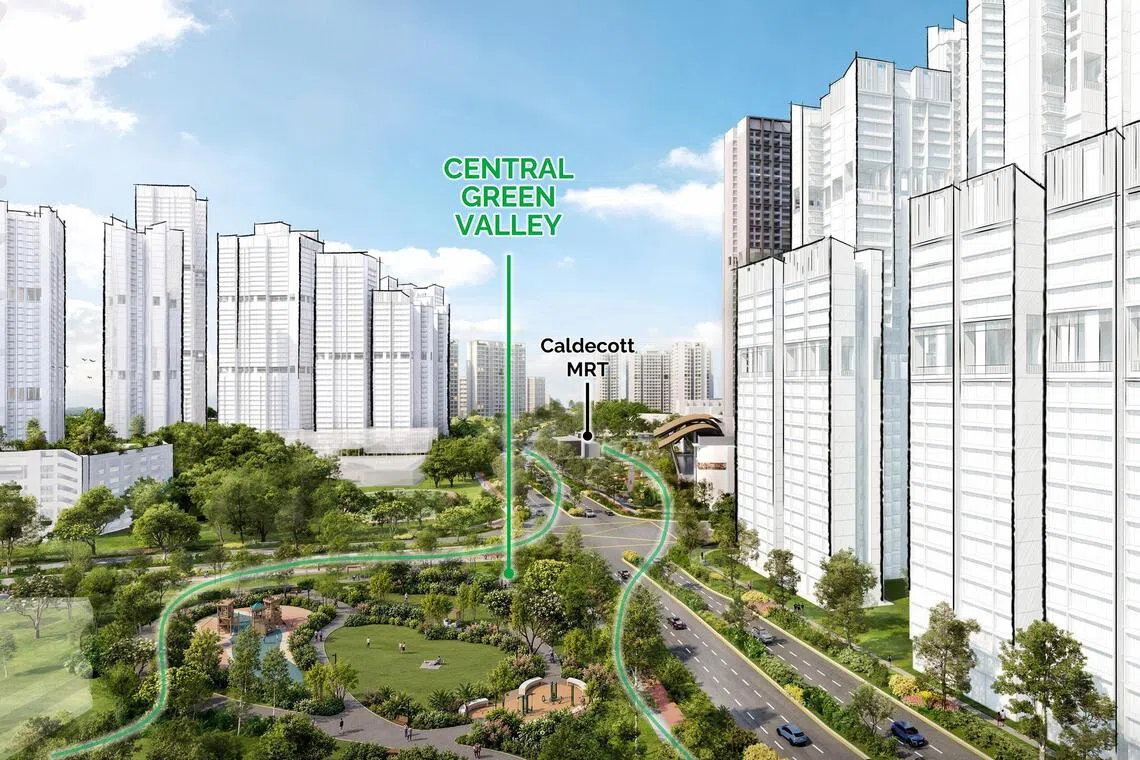
- Braddell MRT (NS18) anchors the north-western edge, with Caldecott (CC17/TE9) — a Circle Line and Thomson-East Coast Line interchange — a short distance beyond.
- Toa Payoh West Market & Food Centre at Lorong 1 remains one of the town's busiest hawker centres.
- Toa Payoh West Community Club and a dense cluster of schools — including Pei Chun Public School, CHIJ Primary (Toa Payoh), Kheng Cheng School and Beatty Secondary — sit within the same few square kilometres.
- The town's older sports and swimming facilities, which date back to the era of the 1973 SEAP Games, are in the adjacent Lorong 6 area.
The result is a subzone with excellent connectivity, deep amenity stock and an aged housing inventory — the exact combination that makes lease decay and renewal policy collide most sharply.
Contrast that with a non-mature estate like Tengah or Punggol. There, new supply is the only supply, and prices are set almost purely by new-launch dynamics. In Toa Payoh West, new supply has to price against a large stock of existing flats with 40 to 60 years of lease left. That interaction is where the analytical value is.
What "new housing plans" actually covers
The phrase gets used loosely, so it is worth separating the distinct threads running through Toa Payoh's pipeline right now.
- New BTO supply in a mature town. Toa Payoh has seen sporadic BTO launches over the past several years, and mature-estate sites command intense application rates. Following HDB's Standard/Plus/Prime classification introduced with the October 2024 sales exercise, new flats in well-connected mature locations are typically classified as Plus projects — carrying a 10-year minimum occupation period, a subsidy clawback on resale, and tighter resale buyer eligibility.
- The Toa Payoh Integrated Development. Announced in 2023, this is the single largest amenity intervention in the town in decades — a co-located complex bringing together a new sports centre and swimming facility, a regional library, a polyclinic and community spaces, integrated with Toa Payoh MRT and the bus interchange, and targeted for completion around the end of the decade.
- Estate rejuvenation programmes. The Home Improvement Programme (HIP) for older blocks, the Neighbourhood Renewal Programme (NRP) for precinct-level upgrading, and the ongoing replacement of ageing infrastructure.
- Redevelopment instruments. Selective En bloc Redevelopment Scheme (SERS) and the long-signalled Voluntary Early Redevelopment Scheme (VERS), which was first announced in 2018 but has yet to be implemented at scale.
Each of these channels transmits to resale prices differently. Treating them as one blob — as most dinner-table conversation does — is how people misread the market.
The Three Supply Channels That Move Prices in a Mature Estate
Here is a simple mental model. In a mature estate like Toa Payoh West, three distinct supply channels are operating at once, and they pull resale prices in different directions.
Illustrative Directional Impact of Supply Channels on Old Resale Flats
That chart is deliberately directional rather than quantitative — the magnitude depends on the specific block, lease profile and micro-location, which is exactly why cluster-level data matters more than town-level averages. But the signs are stable and worth internalising.
Channel 1: New BTO supply — competitor or catalyst?
The intuitive fear among existing owners is straightforward: more new flats means fewer buyers for my old flat. In practice, the effect is more subtle, for three reasons.
First, the buyer pools only partially overlap. A Plus BTO in Toa Payoh is, by design, rationed — income ceilings apply, application rates are brutal, and the successful applicant waits years for completion. The buyer who loses out on a Toa Payoh BTO eight times does not simply stop wanting to live in Toa Payoh. A meaningful share of them convert into resale buyers, and they convert at a specific moment — usually shortly after a failed ballot.
Second, Plus classification changes the resale comparison set. A Plus flat comes with a 10-year MOP and a subsidy clawback. That makes it a genuinely different asset from a 1970s resale flat with no such strings. Older resale flats retain a liquidity advantage precisely because they carry fewer resale restrictions. New supply can therefore support the older segment's relative appeal rather than undermine it.
Third — and this is the part most people miss — new launches set the price anchor. When a Plus BTO in a mature town prices at a given level, and when its eventual resale comps appear years later, they shift the reference point for the whole town. Sellers in older blocks begin benchmarking against the newest number in the district. That is a positive transmission channel for prices, even if it feels counterintuitive.
Channel 2: Amenity upgrades — the capitalisation channel
The Toa Payoh Integrated Development is the cleanest example of amenity capitalisation in Singapore's public housing market today. A regional library, a new polyclinic, a modern sports centre and improved pedestrian connectivity to the MRT all reduce the "cost" of living in the area — in time, convenience and daily friction.
Standard urban economics says some portion of that improvement gets capitalised into land and property values. In HDB resale, the capitalisation is real but uneven, and it happens at different speeds across the cycle:
- On announcement, expectations get priced in quickly and often over-priced, particularly by optimistic sellers who read a press release as a done deal.
- During construction, there is usually a pause — and in some micro-markets, a discount, because of noise, dust, diverted walkways and reduced parking.
- On completion, the premium gets validated, and blocks genuinely within a short walk of the completed amenity re-rate.
The practical implication: the gap between announcement-day pricing and completion-day value is where most of the mispricing lives.
Channel 3: Redevelopment signals — the windfall premium
SERS has a documented distortion effect on mature estate pricing: once a nearby precinct is announced for redevelopment, adjacent blocks often see asking prices jump on the hope of being next. This is a speculation premium, not a value premium, and it can invert sharply.
VERS, meanwhile, remains a policy without a live implementation track record. Any price premium attributed to "VERS might come" is, at present, pricing a policy design that has not yet been tested.
Rule of thumb: treat any premium tied to unannounced redevelopment as a sentiment premium, not a fundamental one. It can vanish faster than it appeared.
Five Ways New Housing Supply Prices Into Old Resale Flats
If you want to reason about a specific block in Toa Payoh West rather than the town in aggregate, here are the five transmission mechanisms that actually do the work.
1. Substitution within the buyer pool
The first question is always: who is the marginal buyer for this flat? For a 3-room walk-up in Lorong 1, that buyer is likely a first-timer priced out of the town centre, or a downgrader from the private market, or a parent buying near a preferred school. New BTO supply competes hardest for the first group and barely at all for the third. The more school- or amenity-driven the demand for a block, the less exposed it is to new supply competition.
2. Price anchoring from new launches
New-launch pricing resets the town's reference points. Sellers anchor upward; buyers anchor to their last search. Over a two-to-three year window, the anchor drifts upward and the whole distribution shifts.
3. Lease-decay arithmetic
This is the dominant force in Toa Payoh West and it is not negotiable. A flat with 55 years remaining is a different asset from one with 80. The decay is not linear in price terms — it tends to compress faster once remaining lease crosses the thresholds that govern CPF usage and loan financing:
- Where the remaining lease comfortably covers the youngest buyer to age 95, full CPF usage and maximum loan quantum are generally available.
- Where the lease is shorter, CPF usage becomes pro-rated and loan tenures and limits tighten.
- Below roughly 20 years remaining, CPF is generally not usable and financing options narrow sharply.
The exact rules change over time and depend on the buyer's age, so any specific purchase needs a current check. But the shape of the curve matters: the price impact of lease decay is not smooth — it steps down at the financing cliffs.
4. Amenity capitalisation
Covered above, but worth restating as a distinct channel: the same amenity premium is not distributed evenly across a town. A block 300 metres from a new MRT exit and a block 1.2 kilometres away are in the same town and in different markets.
5. Construction-phase friction
A genuinely underrated short-term factor. Multi-year construction adjacent to a residential precinct reduces liveability — noise, dust, diverted routes, lost parking, altered bus stops. In the resale data this shows up as longer time-on-market and softer negotiating positions for directly affected blocks, even when asking prices hold. It is usually temporary, and it is usually the best buying window in the whole cycle.
Reading Toa Payoh Cluster by Cluster: Lease Age, Medians and Volume
Town-level averages are close to useless in a mature estate, because Toa Payoh contains housing from at least six different decades with radically different lease profiles. The right unit of analysis is the cluster — a group of blocks sharing a location, a construction era and an amenity catchment.
Hiva's town and district analytics break Toa Payoh into these clusters and track three things per cluster: median resale price and median PSF, the lease-age distribution across blocks, and transaction volume as a liquidity measure. Each of these factors is validated out-of-sample; the way they are combined is proprietary. But the reading of the three is something any buyer can learn.
A cluster archetype table
The table below maps the broad archetypes you will encounter across Toa Payoh, with the qualitative signature each tends to show. It is a framework, not a price list — the current numbers for each cluster are what the data layer is for.
| Cluster archetype | Typical construction era | Lease profile | Liquidity signature | Renewal exposure |
|---|---|---|---|---|
| Lorong 1 / Braddell fringe | 1960s–1970s | Shortest remaining leases in town | Thinner volume, older buyer profile | High — HIP coverage, possible redevelopment interest |
| Lorong 2 / Toa Payoh West core | 1970s–1980s | Mid-range remaining lease | Steady volume, family-driven demand | Moderate — amenity-led |
| Town centre / Lorong 6 ring | 1970s–2000s | Mixed, wide spread | Highest volume, deepest buyer pool | High — Integrated Development catchment |
| Lorong 4–5 school belt | 1970s–1990s | Mixed | Premium for school-adjacent blocks | Low to moderate |
| Fringe private and mixed | 2000s onward | Long leasehold / freehold | Shallow but price-setting | Low |
The three-number health check
Before you look at any single flat in Toa Payoh West, pull three numbers.
Number one — remaining lease in years, and whether it covers the youngest buyer to 95. This determines your CPF and loan access, which in turn determines your resale buyer pool when you sell. A flat that is financeable today by a 35-year-old buyer will not be financeable by a 35-year-old buyer in ten years. That is the single biggest risk in this subzone.
Number two — the block's median PSF versus the cluster median PSF. A discount to cluster median can mean a bargain or a problem: floor level, orientation, corridor type, proximity to a bin centre, or a shorter lease than neighbours. Always decompose the discount before celebrating it.
Number three — annual transaction volume for the block or immediate precinct. Low volume is not automatically bad, but it means the price you see may be stale, and your exit will be slower. In mature estates, liquidity is a purchasable attribute and it is usually bought through location.
Why volume often leads price
In a thin market, transaction counts move before prices do. When a cluster's volume picks up while median PSF stays flat, that is often the signature of new demand arriving — exactly the pattern you would expect in the early phases of an amenity or connectivity upgrade. When volume falls while asking prices hold, you are usually watching seller expectations detach from the market, and a period of price discovery follows.
Watching volume and lease-age distribution together is what separates a cluster that is genuinely re-rating from one where a handful of outlier transactions have distorted the median.
The Mature Estate Renewal Cycle, Phase by Phase
Mature estates do not decay smoothly, and they do not rejuvenate smoothly either. They move through a recognisable cycle. Toa Payoh is somewhere in the middle of it.
Phase 1 — Ageing and relative decline
The estate's fundamentals — location, connectivity, amenity density — stay strong or even improve, but the housing stock ages. Leases shorten. Maintenance costs rise. Newer towns with fresher leases and modern layouts draw away a portion of the upgrader demand. Prices do not collapse; they lag. This is a relative story, not an absolute one, and it is where a lot of mature estates sit for years.
Phase 2 — The trigger
Something changes the trajectory. In Toa Payoh's case there are several triggers stacked on top of each other: the Integrated Development, progressive HIP coverage of older blocks, NRP precinct works, and the general uplift from the Thomson-East Coast Line improving access to the broader network via Caldecott.
Triggers do not move prices by themselves. They move expectations, which is a different and faster thing.
Phase 3 — Repricing on expectations
This phase is noisy. Sellers read announcements and reprice. Some repricing is justified by genuine accessibility gains; much of it overshoots. A useful discipline in this phase is to ask: what specifically got better, and by how much? A block that gains a genuinely shorter walk to a new MRT exit has a defensible re-rating. A block two kilometres away does not, and its premium will fade.
Phase 4 — The friction years
This is the phase Toa Payoh West is entering. Multi-year construction brings real, temporary costs to nearby residents. Historically, this is the phase where transaction volume thins before prices soften — sellers refuse to accept the discount, buyers have more choice and less urgency, and the market clears slowly.
It is also, for buyers with a long horizon, the most interesting window in the cycle.
Phase 5 — Delivery and validation
When the amenity opens, the market gets to check its homework. Blocks within genuine walking distance re-rate; blocks that priced in a premium they never deserved give it back. Completion is a sorting event, not a uniform uplift.
Phase 6 — Reset
Then the cycle restarts, because the lease kept running the entire time. This is the crucial point that gets lost in renewal enthusiasm: a new library does not add years to your lease. A 1970 flat with 48 years remaining gains amenity value and loses lease value simultaneously, and in most cases the lease decay is the larger of the two forces over a ten-year horizon.
That is the central tension of mature estate investing, and Toa Payoh West is where it is most visible.
What It Means For You: Owners, Upgraders, First-Timers
The same set of facts produces very different conclusions depending on who you are.
If you already own in Toa Payoh West
Your dominant variable is not the Integrated Development. It is remaining lease versus your holding horizon.
- If you plan to sell within five to eight years, your priority is the depth of your buyer pool at exit. That means financing accessibility for the next buyer, which means lease length matters more than amenity proximity.
- If you plan to hold 15 years or more, the amenity and connectivity upgrades will do more work for you — but the lease arithmetic will do more work against you, and the crossover point matters.
- If your block is directly affected by construction, expect a softer negotiating position for the duration. That is a timing cost, not a permanent one.
If you are upgrading within the HDB system
The second-property rules matter enormously here. Buying a second residential property before selling the first triggers ABSD at the prevailing rate for Singapore Citizens — currently 20 per cent on the second property — which for most households is prohibitive without a sale-first sequence. The resale levy also applies if you later buy a subsidised flat.
The practical sequencing question — sell first and rent, or buy first and pay ABSD — is usually decided by arithmetic, not preference, and it is worth running before you fall in love with a unit.
If you are a first-timer eyeing a mature estate
Mature estates remain attractive for reasons that do not show up in a PSF chart: established schools, hawker food, actual trees, and MRT lines that already exist rather than being promised.
Two things to get right:
- Do not buy the shortest lease in the cluster just because it is the cheapest. The discount is usually rational. It reflects a smaller future buyer pool.
- Do not overpay for an amenity that has not been built. The gap between announcement and completion is real, and it is where the market most reliably misprices.
The policy parameters that frame everything
A quick reference table for the rules that shape these decisions. All of these are subject to change and should be verified at the point of transaction.
| Parameter | Current position |
|---|---|
| Loan-to-value limit | 75 per cent for both bank loans and HDB loans |
| Mortgage Servicing Ratio | 30 per cent of gross monthly income, for HDB flats and new ECs |
| Total Debt Servicing Ratio | 55 per cent of gross monthly income |
| MOP — Standard flats | 5 years |
| MOP — Plus and Prime flats | 10 years, plus subsidy clawback on resale |
| ABSD — Singapore Citizens | 0 per cent first property, 20 per cent second, 30 per cent third and subsequent |
| CPF usage | Full where remaining lease covers the youngest buyer to 95; pro-rated for shorter leases |
Risks and What to Watch
No framework is complete without the ways it could be wrong.
The lease cliff is the biggest risk and the least discussed. In Toa Payoh West, a meaningful share of stock will cross financing thresholds within the next decade or two. That is not a crash scenario — it is a gradual narrowing of the buyer pool, and it prices in slowly and then suddenly.
Plus flat resale dynamics are untested at scale. The 10-year MOP and subsidy clawback on Plus projects mean the first meaningful resale comparables will not appear for years. Until then, any assumption about how Plus flats trade relative to Standard resale flats is a hypothesis.
Construction timing slips. Integrated developments of this complexity routinely move. If the Toa Payoh Integrated Development completes later than targeted, the Phase 3 expectation premium will have been priced in well before the Phase 5 validation arrives — a classic setup for a flat period.
Interest rates and financing rules can change faster than leases. A shift in LTV or MSR rules changes affordability across the entire market at once, and mature estates with older stock are more sensitive to financing conditions than new ones.
Sentiment around redevelopment can reverse. Any premium attributed to SERS or VERS expectations is not underwritten by policy. It is underwritten by hope.
Food for Thought
-
If a new regional library and polyclinic add real value to a 55-year-old flat, but the lease loses a year every year anyway — which force is winning in your specific block, and over what horizon?
-
When a Plus BTO launches in Toa Payoh with a 10-year MOP and a clawback, does that make the older unrestricted resale flat next door more valuable or less? Most people answer instantly. Is the answer actually obvious?
-
Singapore has spent decades treating redevelopment as the answer to lease decay. If VERS is never implemented at scale, what does a mature estate's endgame actually look like — and are today's prices consistent with it?
-
Is a mature estate's amenity density a durable advantage, or a one-time upgrade that gets matched by every other town within fifteen years?
-
If you would not buy your own flat today at its current price, with its current remaining lease, what does that tell you about your exit?
The Bottom Line
Toa Payoh West is not a story about new flats replacing old ones. It is a story about two clocks running at different speeds: the renewal clock, which is accelerating on the back of a major integrated development, upgraded precincts and mature-town connectivity; and the lease clock, which has never stopped and never will.
For most of the next decade, the renewal clock will make headlines and move sentiment. The lease clock will quietly determine who can buy your flat when you want to sell it. Getting the balance right between those two forces is the whole game in a mature estate — and it is a game best played with block-level data rather than town-level averages.