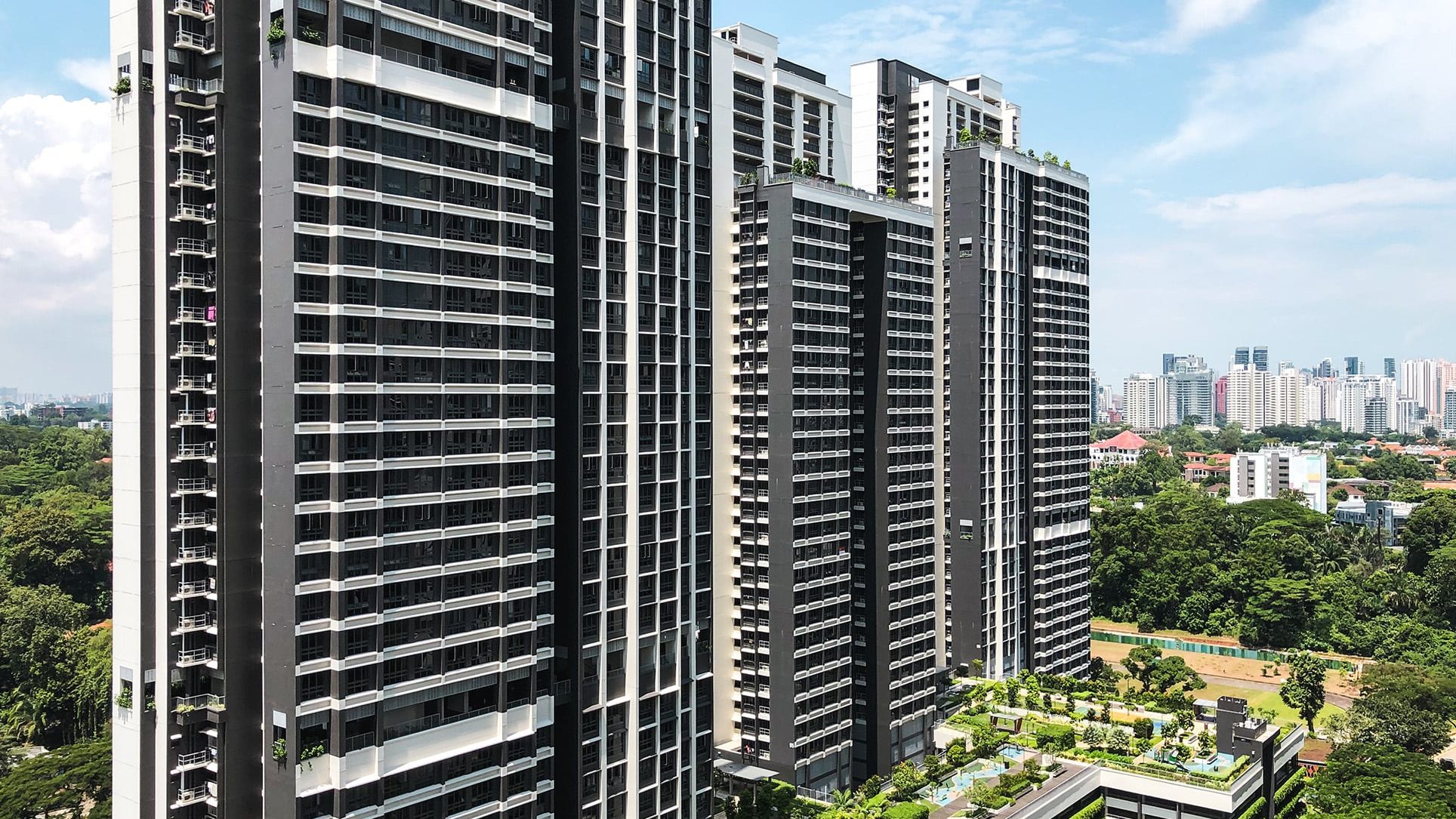
A five-room flat in Dawson — a Queenstown estate that barely existed as a resale market a decade ago — has reportedly changed hands at close to S$1.5 million. For a build-to-order flat launched barely a dozen years ago, that is a remarkable number, and it is the latest chapter in the Dawson HDB record price story that has been quietly reshaping expectations across Singapore's resale market.
The headline grabs attention. But the more interesting question isn't the number itself — it's what the number tells us about how the HDB resale market now prices location, design, lease length and buyer profile. Is Dawson an outlier? A sign of things to come? Or a warning about how thin the top of the market has become?
This piece unpacks the Dawson record: the drivers behind it, how it compares with other mature estates, and what it likely means for HDB resale prices in the years ahead.
Setting the scene: how Dawson got here
Dawson sits within Queenstown, Singapore's first satellite town, developed by the Singapore Improvement Trust and then HDB from the 1950s. For decades the area was associated with ageing walk-up blocks, wet markets and a somewhat sleepy character — a mature estate with strong fundamentals but little new supply.
That changed with two HDB projects that became design landmarks:
- SkyTerrace@Dawson — a project known for its sky terraces and link bridges, designed to demonstrate that public housing could be architecturally ambitious.
- SkyVille@Dawson — a "sky village" concept with connected roof gardens and community decks, also recognised for its design quality.
Both were launched in the early 2010s and completed around 2015. That completion date matters enormously: a five-year Minimum Occupation Period (MOP) meant the first resale transactions in these projects could only happen from around 2020 onwards. In other words, Dawson's resale market is barely half a decade old — and it went from zero to seven figures in that window.
Between 2015 and 2024, three things happened simultaneously: the lease on these flats aged only modestly (they still have roughly 89 years remaining on a 99-year lease), the surrounding Queenstown area gained amenities, and the wider HDB resale market went on an extraordinary run.
HDB Resale Price Index — Annual Change (%)
The national index rose 5.0% in 2020, an extraordinary 12.7% in 2021, 10.4% in 2022, moderated to 4.8% in 2023, then re-accelerated to around 9.7% in 2024. Dawson's first resale transactions landed right at the start of that surge — the best possible timing for sellers — and each subsequent wave of comparables reset the ceiling higher.
The million-dollar flat is no longer rare
To understand the Dawson record, you have to understand the broader shift in the HDB resale market. The million-dollar flat used to be a curiosity. Now it is a category.
Million-Dollar HDB Resale Transactions by Year
According to media tallies of HDB transaction data, the number of resale flats transacting at S$1 million or more grew from 82 in 2020 to 259 in 2021, 369 in 2022, 468 in 2023, and reportedly more than 1,000 in 2024 — the first time the four-figure mark has been crossed.
Even so, context matters. Against total resale volume of roughly 28,000–30,000 transactions a year, million-dollar deals still represent something in the region of 3% to 4% of the market. HDB has consistently emphasised that the overwhelming majority of resale flats transact at far more modest prices, and that buyers should not treat headline records as the norm.
So Dawson's record is both meaningful and statistically narrow. It is a signal about the top end of the market, not a description of the whole market.
Why Dawson: the anatomy of a Queenstown HDB resale premium
A record price is never about one factor. It is the product of several premiums stacking on top of each other. Here is how the Dawson premium breaks down.
1. Location: the city fringe is the battleground
Queenstown is one of the closest HDB towns to the Central Business District. Queenstown MRT station on the East-West Line puts Raffles Place roughly 15 minutes away — a commute that competes with many private condominiums in the Outside Central Region.
That single fact explains a lot. Buyers who want proximity to town but cannot stretch to a private condo in the area increasingly land on Queenstown HDB resale flats as the rational compromise. Demand from that group is deep and income-elastic, which is precisely the condition that allows record prices to form.
2. Design: HDB flats that behave like condos
SkyTerrace@Dawson and SkyVille@Dawson were conceived as design statements. Sky terraces, landscaped decks, linked blocks, sky gardens and multi-storey carparks that read more like a condominium clubhouse than a public housing estate — these features were deliberately built in.
They matter at resale because they widen the buyer pool. A buyer comparing a well-designed Dawson flat against a generic 1980s resale block in the same town is not just comparing square footage; they are comparing lifestyle. And design quality is one of the few attributes in HDB resale that cannot be replicated by supply elsewhere.
3. Unit size: the big-flat scarcity
Dawson's five-room units — the configuration behind most of the headline prices — are large by today's standards, in the region of 1,100 to 1,200 square feet. Newer BTO five-room flats are typically smaller.
This creates a segment that is structurally undersupplied: large, young-lease, well-located flats. Anyone who wants space, a long remaining lease and a short commute has very few options, and almost no new-build options. Scarcity of that specific bundle does the heavy lifting on price.
4. Lease length: the 2015 advantage
Singapore's HDB resale market is increasingly segmented by remaining lease. A flat with 89 years left on its lease is a fundamentally different asset from one with 55 years — different financing, different CPF treatment, different buyer pool, different exit horizon.
Dawson's flats, completed around 2015, sit in the youngest cohort of mature-estate housing. That is arguably their most underrated advantage.
5. Amenities and schools
Mature-estate amenity is cumulative and hard to fake. Around Dawson and Queenstown:
- Queenstown MRT and multiple bus corridors
- Markets, hawker centres and neighbourhood shops, including the rejuvenated Margaret Drive area
- Established schools in the vicinity
- Proximity to Alexandra Hospital, the Rail Corridor and Southern Ridges greenery
- Anchorpoint, IKEA Alexandra, Queensway Shopping Centre and Alexandra Village food centre within easy reach
For families with school-age children, this basket of amenities is a decisive factor — and families are precisely the buyer group that will pay for a five-room flat.
6. The demand side: who actually buys a S$1.4 million HDB flat?
This is the piece most analyses skip. The buyer of a record-priced Dawson flat is usually not a first-timer using grants.
- Income ceiling exclusion: The HDB income ceiling for buying a new BTO flat or receiving housing grants is S$14,000 for a family. Households earning more are shut out of BTO and grants — but not out of resale. For them, resale is the only door into public housing.
- Private downgraders: Some buyers are right-sizing from private property, though the 15-month wait-out period introduced in 2022 for private property owners buying HDB resale flats has dampened this channel.
- Cash-rich upgraders: Sellers exiting other HDB flats with substantial proceeds, who can fund a large downpayment without stretching their loan.
In other words, the record price is being set by a buyer pool that is structurally excluded from the alternatives. That is a durable source of demand, not a temporary one.
The financing reality check
Here is where the analysis gets sobering. A record price is only sustainable if someone can actually carry the loan. Let's run the numbers on a S$1.4 million Dawson five-room flat, using standard HDB loan parameters: 75% loan-to-value, a 2.6% HDB concessionary interest rate, and a 25-year tenure.
| Item | Amount |
|---|---|
| Purchase price | S$1,400,000 |
| Maximum HDB loan (75% LTV) | S$1,050,000 |
| Minimum downpayment (25%) | S$350,000 |
| — of which cash (5%) | S$70,000 |
| — of which CPF (20%) | S$280,000 |
| Monthly instalment, 25 years at 2.6% | ≈ S$4,760 |
| Gross monthly income needed under MSR (30%) | ≈ S$15,900 |
| Gross monthly income needed under TDSR (55%) | ≈ S$8,700 |
The binding constraint is the Mortgage Servicing Ratio, which caps monthly housing payments on an HDB flat at 30% of gross monthly income. That means a buyer of a S$1.4 million flat, financing it conventionally, needs a household income in the region of S$15,900 a month — comfortably above the S$14,000 BTO income ceiling.
Monthly Instalment on a S$1.05m HDB Loan at 2.6% by Tenure
Two implications follow:
- The buyer pool for record-priced flats is mathematically narrow. It is limited to high-income households, cash-rich upgraders, or buyers making very large downpayments. That caps how far and how fast prices at this level can run.
- Stretching to a 30-year tenure only trims the instalment to about S$4,200. It does not transform affordability. The downpayment — S$350,000, of which S$70,000 must be cash — is the real gate.
This is the mechanism that keeps million-dollar HDB flats a small minority, and it is also the mechanism that makes each new record harder to beat than the last.
Dawson versus other mature estates
How does Dawson's premium compare with other mature HDB towns? Here's a qualitative comparison of the drivers, rather than a single price number, because drivers explain persistence.
| Estate | Commute to CBD | Design-led stock | Young-lease large units | Amenity depth | Indicative price positioning |
|---|---|---|---|---|---|
| Queenstown / Dawson | ~15 min (EWL) | Strong (SkyTerrace, SkyVille) | Yes, from 2015 | Very strong | Top tier; Dawson five-room deals reportedly S$1,000–1,300 psf |
| Bukit Merah | ~10–15 min | Mixed, includes PLH projects | Limited resale | Very strong | Top tier, broadly comparable |
| Toa Payoh | ~18 min | Moderate | Moderate | Very strong | Upper-mid; generally below S$1,000 psf for most 5-room resale |
| Bishan | ~20 min | Moderate | Limited | Strong (good schools) | Upper-mid; school-driven premium |
| Clementi | ~25 min | Moderate | Some | Strong (malls, MRT interchange) | Mid; strong rental demand from nearby institutions |
| Ang Mo Kio | ~28 min | Limited | Limited | Strong | Mid; deeper supply caps the ceiling |
A few observations:
- Queenstown and Bukit Merah occupy a tier of their own among HDB towns, because they combine genuine city-fringe proximity with mature amenities. No amount of new-town masterplanning replicates that.
- Bishan competes on a different axis — school prestige and central-north connectivity — which produces high prices but a different buyer profile.
- Ang Mo Kio and Clementi have deeper resale supply, which historically puts a ceiling on how far individual records can travel. Dawson's scarcity is doing work that these towns cannot replicate.
The key structural difference: Dawson's supply is finite and already exhausted. There is no second SkyTerrace@Dawson waiting to be launched. New Queenstown BTO supply in recent years has generally been classified under the Prime or Plus framework, which carries a 10-year MOP, subsidy clawback and rental restrictions. That does two things: it further tightens short-term resale supply, and it makes the older Dawson flats — with their 5-year MOP and no clawback — comparatively more attractive on exit flexibility.
What the Dawson record means for the HDB resale market
The comparables feedback loop
HDB resale valuations are built on comparables. When a Dawson five-room flat transacts at a new high, that transaction enters the comparable set used to value neighbouring flats in Queenstown. The effect is mechanical and self-reinforcing:
- A record transaction is registered.
- Nearby sellers raise asking prices, citing it.
- Valuers, working from recent transactions, support part of that increase.
- A new, higher comparable is set.
- Repeat.
This is why single records matter far beyond their own transaction value. They reset the reference point for an entire micro-market.
Spillover into adjacent estates
The spillover travels outward in rings. Buyers priced out of Dawson look at commonwealth-side Queenstown, Bukit Merah, and parts of Clementi and Toa Payoh. That displacement pressure supports prices in neighbouring towns — and it is visible in the steady broadening of the million-dollar transaction map beyond the traditional core.
Expect this pattern to continue: records cluster. Where one flat clears a threshold, several more in the same town tend to follow within a few quarters.
The normalisation risk
There is a genuine risk in treating records as a trend. Three counterweights deserve equal billing:
- Price resistance at the top. As shown above, the buyer pool for a S$1.4 million flat requires roughly S$15,900 monthly income. That pool is not infinitely deep. Once prices push beyond what even high-income households can finance under MSR, transaction volume at that level thins out.
- Lease decay is a slow tax. A 99-year lease from 2015 has about 89 years left. That is comfortable today. In 20 years, financing rules and CPF usage for flats with shorter remaining leases will change the buyer pool materially. Record prices assume a buyer in 2045 who may face different constraints.
- Policy risk. The last few years have demonstrated willingness to intervene — the August 2024 tightening that cut the LTV limit for HDB loans from 80% to 75%, the earlier TDSR and stress-rate adjustments, the 15-month wait-out for private downgraders, and the Standard/Plus/Prime classification of BTO projects from October 2024. Any further tightening aimed at the resale market would hit the top end first, because that is where leverage and buyer income are most stretched.
The demand-side floor
Set against those risks is a structural floor. Demand for city-fringe, young-lease, large HDB flats is driven by:
- Households above the BTO income ceiling who cannot access new flats
- Private property owners who cannot or will not buy another private unit
- Families prioritising space and school proximity over newness
- A persistent supply gap in the "large + young lease + near CBD" category
None of these drivers look likely to reverse quickly. Which suggests the Dawson record will probably be exceeded — but at a decelerating pace.
A buyer's framework for record-priced flats
If you're looking at a flat in Dawson or a similar estate at a record or near-record price, work through this sequence before committing.
Practical guardrails:
- Get your HFE letter first. Since 2023, a valid HDB Flat Eligibility letter is required before you can be granted an Option to Purchase. Do not shop without it.
- Check comparables, not asking prices. Asking prices are aspiration; registered transactions are evidence.
- Verify the remaining lease and CPF eligibility. Remaining lease affects how much CPF you can use and how much loan you can take.
- Stress-test at a higher rate. The HDB loan stress-test rate has been set at 4% since the 2022 cooling measures. If the numbers only work at 2.6%, they don't work.
- Think about your exit buyer. When you sell, who buys it, at what lease length, with what financing rules? The record price you pay today is a claim on a future buyer's willingness to pay more.
Food for Thought
-
Is Dawson's record a signal or a sideshow? If million-dollar HDB flats are roughly 3–4% of transactions, how much should the other 96% of buyers actually care — and at what point does a statistical minority start reshaping the whole market's expectations?
-
What happens to the premium when the design novelty fades? SkyTerrace and SkyVille are celebrated today. In 15 years, will buyers still pay a design premium, or will the premium migrate to whatever the newest design-led estate is?
-
Does the Prime/Plus framework help or hurt older resale flats? New city-fringe BTO flats now come with 10-year MOPs, subsidy clawback and rental restrictions. Does that make a 2015-vintage Dawson flat with none of those conditions permanently more valuable — or does it simply redirect demand?
-
How much of the record is a rate story? HDB's concessionary loan rate has been stable, but bank rates and CPF rules are not. If financing conditions shift materially, how quickly would the top of the resale market reprice?
-
Is a 99-year lease a long asset or a wasting one? Buyers are paying record prices for a depreciating leasehold interest. At what remaining-lease threshold do Singapore buyers stop treating HDB flats as appreciating assets and start treating them as consumption?
The bigger picture
The Dawson HDB record price is best read not as an isolated headline but as a data point about how Singapore's resale market has stratified. Location, lease length, unit size and design are now priced with far more granularity than they were a decade ago — and buyers who understand that stratification have an edge over those who simply follow the market average.