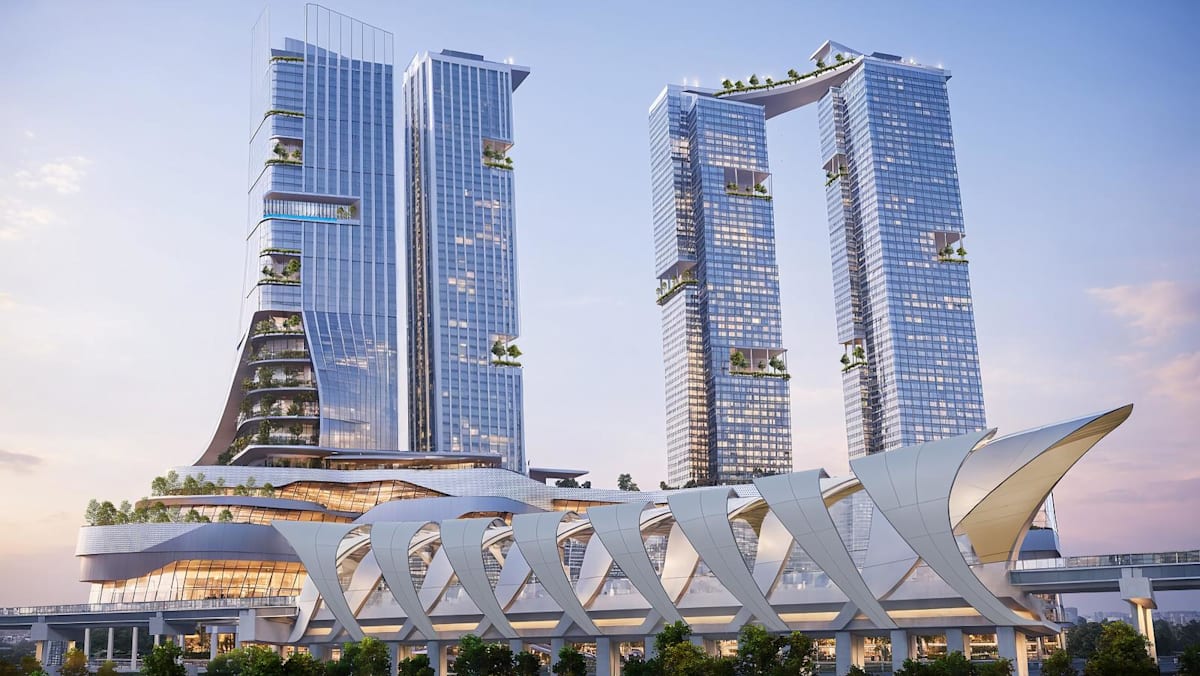
Five minutes. That's the number every Johor property brochure in Singapore wants you to remember — the claimed journey time on the Rapid Transit System Link between Woodlands North and Bukit Chagar. Five minutes instead of ninety, the pitch goes, so the whole geography of the Singapore property market has been redrawn, and the condo across the road from the Johor Bahru terminus is now "the next Woodlands."
The train is real. The track is being built. The five-minute figure is roughly right. What's far less settled is the chain of assumptions that runs from "there will be a train" to "this specific unit on the 23rd floor will be worth more in 2032 than it is today." That chain has a lot of links, and several of them are not engineering problems — they are immigration capacity problems, supply problems, tenancy problems, and exit-liquidity problems. This piece separates the connectivity gains that are genuinely locked in from the parts of the Johor property story that are still marketing copy.
The RTS Link in numbers: what the connectivity actually buys you
Start with what is not in dispute. The RTS Link is a roughly 4 km rail shuttle connecting Bukit Chagar in Johor Bahru to Woodlands North in Singapore, crossing the Johor Strait on an elevated guideway. It has two stations, one on each side, and it is designed to move people, not cars.
| Feature | Detail |
|---|---|
| Route | Bukit Chagar (JB) ↔ Woodlands North (Singapore) |
| Length | Approximately 4 km |
| Journey time | Roughly 5–6 minutes |
| Stations | Two — one at each end |
| Design capacity | 10,000 passengers per hour per direction |
| Immigration model | Co-located CIQ — travellers clear both exit and entry at the station of departure |
| Operating company | RTS Operations, a joint venture between SMRT and Prasarana Malaysia |
| Maintenance depot | Mandai, Singapore |
| Latest public target | Completion around end-2026, with passenger service targeted to begin in 2027 |
The project's history matters, because it tells you something about delivery risk. The bilateral agreement was signed in 2018, with an original completion target of 2024. Malaysia requested a deferment in 2019, the project sat suspended through a change of government in Kuala Lumpur, and it was only revived in 2020 after Malaysia agreed to bear reported abortive costs in the region of RM 500 million. Construction then began on both sides in 2021. The target has moved once already, from 2024 to the current end-2026 completion window.
So what does the RTS genuinely change?
It removes the variable. Today, crossing the Causeway is a stochastic experience. Tuesday at 6.40am might take 45 minutes; the same trip on a rainy Friday might take two hours. That variance is what makes cross-border living exhausting, and it's the single biggest reason most Singapore-based workers who own Johor homes don't actually live in them. A fixed-headway rail service converts a gamble into a timetable. That is a real, structural improvement.
It collapses the clearance bottleneck into one stop. Under the co-located CIQ arrangement, a traveller clears Singapore exit formalities and Malaysian entry formalities at Woodlands North before boarding — then walks out of Bukit Chagar with nothing left to do. The reverse applies heading south. The old routine of clearing one side, waiting for a bus, then queueing again at the other side disappears entirely.
It lands you inside a real city, not a car park. Bukit Chagar sits next to the existing JB Sentral transport hub and the Sultan Iskandar customs complex, within walking distance of City Square and the older shophouse grid of downtown Johor Bahru. That is a materially different arrival experience from being dropped at a bus terminal on the fringe.
What it does not change is just as important. Both countries retain their own immigration policies — the RTS does not create a customs union, a work-pass-free zone, or freedom of movement. You still clear customs on goods. You still need a valid passport. You still cannot take a job in Singapore without a pass. The train compresses distance; it does not compress regulation.
The connectivity math: 10,000 an hour sounds enormous until you divide it
Here's the number everyone quotes: 10,000 passengers per hour per direction. It is a genuine engineering figure, derived from the planned peak headway and the capacity of each trainset. It also happens to be the figure most often misused in property marketing, because it describes a ceiling, not a forecast.
RTS Link theoretical one-way capacity by operating window (based on 10,000 pax/hour design figure)
This chart is arithmetic, not prophecy. It shows what the design capacity would theoretically move in one direction if the service ran at full peak frequency all day — which no metro in the world does, because demand is not flat. Real ridership will concentrate into a morning peak heading south and an evening peak heading north, with a much thinner off-peak.
Now put it next to the incumbent. Before the pandemic, close to 300,000 people crossed the Causeway daily across all modes and both directions — a widely cited figure that captures cars, motorcycles, buses and the shuttle train together.
Reported cross-border volume vs RTS theoretical capacity, per direction per day
Read that comparison carefully and a very different conclusion emerges from the brochure version. The RTS is not a growth engine that manufactures hundreds of thousands of new cross-border residents. It is, at full theoretical stretch, roughly comparable to half of one direction of today's Causeway traffic — and that's before you account for the fact that it will absorb existing commuters first.
Three practical consequences follow.
One: the RTS cannibalises before it creates. When the service opens, the existing cross-border bus network will be restructured around it, and a large share of today's bus and motorcycle commuters will switch modes rather than new households forming. The marginal new demand for Johor housing attributable to the train is therefore a fraction of the headline ridership. Anyone modelling rental demand off "10,000 passengers an hour" is modelling the wrong thing.
Two: the bottleneck relocates. Congestion doesn't vanish; it moves to the immigration halls at Woodlands North and Bukit Chagar, to the fare gates, and to the first and last mile at each end. The single most predictive variable for how pleasant the RTS is in year one will be how many immigration counters are staffed at 7.30am — a staffing question, not a rail engineering question. If clearing the combined CIQ takes 25 minutes at peak, the five-minute ride is a footnote.
Three: fares are still unknown. The fare structure and ticketing integration have not been finalised in public. Whatever it costs, it must be competitive with a bus fare that many daily commuters currently pay, and cheap enough that the train is the default rather than a premium option. A fare set high enough to recover costs would suppress ridership and, with it, the residential logic of living in JB and working in Singapore.
The first-and-last-mile question deserves its own paragraph, because it's where most projections quietly break. Woodlands North is the northern terminus of the Thomson-East Coast Line, which opened in stages from 2020 and is being extended to Sungei Bedok. On paper, a JB resident could clear immigration, ride five minutes, then stay on the same network all the way to Marina Bay or Shenton Way. In practice, the total door-to-desk journey from a JB condominium includes getting to Bukit Chagar in the first place — a walk if you bought correctly, a Grab ride if you didn't. That walkability gap is precisely where the marketing and the map diverge, and it is the single most reliable filter for telling a genuinely RTS-adjacent project from a project that merely mentions the RTS.
RTS Link readiness: three tests before the first train
Completion of the civil works is necessary but nowhere near sufficient. Readiness splits into three separate tests, and they fail independently.
Test 1 — Physical integration in Johor Bahru
The Bukit Chagar station has to plug into a dense, already-congested part of downtown JB. That means linkages to JB Sentral, the existing Sultan Iskandar CIQ building, pedestrian connections across the road network, and a traffic management plan for the surrounding grid. A station that is technically open but functionally separated from the city centre by a six-lane road and an unfriendly underpass will not deliver the "walk out into JB" experience that the brochures imply. Look for published pedestrian linkway plans, not artist's impressions of people with suitcases walking confidently into the distance.
Test 2 — Absorptive capacity on the Singapore side
At Woodlands North, the RTS deposits arrivals directly onto the TEL. The good news is that Woodlands North is a terminus, so trains arriving from the south are empty and boarding capacity in the morning peak is not the constraint. The less good news is that the TEL's central segment through the city has its own load profile, and the RTS will add a new surge of passengers to a line still bedding in its later stages. Beyond rail, the Woodlands regional centre — including the long-planned Woodlands North Coast precinct — is intended to give the area its own employment base, which would reduce the need for every arrival to ride south. That's a multi-year build, not a 2027 deliverable.
Test 3 — Institutional readiness
This is the least visible and the most likely to cause a soft launch. Fares, the operating licence, revenue risk allocation between the two operators, ticketing standards and integration with existing payment systems, contingency plans for service disruption, and the customs treatment of goods carried by passengers all need to be settled. Cross-border rail projects have a habit of opening on time and then running at partial usefulness for a year while the commercial and operational details catch up.
Add to this a fourth, softer test: the opening-day premium. Property markets price news, not completion. The RTS has already been announced (2018), financed (2020), and under construction (2021 onwards) — three separate waves of optimism. History suggests cross-border infrastructure tends to be bought on announcement and sold on delivery, because delivery converts a story into a set of observable facts, and observable facts include vacancy rates.
A question worth asking of any agent quoting the 2027 date: what happens to your thesis if it opens in 2028? If the answer is "prices will correct", you are buying a catalyst, not a location.
Johor property supply: the pipeline that never makes the brochure
Here is where the fundamentals conversation has to start, and where most Singapore-facing marketing goes quiet.
Malaysia's National Property Information Centre (NAPIC) has for years identified Johor as one of the states with the largest residential overhang in the country — completed but unsold units — with serviced apartments and small-format high-rise condominiums particularly affected. Johor has also been among the most active states for new serviced residence launches. The result is a market where supply has consistently run ahead of absorption, and where the stock is strikingly homogeneous: the same 500 to 900 sq ft two-bedders, at similar price points, in similar towers, chasing the same tenant.
Stack that against the RTS story and the tension is obvious. The train improves accessibility to a market that already has too much product of the type investors buy. Accessibility tells you where demand might come from. It says nothing about whether demand will exceed the supply already sitting there.
The tenant question nobody asks
Every rental projection rests on a named tenant. So name one. In downtown Johor Bahru, the realistic tenant pool looks like this:
- Local Malaysian professionals working in JB, earning in ringgit, for whom RM 2,000–2,800 a month is a large share of household income and who often have cheaper alternatives slightly further out.
- Malaysian commuters to Singapore who need a room or a small unit near the terminus, are highly price-sensitive, and frequently share or sublet.
- Short-stay and Airbnb-style guests, whose viability depends on regulation and on tourism volumes that are seasonal.
- Singaporean owner-occupiers, who don't rent — they buy.
Notice what's missing: a deep, high-income, rent-insensitive tenant base. The RTS does not create one by itself. Jobs do. That's why the Johor-Singapore Special Economic Zone, agreed in January 2025, and the special financial zone designation around Forest City matter more to long-run Johor property fundamentals than the train does. A special economic zone is a jobs programme. A train is a transport programme. A dormitory town with excellent transport is still a dormitory town.
The arithmetic of holding
Consider an illustrative case, deliberately labelled as illustrative rather than a market quote: a RM 700,000 two-bedroom unit near the JB city centre, bought with 30% down and a 30-year mortgage at a typical Malaysian bank rate in the low 4% range.
| Line item | Approximate annual amount (RM) |
|---|---|
| Gross rent assumed (RM 2,200/month, 11 months collected) | 24,200 |
| Maintenance fee (~800 sq ft at ~RM 0.40 psf/month) | (3,840) |
| Sinking fund | (384) |
| Quit rent and assessment tax | (1,200) |
| Agent / letting costs | (1,100) |
| Net rental income | ~17,700 |
| Mortgage instalments (~RM 2,400/month on RM 490,000) | (28,750) |
| Net cash position before tax | ~ −11,000 |
That works out to a gross yield of roughly 3.5% and a net yield closer to 2.5% — while the financing alone costs about 4% a year. The negative carry is only tolerable if you expect capital appreciation, and capital appreciation depends on the exit, which is the next problem.
Exit liquidity is the real test
Ask who buys the unit from you in 2035. The answer, for most JB condominiums, is: another investor from the same pool you bought from, or a foreign buyer subject to minimum price thresholds, state consent requirements, and — if relevant to their immigration route — the tiers of the Malaysia My Second Home programme. Meanwhile, new launches from the same developers will still be selling at competitive prices, often with packages, sometimes with rebates that make the headline price look better than the transaction price.
This is the structural asymmetry of the JB market: developers compete with your resale. In Singapore, new launch supply comes from a land-constrained government pipeline and competes less directly with resale. In Johor, the land bank is enormous. That single difference explains more about returns than any rail line will.
What would actually make the Johor property market fundamentals work
None of this means the RTS is irrelevant. It means the RTS is a necessary condition, not a sufficient one. Here's what would move Johor property from a story to a thesis.
Genuine employment density in JB. The JS-SEZ's target of a substantial number of new projects in its first phase, and the financial zone incentives around Forest City, are aimed squarely at this. If they land — if there are well-paid jobs in JB in 2032 paying enough that a Malaysian professional chooses to stay rather than commute — the tenant pool thickens and rents become defensible. If they don't, prices rest entirely on Singapore-driven sentiment.
Wage convergence, at least partial. Singapore's median incomes remain several times Johor's. So long as that gap is wide, the cross-border commute will be one-directional in the morning, and JB housing demand will be shaped by Singapore affordability rather than Johor incomes. That's not a bad thing — it's just a very different risk profile from buying in a market driven by local earnings.
Absorption of the existing stock. Watch NAPIC's overhang numbers for Johor, not the price index. Falling overhang with stable prices is a healthy signal. Rising prices with rising overhang is a warning.
On the Singapore side, the RTS cuts both ways. Northern towns — Woodlands, Admiralty, Marsiling, Sembawang — gain a genuine alternative for residents who want a second base across the water. But they also face a retail and F&B leakage risk that Singapore has already been experiencing: a strong Singapore dollar against the ringgit has, for years, drawn heartland shoppers north on weekends. Better connectivity accelerates that flow. It does not follow that a Woodlands four-room flat gets more valuable because there is a train to Johor Bahru. A new rail line does not reset a 60-year lease. Buyers in older estates still need to weigh remaining lease, block condition and resale pool — the same factors that applied before the RTS was announced.
Worth stating plainly: the strongest version of the JB thesis is occupation, not speculation. A Singaporean in their 40s or 50s who genuinely wants a larger home in a walkable urban setting, for a fraction of the price, and who will actually spend time there, is making a reasonable lifestyle decision with a real consumption benefit. A Singaporean buying a shoebox off a brochure on the assumption of a 5% yield and a 2030 exit to the next wave of investors is making a very different bet.
Johor property due diligence: the checklist that saves you six figures
If you're going to look, look properly. Here's a structured checklist, grouped by the questions that actually determine outcomes.
The project and the developer
- Track record on delivery, not marketing. Find a completed project by the same developer and visit it five years after handover. Are the lifts working? Is the security desk staffed? Are the common areas maintained? In JB, post-handover management quality separates liveable buildings from ones that quietly decay.
- Actual delivery record on vacant possession. Malaysian developers can be subject to late delivery claims, but claiming is a process. Ask which prior projects delivered on schedule.
- Density and unit mix. A tower with 900 units and a high proportion of small two-bedders is a rental tower. That's fine if you're renting it out, and terrible if you're trying to sell when 200 other owners are doing the same.
- The management corporation. Who runs it, what are the sinking fund balances, and have there been disputes over maintenance fee arrears? Arrears in a low-occupancy building compound quickly.
The land and the title
- Freehold versus leasehold, in writing. "Freehold" claims should be verified against the title, not the brochure.
- Strata title status. Many Malaysian strata developments operate for years under a developer's licence without individual titles being issued. This affects your ability to sell cleanly.
- Bumiputera quota and release status. A portion of units in many Malaysian developments is reserved under state policy. Understand whether your unit is affected and how the release mechanism works.
- State consent for foreign buyers. Foreign acquisitions require approval. Understand the timeline and the conditions before you pay a booking fee.
- Minimum price thresholds. These vary by state and property type and change. Check the current Johor policy rather than relying on an agent's summary from three years ago.
The money
- Financing terms for foreign buyers. Malaysian bank lending to non-residents typically tops out below the loan-to-value you'd get in Singapore, at rates that are not SORA-linked. Model the instalment in ringgit and stress-test at a higher rate.
- Currency exposure. You earn in Singapore dollars and pay in ringgit. That has worked in your favour for years. It is a position, not a law of nature.
- Taxes on the way in and the way out. Stamp duty, legal fees, and Real Property Gains Tax — for foreign individuals, RPGT applies at a flat rate regardless of holding period, unlike the tiered schedule for citizens and permanent residents. Verify the current schedule.
- Recurring costs. Maintenance fees, sinking fund, quit rent, assessment tax, insurance, and the letting agent's commission. Add them up before you believe any yield figure.
The walkability test
- Walk the route yourself. From the unit's lobby to what will be the Bukit Chagar entrance, on a weekday, at 7.30am. Not in a car, not on Google Maps. If the walk involves crossing a highway or an unlit stretch, the RTS is not your amenity.
- Check the actual distance. "Five minutes to RTS" should have a number attached in metres, and that number should survive a check on a map.
- Ride the existing alternative. Take the bus route you'd take today, at peak. That tells you what the RTS is replacing and how much you'd actually gain.
The exit test
- Compare new launch price to resale price in the same building or street. If new is meaningfully more expensive per square foot than resale, you're paying a premium to the developer that you'll need to recover in a market with abundant alternatives.
- Count the comparable stock. How many similar units are within a 10-minute radius? That's your future competition for both tenants and buyers.
- Ask what the unit is worth if the RTS opens on time and nobody new moves in. That's the base case, and it should be survivable.
Food for Thought
1. If the RTS moves the same commuters faster, who exactly is the new buyer of Johor property? The train improves the quality of an existing commute. It does not, by itself, create households. What is the actual mechanism by which a faster commute becomes higher rent?
2. Which is more likely to lift Johor property fundamentals by 2032 — a five-minute train ride or a thousand well-paid jobs in the special economic zone? And if it's the jobs, why does almost all of the marketing lead with the train?
3. What is your exit assumption, stated numerically? If your plan requires selling to a foreign buyer at a price above today's new launch pricing, what happens when the developer next door is still launching, with a rebate, in 2031?
4. Would you still buy the unit if the RTS opened in 2029 instead of 2027? If the answer changes, you're buying an event rather than a property — and events have a habit of arriving late.
5. How much of your Singapore-side thinking is being distorted by the same hype? A train to Johor Bahru does not lengthen the lease on a 1970s Woodlands flat, does not fix a cramped layout, and does not change the school you're near. The northern towns have their own supply and lease dynamics, and they deserve the same scepticism you're applying across the water.
The RTS Link is a genuine piece of infrastructure and, on balance, a good one — it will make cross-border life materially less miserable for tens of thousands of people. But infrastructure improves journeys; it does not underwrite prices. The gap between those two things is exactly where the money is made and lost.