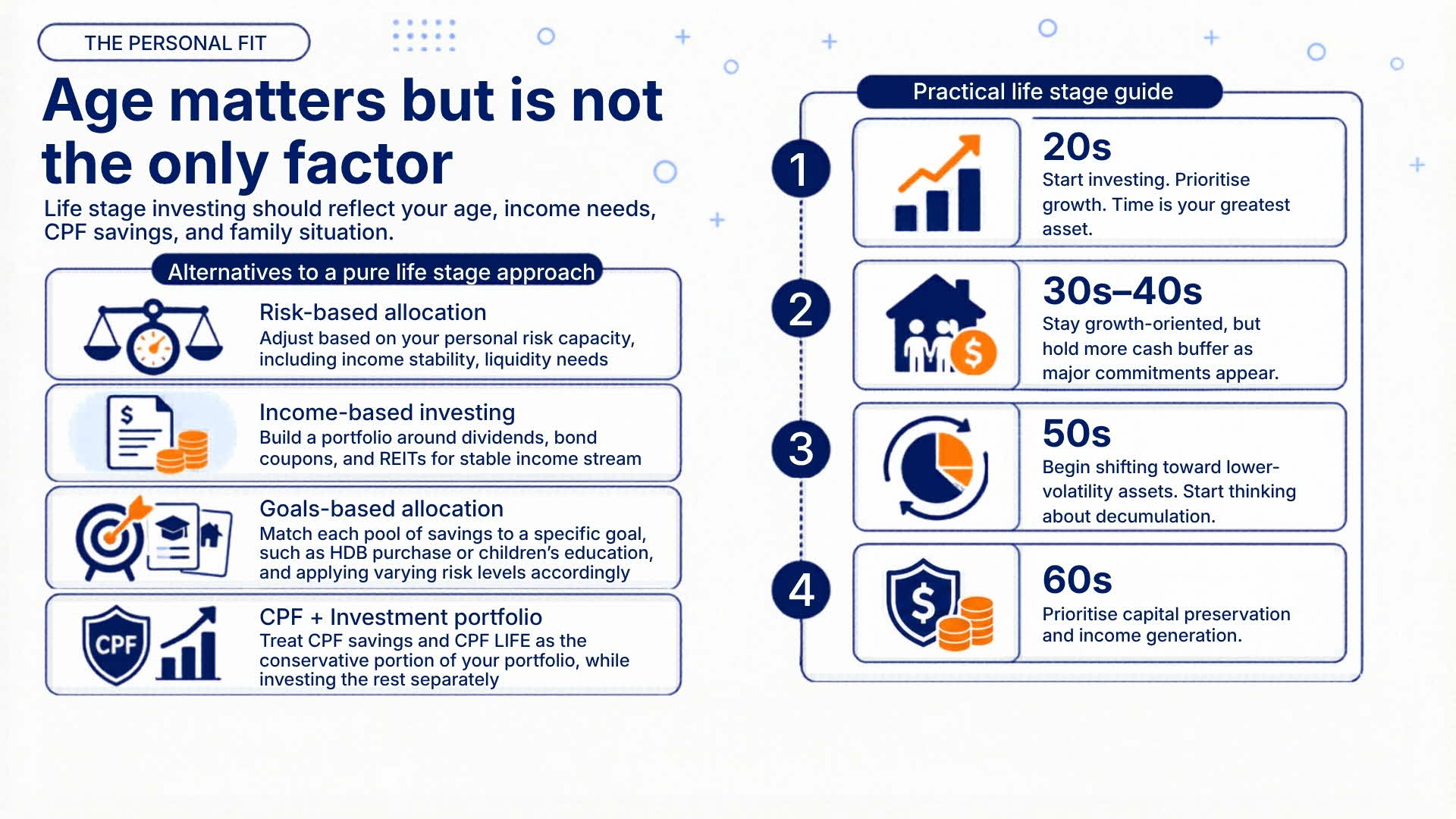
Ask a 34-year-old Singaporean how much they're "worth" and there's a good chance the answer starts with a CPF balance. Ask how much cash they could mobilise in 72 hours if something went wrong, and the conversation gets noticeably quieter.
That gap — between balance-sheet wealth and spendable wealth — is the defining financial tension of building wealth in your 30s in Singapore. It's the decade when most of us cross from renting or living with parents into owning, when the first HDB flat starts flirting with its Minimum Occupation Period, when salaries climb fast enough that a second property stops sounding absurd, and when the ABSD counter resets from 0% to something with a lot more digits. It's also the decade when the largest single bet of most Singaporean households — a leveraged, illiquid, geographically concentrated residential property — gets placed.
This piece is about that bet. Not whether property is good or bad, but how the Singapore property market, CPF rules, stamp duties and interest rates interact inside a household budget in your 30s — and where the honest trade-offs sit between upgrading, investing, and simply holding enough cash to sleep.
Why Your 30s Are the Decade That Decides the Next Three
Three things converge in your thirties, and they don't converge politely.
First, your CPF allocation mix starts working against your housing plans. The Ordinary Account — the one that pays for mortgages — gets the largest share of your contribution when you're youngest, then shrinks with every birthday band. The window where CPF is most useful for property is the same window where your income is still climbing.
Second, the ABSD ladder is priced to make the second property expensive. Under the rates in force since 27 April 2023, a Singapore Citizen pays 0% ABSD on a first residential property and 20% on a second. A Permanent Resident jumps from 5% to 30%. There is no gentle middle rung.
Third, the loan quantum you qualify for is capped long before the loan you can comfortably service. The Total Debt Servicing Ratio (TDSR) caps total monthly debt at 55% of gross monthly income, and for HDB flats and new Executive Condominiums the Mortgage Servicing Ratio (MSR) caps the mortgage alone at 30%. Both are stress-tested against an assumed interest rate floor of 4% for residential mortgages — a rule that matters enormously in a world where actual rates move.
Put those three together and you get the central tension of the decade: the years when you have the most borrowing capacity are the years when you have the least liquidity, and the asset you're told to buy is the one you can't sell quickly.
The CPF Illusion: How Much of Your Wealth Is Actually Yours to Spend
CPF is not a savings account. It's a set of three accounts with three different jobs, and only one of them can be pointed at a mortgage.
For a working adult aged 35 and below, total CPF contributions are 37% of ordinary wages — 20% from the employee, 17% from the employer. From 1 January 2025 the Ordinary Wage ceiling sits at $7,400 a month, scheduled to rise to $8,000 in 2026, which means the CPF-able slice of a rising salary is itself rising.
How that 37% splits matters far more than the headline number.
Share of Wages Allocated to the CPF Ordinary Account, by Age Band (%)
At 35 and below, 23 cents of every dollar of CPF-able wage lands in the Ordinary Account — the account that pays mortgage instalments, HDB loan downpayments, HPS premiums, and approved investments. By your late forties that share has fallen to 19%. By your early fifties, 15%.
The accrued interest trap
Here's the part that catches people at the point of sale. When you use CPF Ordinary Account monies to pay for a property, those monies are treated as a loan from your own CPF — and CPF charges you 2.5% per annum accrued interest on the amount withdrawn, compounding until the property is sold.
On a $400,000 HDB flat bought with, say, $120,000 of CPF for the downpayment and a decade of monthly instalments funded largely from OA, the accrued interest can quietly accumulate into five figures. When you sell, that principal plus accrued interest goes back into CPF first. What lands in your bank account is the residue.
The practical implication is uncomfortable and worth stating plainly:
- Your "profit" on paper is not your cash profit. A flat that appreciated $150,000 may return considerably less to your bank account once the CPF refund is settled.
- Selling to upgrade often releases less cash than expected. The upgrade budget should be built off the CPF refund statement, not off the sale price minus the purchase price.
- CPF OA is a housing account, not an emergency fund. It cannot pay for a hospital bill, a retrenchment, or a car repair. Treat any mental accounting that says "I have $200k in CPF" as a liquidity plan with real scepticism.
The flip side is that CPF is genuinely powerful for the specific job it was designed for. A 2.5% OA interest rate that is not paid out in cash but credited to your account is a real return, and the HDB concessionary loan at 2.6% — pegged at 0.1 percentage points above the OA rate — remains one of the most forgiving mortgage products available to a first-time buyer anywhere.
What You Can Actually Afford: TDSR, MSR and the LTV Ladder
Most people approach affordability from the wrong end. They start with the flat they want, then work backwards to the loan. The regulatory framework works the other way, and it has three gates.
The gates do different jobs, and confusing them is where budgets break.
- TDSR (55%) is the outer wall. It counts car loans, renovation loans, credit card minimums, personal loans and the new mortgage together. A $200,000 car loan at 2.8% over seven years consumes roughly $2,600 a month of servicing room — which is servicing room that cannot go to a mortgage.
- MSR (30%) is the tighter inner wall, and it only applies to HDB flats and new ECs bought with a housing loan. For a household earning $10,000 a month, MSR caps the mortgage at $3,000 — well below the $5,500 that TDSR would permit.
- LTV (Loan-to-Value) caps how much of the price can be borrowed at all: 75% for a first housing loan, dropping to 45% for a second and 35% for a third. The rest must come from cash and CPF.
The LTV ladder is where the ABSD conversation actually bites, because the second-property purchase requires both a 20% stamp duty and a 25% cash-and-CPF downpayment, together consuming 45% of the price before a single instalment is paid.
The stress test is not a formality
Banks assess servicing at the higher of the actual rate or a 4% floor. In a period where mortgage rates have ranged from the low-2% region up toward 4% and back, that floor has repeatedly turned "I can afford it" into "the bank disagrees."
Run the numbers on a $1,000,000 loan over 30 years:
| Interest rate | Monthly instalment | Annual servicing cost |
|---|---|---|
| 1.5% | ~$3,451 | ~$41,400 |
| 2.0% | ~$3,696 | ~$44,350 |
| 2.6% | ~$4,003 | ~$48,040 |
| 3.5% | ~$4,490 | ~$53,880 |
| 4.5% | ~$5,067 | ~$60,800 |
The spread between the cheapest and most expensive scenario is roughly $1,600 a month — about $19,400 a year — on an identical property at an identical price. That is not a rounding error. It is a second car, a year of childcare, or the entire annual savings rate of a median household.
And crucially, the borrower does not control which row of that table they live in. SORA-linked packages reprice as rates move. Fixed-rate packages expire, typically after two or three years, at which point the loan floats. A household that borrowed at the top of its TDSR allowance has no room to absorb the transition.
The Upgrade Question: HDB to Condo and the Real Cost of Moving Up
The most common wealth move attempted in the thirties is the HDB-to-condo upgrade. On paper it looks like trading up an asset. In practice it is a transaction with a surprisingly large friction cost, and the friction is what most planning models miss.
Selling first versus buying first
Because ABSD on a second residential property is 20% for Singapore Citizens, most upgraders cannot realistically buy before selling. On a $1.3 million condo that's $260,000 payable upfront. While remission exists for married Singapore Citizen couples in defined circumstances, and a refund mechanism applies where the existing home is disposed of within a set window, the cash-flow requirement in the interim is severe.
For most households, the sequence is sell, rent, then buy.
The interim rental period is the invisible cost of upgrading. Six to nine months of rent at $3,000–$3,500, plus storage and two moves, can quietly absorb $25,000–$40,000 — money that never appears in a "price paid" comparison.
The full friction stack
Take a realistic upgrade: sell a resale flat at $650,000, buy a condo at $1.3 million.
| Cost item | Approximate amount | Notes |
|---|---|---|
| Buyer's Stamp Duty on $1.3m | ~$36,600 | Tiered, 1%–6% |
| ABSD (SC, first property) | $0 | Only if the HDB is disposed of correctly |
| Agent commission on sale | ~$13,000 | Around 2% of sale price |
| Legal fees (sale + purchase) | ~$5,000–$7,000 | Two conveyancing sets |
| Renovation | $30,000–$60,000 | Highly variable |
| Interim rent + storage + moves | $25,000–$40,000 | The cost nobody budgets |
| Total friction | ~$110,000–$155,000 | Excludes ABSD |
That friction number is the real question. Spending $120,000 to upgrade is only rational if the new asset outperforms the old one by more than $120,000 over your holding period — plus the transaction costs when you eventually sell. On a $650,000 flat, that's a hurdle of roughly 18–24% before you break even relative to simply staying put.
The BSD tiers worth knowing
Buyer's Stamp Duty on residential property has been on a rising scale since 15 February 2023:
- 1% on the first $180,000
- 2% on the next $180,000
- 3% on the next $640,000
- 4% on the next $500,000
- 5% on the next $1,500,000
- 6% on the portion above $3,000,000
Because of the 4% and 5% bands, BSD scales faster than most buyers expect at the $1.5m–$3m range. It's a genuinely progressive tax on property value, and it's payable within 14 days of exercising the option.
A note on decoupling
"Decoupling" — one spouse transferring their share to the other so each holds one property — is frequently discussed as an ABSD workaround. It is not a loophole to be entered casually. Transfers attract BSD, may require the remaining owner to refinance and service the full loan alone under TDSR, and arrangements whose primary purpose is stamp duty avoidance have drawn scrutiny. Treat it as a legal and financial restructuring exercise with real costs on both sides, not a shortcut.
The Hidden Costs of Over-Leveraging in a Higher-Rate Environment
Leverage magnifies returns. It also magnifies every cost attached to ownership, and those costs are the ones most first-time upgraders underweight.
The costs that don't appear in the brochure
- Mortgage interest itself. At 3%, a $1 million loan costs roughly $30,000 in interest in year one alone. Over a 30-year term at that rate, total interest is in the region of half a million dollars.
- Property tax. Owner-occupied residential property tax runs on a progressive scale up to 32% of Annual Value; non-owner-occupied property is taxed at higher rates, starting at 12% and running to 36%. A property you rent out is taxed on the non-owner-occupied schedule.
- Management corporation fees. Typically $250–$450 a month for a mass-market condo — $3,000–$5,400 a year, rising with age of development as sinking fund demands grow.
- Maintenance and repairs. Budget 0.5%–1% of property value per year. Air-conditioning, plumbing, waterproofing and painting are not optional.
- Vacancy. A rental unit empty for two months a year loses roughly 17% of gross yield.
- No mortgage interest tax deduction. Unlike some jurisdictions, Singapore does not allow individuals to deduct residential mortgage interest against employment income. The interest is paid from after-tax dollars.
- Insurance. Fire insurance for the building (usually via MCST), home contents, and Mortgage Reducing Term Assurance if you want the loan covered on death or terminal illness.
The concentration problem
There is a subtler risk than any single line item. For many Singaporean households in their thirties, residential property represents 70–90% of net worth, is leveraged at 3–4x equity, generates income in one currency, sits in one city, and is regulated by one government that has demonstrated willingness to intervene in the market at short notice — through cooling measures in 2018, 2021, 2022 and 2023, through LTV tightening, and through the 15-month wait-out period imposed on private property owners buying resale HDB flats.
That is not an argument against owning property. It is an argument against owning only property, and against stretching to the absolute limit of your borrowing capacity in order to do so.
What the Market Has Actually Done
Any upgrading decision implicitly assumes something about future price growth. It's worth grounding that assumption in what the last few years actually delivered.
On the public housing side, the HDB Resale Price Index has moved through a dramatic cycle — a near-flat 2019, a stimulus-driven surge, an extended run of strong growth, a slowdown, then a re-acceleration.
HDB Resale Price Index: Annual Change (%)
The private market tells a different story — stronger early in the cycle, then cooling as additional buyer's stamp duty, higher rates and tighter loan limits filtered through.
URA Private Residential Price Index: Annual Change (%)
Two observations worth carrying into a personal decision.
Volatility is not symmetric across segments. Resale HDB, anchored by grants, income ceilings and a genuine owner-occupier base, has shown remarkable resilience. Private residential responds faster to rate cycles and cooling measures, and its growth has decelerated for three consecutive years.
The last six years were exceptional, and exceptional periods are a poor basis for a 25-year projection. Anyone underwriting an upgrade on the assumption that the 2021–2022 pace continues is not modelling; they're extrapolating.
Liquidity: The Asset Nobody Puts on a Balance Sheet
Here's the discipline that separates households that survive a rate shock from those that don't.
Property is illiquid, leveraged, and slow to sell. A resale flat takes roughly three to four months from listing to completion in normal conditions. A private unit can take longer, and in a soft market, longer still. Neither timeline shortens because you lost your job.
Cash is liquid, unleveraged, and fast. It earns less. That's the point — it's insurance with a return.
The working rules that hold up well for a mortgaged household in their thirties:
- Keep 6–12 months of total household expenses in cash or near-cash. Total expenses, not just the mortgage. That means groceries, school fees, insurance premiums, utilities and transport.
- Keep at least 12 months of mortgage instalments separately accessible. If the mortgage is $4,000 a month, that's $48,000. It sounds excessive until it isn't.
- Do not treat your CPF Ordinary Account as part of the buffer if it's fully committed to servicing the loan. There is nothing left over.
- Do not treat a credit line as a buffer. Banks reprice and withdraw unsecured facilities precisely when economic conditions deteriorate.
- Do not treat "I can always sell" as a plan. Selling under duress is how people crystallise losses.
The order matters. Most financial mistakes in the thirties come from doing step four before step one — investing for the long term while holding no short-term cushion, then being forced to liquidate at the worst possible moment.
Alternatives to a Second Property (and Why They're Not Boring)
The second property is the default aspiration. It is also, for a household with a fully committed HDB mortgage, frequently the wrong marginal dollar.
The yield comparison nobody runs
Gross rental yields on Singapore private residential property have typically sat in the low-3% range, and net yields after property tax, MCST fees, maintenance, agent fees and vacancy are commonly 1.5%–2.5%. Set that against:
- T-bills and Singapore Savings Bonds, which have at times offered comparable or better risk-free yields with daily or monthly liquidity and zero transaction costs.
- CPF Special Account top-ups, which earn a floor rate and attract tax relief of up to $8,000 per year for self top-ups (with a matching allowance for family members) — subject to the overall personal income tax relief cap of $80,000.
- Supplementary Retirement Scheme contributions, up to $15,300 a year for Singapore Citizens and PRs, which are tax-deductible and investable.
- A diversified global equity portfolio, which offers exposure across dozens of markets and sectors instead of one postcode.
A 2% net yield on a leveraged, illiquid, concentration-heavy asset is not obviously superior to a 3% risk-free yield on a liquid one. The property case rests almost entirely on capital appreciation and leverage — and leverage cuts both ways.
The one genuine argument for a second property
It's the ability to borrow a large sum at a relatively low rate for a long tenure and hold a real asset with it. No other instrument available to a salaried household offers 75% financing over 30 years at mortgage rates. If you believe in Singapore residential property over a 15-to-25-year horizon, that structural advantage is real.
But it only works if the household can carry the loan through a full cycle — through a rate spike, a job change, a vacancy, and a period of flat prices — without being forced to sell.
A Framework for the Decade
Pulling it together, a defensible approach for a Singaporean household in their thirties looks less like a single decision and more like a sequence.
Stage 1: Fix the balance sheet before optimising the portfolio. Clear high-interest debt, build the 6–12 month cash buffer, and confirm the existing mortgage is serviceable at 4% rather than at today's rate. This stage has no glamour and the highest return per dollar of effort.
Stage 2: Maximise the free money. Employer CPF contributions, HDB grants (the Enhanced CPF Housing Grant goes up to $120,000 for eligible families, and the Enhanced CPF Housing Grant plus the applicable family grant can materially change what's affordable), and tax reliefs from CPF and SRS top-ups. These are risk-free returns that compound.
Stage 3: Decide deliberately between upgrading and diversifying. If the upgrade happens, budget for the full friction stack — stamp duties, commission, legal, renovation, interim rent — and stress-test the new instalment at 4%. If it doesn't, put the marginal dollar to work in liquid, diversified assets rather than letting it sit idle.
Stage 4: Only then consider a second property. And only with a 15-year-plus horizon, a buffer that survives the mortgage being vacant and the rate being 2 percentage points higher, and a clear-eyed view of what 20% ABSD does to your break-even.
The uncomfortable truth is that most households in their thirties are better served by fewer, larger, better-timed moves than by a portfolio of small ones. Property rewards patience and punishes over-extension. The friction costs are large enough that a mediocre decision held for 15 years usually beats a clever decision churned every four.
Food for Thought
1. If your income fell by 30% tomorrow, how many months could you service the mortgage without selling anything? If the honest answer is "fewer than six," the leverage is doing more of the work than the plan is.
2. What is your upgrade actually costing you in friction, and what growth rate does the new property need to deliver just to break even? Most people can quote the purchase price. Far fewer can quote the $110,000–$155,000 of transaction costs sitting between them and the same net position.
3. Are you buying the property or the postcode? A district's price premium reflects a bundle of attributes — connectivity, schools, amenities, supply pipeline, lease decay. Understanding which of those attributes you're paying for, and which you could live without, is often worth more than negotiating 1% off the price.
4. How much of your net worth is in one asset in one country? If it's above 70%, what is the actual plan if Singapore residential property has a flat decade — which it has had before, for extended stretches?
5. Would you make the same decision if mortgage rates were 4.5% instead of 2.5%? If the answer changes, the decision is being driven by the rate environment rather than by your circumstances. Rates are not a permanent condition.