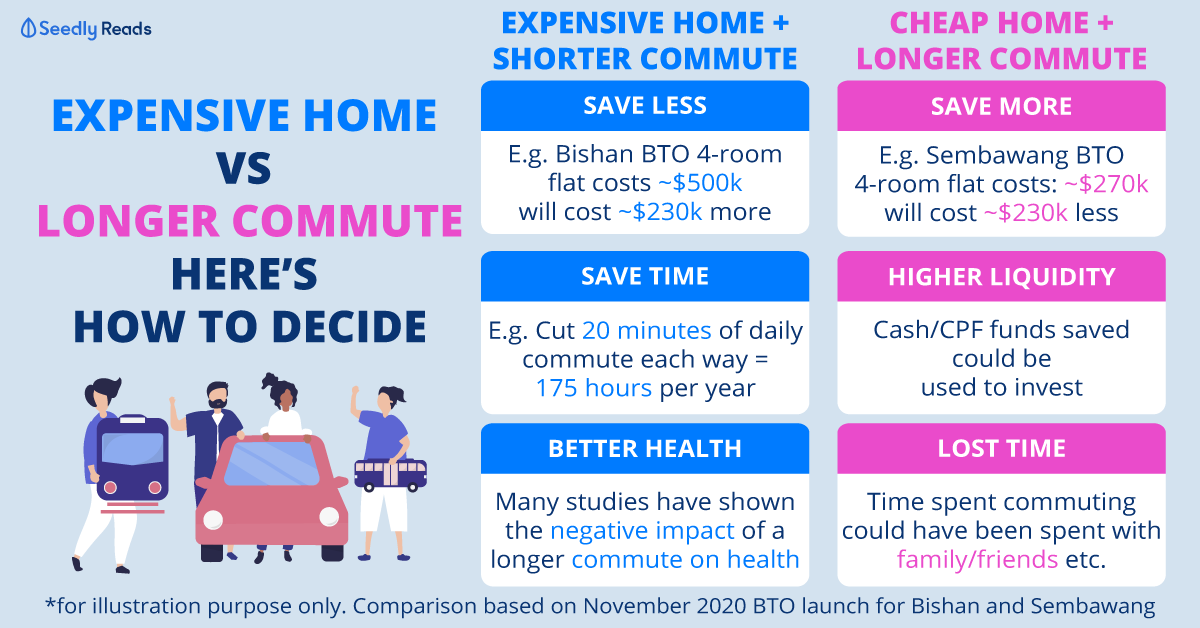
Two couples. Same salary. Same down payment. Same age.
One buys a four-room resale flat in Queenstown for around $920,000, with a 15-minute MRT ride to Raffles Place. The other buys in Punggol for around $620,000, with a 37-minute ride. Both are good flats. Both are near an MRT line. Both couples think they made the smart choice.
But the Punggol couple is saving roughly $1,400 a month in mortgage payments — and paying for it with about 15 extra hours a month on the North East Line. That works out to roughly $93 for every extra hour spent on a train platform.
Whether that is a bargain or a trap is the single most consequential question most young Singaporean buyers will ever answer. And almost nobody actually runs the numbers.
This piece does. We map commute times against resale prices, look at how the value geography shifts depending on whether your office is at Raffles Place, Jurong East, or Changi, and build a framework you can apply to your own shortlist this weekend.
Background: Why Commute Time Is Already Priced Into the Market
Singapore's property market is, in a very literal sense, a map of the MRT network with prices attached.
The country runs on a small number of employment nodes — Raffles Place and Marina Bay being the largest, with one-north, Jurong East, Changi Business Park, Paya Lebar, Tampines Regional Centre and Woodlands Regional Centre forming secondary cores. Because the rail network funnels almost everyone toward these nodes, the price of a flat is heavily shaped by one question: how many minutes does it take to get to the jobs?
This is not a uniquely Singaporean observation — urban economists have documented rail-access premiums in London, Tokyo and Hong Kong for decades. But Singapore's version is unusually clean, because:
- Public transport mode share is very high. A large majority of peak-hour commutes are made on public transport, so rail access is not a niche amenity — it is the primary transport system.
- The network is compact and legible. There is no ambiguity about which line goes where. Buyers can and do price this in directly.
- The state plans it. Singapore's land transport masterplan has long targeted "20-minute towns" and a "45-minute city" — meaning that connectivity is not a natural market outcome but a deliberate policy output. That makes future connectivity unusually predictable, and increasingly priceable.
The rail proximity premium, in plain terms
Market analysts and URA-derived studies have repeatedly found that flats and condos within roughly a five to ten minute walk of an MRT station command a premium — generally in the region of 5% to 15% over comparable stock further out, with the effect fading sharply beyond around 400 to 600 metres. Beyond a 10-minute walk (roughly 800 metres), the premium largely evaporates.
Two things follow from this:
- Two flats in the same town can be priced very differently based on a 300-metre difference in address. Town-level medians hide this completely.
- A "cheap" town with poor last-mile access may not be cheap at all once you convert a feeder bus into a daily cost.
The diagram above captures the thing most buyers miss: there is no single Singapore property price ladder. There are at least four, and they point in different directions.
Three Hubs, Three Different Value Maps
Before we look at numbers, it is worth being precise about what each employment hub does to the surrounding price surface.
Raffles Place and Marina Bay: the steepest gradient
The CBD produces the sharpest price decay with distance. Moving from Queenstown (roughly 15 minutes out) to Punggol (roughly 37 minutes out) knocks around $300,000 off a four-room resale flat. That is one of the steepest per-minute gradients in the region, and it exists because the CBD is where the deepest pool of high-paying jobs sits.
But the gradient is not smooth. It is stepped, because the rail network is radial. Towns on a direct one-seat line to Raffles Place — Queenstown, Toa Payoh, Bedok, Tampines, Pasir Ris, Punggol — carry a "direct line" premium. Towns that require an interchange — Bukit Panjang, parts of Bukit Batok, Sembawang — trade at a discount that partly reflects a transfer penalty of four to six minutes.
Jurong East: the second CBD that is still being priced
Jurong East is the most interesting node in the entire market for young buyers, because it is the only one where the jobs are arriving faster than the price has adjusted — or at least, where that argument can plausibly be made.
The Jurong Lake District is planned as Singapore's largest business district outside the CBD, anchored by a major transport interchange connecting the North-South and East-West lines to the incoming Jurong Region Line. For someone working in Jurong East, the value map flips completely:
- Choa Chu Kang is roughly 10 minutes away.
- Jurong West is roughly 5 minutes away.
- Woodlands is roughly 20 minutes away.
- Bedok is roughly 40 minutes away.
A buyer optimising purely for the CBD would never consider Choa Chu Kang. A buyer working in Jurong East should consider it first.
Changi: the most undervalued commute in Singapore
The Changi cluster — Changi Business Park, Changi Airport, the aviation and logistics belt, plus the Expo area — is the third major node, and it is the one where commute times are most poorly understood by buyers who don't work there.
Because the East-West Line branches at Tanah Merah, and because the Downtown Line now runs through the Upper Changi corridor, towns like Bedok, Tampines and Pasir Ris are extraordinarily well-positioned for Changi employment:
- Bedok to Expo: roughly 8 minutes.
- Tampines to Expo: roughly 8 to 10 minutes.
- Pasir Ris to Expo: roughly 12 to 14 minutes.
Set that against the same towns' journey times to Raffles Place — 22, 30 and 36 minutes respectively — and you get a very different ranking of "good value" depending on where you actually work.
Illustrative journey times across the three hubs
The table below gives a feel for how dramatically the ranking changes. Times are approximate platform-to-platform journey times in minutes, rounded, and exclude walking and waiting time at the start of the trip.
| Town | To Raffles Place | To Jurong East | To Changi (Expo) |
|---|---|---|---|
| Queenstown | 15 | 11 | 40 |
| Clementi | 22 | 4 | 42 |
| Bedok | 22 | 40 | 8 |
| Tampines | 30 | 48 | 9 |
| Jurong West | 33 | 4 | 65 |
| Punggol | 37 | 50 | 35 |
| Woodlands | 42 | 20 | 65 |
| Choa Chu Kang | 44 | 10 | 70 |
Read that table again. Bedok is a mediocre CBD commuter town and an outstanding Changi commuter town. Choa Chu Kang is a poor CBD commuter town and an excellent Jurong East commuter town. Neither fact shows up in a generic "best places to buy" listicle.
The first principle of the commute-vs-price trade-off, then, is this: there is no such thing as a good location. There is only a good location for your specific commute.
Mapping Commute Times vs Property Prices
Now to the numbers. Below are indicative median resale prices for four-room HDB flats by town, alongside approximate MRT journey times to Raffles Place. Prices are rounded to the nearest $10,000 and are indicative of recent resale activity — treat them as a starting point for your own research rather than gospel.
| Town | Median 4-room resale (approx.) | MRT to Raffles Place (min) | Price per minute |
|---|---|---|---|
| Bukit Merah | $950,000 | 12 | $79,200 |
| Queenstown | $920,000 | 15 | $61,300 |
| Bishan | $900,000 | 20 | $45,000 |
| Toa Payoh | $860,000 | 16 | $53,800 |
| Clementi | $830,000 | 22 | $37,700 |
| Ang Mo Kio | $780,000 | 24 | $32,500 |
| Tampines | $660,000 | 30 | $22,000 |
| Bedok | $640,000 | 22 | $29,100 |
| Pasir Ris | $630,000 | 36 | $17,500 |
| Punggol | $620,000 | 37 | $16,800 |
| Hougang | $610,000 | 30 | $20,300 |
| Sengkang | $600,000 | 34 | $17,600 |
| Bukit Panjang | $580,000 | 38 | $15,300 |
| Choa Chu Kang | $560,000 | 44 | $12,700 |
| Yishun | $545,000 | 35 | $15,600 |
| Woodlands | $540,000 | 42 | $12,900 |
| Jurong West | $530,000 | 33 | $16,100 |
Indicative median 4-room HDB resale price by town (S$)
The chart makes the headline obvious: the gap between the most and least expensive towns on this list is more than $400,000 — roughly a 40% difference in absolute price.
But the number that matters is the last column: price per minute of commute. It ranges from around $12,700 per minute in Choa Chu Kang to nearly $80,000 per minute in Bukit Merah. That spread is the entire trade-off, compressed into one figure.
Approximate MRT journey time to Raffles Place (minutes)
Notice something important in the comparison: the relationship is loose, not tight. Choa Chu Kang is 44 minutes out and costs $560,000. Woodlands is 42 minutes out and costs $540,000. But Bukit Panjang is 38 minutes out and costs $580,000, while Punggol is 37 minutes and costs $620,000. Meanwhile Jurong West is 33 minutes out at just $530,000 — cheaper than Yishun, which is two minutes closer.
That scatter matters enormously. If commute time fully explained price, there would be no arbitrage. The fact that it doesn't means you can find towns that are far and cheap, and towns that are moderately far and expensive. The job is to tell them apart.
The Commute Dividend: Where Extra Minutes Buy the Most
Here is the analytical move that turns this from a list into a decision.
Instead of asking "how much does this town cost," ask: how much mortgage relief do I get for every extra hour of commuting I accept?
To compute it, we take Queenstown as the baseline (15 minutes to Raffles Place, ~$920,000), then for each town calculate:
- The extra minutes each way, doubled for the round trip, multiplied by 250 working days, divided into a monthly figure.
- The mortgage relief from the price gap — assuming a 25-year loan at 3% p.a., which works out to roughly $474 per month for every $100,000 borrowed.
- Divide one by the other.
| Town | Extra min each way vs Queenstown | Price saving | Approx. monthly mortgage relief | Relief per extra commute hour |
|---|---|---|---|---|
| Bedok | 7 | $280,000 | $1,330 | $273 |
| Jurong West | 18 | $390,000 | $1,850 | $148 |
| Hougang | 15 | $310,000 | $1,470 | $141 |
| Yishun | 20 | $375,000 | $1,780 | $128 |
| Tampines | 15 | $260,000 | $1,230 | $118 |
| Sengkang | 19 | $320,000 | $1,520 | $115 |
| Ang Mo Kio | 9 | $140,000 | $660 | $106 |
| Bukit Panjang | 23 | $340,000 | $1,610 | $101 |
| Woodlands | 27 | $380,000 | $1,800 | $96 |
| Pasir Ris | 21 | $290,000 | $1,380 | $94 |
| Punggol | 22 | $300,000 | $1,420 | $93 |
| Clementi | 7 | $90,000 | $430 | $88 |
| Choa Chu Kang | 29 | $360,000 | $1,710 | $85 |
| Bishan | 5 | $20,000 | $95 | $27 |
Mortgage relief per extra commute hour vs Queenstown baseline (S$)
Three findings jump out.
1. Bedok is the standout trade in the market
Bedok sits only about seven minutes further from Raffles Place than Queenstown, yet trades roughly $280,000 cheaper. That is an exceptional ratio — the best on this list by a wide margin.
Why does it exist? Bedok is an older mature estate with a large supply of older flats, a strong local amenity base, and an East-West Line connection that is genuinely fast. It does not carry the "premium" branding of Queenstown or Bishan, but it delivers nearly the same commute. The caveat is that much of Bedok's stock is older, with shorter remaining leases — which is precisely why the discount exists. You are not getting a free lunch; you are getting a shorter lease in exchange for a shorter mortgage. Whether that is a good trade depends entirely on your horizon.
2. The far north-west is cheap per minute, but not per hour
Choa Chu Kang and Woodlands look cheap on sticker price, but their commute dividend ($85 and $96 per hour) is middling, because you are accepting 27 to 29 extra minutes each way. The absolute savings are large, but the time cost is brutal — you are trading nearly an hour a day.
Jurong West, by contrast, delivers $148 per hour, because its 33-minute journey is far shorter than its price suggests it should be. Its weakness is entirely hub-specific: it is excellent for Jurong East and poor for Changi.
3. Bishan and Clementi are the worst trades on the board
Bishan costs $900,000 for a 20-minute commute. Against Queenstown that is 5 extra minutes for $20,000 — a commute dividend of just $27 per hour. You are paying for schools, maturity, amenities and the Bishan–Toa Payoh halo, not for transport. That may be worth it to you, but be honest that it is a lifestyle purchase, not a transport optimisation.
Clementi is a subtler case: at $88 per hour, it also underperforms — but it is only four minutes from Jurong East and sits next to one-north. For a buyer working in the west, Clementi's value proposition is completely different from what this CBD-focused table implies.
Methodological caveat: These figures assume 250 office days a year, a 25-year loan at 3%, and ignore stamp duties, interest rate variation, lease decay, capital appreciation and everything else. They are a relative ranking heuristic, not a financial plan. Small deltas (like Toa Payoh versus Queenstown, which differ by one minute) are noise.
The Hybrid-Work Twist That Changes Everything
Here is the factor almost no buyer prices in, and it is the one most relevant to anyone under 40.
The calculations above assume five office days a week. But a substantial share of young professionals now work hybrid — three days in office, or even two.
Watch what happens to the numbers when you cut office attendance from five days to three:
| Scenario | Extra commute hours per month (Punggol vs Queenstown) | Mortgage relief per extra hour |
|---|---|---|
| 5 days in office | ~15.3 hours | ~$93 |
| 4 days in office | ~12.2 hours | ~$116 |
| 3 days in office | ~9.2 hours | ~$155 |
| 2 days in office | ~6.1 hours | ~$233 |
The commute penalty for living far out falls by roughly 40% when you drop from five days to three. A town that looked marginal on a five-day calculation becomes clearly attractive on a three-day one.
This has a real and underappreciated implication: if you are hybrid, the market may still be pricing your town on a five-day assumption. If enough buyers work hybrid, the "correct" premium for central living is lower than what the market currently charges — which means buying further out and accepting a longer commute on the days you do travel may be structurally undervalued right now.
The reverse warning: if your employer signals a return to five days, the maths flips immediately. Do not buy on a three-day assumption unless you are confident it holds for the next five years — or unless you can absorb the change.
The Costs That Don't Show Up on the Price Tag
Mortgage relief is the biggest number, but it is not the only one. A proper trade-off analysis includes four more.
The fare gap is trivial — until you forget it
Adult card fares in Singapore are distance-based, generally landing somewhere between about $1.20 and $2.30 per trip. A longer commute might cost an extra $0.30 to $0.50 per trip, which works out to roughly $150 to $250 a year — utterly negligible against a six-figure mortgage difference.
The lesson: fares are noise. Time is the currency. Do not let a $200 annual fare difference sway a $300,000 decision. But do budget for it, so it doesn't surprise you.
The last mile is where "near MRT" lies
A flat advertised as "5 minutes to MRT" often means 5 minutes' walk — around 400 metres, which is genuinely good. A flat "near MRT" two bus stops away means 12 to 15 minutes door-to-door including the wait, the feeder bus, and the walk at the other end.
Twelve minutes of last-mile friction, twice a day, 250 days a year, is 100 hours — equivalent to more than two full working weeks. A feeder-bus dependency can quietly erase the entire advantage of a town that looks well-connected on a map.
Practical rule: add 2 minutes for a short walk, 6 to 8 minutes for a feeder bus, and 4 to 6 minutes for every interchange. Then price the town on that number, not on the platform-to-platform time.
Reliability and crowding are real costs
Line reliability varies, and so does peak-hour crowding — some lines are meaningfully more uncomfortable at 8am than others. A 40-minute journey that occasionally becomes 55 minutes is qualitatively different from a 40-minute journey that reliably runs to time. This is hard to quantify but easy to experience: do the commute yourself, in both directions, at peak hour, before you commit.
The exit matters as much as the entrance
A town is only cheap if you can sell it. The things that make a distant town cheap today — long commute, limited amenities, older stock — will make it cheap when you sell, too. The things that make it valuable tomorrow are future connectivity and future demand, and that is where the next section comes in.
Buying Future Connectivity, Not Current Connectivity
Because Singapore plans its rail network publicly and years in advance, buyers get something most property markets never offer: a reasonably reliable preview of future commute times.
The pipeline is substantial.
(Dates are the widely reported targets at the time of writing and are subject to change. Verify against LTA announcements before relying on them.)
Three of these matter enormously for young buyers.
The Jurong Region Line is the biggest structural change in the west
The JRL is not a line into the CBD. It is a web — designed to connect the western towns to each other and, critically, to Jurong East. Towns that today have no direct rail link to the second CBD will get one.
For a buyer working in Jurong East or the western industrial and tech belt, the JRL meaningfully compresses the effective map. Choa Chu Kang, Bukit Batok, Boon Lay, Jurong West and Tengah all move closer, while places that were already well-connected move less.
The Cross Island Line reshapes the east and north-east
The CRL's first phase, running from Aviation Park through the east and north-east to Bright Hill, creates a genuinely orbital connection that reduces dependence on the East-West Line and the North East Line for cross-island trips. The Punggol Extension further knits the north-east into the eastern employment belt.
For residents of Pasir Ris, Tampines, Hougang, Punggol and Ang Mo Kio, this is a real improvement in Changi-direction access specifically — a hub that is currently awkward for many of them.
The TEL has already re-priced the east
The Thomson-East Coast Line's fourth stage, which opened in 2024 and runs through Tanjong Rhu, Katong Park, Tanjong Katong, Marine Parade, Marine Terrace, Siglap and Bayshore, has already changed the value of the eastern corridor. Areas that were previously bus-dependent for CBD access now have direct rail.
The pattern to know: markets tend to price future rail in gradually, with a meaningful chunk of the premium arriving closer to the opening date. That means there is a window — not a guarantee, and not without risk — during which a buyer can purchase connectivity that has not yet fully been capitalised into the price.
The three rules of buying connectivity:
- Buy the station that is under construction, not the one that is being studied. Announced-and-funded beats proposed-and-aspirational by a wide margin.
- Buy the walk, not the line. A new station 900 metres away changes nothing about your life.
- Check the interchange, not just the station. A one-seat ride is worth materially more than a station that gets you two stops closer but adds a transfer.
A Practical Framework for Young Buyers
Here is the framework, condensed into six steps.
Step 1: Anchor on your actual hub — and be honest about it
Not "the CBD." Yours. If you work at Changi Business Park, optimising for Raffles Place is actively harmful. If your employer is moving, or your sector clusters somewhere specific, weight that.
If two of you are buying together and work in different places, model both commutes and optimise for the sum, not the average of the vibes.
Step 2: Set a hard door-to-door ceiling
This is the single most effective decision you can make, because it converts an infinite search into a finite list. A defensible ceiling for most people is 45 minutes door-to-door, which is roughly where commuting stress begins to bite. Some will accept 60; others will refuse anything past 30. Pick a number and hold it.
Step 3: Compute your personal commute dividend
For each shortlisted town, plug in:
- (A) Extra minutes each way versus your closest-in option
- (B) Price difference
- (C) Mortgage relief from B — roughly $474/month per $100,000 over 25 years at 3%
- (D) Extra hours per month from A — that is, A × 2 × office days × 50 ÷ 12 ÷ 60
- (E) C ÷ D — the relief per extra commute hour
Then rank. Towns with a high E are genuinely efficient trades. Towns with a low E mean you are paying for something other than transport — which is fine, as long as you know what it is.
Step 4: Adjust for the last mile
Add realistic walk and feeder-bus time before you compute anything. Recompute. Some shortlists collapse at this stage, and that is the point.
Step 5: Check the pipeline
Is there a station opening within walking distance in the next five to eight years? If yes, your future commute is shorter than today's — and your resale buyer is purchasing a better asset than you did. If no, and there is no plan for one, assume today's commute is permanent.
Step 6: Stress-test the exit
Ask: who buys this from me in ten years? If the answer is "someone with the same commute tolerance I have, in a market where the rail map is the same," you are relying entirely on general market growth. If the answer is "someone whose commute just got 15 minutes shorter because of a new line," you have a structural tailwind.
A quick scoring sheet
| Criterion | Weight | What to check |
|---|---|---|
| Door-to-door commute to your hub | High | Walk + wait + ride + walk, at peak hour |
| Commute dividend per extra hour | High | The calculation in Step 3 |
| Last-mile quality | High | Under 10 minutes' walk, no feeder bus |
| Rail pipeline | Medium | Any funded station within 800m before 2035 |
| Remaining lease | Medium | Especially for older mature estates like Bedok |
| Amenity depth | Medium | Hawker, supermarket, clinic, schools |
| Resale liquidity | Medium | Transaction volume, not just median price |
| Hybrid-work durability | Personal | How confident are you in 3 days a week? |
Food for Thought
1. If you are hybrid, is the market still charging you for a five-day commute — and are you paying it voluntarily? The premium for central living was built on a five-day office assumption. If your actual pattern is three days, you may be buying something you no longer need. But how confident are you that your employer's policy holds for the next five years?
2. Are you optimising for your commute, or your ego's commute? Many buyers choose a town because it sounds like the "right" answer at a family dinner — Bishan, Queenstown, Toa Payoh — rather than because the numbers work for their actual daily route. Which of your preferences would survive if you had to justify them with a spreadsheet?
3. What is an hour of your life actually worth to you? The commute dividend gives you a number — $93, $148, $273 per extra hour. But that number only tells you what the market is offering. It cannot tell you what your time is worth. If someone offered you $150 to spend an extra hour on the MRT every working month, would you take it? If not, why is the mortgage version of the same trade so tempting?
4. Is "cheap and far" actually cheap if the lease is short? Bedok's exceptional commute dividend is partly a function of older stock. A flat with 55 years left on the lease is not directly comparable to one with 90. Have you converted the lease difference into an annual cost before declaring it a bargain?
5. If a new line opens in 2030, who captures that value — you, or the seller you buy from? Some of the future connectivity premium is already in today's price. The question is how much. Buying near a funded station is not a guaranteed win; it is a bet that the market has not yet fully priced what you can already see on the map.
The Bottom Line
Commute times vs property prices is not a simple trade-off of minutes for dollars. It is a hub-specific, hybrid-adjusted, last-mile-sensitive calculation — and the answer changes depending on whether your office is at Raffles Place, Jurong East or Changi.
The headline findings are robust enough to be useful:
- Bedok offers the most efficient trade on this list — a modest commute penalty for a very large price difference.
- Jurong West, Hougang, Yishun and Tampines deliver solid commute dividends, each with a different hub dependency.
- Bishan and Clementi are expensive relative to their CBD commute — you are paying for amenity and location prestige, not transport efficiency.
- The far north-west is cheap in absolute terms but costly in hours; it only makes sense if your job is in the west.
- Hybrid work materially improves the economics of living further out — and this may be the most underpriced variable in the entire calculation.
Singapore's rail network is one of the few things in the property market you can actually forecast. Use it.