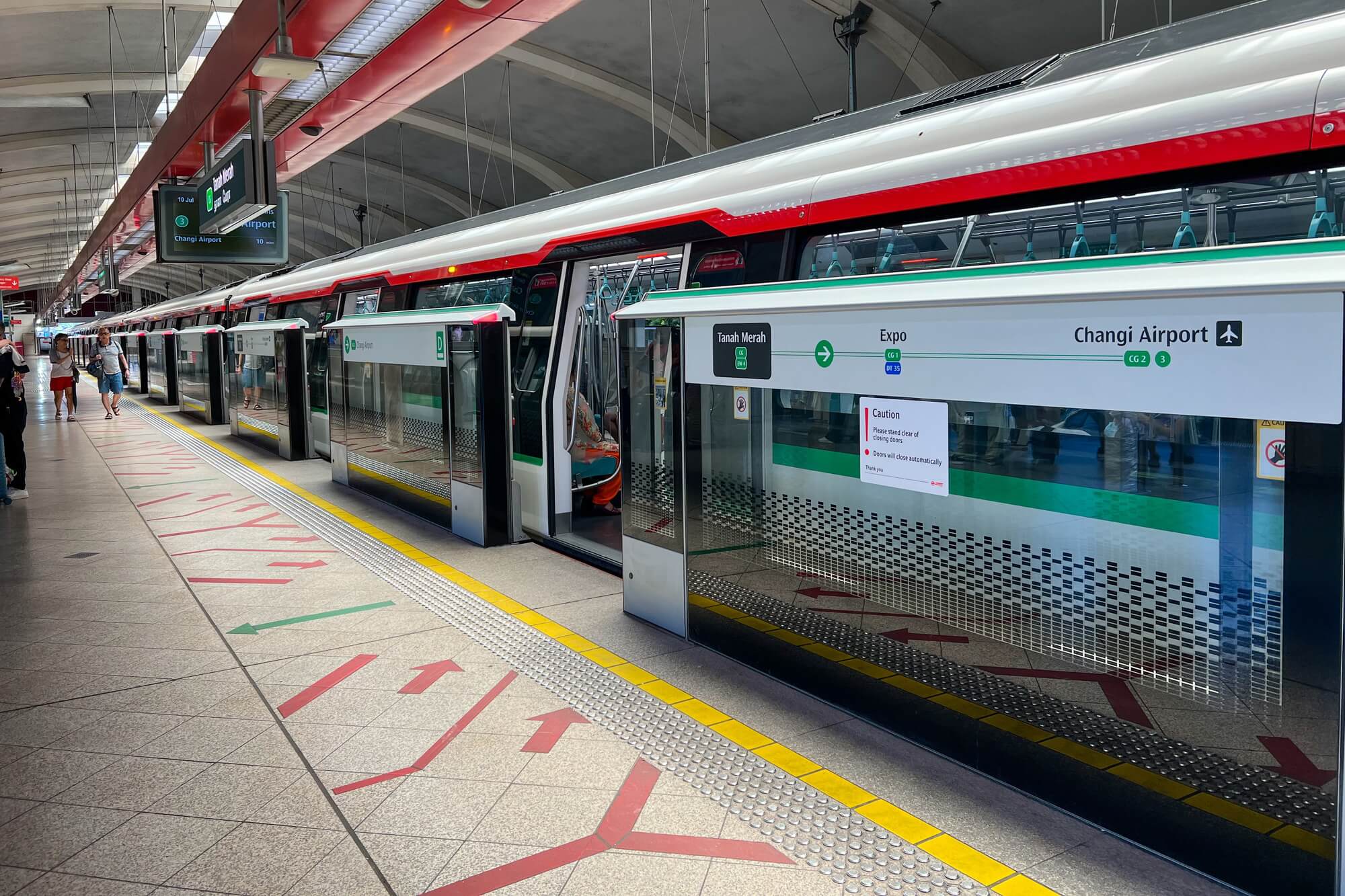
Two flats. Same price. Same number of rooms. Same lease started in the same year. One of them quietly costs you 264 hours a year more than the other — roughly six and a half working weeks — and you will never see that cost on a single piece of paper at the viewing.
That gap is the single most under-priced variable in Singapore's property market. Buyers will haggle over a $5,000 discount, then sign for a home that adds 25 minutes each way to their daily journey and never run the arithmetic. So let's run it properly, using a framework rather than a vibe: a commute-time budget that turns door-to-door travel minutes into a number you can stack directly against the asking price.
This is not an argument that everyone should live near Raffles Place. It is an argument that the distance between two homes is a cost with a price tag, and that a Singapore property search which ignores it is only half a search.
Why 45 Minutes Is Already the Number Singapore Uses
The 45-minute figure isn't arbitrary. Singapore's Land Transport Master Plan 2040, published by the Land Transport Authority, sets out the "45-Minute City, 20-Minute Towns" vision — a target that 9 in 10 peak-hour journeys be completed within 45 minutes door to door. The same plan aims for 20-minute towns, where daily needs are reachable within 20 minutes by walking, cycling or riding.
Two things are worth noticing about that.
First, it is door to door, not station to station. Planners count the walk to the station, the wait on the platform, the transfer, and the walk at the other end. Buyers almost never do. They count the train ride, because the train ride is the only part that is visible on a map.
Second, it is a network-wide average, not a personal standard. Nine in ten trips within 45 minutes means one in ten is worse, and it says nothing about whether 45 minutes is right for you. A couple with a toddler and a parent in Woodlands has a completely different geometry to a single 28-year-old working in Raffles Place.
So treat 45 minutes as the industry default ceiling — the point past which a home's resale pool starts to narrow noticeably. Then set your own number below it.
The Anatomy of a Door-to-Door Journey
The map tells you almost nothing about the real number. Here's what a door-to-door journey actually decomposes into:
Every one of those segments is real time, and several of them are systematically under-counted:
- The initial walk is often 8–12 minutes for blocks marketed as "near MRT". Singapore blocks "within 400m" can still be a 6-minute walk with a traffic light crossing.
- The wait is not the average headway. At 7:45am on the North-South Line, it's the crowded headway — the first train you physically cannot board.
- The transfer costs far more than its walking time. A 200m interchange walk plus a 3-minute wait plus a platform-level change is routinely 8–12 minutes, and it is the segment buyers most often delete from their mental model.
- The exit walk at the destination is the one people forget entirely, and in the CBD it's often the longest walk of the day.
Add those honestly and a "30-minute train ride" becomes a 48-minute journey. That 18-minute shadow is where a commute-time budget earns its keep.
What a Long Commute Actually Costs You
There are three separate costs, and they behave differently.
1. The time cost — large, recurring, and compounding
Time cost is the big one, and it's simple arithmetic. Assume two trips a day, 22 working days a month:
528 one-way commute trips per year — 264 round trips. Then multiply by your door-to-door time:
Annual Hours Spent Commuting by Door-to-Door Time (528 trips/yr)
Read that again: a 60-minute door-to-door commute consumes 528 hours a year — the equivalent of 13 full working weeks, or roughly 3.5 months of annual leave at a typical 20-day entitlement. A 90-minute commute consumes 792 hours, which is more than a fifth of all your waking hours in a year.
And note this is commute only. It excludes the trip to your parents' place, the gym, the doctor, the friend in Pasir Ris. The real number is always higher.
2. The cash cost — smaller than you think, until it isn't
Here's a genuinely counter-intuitive finding. MRT fares barely move with distance. Fares are distance-banded with a modest gradient, so the difference between a 12km journey and a 22km journey is measured in cents per trip, not dollars. At roughly S$1.90–S$2.20 per adult trip, commuting cash cost is nearly flat across the island — call it around S$1,000 a year whether you live in Queenstown or Punggol.
That's the good news. The bad news is what happens when the network doesn't work for your specific journey:
| Mode | Typical annual cost (528 trips) | When it kicks in |
|---|---|---|
| MRT/bus only | ~S$1,000 | Station walk under ~12 min, ≤1 transfer |
| MRT + daily last-mile bus | ~S$1,300 | Station walk over 15 min, or poor feeder coverage |
| MRT + regular ride-hail top-ups | ~S$2,000–2,500 | Rain, late nights, unreliable feeder services |
| Car-dependent | Five figures | No viable rail route to the anchor destination |
That third row is the quiet killer. If your home is a 20-minute walk from the station, you will not make that walk in a thunderstorm at 7:40am in November. You will call a car. Two or three times a week at S$15–20 a trip is S$1,500–2,000 a year that never appears in any affordability calculator.
Distance from the rail network doesn't just cost time. It changes your transport mode, and mode is where the money goes.
3. The optionality cost — the one nobody prices
A long commute doesn't just consume hours. It consumes choices.
- The evening class you'd have taken, if you got home before 8pm.
- The gym you'd have joined, if it weren't a 50-minute journey from your office.
- The hawker centre dinner with colleagues, if the last train weren't a consideration.
- The childcare pickup window, if a delay meant a $20-per-15-minutes late fee.
These are real, they are recurring, and they are invisible in a mortgage calculator. They're also the reason surveys of commuter wellbeing consistently find that commute time is one of the most robust predictors of self-reported life satisfaction — more so than many things people actively shop for.
The Ten-Year Cost, in One Picture
Here's the same comparison expressed as a ten-year present-value cost, for five illustrative flats (assumptions below). Look at the gap between the cheapest home to buy and the most expensive one to commute from:
Illustrative 10-Year Commute Cost: Time + Fares, Present Value (S$'000)
Flat A looks like the bargain on the price tag. It is carrying S$82,000 more in commute cost than Flat E over ten years. That's not a rounding error — that's a second down payment.
The Framework: Turning Minutes Into Dollars
Here's the five-step process. It takes about an afternoon and it will change your shortlist.
Step 1: Fix Your Anchors — Three Maximum
Most buyers anchor on one destination: the office. That's a mistake in two ways.
- You will change jobs more often than you change homes. The median job tenure for a Singapore professional is measured in years, not decades. A home optimised entirely around a CBD office is a home exposed to a single point of failure.
- The second anchor is usually the one that hurts. For dual-income couples, it's two offices. For the sandwich generation, it's a parent's flat. For young families, it's a childcare centre or a grandparent who does pickup.
Write down no more than three anchors, and mark which one is non-negotiable. A useful heuristic: the anchor that involves someone other than you waiting — a child, an elderly parent, a caregiving arrangement — should almost always outrank the office.
Step 2: Measure at Peak, Both Directions, and Write It Down
Not the off-peak number. Not the number from a routing app at 2pm on a Sunday. The actual 7:45am Tuesday number, measured once, for real, by making the journey.
Then apply a crowding and reliability premium of 3–5 minutes per journey on the busiest segments. If the app says 38 minutes, budget 42.
And measure the return separately. Evening frequencies drop, and a journey that's 40 minutes in the morning can be 55 at 8pm if it involves a feeder bus or an LRT.
Step 3: Set Your Cap, and Grade It
Use the 45-minute default as a starting ceiling, but grade your tolerance:
| Door-to-door band | What it buys you | Trade-off |
|---|---|---|
| Under 25 min | Walking-distance urban living, maximum optionality | Highest PSF; smallest floor area per dollar |
| 25–45 min | The mainstream sweet spot; widest resale pool | You will still be on a train twice a day |
| 45–60 min | Meaningfully more space per dollar | Resale pool begins to narrow; mode drift to ride-hail |
| Over 60 min | Cheapest PSF in the market | Time cost alone can exceed S$10,000/year |
The insight most buyers miss: there is a hard discontinuity around 45 minutes, because that's the point at which a meaningful share of the buyer pool stops looking. Homes inside the band have a deeper resale market than homes outside it. That liquidity is worth something, and it's not reflected in the price.
Step 4: Build the Time-Adjusted Price
This is the core calculation. Instead of comparing asking prices, compare:
Time-Adjusted Price = Purchase Price + Present Value of commute time cost + Present Value of transport cash cost
Worked example. The assumptions, stated plainly so you can substitute your own:
- 528 one-way commute trips per year (2 per working day, 22 days, 12 months)
- S$25 per hour as the value of commute time — deliberately conservative; Singapore's median full-time wage works out considerably higher per hour, and transport economists typically value commute time at a substantial fraction of the wage rate
- 4% discount rate, 10-year holding period → present value factor of about 8.11
- Fares ≈ S$1,900/year, roughly flat across distances
| Flat | Purchase price | Door-to-door | Annual commute hrs | 10-yr time cost (PV) | 10-yr fares (PV) | Time-adjusted price |
|---|---|---|---|---|---|---|
| A — The Long Haul | S$480,000 | 72 min | 634 | S$128,500 | S$8,100 | S$616,600 |
| B — The Compromise | S$545,000 | 52 min | 458 | S$92,800 | S$8,100 | S$645,900 |
| C — The Dead Heat | S$560,000 | 44 min | 387 | S$78,500 | S$8,100 | S$646,600 |
| D — The Inner Ring | S$620,000 | 38 min | 334 | S$67,800 | S$8,100 | S$695,900 |
| E — The Doorstep | S$710,000 | 26 min | 229 | S$46,400 | S$8,100 | S$764,500 |
Illustrative figures constructed to demonstrate the method; not actual transactions.
Three things fall out of this table.
1. The rule of thumb. Every single minute of daily door-to-door commute, each way, is worth roughly S$1,800 in purchase price over a 10-year horizon at S$25/hour and 4%. At S$40/hour it becomes about S$2,900 per minute. At S$15/hour, about S$1,070. That's your conversion rate — memorise it.
2. Flats B and C are a dead heat. C is 8 minutes closer for S$15,000 more, and on this model the two are effectively identical (S$645,900 vs S$646,600). 8 minutes × S$1,800 = S$14,400 — almost exactly the price gap. This is the most useful outcome the framework produces: it tells you when the decision should be made on something else entirely — layout, facing, lease balance, floor level, noise. Not price, and not commute.
3. Flat A wins the price war and loses the value war. It's the cheapest by S$65,000. It's also S$29,000 worse than Flat B on a time-adjusted basis, and S$148,000 worse than Flat E.
None of this says buy Flat E. It says: stop comparing flats on purchase price alone.
Step 5: Stress-Test Before You Commit
Three checks before the time-adjusted price becomes a decision:
- Holding horizon. The shorter your horizon, the less commute time matters economically — but the more resale liquidity matters. At under 7 years, weight the resale pool over the commute maths.
- Network risk, in both directions. A station opening near your home is an upgrade. A station opening that pulls demand away from your line's frequency, or a new line that makes your journey require an extra transfer, is a downgrade. Check the Land Transport Master Plan pipeline before you assume today's routing is permanent.
- Job volatility. Re-run the model with your anchor destination swapped to a plausible next employer. If the answer changes drastically, you're making a single-employer bet with a 30-year asset.
The Decision Shortcut
If the full model is more than you want to run on a Saturday, here's the compressed version:
The "about 10 years of time savings" test is simply: minutes saved each way × S$1,800. If the premium is below that number, the closer home is objectively cheap and you should probably take it.
Why the Map Lies: Network Geometry Beats Distance
The single biggest error in Singapore property search is treating distance as a proxy for time. It isn't even close.
There are three distinct effects.
Interchange density. A home one stop from a major interchange can reach half the island with a single change. A home on a branch line three stops from the terminus can be geographically closer to the CBD and still take 20 minutes longer, because every journey begins with a feeder segment.
Transfer penalty. As covered above, a transfer is not a 200m walk. Budget 8–12 minutes for the full event, including the wait. Two transfers can add 20 minutes to a journey that looks short on a map.
Line alignment. Singapore's rail lines are radial, not grid-shaped. A journey between two points that are 6km apart but on different radials can be far longer than a journey of 14km along a single line. This is why "I'm only four stops away" and "I'm 12km away" can produce identical journey times.
New Lines Are Pricing Events, and They're Priced Early
When a new rail stage opens, the property market does not discover it on opening day — it prices it in stages, typically from the announcement of the alignment, again at confirmation of station locations, and again as construction becomes visibly complete.
Recent Singapore examples are instructive. TEL Stage 4 opened in June 2024, bringing Tanjong Rhu, Katong Park, Marine Parade, Siglap and Bayshore onto the network — a substantial change to the commute geometry of the entire East Coast, an area historically reliant on buses. Further stages, the Jurong Region Line and the Cross Island Line, are set to reshape the geometry of the west and the northeast respectively over the coming decade.
The practical lesson cuts two ways:
- If a station is coming to your neighbourhood, the commute-time benefit will be partly capitalised into your resale price before you ever use it. You're buying the improvement, not capturing it.
- If you're buying on the promise of a station, check the timeline against your holding period. Paying today's price for a 2032 station is not the same as buying a station.
Indicative Commute Bands by Town
Broad, indicative peak door-to-door times to the Raffles Place area — the sort of starting range you'd then refine block by block:
| Town / area | Typical peak door-to-door (indicative) |
|---|---|
| Tanjong Pagar, Outram, Raffles Place fringe | 10–18 min |
| Tiong Bahru, Queenstown, River Valley | 15–25 min |
| Bishan, Toa Payoh, Novena, Kallang | 22–32 min |
| Tampines, Bedok, Serangoon, Clementi | 32–42 min |
| Jurong East, Bukit Batok, Hougang, Pasir Ris | 38–48 min |
| Sengkang, Punggol, Choa Chu Kang, Woodlands | 42–55 min |
Indicative ranges only; a block two feeder-bus stops from a station can be 10 minutes worse than one beside it. Always measure the specific block.
Notice the pattern: the spread within a town is often as wide as the spread between towns. "Punggol" as a tag tells you very little. "Punggol, 6-minute walk to the LRT, one change to the NEL" tells you almost everything.
The District Multiplier: Where the 45-Minute Rule Actually Bites
Property prices in Singapore are broadly organised into three market segments, and commute time is one of the main reasons why.
| Segment | Broad price character | Commute character |
|---|---|---|
| Core Central Region (CCR) | Highest PSF by a wide margin | Often the shortest commute; the premium is partly a time premium |
| Rest of Central Region (RCR) | Mid-market | The classic compromise: 25–40 min for meaningfully more space |
| Outside Central Region (OCR) | Most affordable per square foot | Widest range: 25 min in some towns, 55 min in others |
The interesting thing is what the framework reveals about each.
In the CCR, you are often paying a very large premium for a handful of minutes. Run the maths and the implied price-per-minute-saved can be far above the S$1,800 rule of thumb. That doesn't make those homes overpriced — it means you're buying something other than time: prestige, walkability, lease tenure, scarcity, and a resale pool that is deep and international. Time is not the only thing in the price, and the framework should never be used as a sole decision rule.
In the OCR, the spread is enormous and largely unexplained by price. Two towns can have near-identical PSF and a 15-minute difference in door-to-door time. That's where the framework finds value — where the market has not fully arbitraged the time difference.
In the RCR, the framework most often produces the "dead heat" outcome: differences that are real but small, which means the decision should turn on the building, the lease, the layout and the neighbours.
The genuinely useful move is to reverse the order of your search:
- Set your minutes cap first.
- Identify every town inside the circle.
- Then rank those towns by PSF, lease balance and remaining factors.
Most buyers do the opposite — they pick the towns they can afford, then discover what the commute is. Doing it in the right order is the single cheapest upgrade available to a Singapore property search.
The Two-Anchor Problem: When One Circle Isn't Enough
For a dual-income couple, the commute question isn't one circle. It's an intersection of two, and the intersection is often smaller than either person expects.
The problem is asymmetric and worth stating plainly: the couple's commute is not the average of two commutes. If one person's journey is 20 minutes and the other's is 70, the household doesn't have a 45-minute commute — it has one person carrying a disproportionate burden, which tends to surface later as resentment rather than as a line item.
Three workable patterns:
- Split the difference deliberately. Target equal journey times, even if both land at 40 minutes. Equal beats optimal when the optimal arrangement is one-sided.
- Optimise for the less flexible job. If one role has fixed hours and one has hybrid flexibility, weight the fixed one. The flexible partner can schedule around the journey; the fixed one cannot.
- Optimise for the third anchor. If a grandparent, a childcare centre or a school is in the picture, that anchor should generally outrank both offices — because it runs five days a week and it involves someone who can't reschedule.
And if you're hybrid, resist the temptation to divide your commute cost by two. Remote days don't refund the hours on the days you do travel, and the mode-drift effect (needing a car because you've moved further out) doesn't shrink with your calendar.
What the 45-Minute Rule Doesn't Capture
A good framework should be honest about its blind spots. Here are six:
1. Reliability beats average. A 42-minute journey that is 42 minutes every single day is materially better than a 36-minute journey that is 36 minutes twice a week and 55 minutes three times a week. Measure the variance, not just the mean. Ask a neighbour at the viewing — they will tell you.
2. Crowding is a real disutility. Standing for 40 minutes is not the same as sitting for 40 minutes. The framework treats a minute as a minute. It isn't.
3. Commute time isn't always dead time. Some people read, listen to podcasts, study, or use the train as a genuine buffer between work and home. If you're one of them, the true cost of an extra 15 minutes is well below S$25/hour. Be honest about which person you actually are, not which person you'd like to be.
4. The premium is often recoverable. This is the strongest counter-argument to the whole framework. Unlike a car, which depreciates, the proximity premium is embedded in an asset. If you pay S$80,000 for a shorter commute and sell in 12 years, a portion of that S$80,000 comes back — assuming the network doesn't change. The time cost, by contrast, never comes back. So the fair comparison isn't "premium vs time cost," it's "premium minus recoverable premium vs time cost." That makes the close-in home look better than the raw model suggests.
5. It ignores non-commute trips entirely. The 528-trip baseline counts only work journeys. Groceries, school, hawker centres, clinics, the airport, the friend across the island — a town with excellent rail access to the CBD can still be a poor place to live if everything else requires a feeder bus.
6. It rewards a number over a life. A 24-minute commute to a job you'll leave in eight months is not worth a 30-year mortgage decision. The commute-time budget is a filter, not an answer. It narrows the field. It doesn't pick the home.
Food for Thought
-
If your employer moved offices 8km tomorrow, what would the commute premium you paid be worth? Would it still be a good purchase, or did you just buy a very expensive route to one specific building?
-
Which of your three anchors would you sacrifice first — and who else is affected by that sacrifice? A commute decision made for one person is a household decision imposed on everyone else.
-
What would you do with 396 extra hours a year? That's a 45-minute commute's annual cost. If you can't answer specifically, you may be undervaluing the thing you're spending.
-
Are you comparing the purchase price or the time-adjusted price? The cheapest unit in a shortlist is very frequently not the cheapest one to own — and the gap is often six figures over ten years.
-
Is the station you're paying for already built, or is it a promise? Every unbuilt station is a bet on a timeline you don't control and a price you may have already paid.
The Bottom Line
The 45-minute commute rule isn't a rule about minutes. It's a rule about what a home actually costs.
Singapore's own transport planners already think this way — the 45-Minute City target counts door to door, not station to station, and includes every walk, wait and transfer. Buyers should apply the same standard to the largest purchase of their lives. Set your anchors, measure the real door-to-door time at peak, convert the minutes into a figure using the roughly S$1,800-per-minute rule of thumb, and compare homes on a time-adjusted price rather than an asking price.
You won't always buy the closest home. You will, at minimum, know what the distance is costing you — and that's the difference between a considered decision and an expensive guess.