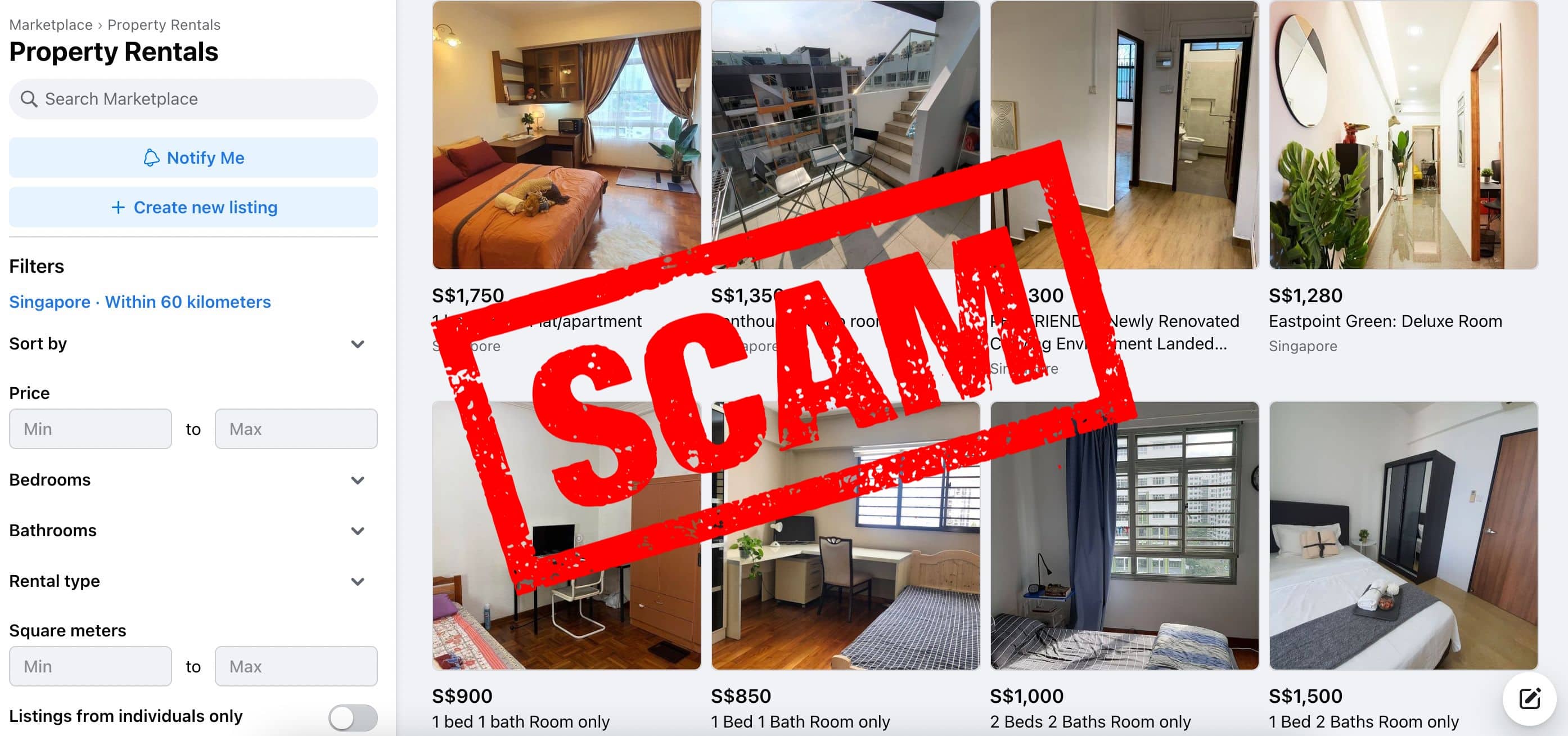
There is a specific moment where rental and property deposit scams succeed, and it rarely looks dramatic. It is not a masked stranger or a suspicious link. It is a WhatsApp message, politely worded, from someone using a photo of a smiling agent in a blazer, telling you that three other viewers want the unit and asking for a one-month deposit by PayNow tonight to hold it. The unit is clean, bright, priced about 15% under everything else you have seen, and you have never set foot inside it.
That moment — the gap between wanting a place badly and having verified anything at all — is the entire business model. In Singapore's rental market, where a young adult moving out of the family flat for the first time is typically wiring four figures within days of starting a search, that gap is worth real money to someone.
This guide is about closing the gap. It covers the patterns rental scams actually take here, how to verify an agent and a listing with the tools that already exist, how to cross-check a quoted rent against project-level data, and how to structure payments so that money can be traced and, if the worst happens, recovered. It is written for the renter who is about to transfer money to someone they met on the internet — which, in 2025, is most renters.
The market young renters are walking into
Singapore's rental market tightened dramatically after 2021. Border reopenings, construction delays, and a wave of displaced households pushed asking rents up across both the HDB and private segments, and although the pace has cooled since its 2023 peak, the structural pressure has not disappeared. What matters for scam risk is not the absolute rent level but the ratio of demand to verified supply at any given moment.
A market where viewings are booked hours after a listing goes live is a market where urgency is normal. And urgency is precisely the lever fraudsters pull.
Three structural features of the Singapore rental market make it unusually fertile ground for deposit fraud:
- Deposits are large and expected. A one-month security deposit plus one month's advance rent is standard practice, so for a flat at S$3,000 a month, a new renter is commonly committing S$6,000 before moving a single box — more once you add commission and stamp duty.
- The process is fast and informal at the front end. Enquiries happen over Carousell DMs, Facebook groups, Telegram channels, and WhatsApp. Photos and floor plans are exchanged before any identity is confirmed.
- Young renters are often transacting for the first time. If you have never signed a tenancy agreement or paid stamp duty, you have no reference point for what a legitimate process looks like — and scammers rely on exactly that.
Add remote-work mobility, a large expatriate and international-student population, and a preference for speed over paperwork, and you get a market where a convincing fake listing can clear several deposits before anyone reports it.
Anatomy of a rental scam: two levers and a window of silence
Almost every rental deposit scam in Singapore is a variation on the same two levers: a price that is too good to be true, and a deadline that is too tight to verify. Pull either lever alone and a careful renter hesitates. Pull both simultaneously and the hesitation itself feels like a luxury you cannot afford.
The third ingredient is the silence window — the days or weeks between the moment you transfer money and the moment you realise something is wrong. Everything a scammer does is designed to extend that window: delays in producing keys, excuses about the landlord being overseas, requests to "wait for the owner's confirmation", a sudden family emergency.
Here is what the flow looks like, and where a renter can break it:
The critical insight from that diagram is that the decision point sits at the top, not the bottom. Once you have transferred money, your options narrow to recovery, and recovery rates for bank transfers made voluntarily to a stranger's account are poor. Prevention is not just cheaper than cure here; it is more or less the whole game.
Five rental and property deposit scams you will actually meet
Scam typologies in Singapore are tracked by the Singapore Police Force and by the Council for Estate Agencies (CEA), and the property-related variants recur with remarkable consistency. These are the five patterns a young renter is most likely to encounter.
1. The bait listing
A unit is advertised at a rent meaningfully below the surrounding market — a two-bedroom condo in a well-connected district at a price that would have been plausible in 2019. The photos are usually stolen from a genuine listing, sometimes from a different country entirely.
How to spot it: compare the asking rent against other listings in the same project, not just the same district. Newer renters compare across an entire town or planning area, where the spread between a 1990s walk-up and a 2024 launch is enormous. Within a single project, the spread should be tight. If one listing is 20% below every other unit in the same building, the most likely explanation is not a motivated landlord.
2. Deposit before viewing
The single most reliable red flag in the category. The story varies — the agent is "fully booked this weekend", the owner "only wants serious parties", the keys are with a colleague — but the ask is the same: transfer a holding deposit to secure a viewing slot or to take the unit off the market.
There is no legitimate reason to pay before seeing the inside of the property you are renting. A holding deposit or good-faith deposit paid after a viewing, against a signed Letter of Intent with clear refund terms, is normal market practice in Singapore. Paid before a viewing, it is not a deposit; it is a donation.
3. The spoofed agent
This one is more sophisticated. The "agent" produces a CEA registration number, an estate agent card, and a professional-looking email signature. Sometimes the identity is lifted wholesale from a real salesperson's public profile, complete with their photo and licence details, and used by someone with no connection to them.
How to spot it: a registration number you have not looked up is a decoration, not a credential. Verify the number on the CEA Public Register, then contact the agency through its main published line — not the number in the WhatsApp chat — and ask whether that salesperson is handling the listing. A real agent will not be surprised by this call. A spoofed one cannot survive it, because the call never reaches them.
Watch also for lookalike email domains: a slight misspelling of a well-known agency's domain, or a free email address where the salesperson's official one should be.
4. The overseas landlord and the courier keys
The owner is posted abroad, or in Malaysia, or "handling a family matter". The keys will be couriered once the deposit and first month's rent clear, or they will be left with a "colleague" who will meet you at the lift lobby. Payment is sometimes directed to an overseas bank account or, increasingly, to a cryptocurrency address.
How to spot it: a landlord who cannot be physically present for a viewing is rare but not impossible, and there are legitimate ways to handle it — a co-owner or family member showing the unit, a properly appointed agent with written authorisation, a video call from inside the flat showing the unit number and street view. "Couriered keys after payment" is not one of those legitimate ways.
5. The lookalike payment instruction
The deal appears genuine, the viewing happened, and then the payment instructions quietly change. The bank account number is different from the one in the earlier message, or the PayNow recipient is a mobile number belonging to a "finance colleague", or you are asked to split the payment into three transfers "for accounting". Sometimes the scam arrives later, mid-tenancy: a message that "the landlord has changed management companies" and rent should now go to a new account.
How to spot it: payment details should be confirmed once, in writing, through a verified channel, and should never change mid-transaction without a signed document and a phone call to a number you independently looked up. Never accept payment instructions that arrive only in a chat thread.
The consolidated red-flag table
| Signal | Why it matters | What to do |
|---|---|---|
| Rent well below other units in the same project | Bait pricing is the most common hook | Cross-check against project-level rental data |
| Any payment requested before viewing | No legitimate landlord needs this | Decline and disengage |
| Pressure to decide within hours | Manufactured urgency defeats verification | Slow down; a real unit survives a 24-hour delay |
| Agent refuses a video call or office meeting | Spoofed identities cannot sustain scrutiny | Verify via CEA register and the agency's main line |
| Payment to a third party, overseas account, or crypto | Breaks traceability, which is your only recovery route | Insist on a Singapore bank transfer to the verified owner |
| Lease shorter than the legal minimum | Short lets are illegal and unenforceable | Walk away; see the rules table below |
| Owner "overseas", keys "couriered later" | The most durable scam story in the playbook | Require in-person viewing or an authorised representative |
| Payment details change mid-transaction | Classic interception pattern | Re-verify in writing and by phone |
Verifying the agent: what the CEA register actually tells you
Estate agency in Singapore is regulated by the CEA under the Estate Agents Act. That gives renters a verification tool that most people never use, and it takes about two minutes.
The three-step agent check
- Look up the salesperson on the CEA Public Register. You should be able to see their name, their registration number, the estate agent (agency) they are registered with, and whether their registration is current. A number that does not return a result, or returns a different name, ends the conversation.
- Look up the agency. Agencies hold a licence; salespersons hold a registration. Confirm both, and confirm that the salesperson is registered with the agency they claim to represent. A genuine registration number paired with the wrong agency is a strong indicator of a lifted identity.
- Call the agency's main published line. Ask to be connected to the salesperson, or ask whether they are handling that specific listing. This is the step that catches spoofing, because it routes around the number the "agent" gave you.
A few related points worth knowing:
- Salespersons carry a CEA-issued estate agent card. Asking to see it in person is reasonable and normal.
- Dual representation is not permitted. A single salesperson should not be acting for both the landlord and you in the same transaction. If yours appears to be, ask which side they represent and get it in writing.
- Commission is negotiable and must be agreed in writing before work begins. Common market practice for residential leasing is that a tenant's agent is paid by the tenant — often around half a month's rent per year of lease — but this is convention, not regulation. What matters is that the number and the payer are documented in an estate agency agreement upfront, so a "surprise" commission demand cannot appear at signing.
- Agents should not be handling your money in their personal capacity. Deposit and rent payments should go to the owner, or to a properly constituted agency account — never into a salesperson's personal account as a favour.
Verifying the property: title, rules, and market cross-checks
Confirming the agent is real is necessary but not sufficient. The next layer is confirming that the person you are paying actually has the right to rent you the unit — and that the rental itself is legal.
Confirm ownership
For private residential property, a title search through SLA's INLIS service returns the registered owner's name for a modest fee — in the region of a few dollars. If the name on the title does not match the name on the tenancy agreement and the bank account you are asked to pay, that discrepancy needs an explanation before any money moves.
For HDB flats, the equivalent discipline is documentary: ask for the owner's identification, cross-check the name against the tenancy agreement and the bank account, and ask for a recent utility bill or property tax notice for the address. These are not difficult documents for a genuine owner to produce and are impossible for a scammer to produce convincingly.
Confirm the rental is legal
Singapore regulates short-term rental tightly, and this is one of the most useful filters available to a renter, because illegal short lets and scams overlap heavily.
| Property type | Minimum rental period | Key rule |
|---|---|---|
| HDB whole flat | 6 months | Owner must have met MOP and obtained HDB approval; rental must be registered with HDB within 7 days of commencement |
| HDB bedroom | 6 months | Same registration requirement applies |
| Private residential | 3 consecutive months | Short-term accommodation under 3 months is prohibited under planning law |
Two further HDB-specific points matter for younger renters in particular:
- The non-citizen rental quota. HDB flats are subject to a quota on the number of flats in a block that can be rented to non-citizen, non-Malaysian tenants. HDB publishes this through an e-service, and a landlord who cannot confirm the quota has room is a landlord who cannot legally rent to you — which is worth knowing before you pay, not after.
- Registration within 7 days. The landlord must register the tenancy with HDB. Ask for the acknowledgement. A landlord who resists this is either unfamiliar with the rules or avoiding them, and neither is a good counterparty.
If a listing offers a three-month or month-to-month arrangement on a private unit, or a two-month let on an HDB flat, the correct response is not to negotiate — it is to leave. An illegal tenancy gives you no enforceable protections, and it is a strong signal about how the counterparty operates.
Cross-check the rent against project-level data
This is where most renters under-invest. Comparing a quoted rent against "the market" in a vague sense tells you nothing, because Singapore's districts contain enormous internal variation. Comparing it against other units in the same project, of a comparable size and condition, tells you a great deal.
What to look at:
- The same project, same bedroom count. This is the tightest and most informative comparison.
- Rental trend direction for the project. Is the asking rent in line with where the project's rents have been trending, or does it look like it was lifted from two years ago — or from the next tier of development?
- Price-to-rent sanity. A unit whose quoted rent implies a yield wildly out of line with the surrounding area is worth questioning.
- Comparable projects within walking distance. Useful when the subject project has thin transaction volume.
A difference of a few percent is negotiation. A difference of 20% or more, in the same building, in the same quarter, warrants suspicion rather than excitement.
Know what the upfront cost should actually be
Scams often succeed because the victim has no baseline for what a legitimate transaction costs, so an inflated or oddly structured ask does not register as strange. Here is the standard shape of it.
For a lease of up to four years, stamp duty is 0.4% of the total rent for the entire lease term, payable to IRAS. On a 24-month lease, that produces the following:
Rental Stamp Duty on a 24-Month Lease (0.4% of total rent)
Stamp duty is payable within 14 days of signing if the agreement is signed in Singapore, or within 30 days if signed overseas. Crucially, you should end up holding the stamp certificate — it is issued by IRAS and names the parties to the lease. It is one of the few pieces of paper in the entire transaction that is issued by a government agency rather than by the counterparty, which makes it disproportionately valuable as proof.
Here is what a legitimate upfront outlay looks like for a S$3,000-a-month flat on a 24-month lease:
Typical Upfront Outlay: S$3,000/month, 24-Month Lease
Note what is not in that breakdown: an administration fee, a viewing fee, a "documentation" charge, a key-handover fee, or a payment to release the unit from a queue. Those are invented. If a fee on your invoice does not appear in a normal tenancy, ask what it is for and who receives it.
Paying safely: the paper trail is the insurance
Every recovery route available to a scam victim depends on one thing: whether the money can be followed. Cash cannot be followed. Cryptocurrency, by design, cannot be reversed. Payments to overseas accounts vanish into jurisdictions you cannot practically reach. A Singapore bank transfer to a named account, by contrast, leaves a documented trail that a bank, the police, and a court can act on.
The payment rules
- Pay by bank transfer or cheque to an account in the name of the registered owner, matching the name on the title or the tenancy agreement. If the account name differs, stop and ask why in writing.
- If paying through an agency, use the agency's corporate account or UEN — not a salesperson's personal mobile number.
- Never pay in cash. There is no legitimate reason a landlord or agent cannot accept a transfer.
- Never pay in cryptocurrency, gift cards, or via remittance to an overseas account.
- Do not split payments across multiple accounts because someone asks you to. Splitting is a structuring technique, not an accounting convenience.
- Get a receipt every time, showing the amount, date, payer, payee, purpose, and signature — even for a small good-faith deposit.
Sequence it properly
The order of operations is itself a security feature. Money should move only after documents exist, never before.
A word on the good-faith deposit attached to a Letter of Intent: this is a normal Singapore practice, and it is usually treated as part of the security deposit once the tenancy agreement is signed. But understand what you are agreeing to — if you withdraw, the deposit is commonly forfeited, and if the landlord withdraws, it should be returned, often with an agreed multiplier. Those terms belong in the LOI itself, in writing, not in a chat message. And the LOI should be signed after you have physically viewed the unit.
Keep everything
The evidence file you want, ideally in one folder:
- The listing as it appeared (screenshot with date and URL)
- All chat correspondence, including the phone number and profile used
- The agent's name, registration number, and agency
- The estate agency agreement and commission terms
- The LOI, the tenancy agreement, and any addenda
- Bank transfer confirmations and receipts
- The IRAS stamp certificate
- Photographs of the unit's condition at handover, timestamped
If a dispute arises — over a deposit refund, over condition, over a mid-tenancy change of payee — this folder is the difference between a position and a complaint.
The pre-payment checklist
Print it, or keep it open while you search. Each line is a binary check, and any "no" is a reason to pause rather than proceed.
Before you enquire
- Is the asking rent in line with other units in the same project?
- Are the photos traceable, or do they appear in other listings elsewhere?
- Is the listing posted from an account with a coherent history, or one created recently?
Before the viewing
- Has the "agent" provided a name, registration number, and agency?
- Have you looked all three up on the CEA Public Register?
- Have you called the agency's main published line to confirm?
At the viewing
- Are you inside the actual unit — not a showroom, not a similar unit "on another floor"?
- Does the unit number and block match the listing?
- Can the person showing you explain their authority — owner, co-owner, or authorised agent with written authority?
Before you pay
- Have you confirmed the owner's name against the title (private) or documentation (HDB)?
- Does the payee name match the owner or the agency exactly?
- Is the lease at or above the legal minimum period?
- For HDB: has the non-citizen quota been confirmed, and the rental registration discussed?
- Is the commission agreed in writing, with the amount and payer stated?
- Have you read the LOI's refund terms?
After you pay
- Do you have a signed receipt?
- Is the tenancy agreement signed by both parties?
- Has stamp duty been paid, and do you hold the certificate?
- Have you saved every document and screenshot in one place?
If the money has already left your account
Speed matters more than dignity. If you suspect you have been defrauded:
- Call your bank immediately. Report the transfer as a suspected scam and ask whether the receiving account can be flagged or the transaction recalled. The sooner this happens, the better the odds — but do not assume recall is likely.
- Call the Police hotline at 1800-255-0000, or 999 if urgent, and lodge a report. You can also submit a report online.
- Report the salesperson to the CEA if an agent or alleged agent is involved. CEA handles complaints against registered salespersons and can act against unlicensed persons holding themselves out as agents.
- Report the listing to the platform it appeared on, so it is removed before the next renter sees it.
- Install ScamShield and check whether the number involved has been reported by others — useful context, and it helps the broader system.
- Write down the timeline while it is fresh: dates, amounts, account numbers, names, and every message. Memory degrades fast and precision matters later.
One more thing worth saying plainly: being scammed is not a failure of intelligence. These operations are designed by people who do it full time, against targets who are simultaneously making one of the more stressful decisions of their adult lives. The renters who get caught are not the naive ones; they are often the decisive ones, who moved quickly because the market rewarded moving quickly.
Food for Thought
- Why is the deposit the target, rather than the rent? A deposit is paid before a relationship exists, before keys change hands, and before any counterparty has anything to lose. If you were designing a fraud, you would pick exactly that moment — so what would make that moment safer structurally, rather than just individually?
- What would a genuinely verifiable listing look like? Agents are already registered, licences are already public, and title records already exist. The information needed to kill most rental scams is available today. The gap is not data — it is that renters do not know to look. How much of this should be automated by platforms rather than left to individual diligence?
- Does a hot rental market make fraud inevitable? Urgency is the scammer's primary tool, and urgency is manufactured by genuine scarcity. When viewings fill within hours, "slow down and verify" competes directly against "you will lose the unit". Is there a version of this market where verification does not cost you the flat?
- Who bears the cost of a bad tenancy? If a rental turns out to be illegal — too short, over quota, unregistered — the tenant is the one evicted, not the landlord who let it. Should that asymmetry be rebalanced, and how?
- Is the deposit model itself outdated? A month's rent held by a stranger for two years is a significant unsecured exposure for someone who may not have savings to spare. Are there escrow or insurance structures that could carry that risk more efficiently than trust?
The bottom line
Rental and property deposit scams in Singapore are not sophisticated hacks. They are ordinary frauds executed with patience, using the two things a renter in a tight market has least of: time and certainty. The defences are correspondingly unglamorous — verify the agent on the CEA register, confirm the owner against the title, check the rent against the project, pay only by traceable transfer to a matching name, and hold the stamp certificate at the end.
Do those five things and the overwhelming majority of scams simply fail, because they depend on none of them happening.