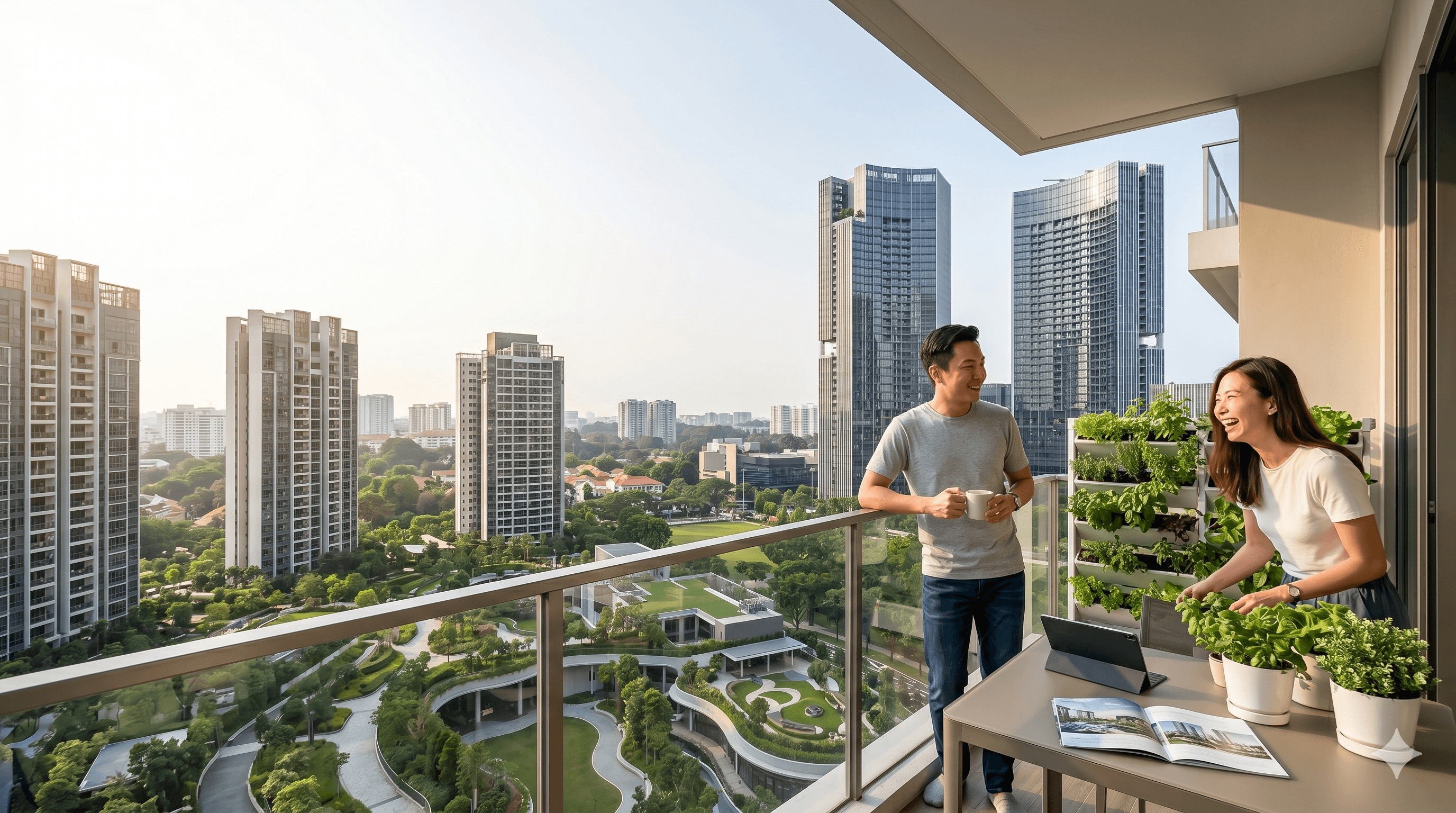
Somewhere between the birthday cake and the group chat messages, turning 35 in Singapore triggers a second, stranger milestone. HDB quietly reclassifies you. You go from being a bystander in the housing market to being a legitimate applicant — eligible for a brand-new flat, eligible for grants, eligible for a mortgage in your own name.
And yet most Singaporeans hit that birthday knowing almost nothing about what the rule actually permits, because the housing conversation in this country is almost always framed around couples. Build-To-Order timelines are explained to fiancé-fiancée pairs. Resale flat guides assume two incomes. Even the grant tables are usually printed with a family in mind.
So here is the guide that nobody hands you at 35. What you can buy as a single Singaporean, what it costs, how long each route takes, and — the part that matters more than any table — what buying alone actually does to your life, your finances and your future plans. Because the age-35 rule has been debated for years, and whether or not it ever changes, the trade-offs of buying alone in Singapore are real and they deserve a straight answer.
The 35th Birthday Is a Housing Policy Event
Let's start with the thing that makes the age limit so controversial: it is not a soft guideline. It is a hard eligibility gate.
Under current HDB rules, a single Singapore Citizen becomes eligible to buy a new flat only upon reaching age 35. Before that, the public housing system is effectively closed to you as a solo buyer. You can be added as an occupier on a family flat. You can buy private property. But you cannot buy a new HDB flat, and you cannot use the singles route to buy a resale flat either.
The rule has been in place for decades, and it has survived repeated calls for change. Backbenchers have raised it in Parliament. Commentators have argued that with Singaporeans marrying later, a 35-year-old single is often not a "young person waiting to settle down" but an adult with a settled career, savings and a genuine housing need. The Government's consistent response has been that public housing priority goes to family formation, and that lowering the threshold would add demand pressure to an already stretched BTO pipeline.
As of the most recent parliamentary replies on the subject, the age floor stands at 35. Anyone planning around a change should not assume one is coming.
What actually changes at 35
| Age | Single SC — new flat | Single SC — resale flat | Single SC — private |
|---|---|---|---|
| Under 35 | Not eligible | Not eligible under the singles scheme | Eligible, ABSD applies |
| 35 and above | Eligible for 2-Room Flexi BTO, subject to income ceiling | Eligible for any flat type, no income ceiling | Eligible |
| Any age | Cannot buy a new EC | Resale EC possible once past MOP | Eligible |
Notice something important in that table: the private property column has no age floor at all. A 25-year-old single Singaporean with enough money can buy a condominium tomorrow. The 35 rule is specifically a public housing rule. That asymmetry is the source of most of the frustration, and it is worth sitting with before we go further.
The cost of waiting, in numbers
Here is an illustrative calculation that rarely makes it into policy debate. Suppose you move out of the family home at 28 and rent a room at S$1,000 a month while you wait for eligibility. From 28 to 35 is 84 months.
84 months × S$1,000 = S$84,000 spent on rent before you are allowed to apply for a new flat. Add the four to five years of construction wait and you are looking at roughly a decade of paying somebody else's mortgage before you hold your own keys. (Renting a whole flat instead of a room, which many people prefer by their early thirties, pushes that figure to well over S$200,000.)
This is the number to keep in your head when you read that the singles age limit is "under review."
Why the Rule Exists — and Why It Persists
Understanding the logic helps you plan around it, even if you disagree with it.
Singapore's public housing system was built as a family formation instrument, not simply as a shelter programme. The Home Ownership Scheme, introduced in 1964, was explicitly designed to give citizens a stake in the country and to support marriage and parenthood. Every major grant since then — the Family Grant, the Proximity Housing Grant, the Enhanced CPF Housing Grant — has been calibrated to that goal, and singles receive either a reduced share or none at all.
The practical argument for the age floor is queue management. Demand for BTO flats consistently exceeds supply. If single applicants could enter at 21 or 25, the waiting times faced by young married couples — the group the system is designed to prioritise — would lengthen further.
The counter-argument is demographic reality. Singaporeans are marrying later, and a growing share will never marry. A housing system that only unlocks at 35 for a large and growing segment of the population is, critics argue, deferring a need rather than meeting it.
Whichever side you find persuasive, the operational takeaway is the same: plan as if 35 is fixed, and treat any future change as upside rather than as a base case.
The Four Pathways, and Who Can Actually Use Them
There are four realistic routes to ownership for a single Singaporean. They are not equally available, and the differences matter more than most guides admit.
Pathway 1: The 2-Room Flexi BTO
This is the flagship singles route, and the one most people mean when they talk about "buying a flat at 35."
Eligibility at a glance:
- Single Singapore Citizen, aged 35 or above
- Gross monthly income of S$7,000 or less
- Must not own or have disposed of private property within the preceding 30 months
- Must not have bought a new HDB flat, DBSS flat or EC previously, or received housing subsidies more than once
What you get is a compact flat — typically around 36 to 45 square metres — on a 99-year lease. The short-lease option, which allows leases of 15 to 45 years, is reserved for buyers aged 55 and above, so at 35 you are buying the full lease whether you want it or not.
What it costs. Two-room Flexi prices vary enormously by location and launch. Non-mature estate projects have historically been priced in the low-to-mid S$100,000s, while mature estate launches have pushed past S$200,000. Because prices are set at launch and are not negotiable, the practical question is not "is this good value" but "can I afford the ballot I win."
The catch is the queue. Two-room Flexi flats are heavily oversubscribed, with application rates at many launches running several times the number of units available. You may ballot two, three, four times before you get a number good enough to select. And there is a rule that penalises serial non-selection: if you are invited to select and decline, you accrue a non-selection count, and accumulating two within a 12-month window can bar you from applying for a year. Treat the ballot as a commitment, not a free option.
Verdict: The cheapest entry point into new-build ownership, and the slowest. Best suited to singles who are patient, earning under the ceiling, and comfortable with a compact flat.
Pathway 2: The Resale Flat
This is where the singles rules get genuinely generous — and where most people are surprised.
Single Singapore Citizens aged 35 and above can buy a resale flat of any flat type on the open market. Not just two-room. Three-room, four-room, five-room, executive — the size restriction that many people assume exists does not. There is also no income ceiling on resale flats.
That second point deserves emphasis. A single earning S$9,000 a month is locked out of a 2-Room Flexi BTO by the S$7,000 ceiling, but can walk into the resale market and buy a five-room flat tomorrow. The BTO ceiling does not cap your ambition; it only caps one particular door.
What to watch for:
- Remaining lease. This is the single most important number in the listing. CPF usage is pro-rated for flats with shorter remaining leases, and HDB loans require a remaining lease of at least 20 years. If you are 35 and buying a 50-year-old flat with 49 years left, you will hit CPF limits well before you retire.
- Cash-over-valuation. Resale prices are negotiated, and the valuation used for your loan may come in below the agreed price. Any gap is payable in cash.
- Grants trigger an MOP. If you take a CPF housing grant, a five-year Minimum Occupation Period applies before you can sell.
Verdict: The fastest and most flexible route, and the only one that lets you buy a genuinely large flat alone. It also preserves optionality — a five-year MOP starting at 35 ends at 40, not 45.
Pathway 3: The Joint Singles Scheme
The Joint Singles Scheme lets two to four single Singapore Citizens, all aged 35 or above, jointly buy a resale flat. It is the closest thing the system offers to buying with a friend or a sibling, and it is increasingly discussed among singles pooling resources.
On paper it solves the affordability problem elegantly. Two people on S$6,000 each can service a much larger loan than either could alone, and each ends up with a share of an asset rather than a share of a rental lease.
In practice, it introduces a legal relationship that is far harder to unwind than a tenancy. And this is where most guides go quiet.
Three things to understand before you sign:
- You generally cannot decouple an HDB flat. Unlike private property, transferring your share to a co-owner is not a routine transaction. HDB permits changes in ownership only in specific circumstances — marriage, divorce, death, financial hardship and a narrow set of others. If your co-owner wants out in year three, there is no clean mechanism to buy them out without selling the flat.
- Your co-owner's life events become your problem. If one party marries, the flat becomes part of a household with a new spouse's property interests. If one party needs cash urgently, the asset is illiquid. If one party dies, the share passes according to the will or intestacy rules — not automatically to the survivor unless it was held as a joint tenancy.
- Tenure structure matters. Holding as joint tenants means the survivor inherits automatically. Holding as tenants-in-common means shares pass through the estate. Choose deliberately, ideally with legal advice.
Verdict: A legitimate route for singles who are certain about their medium-term plans and their co-owner. Not a casual arrangement.
Pathway 4: Resale ECs
New Executive Condominiums are sold by developers under HDB's EC framework, and that framework requires a family nucleus. A single applicant cannot buy a new EC directly from a developer, no matter their age or income.
Resale ECs are a different matter. Once an EC has passed its five-year Minimum Occupation Period, it can be resold on the open market — and there is a route in for single buyers, subject to the project's status and your own eligibility. (Confirm the specifics for any particular project with HDB or the developer before you commit; EC rules layer HDB eligibility on top of private-market mechanics, and they change.)
What you get is a condominium-style development — pool, gym, security, the works — at a price that has historically sat between resale HDB and private condo. What you give up is the HDB grant ecosystem; resale ECs do not come with CPF housing grants, and there is no income ceiling because it is treated as a private purchase.
Verdict: The middle path. Worth shortlisting if lifestyle amenities matter to you and your budget comfortably clears HDB resale pricing.
The Money: What You Can Actually Afford on One Income
Here is where single buyers get a reality check that couples often avoid.
The lending rules do not care that you have one income
Three numbers govern every HDB purchase:
- Mortgage Servicing Ratio (MSR): 30% of gross monthly income for HDB flats and new ECs
- Total Debt Servicing Ratio (TDSR): 55% of gross monthly income across all debt
- Loan-to-Value (LTV): 75%, meaning a 25% downpayment
For most singles, the MSR is the binding constraint. Then layer on existing obligations — a car loan, a renovation instalment plan, a student loan — and the TDSR can bite first.
A worked affordability table
Assume a 25-year HDB loan at 2.6% per annum, no other debts, and a 25% downpayment fully covered by CPF Ordinary Account. The maximum flat price you can reach looks like this:
| Gross monthly income | MSR cap (30%) | Max loan | Max flat price (75% LTV) |
|---|---|---|---|
| S$4,000 | S$1,200 | ~S$264,000 | ~S$352,000 |
| S$5,000 | S$1,500 | ~S$331,000 | ~S$441,000 |
| S$6,000 | S$1,800 | ~S$397,000 | ~S$529,000 |
| S$7,000 | S$2,100 | ~S$463,000 | ~S$617,000 |
Maximum flat price by monthly income (25-year HDB loan at 2.6%, 75% LTV)
Two things jump out of that table. First, the income ceiling at S$7,000 is not really a barrier to a decent flat — it is a barrier to the new flat, not to ownership. Second, the 25% downpayment is doing enormous work. If your CPF Ordinary Account is thin, the achievable price drops sharply, because the gap must be paid in cash.
The grants, and the catch for singles
Singapore offers a stack of housing grants, but singles receive a reduced share and face tighter income tests.
| Grant | Families | Singles | Income ceiling for singles |
|---|---|---|---|
| Enhanced CPF Housing Grant (EHG) | Up to S$120,000 | Up to S$60,000 | S$4,500 |
| Proximity Housing Grant — live with parents/child | S$30,000 | S$15,000 | None |
| Proximity Housing Grant — live near parents/child | S$20,000 | S$10,000 | None |
| Singles Grant (resale flats) | n/a | Sized at a fraction of the Family Grant | None |
Maximum CPF housing grants: singles vs families
The critical line is the EHG income ceiling of S$4,500 for singles. If you earn S$7,000 — the maximum allowed for a 2-Room Flexi BTO — you receive zero Enhanced CPF Housing Grant. The two thresholds pull in opposite directions: the income ceiling lets you in the door, and the grant ceiling locks you out of the subsidy. Plan for the flat, not the grant.
The full upfront bill
Purchase price is not the only cheque. Here is an illustrative breakdown for a S$400,000 resale flat:
| Item | Amount | Notes |
|---|---|---|
| Downpayment (25%) | S$100,000 | Can be fully covered by CPF OA with an HDB loan |
| Buyer's Stamp Duty | S$6,600 | 1% first S$180k, 2% next S$180k, 3% above |
| Legal and valuation fees | ~S$2,800 | Varies by law firm |
| Renovation | ~S$30,000 | Illustrative; a 2-room may cost less |
| Buyer's agent commission | ~S$4,000 | Typically around 1% |
| Total | ~S$143,400 |
Illustrative upfront cost breakdown: S$400,000 resale flat
Stamp duty scales predictably: a S$500,000 flat attracts S$9,600, and a S$600,000 flat attracts S$12,600. Budget roughly 1.5% to 2.1% of the price.
The buffer that couples have and you don't
A dual-income household can absorb a job loss for a while because the other income keeps the mortgage serviced. A single buyer cannot. The standard advice is a 12 to 24 month mortgage buffer held in liquid savings before completion. On a S$2,000 monthly instalment, that is S$24,000 to S$48,000 sitting outside your CPF.
Also note the Home Protection Scheme: HPS is mandatory for HDB loan borrowers and covers the outstanding loan if you die or become permanently incapacitated. With no dependants, you may be able to apply for exemption — but think carefully. Without HPS, the flat becomes an estate asset with a mortgage attached, and your family inherits the problem.
The Clock: How Long Each Path Actually Takes
Time is the most underrated variable in the singles decision, because it interacts with everything else in your life.
Look at the BTO column carefully. If you ballot successfully on your first try at 35, select at 36, collect keys at 39 or 40, and serve a five-year MOP, you cannot sell without penalty until you are 44 or 45. If you need a second ballot attempt, push that out further.
That is the trap nobody draws on the brochure. The 2-Room Flexi BTO is not just a flat purchase — it is a nine to ten year commitment from application to freedom.
The resale route, by contrast, has you in a flat within roughly three months and free to sell at 40, with all of your thirties still ahead of you as options.
The practical sequence, either way
Since 2023, every buyer needs a valid HDB Flat Eligibility (HFE) letter before submitting a resale application or a BTO application. It is a single application that confirms your eligibility to buy, your grant entitlements and your loan amount. Processing takes roughly four weeks, and it is valid for a limited period — so do not apply years in advance.
Get the HFE letter before you start viewing flats or shortlisting BTO launches. It converts a vague hope into a hard number, and it prevents the specific heartbreak of falling in love with a flat you cannot finance.
The Part Nobody Puts in the Brochure: Buying Alone
Now to the honest section.
Your flat is your entire asset allocation
For a couple, a flat is typically one half of a joint balance sheet. For a single buyer, it is usually the overwhelming majority of net worth — often 80% or more. That is a concentrated bet on one asset class in one country in one neighbourhood, financed with leverage.
There is nothing inherently wrong with this; home ownership is the standard Singaporean wealth engine. But it does mean the decision deserves more scrutiny than "can I afford the monthly." Ask what happens if you want to move cities, change careers, or take a sabbatical. The flat will have an opinion.
Lease decay is a solo problem
A 99-year lease is not a problem if you sell within 30 years. It becomes a problem if you are still holding at 70 with 45 years left and no spouse to co-own the next place with. Buying a flat with a fresh 99-year lease at 35 means the lease expires when you are 134 — comfortably beyond you, which is exactly what you want. Buying a flat with 55 years remaining means the CPF pro-ration and the resale market both start working against you well before retirement.
The rule of thumb: buy the longest remaining lease you can afford, and treat the lease as part of your retirement plan, not an afterthought.
The single-income mortgage is a single point of failure
Beyond the emergency fund, consider income insurance or a longer loan tenure to lower the monthly commitment. A 30-year tenure is not available on HDB loans beyond certain conditions, but bank loans can stretch further — at the cost of more total interest. For a solo borrower, the lower instalment is often worth it.
You will do all the admin
Valuation reports, HFE applications, conveyancing, renovation quotes, contractor disputes, town council matters. A couple splits this. You will not. Budget time, not just money.
If You Partner Up Later
This is the scenario the "dating after 35" framing really points at, and it is the one most guides ignore entirely.
If you buy a 2-Room Flexi BTO at 35 and meet someone at 38, you can generally add your spouse to the flat. But you cannot upgrade to a larger flat until your five-year MOP ends — which, per the timeline above, means your mid-forties. Couples who want children and a bigger flat may find the sequencing awkward.
If you buy a resale flat at 35, your MOP (if you took a grant) ends at 40. You have far more room to manoeuvre.
If your partner also owns a flat, you have a problem. Two owners, one household, and the Additional Buyer's Stamp Duty regime sitting on top. ABSD for Singapore Citizens is 0% on a first property and 20% on a second — so buying a second home together is expensive, and one of you will usually need to sell. Which one, and when, is a negotiation you should have before you fall in love with a showflat.
The uncomfortable truth: buying alone is not a neutral financial decision. It shapes the timeline of your future relationship, because a property bought at 35 is a constraint on a life built at 40. That does not mean don't buy. It means buy with the constraint visible.
Food for Thought
-
If you met the right person at 37, would your flat help or hinder? Run the MOP timeline against your realistic life plan, not your optimistic one. If the answer is "hinder," the resale route — with its shorter lock-in — may be worth the higher price.
-
Are you buying a home or buying an exit from your parents' house? These are different purchases. The first is a long-term asset decision. The second is an urgent lifestyle decision, and urgency is expensive in property. If it is the second, rent for two years and decide calmly.
-
What is your income trajectory, not your income today? The S$7,000 BTO ceiling is a snapshot test. If you expect to cross it in three years, the 2-Room Flexi route may become a flat you outgrow before you can sell it. If your income is stable and modest, it is the best-value door in the country.
-
Would you actually recommend the Joint Singles Scheme to a friend? Co-ownership looks like a financial arrangement and behaves like a marriage — without the legal framework for dissolving it. If you would hesitate to lend that person S$300,000 with no exit clause, hesitate here too.
-
Are you waiting for the age limit to drop? Parliament has been asked repeatedly and the answer has not changed. A housing plan built on a policy change that hasn't happened is not a plan. Build around 35 as it stands and treat any movement as a bonus.
The Conclusion
The singles housing conversation in Singapore is usually conducted as an argument about fairness. That debate is worth having, but it is not the one that helps you decide what to do with your next five years.
What actually helps is knowing the terrain precisely. At 35 you gain access to the 2-Room Flexi BTO if you earn under S$7,000, to the entire resale market regardless of income, to the Joint Singles Scheme if you have trusted co-buyers, and to resale ECs if the lifestyle premium is worth it to you. Each route carries a different clock, a different lock-in, and a different set of grants — and the differences compound over decades, not months.
The mistake is treating "buy a flat at 35" as a single decision. It is at least four decisions, and the right one depends on your income curve, your relationship plans, and how much you value speed over price.