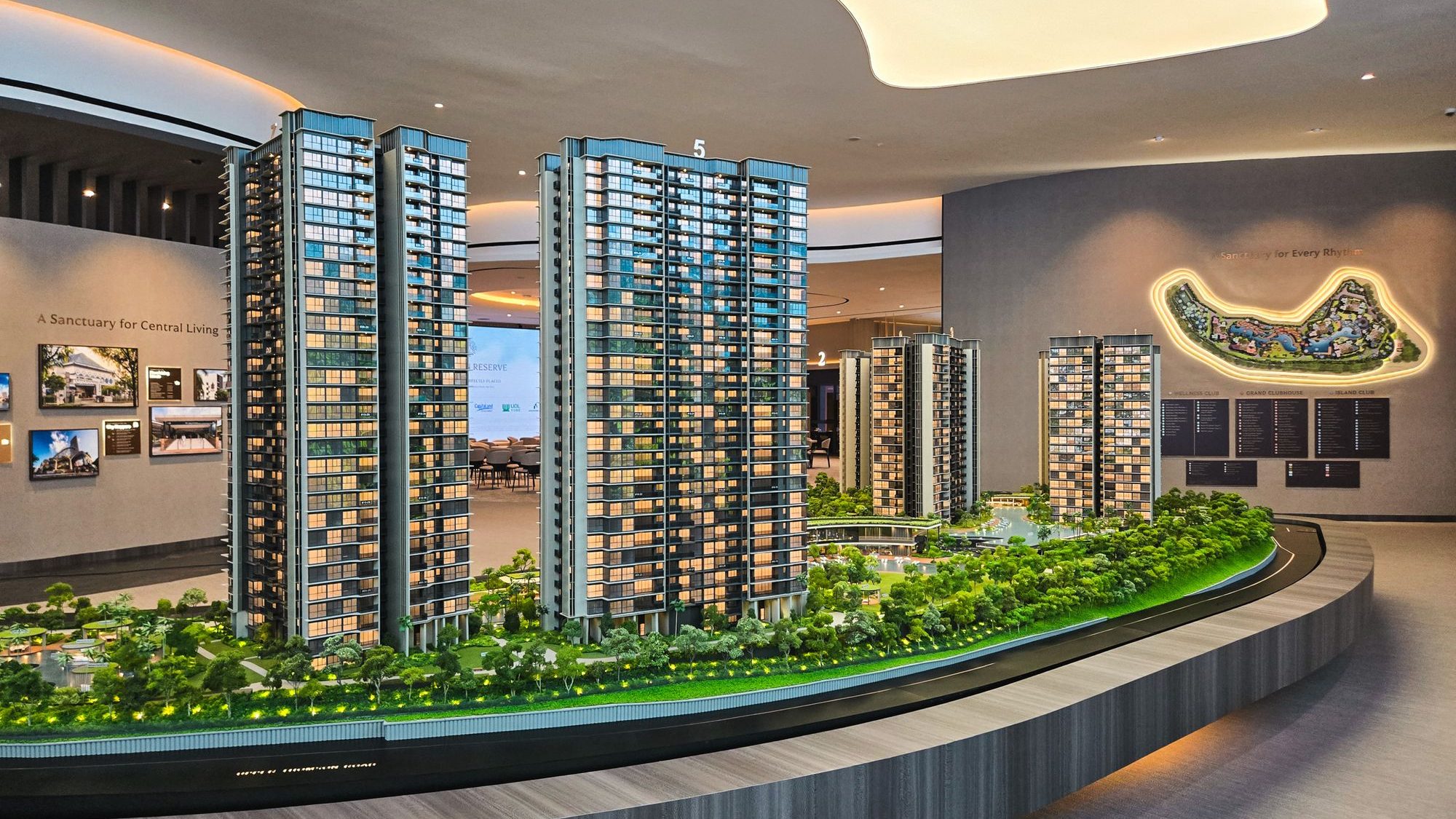
Every new launch in Singapore gets priced twice. The first time is by the developer, on a spreadsheet, with land cost, construction cost, a margin target and a showflat opening date pencilled in. The second time is by the market — and that second pricing exercise is never confined to the new project itself.
Thomson Reserve is a case worth watching closely, because of where it sits. The Upper Thomson corridor is not a blank slate: it is one of the oldest private residential catchments in Singapore, dense with 1990s and 2000s leasehold condos, half of them now past the 25-year mark, all of them about to be re-priced against a shiny new benchmark a few hundred metres away.
For anyone owning, buying or simply watching a home in the area, the interesting question is not "how much will Thomson Reserve sell for?" It is: once it sells at that price, what happens to everything around it?
Let's work through it — the location, the transport story, the price comparisons, and the decision framework a buyer in this corridor should actually be using.
Thomson Reserve and the Upper Thomson Condo Market
The micro-market in one paragraph
The Upper Thomson corridor runs roughly from Bright Hill down through Upper Thomson Road toward Caldecott and Marymount, wedged between Bishan to the south-east, Ang Mo Kio to the north-east and the Central Catchment Nature Reserve to the west. It is a rare thing in Singapore: a mature private-housing belt with older low-rise stock, serious school density, two reservoirs, and — since 2021 — a brand-new MRT line running straight through it.
That combination is exactly the profile that new launches get built into. Land is scarce, plots are small, and every site that comes up is fought over by developers who need to replenish landbank.
Why the surrounding stock matters so much
Most of the private homes within a 1km radius of the corridor's new supply are 99-year leasehold, completed between roughly 1995 and 2020. That matters for three reasons:
- Lease decay is now visible. A project completed in 1998 has used up more than a quarter of its lease. Buyers price that in, and banks get stricter with financing as leases shorten.
- The en bloc conversation is live. Several of these sites are large enough, and old enough, to be collective-sale candidates — and a strong new-launch price is precisely the catalyst that restarts those conversations.
- The stock is physically similar. Same layouts, same sizes, same facilities. When a buyer can compare a 1,200 sq ft old condo to an 850 sq ft new one at the same quantum, the decision becomes about far more than price per square foot.
Amenities that actually move the needle
| Category | What's in the catchment | Why buyers care |
|---|---|---|
| Rail | Bright Hill (TE7), Upper Thomson (TE8), Caldecott (TE9, CCL interchange), Marymount (CC16), Bishan (NS17/CC15) | Direct access to the CBD, Orchard and the East Coast without a bus ride |
| Future rail | Bright Hill is slated to interchange with Cross Island Line Phase 1, targeted around 2030 | One of the few double-line interchanges outside the core |
| Schools | Ai Tong School, Catholic High School, Raffles Institution, Raffles Girls' School, CHIJ St Nicholas Girls', Marymount Convent, Eunoia Junior College | The single biggest driver of family demand in this corridor |
| Retail | Thomson Plaza, Junction 8, AMK Hub, Sin Ming Plaza, Upper Thomson Road shophouse strip | Everyday convenience without a mall-at-your-doorstep premium |
| Green | MacRitchie Reservoir Park, Lower Peirce Reservoir Park, Bishan-Ang Mo Kio Park | Genuine, not marketing-department, green space |
| Food | The Upper Thomson and Sin Ming food corridors | Underrated but hugely relevant to daily life |
The honest summary: this is a suburban catchment with city-grade rail. That's an unusual combination in Singapore's private market, and it's why the area's price band has widened so much over the past five years.
MRT Access: What the Thomson-East Coast Line Does for Thomson Reserve and Its Neighbours
If you want to understand why a new launch in Upper Thomson is viable at all, start with the rail map. Before the Thomson-East Coast Line, this corridor's private homes leaned on the Circle Line (Marymount, Caldecott, Bishan) or on buses feeding into the North-South Line.
The TEL changed the geometry.
What this means in practice
- Bright Hill and Upper Thomson stations put the corridor on a single-seat ride to Orchard, Marina Bay and the Thomson-East Coast spine — no interchange required, which is materially different from the old bus-then-train routine.
- Caldecott is an interchange with the Circle Line, giving a second routing option toward the one-north and Buona Vista employment cluster.
- Bright Hill's planned CRL interchange effectively future-proofs the station: when Phase 1 of the Cross Island Line is completed — targeted around 2030, according to LTA's published programme — Bright Hill becomes a two-line node in a corridor that previously had none.
- The TEL stations are also unusually spaced. Bright Hill, Upper Thomson and Caldecott are close together relative to older lines, which means a wider catchment of homes counts as "walkable to rail" than the raw station count suggests.
The rail premium, honestly assessed
There's a temptation to treat "near MRT" as an automatic multiplier. It isn't. In mature Singapore corridors, the rail premium tends to be:
- Steepest where access was previously worst. A condo that goes from a 12-minute bus ride to a 6-minute walk gains more than one that was already near a Circle Line station.
- Capped by noise and density. Units backing onto the viaduct or the station entrance often trade at a discount to identical units 150 metres further in.
- Already partly priced in. For projects near the Circle Line, the TEL is an enhancement, not a transformation.
For Thomson Reserve, the rail story is genuinely strong — but the same story applies to Thomson Three, Thomson Impressions and the Sin Ming cluster. Location advantage shared is location advantage partly neutralised. What the new launch can do that its neighbours cannot is pair the rail access with a fresh 99-year lease, a new build, and modern facilities.
Price Comparison: Thomson Reserve vs Nearby Resale Condos
Here's where the analysis needs care. Launch pricing for a project like Thomson Reserve is set by the developer at a point in time, and it moves during the sales campaign. Rather than pretend to a precise number, it's more useful to frame the comparison as a range and a scenario — then show what the neighbourhood looks like on either side of it.
All figures below are indicative, rounded, and drawn from recent transacted ranges and prevailing asking levels in the corridor. They are illustrative for comparison, not a valuation. Verify against URA caveats and the developer's price list before making any decision.
Indicative PSF by project
Indicative Median PSF, Upper Thomson and Bishan Corridor
Two things jump out of that chart:
- The spread inside a single catchment is enormous — roughly $1,300 to $2,100 psf across projects that are, in some cases, barely 2km apart. Age, lease, rail proximity and finish all get priced.
- The upper end of the band is set by new launches, not resales. Jadescape and Lentor Modern are both recent completions, and both re-anchored the price ceiling of their respective clusters.
The corridor has already re-rated
Indicative Median PSF Trend, Corridor Resale Condos
The corridor has repriced by roughly 30% across the cycle — broadly in line with the private resale market nationally, but with a distinct inflection in 2021, the year TEL2 opened through Springleaf, Lentor, Mayflower, Bright Hill and Upper Thomson. Rail openings don't reliably move prices on their own, but they do tend to coincide with the phase of a cycle where demand is already turning.
The quantum reality check
Here is the part most buyers miss. Comparing PSF is intuitive but misleading, because new launches today are smaller than the resale stock they compete with.
Indicative Entry Quantum for a 3-Bedroom Unit
All figures in S$ millions, indicative.
The scenario above — Thomson Reserve at an assumed $2,100 psf on an 850 sq ft three-bedder — produces a quantum of about $1.79 million. That is below a 1,100 sq ft unit at Clover by the Park and only modestly above a 950 sq ft unit at Thomson Three.
The insight: the new launch doesn't necessarily lose on absolute price. It loses on space, and it wins on lease, finish and facilities. Whether that's a good trade depends entirely on what you're buying the home for.
New launch vs nearby resale: the honest scorecard
| Factor | Thomson Reserve (new launch) | Nearby resale (e.g. Thomson Three, Thomson Impressions) |
|---|---|---|
| Lease remaining | Full 99 years from TOP | Roughly 85–90 years (more for later completions) |
| PSF | Higher — likely the corridor's new ceiling | Lower, but rising as the ceiling moves |
| Quantum | Competitive on smaller formats, higher on larger ones | Larger units at lower PSF, so quantum stacks differently |
| Layout efficiency | Mixed; expect more compact formats and dual-key options | Often more generous, with proper yard and utility areas |
| Payment profile | Progressive payments over construction | Full payment and immediate occupation |
| Rental income | Nil until TOP | Immediate, if tenanted |
| Condition and maintenance | New; warranty period applies | Wear, tear and sinking-fund health to check |
| Exit liquidity | Strong at launch, uncertain at resale in year 10 | Proven transaction depth in the resale market |
| En bloc upside | Effectively nil in the near term | Real, if the site is large and the lease is shortening |
What a New Launch Does to the Homes Around It
This is the part of the story that rarely gets explained properly. A new launch doesn't just compete with nearby resale — it changes the information environment around it.
Channel 1: The benchmark effect
Every seller in the corridor now has a fresh reference point. A launch at $2,100 psf doesn't automatically lift an older condo's transacted price — buyers still discount for lease and condition — but it narrows the psychological gap. Sellers who were asking $1,500 psf on a 2016 project suddenly feel reasonable asking $1,650.
Sometimes that's justified. Sometimes it just creates a standoff where transaction volume falls while asking prices rise. Watch volume, not asking prices, to tell the difference.
Channel 2: The collective sale catalyst
This is the underrated one. Older 99-year projects in the corridor that have been stuck below their en bloc reserve price suddenly have a comparable that supports a higher land rate. Once one site transacts, the neighbours get a template.
The catch: developers are disciplined. Post-2021, land bids have been cautious, financing costs are materially higher than the 2017–2018 en bloc boom, and the Additional Buyer's Stamp Duty regime for developers means holding costs bite quickly. A strong launch price raises the conversation, not the probability. Treat any en bloc rumour in a nearby project as narrative, not fact.
Channel 3: Rental dynamics
New supply does two opposite things at once:
- Short term, it competes. A brand-new project with modern facilities and full-year lease terms pulls tenants away from older stock. Landlords of 2000s-era units often have to adjust rents or accept longer vacancy while a new project is in its first lease-up phase.
- Medium term, it improves the neighbourhood. Better retail, better footfall, better amenities, better perception. Rents in the older stock tend to recover once the new supply is absorbed.
For investors in the surrounding condos, the practical takeaway is that the 12–24 months following a major completion in your immediate area is the period to watch your rent roll most carefully.
Channel 4: Lease decay vs new supply
The uncomfortable structural reality: every year, the surrounding 99-year stock gets older while the new launch stays young. Over a ten-year horizon, the gap in remaining lease between a 1998 project and Thomson Reserve goes from roughly 23 years to 33 years.
That gap is eventually reflected in both pricing and financing. Buyers of older units should go in with clear eyes about how and when they plan to exit.
Buyer Considerations: Who Should Buy What
The correct answer to "should I buy Thomson Reserve or a nearby resale?" is not a price opinion. It's a personal-circumstances opinion. Here's the decision framework.
The payment schedule is not the same
Private new launches use the Progressive Payment Scheme, which means your cash outlay is spread across construction rather than paid upfront.
| Stage | Payment | Cumulative |
|---|---|---|
| Option fee | 5% | 5% |
| Signing of S&P (within 8 weeks) | 15% | 20% |
| Foundation completed | 10% | 30% |
| Reinforced concrete framework | 10% | 40% |
| Partition walls | 5% | 45% |
| Roofing and ceiling | 5% | 50% |
| Door and window frames | 5% | 55% |
| Electrical wiring and plumbing | 5% | 60% |
| Roads, car parks, drains | 5% | 65% |
| Temporary Occupation Permit | 25% | 90% |
| Legal completion | 10% | 100% |
Standard PPS structure for uncompleted private residential property. Confirm the exact schedule and any deferment options with the developer and your bank.
The practical implication is that your loan quantum and your income need to be assessed against a future version of you, not the current one. Rising rates during construction, a job change, or a second child can all turn a comfortable progressive schedule into a squeeze.
The policy layer
As at the time of writing, the following apply to a private residential purchase:
- ABSD: Singapore Citizens pay 20% on a second property and 30% from the third; Permanent Residents pay 5% on the first, 30% on the second; foreigners pay 60%. (This single line has done more to shape new-launch buyer profiles than any design decision.)
- LTV limits: 75% for a first housing loan, dropping to 45% for the second and 35% for the third.
- TDSR: total debt servicing capped at 55% of gross monthly income.
- Seller's Stamp Duty: applies to resale of residential property within three years of purchase for properties bought on or after 11 March 2017.
If you're upgrading from an existing home, the sequencing matters enormously — buying before selling triggers ABSD and a bridging-loan headache; selling before buying leaves you temporarily homeless. There is no universally correct order, only a correct order for your situation.
The buyer archetypes
| Buyer | Better fit | Why |
|---|---|---|
| Young family, first private home, 5–10 year horizon | New launch | Full lease, family-friendly facilities, progressive payments spread the cash flow |
| Family with school-age kids, needs space now | Resale | Larger format, immediate move, no construction risk |
| Upgrader from a nearby HDB flat | Newer resale (5–10 years old) | Balances lease, space and price; avoids the new-launch ceiling |
| Investor chasing yield | Resale | Immediate rental income, entry PSF below launch pricing |
| Investor with a 10+ year horizon | New launch | Lease advantage compounds; the corridor is structurally undersupplied |
| Buyer with a possible en bloc thesis | Older large-format resale | Free option on collective sale, though the timing is unknowable |
Risks and What to Watch
Being constructive doesn't mean being uncritical. Five things deserve attention.
1. Supply pipeline in the wider north. The Lentor and Springleaf clusters have delivered a substantial wave of new units in a short span. Upper Thomson is a different catchment, but buyers cross-shop. A heavy launch calendar compresses rental growth and stretches absorption timelines.
2. Interest rate path. Progressive payments mean your exposure to rates is back-loaded, and the bulk of the loan activates around TOP. A meaningful move in SORA during construction changes the affordability picture for a lot of buyers.
3. Lease decay in the surrounding stock. If you're buying an older resale unit, model the remaining lease at your expected exit, not today. Financing constraints kick in earlier than most buyers expect.
4. Construction and quality risk. Delivery delays and defects are real. Check the developer's track record across prior projects, not just the showflat.
5. The launch-price ceiling problem. If you buy at the corridor's peak PSF, your resale exit years later depends on the next project launching higher still. That works in a rising market. It is much less comfortable in a flat one. Buying at the ceiling is the single most common mistake in new-launch investing.
Food for Thought
1. Are you buying the unit, or the lease? Strip away the showflat, the facilities and the marketing and ask what proportion of your purchase price is attributable to a fresh 99-year lease. If the answer is "a lot", you're buying time — and time is only worth it if your holding period is long enough to use it.
2. What does the corridor look like in 2040? Every one of the 1990s-era projects nearby will be 40-plus years old by then. Yours will be 15. Which end of that trade do you want to be holding?
3. Would you still buy it if the MRT station were 1.2km away instead of 400m? If the answer is no, you're buying connectivity, not a home — and connectivity premiums are the first thing to compress when supply catches up.
4. Who is your exit buyer? At resale, your buyer will compare your unit against whatever new launch exists in the corridor that year. If you can't describe that buyer and why they'd pick your unit over a brand-new one, the exit thesis is incomplete.
5. Is the en bloc story doing any real work in your decision? Collective sales are a bonus, not a strategy. If your numbers only work with a collective sale, they don't work.
The Bottom Line
The Upper Thomson corridor is one of the more structurally interesting private residential catchments in Singapore right now: mature, well-schooled, green, and newly connected to a rail network that materially improved its access to the rest of the island. A launch like Thomson Reserve doesn't just add units to that catchment — it resets the benchmark that every nearby seller, buyer, landlord and tenant will reference for the next several years.
For owners of nearby homes, the effect is broadly supportive but uneven. Full-lease, well-located, well-maintained projects will capture the uplift. Older, lease-depleted, poorly located ones will find that the rising tide lifts them less than they hoped.
For buyers, the choice between the new launch and the resale next door is not really a price decision. It's a decision about time, space and exit — and those three things should be settled before a single number is compared.