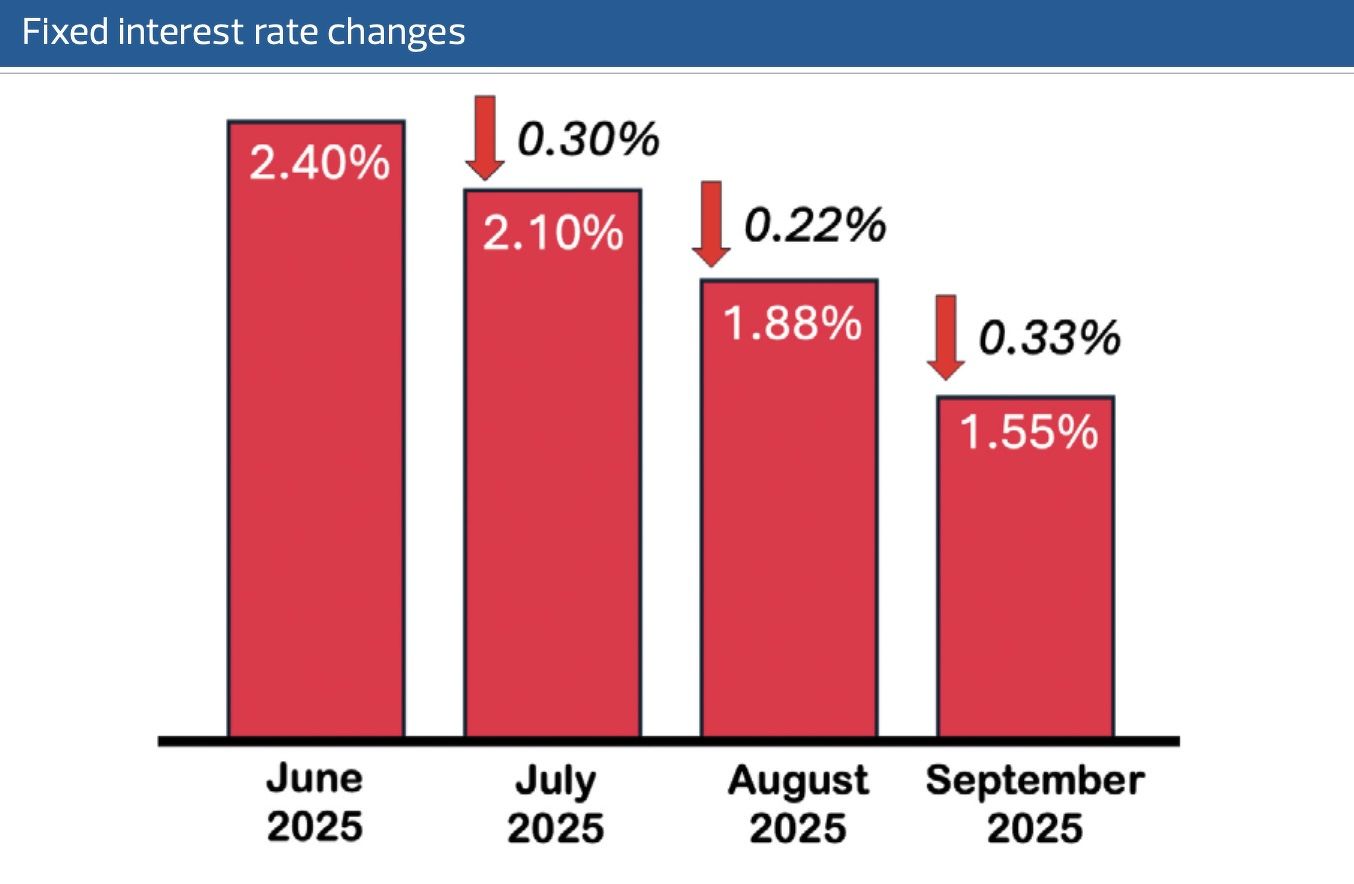
Two homeowners. Same HDB resale flat in Punggol. Same S$520,000 outstanding loan. Same 25-year remaining tenure. One took a floating SORA-pegged package in 2022; the other locked in a two-year fixed rate at the peak of the cycle. By the end of 2023, the floating borrower was paying roughly S$400 a month more than his neighbour. By mid-2025, the tables had turned almost completely — and the fixed-rate borrower is now the one quietly checking refinancing quotes on his phone at lunch.
That swing is the single most consequential number in most Singaporean household budgets, and it is driven by forces that have nothing to do with Singapore's property market at all. If you're holding a mortgage — or about to take one — understanding how bank interest rate changes flow into your monthly payment is worth more than almost any other piece of financial literacy you can acquire between the ages of 25 and 40.
This article breaks down the 2025 rate landscape: where mortgage interest rates in Singapore have come from, where they may be heading, how a SORA home loan actually behaves when the ground shifts, and how to think about fixed vs floating rates and home loan refinancing without drowning in jargon.
The 30-Second Version
If you read nothing else:
- Most Singapore floating-rate home loans are pegged to the 3-month compounded SORA, a benchmark that tracks short-term SGD money-market rates.
- Those rates spiked hard through 2022 and 2023, then eased substantially through 2024 and into 2025.
- A one-percentage-point move on an S$800,000, 25-year loan changes your monthly instalment by roughly S$200. Over the life of the loan, the difference between a 1.5% and a 4.0% rate is more than S$300,000 in interest.
- Fixed-rate packages in 2025 have come back to levels that were unthinkable in 2023 — a shift that has made the fixed-versus-floating decision genuinely difficult again.
- Falling market rates do not increase how much you can borrow. MAS's stress-test floor is fixed at 4% for bank loans, so your maximum loan quantum is largely unchanged by the easing cycle.
- Refinancing math is simple: divide your total switching cost by your monthly saving to get a break-even in months. The complexity lies in the lock-in clauses and clawbacks.
Why Singapore Mortgage Rates Move the Way They Do
MAS doesn't set interest rates — and that matters enormously
Most central banks, from the US Federal Reserve to the European Central Bank, set a policy interest rate and let the currency float. The Monetary Authority of Singapore does the opposite. MAS manages monetary policy by managing the Singapore dollar exchange rate against a basket of currencies, letting domestic interest rates settle wherever market forces push them.
The practical consequence: SGD interest rates are heavily influenced by global — particularly US — rates, because money flows to wherever it earns the best risk-adjusted return. When US rates rise, SGD rates tend to follow, and vice versa. If you've ever wondered why a Federal Reserve decision in Washington shows up in your DBS or OCBC home loan letter, that's the mechanism.
SORA replaced SIBOR — and simplified the picture
Until the early 2020s, most Singapore floating-rate mortgages were pegged to SIBOR, the Singapore Interbank Offered Rate. SIBOR was an administered, panel-based benchmark with some of the same transparency weaknesses that plagued LIBOR globally.
SORA — the Singapore Overnight Rate Average — is different. It's computed from actual overnight borrowing transactions in the SGD market, volume-weighted, and published by MAS. It's an observable, transaction-based rate. Retail floating-rate home loans are almost universally pegged to the 3-month compounded SORA, which averages the overnight rate over the preceding three months.
That three-month averaging is important: it means your loan rate lags the spot market. When rates fall sharply, your instalment adjusts downward over the following months rather than overnight. When rates spike, you get a gentler ramp-up — but you also can't escape it.
The transmission chain
Here's how a change in global rates reaches your bank statement:
Notice the two distinct paths. Your floating package moves mechanically with SORA (plus a fixed spread the bank builds in as profit). Your fixed package, by contrast, is priced on the bank's expectation of where rates will go over the fixed period — which is why fixed rates can start falling before SORA does, and can stay stubbornly high if the market thinks cuts will be reversed.
The 2025 Rate Landscape: What Actually Changed
The hike cycle and the unwind
Singapore's rates went on a wild ride. From near-zero levels in 2021, 3-month compounded SORA climbed steeply through 2022 as global central banks tightened aggressively, plateaued in a high range through 2023, and then began a sustained decline from late 2024 as the Fed pivoted to cutting.
The directional picture, based on published MAS benchmark data and market reporting, has looked roughly like this:
3-Month Compounded SORA — Approximate Directional Trend
Figures are approximate and indicative of direction rather than exact month-end prints. Always check MAS's published SORA data for precise values.
The arc is unmistakable: a peak near 4% in late 2023, followed by a decline of well over a percentage point into 2025.
What banks were actually quoting
Fixed-rate packages tell the story most Singaporeans care about. Through 2023 and much of 2024, two-year fixed packages were commonly quoted in the 3.0% to 3.5% range, with some banks briefly pushing above 3.5%. By mid-2025, indicative quotes for comparable two-year fixed packages had drifted down into roughly the 2.0% to 2.8% band, depending on loan size, property type, and how aggressively the bank wanted the business.
Indicatively:
| Package type | Typical 2023 range | Typical mid-2025 range |
|---|---|---|
| 2-year fixed | ~3.3% – 3.8% | ~2.0% – 2.8% |
| 3-year fixed | ~3.3% – 3.7% | ~2.2% – 2.9% |
| Floating (3M SORA + spread) | ~3.7% – 4.3% | ~2.3% – 3.0% |
| HDB concessionary loan | 2.6% | 2.6% |
Indicative ranges only; bank pricing changes frequently and varies by borrower profile and loan size.
Notice something interesting in that table: the HDB concessionary loan rate didn't move at all. It's pegged at 0.1 percentage points above the CPF Ordinary Account interest rate, which has been held at 2.5% for years. That peg makes the HDB loan rate 2.6%, full stop.
For a large part of the hiking cycle, that made the HDB loan look expensive relative to bank floating packages — which were once as low as 1.5% and then shot up. But as bank rates have eased, the HDB loan has moved from being the obvious loser to being genuinely competitive with the better fixed-rate bank offers, without the refinancing treadmill.
That's a meaningful shift in the decision architecture for HDB flat buyers, and it's one of the most under-discussed consequences of the 2025 rate environment.
Are rates going lower?
Market consensus entering 2025 expected continued easing, but the pace has been a recurring source of volatility. Rate-cut expectations have been repriced repeatedly as inflation data, labour market figures, and geopolitical developments have shifted the outlook.
The honest answer is that nobody knows. What you can do is understand how sensitive your household is to being wrong — which is the whole point of the next section.
What a Rate Change Actually Costs You Each Month
This is where the abstraction ends. Let's put numbers on it.
For an S$800,000 loan over 25 years — roughly what a buyer of a mid-priced private condo or a large resale flat might carry — here's what different rates mean:
| Interest rate | Monthly instalment | Difference vs 4.0% | Total interest over 25 years |
|---|---|---|---|
| 1.5% | ~S$3,200 | −S$1,023 | ~S$160,000 |
| 2.0% | ~S$3,391 | −S$832 | ~S$217,000 |
| 2.5% | ~S$3,589 | −S$634 | ~S$277,000 |
| 3.0% | ~S$3,794 | −S$429 | ~S$338,000 |
| 3.5% | ~S$4,005 | −S$218 | ~S$402,000 |
| 4.0% | ~S$4,223 | — | ~S$467,000 |
Two things jump out. First, the monthly differences are large but not linear — the gap between 1.5% and 2.0% is smaller in absolute dollars than the gap between 3.5% and 4.0%, because at low rates the principal dominates the payment.
Second, and far more importantly: the total interest column is where the real damage lives. The difference between financing at 1.5% and 4.0% over 25 years is over S$300,000 — a sum that dwarfs almost any other financial decision a young Singaporean household will make.
Monthly Instalment by Interest Rate — S$800,000 Loan, 25 Years
The rule of thumb worth memorising
On a 25-year loan, each 1 percentage point change in your interest rate moves your monthly instalment by roughly 0.25% of the loan amount. On S$800,000, that's about S$200 a month. On a S$500,000 loan, about S$125.
Let's check that against the smaller, more common scenario — a S$500,000 loan over 25 years:
| Interest rate | Monthly instalment |
|---|---|
| 1.5% | ~S$2,000 |
| 2.5% | ~S$2,243 |
| 3.5% | ~S$2,503 |
| 4.0% | ~S$2,639 |
Going from the 1.5% lows of 2021 to the 4.0% heights of 2023 cost that borrower about S$640 a month — roughly S$7,700 a year. For a household earning S$8,000 a month, that's nearly 10% of gross income evaporating into the same asset, at the same address, with nothing to show for it.
That's the real story of the 2022–2024 period. Not defaults, not a crash — just a slow, grinding squeeze on household cash flow.
Why the early years hurt most
There's a second-order effect that catches people out. In the early years of an amortising loan, most of your instalment is interest, not principal. On an S$800,000 loan at 3%, your first few hundred payments are roughly three-quarters interest. Raise the rate and the interest portion swells further — which means a rate hike doesn't just cost you more each month, it slows how fast you build equity.
This is why borrowers who took floating loans in 2021 and held through 2024 often find their outstanding balance is higher than they expected. They weren't paying more off; they were paying more for.
Fixed vs Floating in 2025: How to Choose
This is the question that generates the most heat and the least light. Let's structure it properly.
What you're actually choosing between
| Fixed rate | Floating (SORA-pegged) | |
|---|---|---|
| Rate certainty | Locked for 12–36 months | Moves every 3 months |
| Starting rate | Usually higher | Usually lower |
| Spread transparency | Bundled into the headline rate | Usually stated explicitly as "SORA + X%" |
| Benefit if rates fall | None during lock-in | Immediate (with a lag) |
| Pain if rates rise | None during lock-in | Immediate (with a lag) |
| Exit cost during lock-in | Typically ~1.5% of outstanding | Typically ~1.5% of outstanding |
| What happens after lock-in | Usually reprices to a board or SORA peg | Continues |
| Best for | Budget certainty, tight cash flow | Flexibility, tolerance for volatility |
The decision, as a flowchart
The three borrower profiles in 2025
Profile 1: The stretched first-timer. Maxed out on loan quantum, monthly instalment hovering near the MAS thresholds, little slack in the budget. For this borrower, the value of certainty is not financial, it's psychological and structural. A floating package that's 0.4 points cheaper saves maybe S$200 a month — but a 1.5-point upward move costs S$750 and could put you in genuine difficulty. Fixed is the correct answer, even at a higher headline rate.
Profile 2: The comfortable upgrader. Dual income, healthy emergency fund, loan-to-value well below the cap, no intention of selling for a decade. This borrower can rationally take floating exposure, bank the lower starting rate, and treat short-term volatility as noise. Historically, floating packages have often been cheaper over a full cycle — but "often" isn't "always," and the last four years are a cautionary tale.
Profile 3: The near-the-end borrower. Ten years into the loan, outstanding balance modest, remaining tenure short. At this stage, you should be aggressively optimising for rate, not structure — and probably shortening your tenure if cash flow allows, because the interest you save compounds.
The trap in the "fixed" label
A critical detail: Singapore "fixed-rate" packages are fixed for a defined period — usually two or three years. After that, they typically revert to a floating peg or a bank board rate. Some revert to spreads that are considerably wider than a fresh customer could obtain.
That means the real question isn't "fixed or floating?" — it's "what is my effective all-in cost over the next three to five years, including what happens after the lock-in ends?" A package with a beautiful 2.1% headline and a punitive post-lock-in spread is worse than a 2.4% package with a fair reversion peg.
Always read the post-lock-in clause. It is the single most neglected line in any home loan Letter of Offer.
Refinancing in 2025: The Maths, the Timing, the Traps
With rates having moved significantly, a large cohort of Singapore borrowers are now sitting on loans priced above where the market is. If you locked in a two-year fixed rate in 2023 or 2024, your lock-in has likely expired or is about to.
The break-even calculation nobody does
Refinancing isn't free. Typical costs:
| Cost item | Typical range |
|---|---|
| Legal fees | S$1,500 – S$2,500 |
| Valuation fee | S$300 – S$500 |
| Bank legal subsidy | Often S$1,500 – S$2,500, with clawback conditions |
| Repricing fee (same bank) | S$200 – S$800 |
The break-even is straightforward:
Break-even months = Total switching cost ÷ Monthly instalment saving
| Monthly saving | Break-even at S$2,500 cost | Break-even at S$3,500 cost |
|---|---|---|
| S$150 | ~17 months | ~23 months |
| S$300 | ~8 months | ~12 months |
| S$500 | ~5 months | ~7 months |
If the answer is under 12 months, refinancing is almost always worth doing — provided you intend to hold the property long enough to clear the break-even.
Repricing vs refinancing
Repricing means staying with your existing bank and moving to a new package from their current menu. It's faster, involves less paperwork, and usually costs a few hundred dollars. The catch: you only get your current bank's pricing, which may not be competitive.
Refinancing means moving to a different bank entirely. More paperwork, full legal process, but access to the whole market. If your existing bank's repricing offer is materially worse than the best external quote, the extra friction is usually worth it.
The refinancing workflow
Four traps to watch
1. The legal subsidy clawback. Banks frequently subsidise your legal fees for refinancing — but the subsidy is typically clawed back in full if you redeem or refinance within three years. A package that looks 0.1% cheaper but has a three-year clawback may be worse than one with a clean two-year structure.
2. Early repayment penalties during lock-in. Standard in Singapore at around 1.5% of the outstanding balance. On a S$600,000 balance, that's S$9,000 to break a lock-in early. Wait it out.
3. Resetting your tenure. If you're eight years into a 25-year loan and refinance into a fresh 25-year term, your monthly payment drops — but you'll pay interest for another 25 years. That's not savings; it's term extension. Keep the remaining tenure constant unless you deliberately want to stretch.
4. Fixed rates are priced on expectations, not today's SORA. If the market has already priced in two more cuts, a fixed package may not fall further even if SORA does. You're buying certainty, not a discount.
A word on the CPF angle
Many Singaporeans service their mortgage from CPF Ordinary Account funds. CPF OA earns 2.5% risk-free. If your mortgage rate is below 2.5%, the arithmetic technically favours paying in cash and leaving your OA intact to compound — but that ignores a critical detail: CPF monies used for housing, plus accrued interest at 2.5%, must be refunded to your CPF account when you sell. That makes CPF a 2.5% loan to yourself, not free money.
There's no universally correct answer here. It depends on your cash position, your intended holding period, and whether you view the OA as an investment account or a housing fund. But it is absolutely a decision worth modelling rather than defaulting on.
The Rate You Get Isn't the Rate You're Judged On
Here's a piece of the puzzle that catches out almost every first-time buyer, and it becomes especially relevant in a falling-rate environment.
When a bank assesses your loan application, it does not assess you at the rate you'll actually pay. MAS requires banks to apply an interest rate floor of 4% for residential property loans when computing your Total Debt Servicing Ratio. That's true even if your actual package rate is 2.2%.
The TDSR framework caps your total monthly debt obligations at 55% of gross monthly income, covering all property loans, car loans, credit card minimums, and personal loans. For HDB flats and new Executive Condominiums, there's an additional and stricter test — the Mortgage Servicing Ratio, which caps your property loan instalment at 30% of gross monthly income. HDB concessionary loans are stress-tested at a 3% floor rather than 4%.
The counterintuitive takeaway
Because the stress-test floor is fixed at 4%, a fall in market rates from 3.5% to 2.2% does not increase how much you can borrow. Your maximum loan quantum is anchored to the 4% floor, not to your actual rate.
This produces a genuinely useful insight: the easing cycle reduces your monthly cost, but it does not increase your purchasing power. If you were priced out of a particular property in 2023, the same TDSR and MSR ceilings apply today. What has changed is the affordability of servicing a loan you were already eligible for.
That distinction matters enormously when you're reading headlines about "lower rates boosting the property market." Lower rates improve cash flow. They do not, on their own, unlock capacity.
Why Mortgage Rates Matter Beyond Your Mortgage
It would be naive to discuss mortgage rates purely as a household budgeting topic. In Singapore, mortgage rates are one of the most powerful levers on property prices.
The logic runs like this:
- Lower rates → lower monthly instalments for the same price. A buyer's maximum monthly payment is capped by TDSR and MSR; lower rates means more of that cap goes to principal, supporting higher prices.
- Lower rates → alternative assets look less attractive. When fixed deposits and T-bills yield 2%, the relative appeal of property income rises.
- Lower rates → developers and investors can hold more comfortably, reducing distressed selling.
But three factors temper this in Singapore:
- TDSR and MSR are rate-independent. Because the 4% stress floor doesn't move, the loan quantum lever is genuinely frozen. This is a deliberate design feature of Singapore's macroprudential framework, and it's why Singapore's property market tends to have less of the rate-driven boom-bust dynamic seen elsewhere.
- Supply is policy-controlled. BTO pipelines, Government Land Sales programmes, and en-bloc cycles all shape supply in ways that interest rate movements don't touch.
- Cooling measures remain in place. Additional Buyer's Stamp Duty rates remain elevated for most buyer categories, which suppresses the marginal investor demand that lower rates would otherwise encourage.
The net result is that Singapore's property market is more insulated from interest rate cycles than most global cities — but not immune. Resale volumes, in particular, respond to rate movements because they're driven by upgraders whose affordability is directly affected by instalment levels.
Five Mistakes Borrowers Make in a Falling-Rate Environment
1. Assuming "lower rates" means "refinance now." The relevant question isn't where SORA is — it's whether the all-in, three-year effective cost of your new package beats your existing one after switching costs. A 0.3-point reduction with a three-year clawback on S$2,500 of legal fees can net out to almost nothing.
2. Fixing for too long at the bottom. Three-year fixed packages look comforting in 2025. But if rates fall further in 2026 and 2027, you're locked into a rate that looked reasonable in 2025. If you fixed for three years and the market drops a full point, you've paid a meaningful premium for certainty you may not have needed.
3. Ignoring the post-lock-in spread. As covered above: the headline rate is the advertisement, the reversion clause is the product.
4. Extending tenure to reduce the payment. Dropping from 25 to 30 years may make the monthly instalment comfortable, but it typically adds six figures of interest. If you need the breathing room, take it — but know what it costs.
5. Not checking whether an existing bank's repricing offer is competitive. It's often the path of least resistance, and banks know it. Pull three external quotes first; you'll negotiate from a much stronger position.
Food for Thought
1. If the TDSR stress floor is fixed at 4%, does it actually make sense to talk about "lower rates making property more affordable" — or does it only make an already-affordable purchase cheaper to service?
2. Singapore's 4% floor has kept loan quantums stable through the entire rate cycle. Is that insulation a genuine stabiliser, or is it deferring price discovery that other markets have already gone through?
3. The HDB concessionary loan has stayed at 2.6% while bank rates moved from 1.5% to 4% and back down into the 2% range. For a buyer today, is the HDB loan's stability worth more than a bank package's lower headline rate — and how would you price that stability?
4. Most borrowers optimise for the next two years because that's the lock-in period. But 25-year loans are decided by 25-year averages. How much of your mortgage decision is genuinely rational, and how much is just responding to the most recent headline?
5. If refinancing saves S$300 a month but requires an hour of paperwork and a S$2,500 upfront cost, the break-even is roughly eight months. What other financial decisions in your life have a break-even that short — and are you making them?
The Bottom Line
The 2025 rate environment is genuinely different from 2023. Borrowers who locked in at the peak are now sitting on above-market rates. Floating-rate borrowers who endured two years of punishing instalments have seen real relief. And the HDB concessionary loan — long dismissed as uncompetitive during the low-rate years — has quietly become one of the better-value options on the table.
But the fundamentals haven't changed. Your loan quantum is set by a 4% stress test, not by today's headline rate. Your long-run cost is set by how long you hold, how much you borrow, and how well you manage the refinancing cycle — not by whether SORA ends 2025 at 2.0% or 2.4%. The rate is the most visible number and the least controllable one.
What you can control is your own diligence: checking your lock-in end date, comparing three-year effective costs rather than headline rates, reading the post-lock-in clause, and not confusing a lower monthly payment with a better long-term outcome.