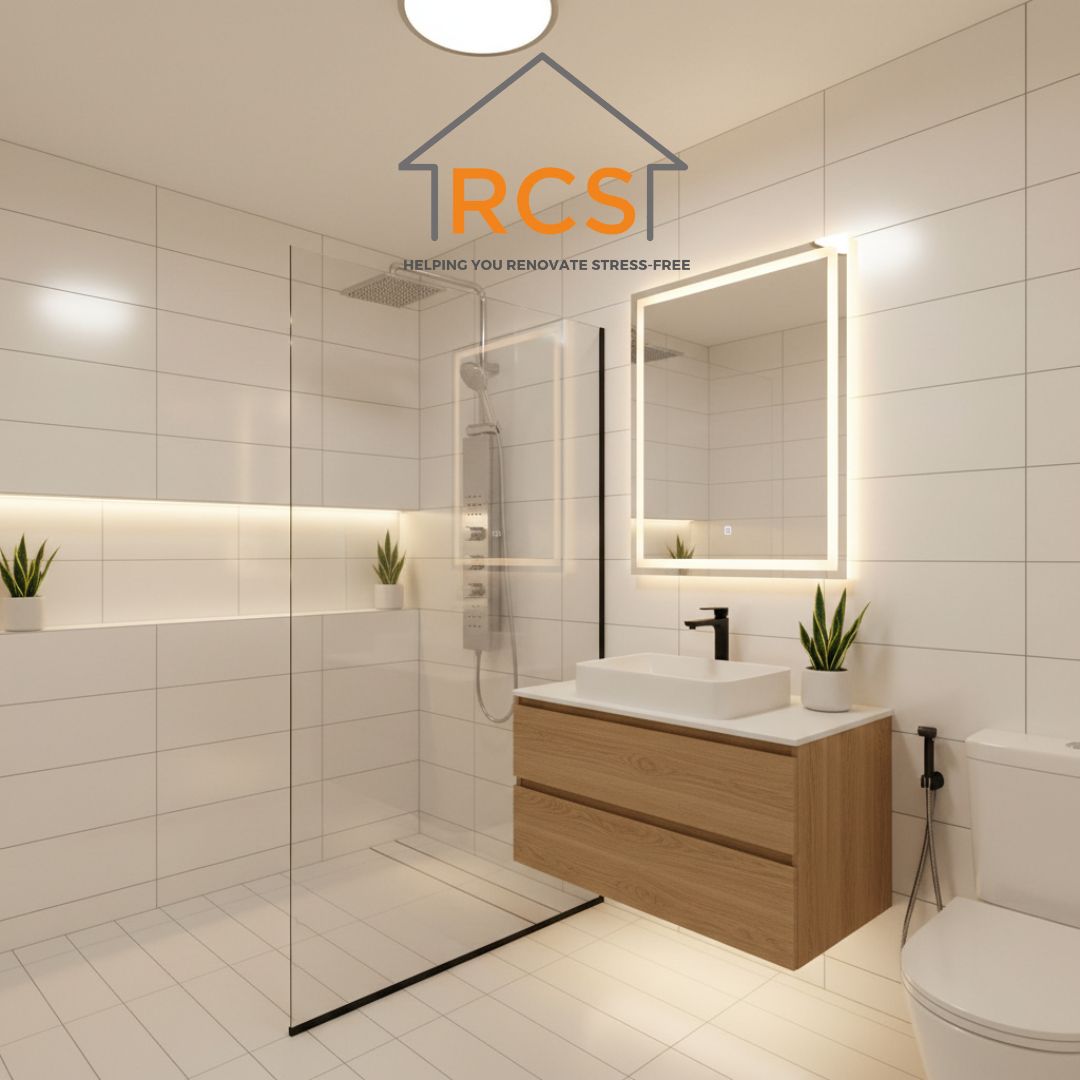
Here is a number that surprises most first-time homeowners: a typical Singapore bathroom is about 4 to 5 square metres — roughly one parking lot. Yet a full toilet renovation in Singapore can account for a fifth or more of your entire renovation budget, and it is the single room where buyers, valuers, and your downstairs neighbour all have a direct interest in how well you did the job.
In 2025, bathrooms have quietly become the most contested square footage in the Singapore home. Resale flats from the 1990s are hitting the market with their original sanitary ware. Condo owners are retrofitting bidet seats and curbless showers. And an entire generation of buyers — many of them 25 to 40, buying their first or second home — is discovering that the bathroom renovation cost Singapore contractors quote is only half the story. The other half is waterproofing, compliance, and how much of it you will ever get back at resale.
This article breaks down what a bathroom costs in 2025, what the design trends actually look like on the ground, and what a renovated toilet is really worth when you sell.
Why Bathrooms Are Suddenly the Most Important Room in the House
The housing stock is ageing — fast
A large share of Singapore's HDB flats were built between the 1970s and 1990s. That means a substantial chunk of the resale market is transacting with bathrooms that are 25 to 40 years old: original colour-matched wall tiles, low-slung WC bowls, single-lever or cross-head taps, and waterproofing membranes that were specified to a different era's standards.
When these flats change hands — roughly 27,000 to 29,000 resale HDB transactions a year in recent years, according to HDB's quarterly resale statistics — the bathroom is almost always the first thing on the renovation list.
The "renovate, don't move" effect
Cooling measures have made moving expensive. Since the April 2023 round of property cooling measures, ABSD for a second residential property sits at 20%, and at 30% for a third. For a household that already owns one home, upgrading now carries a stamp duty bill that can run into the hundreds of thousands.
The rational response is obvious: if moving costs more than renovating, renovate. And when households renovate to stay rather than to flip, the spec sheet changes. They stop asking "what's the cheapest way to make this sellable?" and start asking "what do I want to live with for the next 15 years?"
That shift is the single biggest driver of 2025's bathroom trends — more durable, more comfortable, and more accessible.
The bathroom is the highest-stress, highest-skill part of any renovation
Unlike a bedroom (paint, wardrobe, done), a bathroom involves almost every trade in the industry:
- Hacking and debris disposal
- Plumbing rough-in and re-piping
- Electrical work in a wet area
- Waterproofing and curing time
- Screeding and fall to the floor trap
- Tiling, grouting, and silicone
- Sanitary ware, glass, and accessories
Get one stage wrong and the failure is not cosmetic. It is water in your neighbour's ceiling — and a repair bill that dwarfs whatever you saved by choosing the cheaper quote.
What a Toilet Renovation in Singapore Costs in 2025
A note on the numbers
The figures below are indicative market ranges, compiled from the kinds of line-item quotes Singapore renovation platforms and contractors commonly present. Your actual quote will swing based on flat type, access, tile choice, brand selection, and how much of the existing bathroom you keep. Treat them as a budgeting frame, not a price list.
The line-item breakdown
Here is how a mid-range overhaul of a single HDB bathroom typically decomposes.
| Work item | Typical range (S$) | Notes |
|---|---|---|
| Hacking and debris disposal | 900 – 1,800 | Higher if no service lift nearby |
| Waterproofing (membrane + labour) | 800 – 1,500 | Must be by a registered contractor |
| Plumbing re-pipe and relocation | 600 – 1,500 | More if you move the WC or basin |
| Electrical (IP-rated points, fans, LED) | 400 – 900 | Dedicated point needed for a bidet |
| Screeding and levelling | 300 – 600 | Includes fall to the floor trap |
| Tiling labour | 900 – 2,000 | Large-format tiles cost more to lay |
| Tile supply | 600 – 2,500 | Big driver of variance |
| Sanitary ware (WC, basin, taps, shower set) | 800 – 6,000+ | Smart toilets push the top end |
| Shower screen / glass | 500 – 1,500 | Frameless costs more |
| Accessories (mirror, rails, hooks) | 200 – 1,000 | |
| Site protection and final cleaning | 100 – 300 | |
| Indicative total | 7,000 – 15,000+ | Per bathroom |
Indicative Cost Breakdown: One HDB Bathroom, Mid-Range Overhaul (S$)
Notice something important in that chart: the things you can see cost about as much as the things you can't. Hacking, waterproofing, plumbing, electrical, and screeding together come to roughly the same as tiles, sanitary ware, and glass. That is the structural reality of bathroom renovation — you are paying for a watertight box, and the finishes are what you dress it in.
Scope comparison: what you actually pay
| Scope | Indicative cost (S$) | Typical timeframe |
|---|---|---|
| HDB, 1 bathroom, basic refit (no hacking) | 3,000 – 6,000 | 5 – 7 days |
| HDB, 1 bathroom, mid-range full overhaul | 9,000 – 13,000 | 2 – 3 weeks |
| HDB, 1 bathroom, premium (smart toilet, large-format tiles, niche) | 15,000 – 20,000+ | 3 – 4 weeks |
| HDB, 2 bathrooms, mid-range overhaul | 17,000 – 25,000 | 3 – 4 weeks |
| Condo, 1 bathroom, mid-range overhaul | 11,000 – 18,000 | 2 – 3 weeks |
Indicative Total Cost by Renovation Scope (S$)
Why condos cost more for less space
Condo bathrooms are often smaller but pricier to redo. The reasons are structural, not cosmetic:
- MCST approvals and deposits. Most condos require a renovation application, an approved contractor list, and a refundable deposit — commonly in the S$1,000 to S$3,000 range, though this varies by management corporation.
- Restricted work hours. Weekdays only in many developments, with limited or no work on Saturdays, and none on Sundays and public holidays. Tighter windows mean slower progress.
- Lift and common-area protection. Corridor protection, lift padding, and debris routing rules add cost.
- Higher-spec existing finishes. Removing quality stone or large-format porcelain without damaging adjacent surfaces takes more care.
The hidden costs nobody quotes you for
- HDB renovation permit and registered contractor requirement. Wet-area works in a resale flat must go through the proper permit route, and hacking works must be carried out by an HDB Registered Renovation Contractor. There is a permit process and administrative cost attached.
- Contingency. Budget 10–15% on top. In an older flat, you will almost always find something — a corroded pipe, a cracked waste line, a hollow screed patch.
- Alternative accommodation. If you only have one bathroom and it is out of action for three weeks, factor in the cost of staying elsewhere or the logistics of sharing.
- Replacement of the floor trap and waste pipes. Cheap to do while hacked, extremely expensive to do later.
Compliance: two very different routes
If you are in a new BTO flat, one more rule matters: your flat comes with a defects liability period, typically 12 months from key collection. Report and rectify defects before you hack anything. Hacking a bathroom floor inside the DLP can void coverage for that area, and you will be arguing about who pays for a leak that appears in month 13.
2025 Bathroom Design Trends: What Singaporeans Are Actually Building
1. Smart toilets and bidet seats have gone mainstream
The Japanese washlet has finished its journey from novelty to default. In 2025, the question is less "should I get a bidet?" and more "which kind?"
| Option | Typical price (S$) | What you get |
|---|---|---|
| Bidet seat (add-on to existing WC) | 500 – 1,500 | Warm seat, wash modes, often a dryer |
| Integrated smart toilet (one-piece) | 1,500 – 8,000+ | Tankless, auto flush, deodoriser, remote |
| Basic WC with dual flush | 250 – 800 | The reliable default |
Two practical things trip people up:
- You need a power point near the WC. Ideally IP-rated and on residual current protection. If you are hacking anyway, run it now. Retrofitting later means surface trunking across a tiled wall.
- Rough-in dimensions matter. Toilets come in different trap configurations and setback distances. Measure before you buy, or you will own a very expensive object that does not fit the waste pipe.
2. The spa shower: curbless, linear-drain, frameless
The walk-in shower with a linear drain set flush to the floor is the defining bathroom look of the mid-2020s. It reads bigger, cleans easier, and — critically — is step-free, which makes it a future-proofing move as much as an aesthetic one.
What to watch:
- Curbless designs demand very precise screeding and a longer, flatter fall to the drain. This is a skill question, not a taste question.
- A recessed niche replaces the rusty corner caddy. Cheap to build during tiling, awkward to add later.
- Rain showers need decent water pressure. If you live on a high floor with a low-pressure supply, test before committing.
3. Warm minimalism: microcement, terrazzo, and Japandi neutrals
The grey-and-white industrial look is receding. What is replacing it:
- Microcement — seamless, no grout lines, warm matte finish. Pricier and more specialised to apply correctly.
- Terrazzo and stone-look porcelain — large-format, often book-matched on opposing walls.
- Warm neutrals — sand, clay, mushroom, and off-white, paired with brushed brass or gunmetal fittings instead of chrome.
- Fluted and textured panels — used sparingly as a vanity front or feature wall.
4. Large-format tiles and full-height tiling
600 x 1,200mm and even 750 x 1,500mm tiles are increasingly common. Fewer grout lines mean a cleaner look and less mould-prone surface area. The trade-off is labour: large slabs need levelling clips, more cutting waste, and higher-skill installers, so the laying cost per square foot rises.
Full-height tiling to the ceiling is also now standard in mid-range work, partly for looks and partly because it lets you tile over the waterproofing upstand properly.
5. Lighting and mirrors
- Backlit LED mirrors with anti-fog heating — now a near-default in mid-range projects.
- 3,000–4,000K colour temperature for accurate grooming light without a clinical feel.
- Motion-sensor night lighting at floor level — a genuinely useful addition, especially for older occupants.
- Separate lighting circuits for task, ambient, and night lighting.
6. Wellness and water efficiency
- Thermostatic shower mixers to prevent scalding — relevant for households with young children or elderly parents.
- Heated towel rails — niche in Singapore's climate but growing.
- WELS-labelled fittings. Singapore's Mandatory Water Efficiency Labelling Scheme rates fittings by ticks; choosing 2- or 3-tick taps, showers, and dual-flush cisterns cuts water use without affecting performance.
Waterproofing: The Invisible Line Item That Decides Everything
If you take one thing from this article, take this: waterproofing is not a line item you should be shopping for on price.
What the rules require
For resale HDB flats, wet-area renovation works — including waterproofing — must be carried out by an HDB Registered Renovation Contractor, and the new waterproofing must come with a warranty of at least five years against water seepage. This is not paperwork for its own sake. It exists because water damage in a high-rise flat does not stay in your flat.
What good waterproofing actually looks like
- Cementitious or polyurethane membrane applied to the full floor area, not just the shower zone.
- Upstands turned up the wall at the perimeter — commonly at least 200–300mm, and full height within the shower enclosure.
- Sealed pipe penetrations and floor trap junctions. These are the most common leak points.
- A ponding test. The floor is flooded and left for around 24 hours, with the water level marked. If the level drops, there is a breach — find it before tiling.
- Correct fall. The screed must slope consistently toward the floor trap. Too shallow and water pools; too steep and you feel like you are standing on a ramp.
Warning signs that you already have a problem
- Paint blistering or peeling on the wall outside the bathroom
- White, chalky efflorescence on skirting or adjacent walls
- A persistent musty smell that returns after cleaning
- Dark patches on the ceiling of the unit below
- Grout that crumbles or silicone that keeps failing in the same spot
If you are seeing these in a flat you are considering buying, treat the bathroom as a full overhaul, not a refresh. The cost of redoing it properly is real, but the cost of a leak dispute with your neighbour is worse.
Cost of getting it wrong
A failed waterproofing job generally means:
- Hacking out the entire bathroom again
- Re-doing waterproofing, screeding, and tiling from scratch
- Possible repair liability for the unit below
- The disruption of living through a renovation twice
In other words, the cheapest possible waterproofing quote is the most expensive option available.
Accessible and Future-Proof Design: The 2025 Differentiator
The demographic reality
Singapore is ageing quickly. Official projections point to roughly one in four residents being aged 65 and above by around 2030. For homeowners in their 30s and 40s planning a "forever home", that has a direct design implication: the bathroom you build now may need to serve you, or your parents, in a very different physical condition 20 years from now.
The single best decision: install blocking
Blocking means fixing timber or steel reinforcement inside the wall before tiling, at the heights where a grab bar would eventually go. It costs very little during a renovation. Installing grab bars later without blocking requires opening up finished walls — or settling for surface-mounted bars fixed into anchors that may not hold.
If you install blocking and never use it, you have lost nothing. If you skip it and later need it, you will regret it.
Universal design features worth building in
| Feature | Why it matters | Rough cost impact |
|---|---|---|
| Curbless / step-free shower | Works for wheelchairs, walkers, and tired legs | Moderate — requires precise screeding |
| Grab bar blocking in walls | Future grab bars without hacking | Low |
| Comfort-height WC (400–450mm) | Easier to sit and stand | Negligible |
| Anti-slip floor tiles | Reduces falls; look for higher slip resistance ratings | Low to moderate |
| Lever taps and mixers | Operable with a closed fist or weak grip | Negligible |
| Good, even lighting | Reduces fall risk and improves visibility | Low |
| Outward-swinging or sliding door | Accessible if someone collapses inside | Moderate |
HDB's EASE programme
For eligible households with elderly members, HDB's Enhancement for Active Seniors (EASE) programme subsidises the installation of grab bars, ramps, and slip-resistant treatment in flats, with direct application to HDB. If you are renovating a flat that an elderly parent will live in — or will live in themselves — it is worth checking eligibility before you spend your own money on the same features.
Why this matters for resale too
A future-proofed bathroom appeals to a broader buyer pool: young families thinking about visiting grandparents, buyers in their 50s right-sizing, and anyone who has watched a relative struggle on a wet tiled floor. It is one of the few upgrades that improves both your daily life and your exit options.
Does a Renovated Bathroom Actually Boost Resale Value?
Here is the honest answer, and it will disappoint anyone hoping for a clean multiplier: a renovated bathroom rarely returns dollar-for-dollar, but a failed one can cost you the sale.
What the valuation does and does not see
Bank valuers price your flat against comparable transactions — location, floor area, floor level, remaining lease, and recent nearby sales. They are not measuring your microcement. In practice, a beautifully renovated bathroom does not materially move a formal valuation.
Where it moves money is in the negotiation:
- A bathroom with obvious damp, cracked tiles, or a persistent smell gives buyers a reason to bargain. Renovation-savvy buyers will mentally deduct $10,000–$20,000 for a bathroom they intend to redo.
- A clean, dry, well-finished bathroom removes that objection. It makes the flat feel "move-in ready", which shortens your time on market — and time on market is leverage.
- Industry rule of thumb, reported across renovation platforms, is that homeowners recover roughly 50–70% of renovation spend through price and speed of sale, with wet areas typically performing better than cosmetic upgrades.
Where your money performs best at resale
| Upgrade | Perceived buyer impact | Notes |
|---|---|---|
| New waterproofing with a valid warranty | High | Removes the biggest fear |
| Replacing 25-year-old sanitary ware | High | Visible and tactile |
| Fixing leaks, damp, and mould | High | A red flag if unresolved |
| Full re-tiling with neutral tiles | Medium | Taste-dependent; keep it neutral |
| Smart toilet / bidet | Medium | Delight for some, "extra plumbing" for others |
| Luxury materials (microcement, stone) | Low to medium | Rarely valued at cost |
| Designer fittings and accessories | Low | Emotionally nice, financially thin |
The pre-sale refresh: the highest-ROI bathroom spend
If you are selling within the next 12 months and the bathroom is structurally sound, a full overhaul is usually the wrong financial move. Instead:
- Re-grout and re-silicone — a few hundred dollars, and it changes the entire read of the room
- Replace taps, shower set, and shower screen — high visual impact, low cost
- Replace the WC seat or the WC itself if it is visibly dated
- Fix the ventilation. A working exhaust fan and no lingering damp smell does more for buyer confidence than any tile choice
- Deep clean the grout lines and glass — professional cleaning runs into the low hundreds
Call it $300 to $2,000 for a refresh that neutralises the most common buyer objection.
The timing calculation
The logic: a bathroom overhaul has a useful life of roughly 15 to 20 years for the waterproofing and tiling, and shorter for fittings. If you will sell before that life is half-used, you are renovating for someone else's benefit. If you will live in it, renovate for yourself and let the resale value follow.
Common Mistakes That Cost Singapore Homeowners Real Money
1. Buying the smart toilet before checking the waste pipe. Trap type and setback distance must be verified against your existing plumbing, or against the new plumbing you are installing.
2. Skipping grab bar blocking. The cheapest future-proofing decision you will ever make, and the one most often forgotten.
3. Choosing slippery tiles for a wet floor. Aesthetic tiles with a low slip resistance rating are a genuine hazard in a room that is wet for part of every day.
4. Over-tiling instead of hacking. Overlaying tiles raises the floor level. That can mean a door that no longer clears, a step at the threshold, and a floor trap that now sits proud of the finished floor.
5. Ignoring the floor trap position. Moving sanitary ware without moving the trap creates pooling water and a permanent cleaning problem.
6. Not planning electrical points. Bidet, heated rail, exhaust fan, mirror, night light — count them before tiling. Every added point after tiling means surface trunking.
7. Choosing a contractor on price alone for wet works. This is where the warranty and the registration status matter most, and where cutting corners is least visible until it fails.
8. No contingency budget. In a flat older than 20 years, expect to find something. 10–15% on top of the quote is not pessimism; it is planning.
9. Forgetting the condo paperwork. Starting work without MCST approval can result in a stop-work order, a forfeited deposit, and delays that cost more than the approval would have.
10. Renovating for a buyer who does not exist yet. Bold, highly personal finishes in a bathroom narrow your buyer pool. Neutrals in wet areas are not boring — they are strategic.
Renovation Timeline: What Three Weeks Actually Looks Like
Most single-bathroom overhauls run 2 to 3 weeks of on-site work, plus lead time for materials. Here is how the days are typically spent.
Indicative On-Site Duration by Phase (Working Days)
A few things worth noting from that distribution:
- Waterproofing and curing is the longest single block after tiling, and it is entirely non-negotiable. Anyone offering to skip or compress the curing time is telling you something about their standards.
- Tiling takes the most days because it is where precision shows. Check the tiling — not the tiles — when you inspect.
- Two bathrooms done concurrently do not take twice as long if hacking happens together, but tiling and finishing are usually sequenced because of manpower. Budget 3 to 4 weeks.
Food for Thought
1. If a renovated bathroom does not move the valuation, only the negotiation, how much of your renovation budget are you actually spending on yourself versus on the eventual buyer?
2. Singapore is projected to have roughly one in four residents aged 65 and above by 2030. If you plan to stay in your flat for 20 years, why is step-free access still treated as an optional upgrade rather than a baseline specification?
3. A five-year waterproofing warranty is a requirement for resale flat wet works. If you are buying a resale flat today, do you know whether the previous owner's warranty is still valid — and whether you would even be able to claim against it if not?
4. With ABSD at 20% for a second property, more households are choosing to renovate rather than move. Does that make over-investing in a single home more rational than it used to be — or does it just concentrate risk in one asset?
5. The bathroom is the only room where a defect can damage someone else's property. Should renovation quality in wet areas be more visible — for example, a transferable, registered warranty that follows the flat rather than the owner?
The Bottom Line
A toilet renovation in Singapore in 2025 sits somewhere between $7,000 and $20,000 per bathroom, depending on scope, and it is the one part of your home where the invisible money matters more than the visible money. Waterproofing, compliance, blocking, and correct falls are what make a bathroom last. Tiles, smart toilets, and backlit mirrors are what make it yours.
On resale, be clear-eyed: a well-built bathroom clears objections and speeds up a sale, while a failed one hands the buyer a bargaining chip worth five figures. Spend accordingly — and if you are selling soon, spend on a refresh rather than an overhaul.