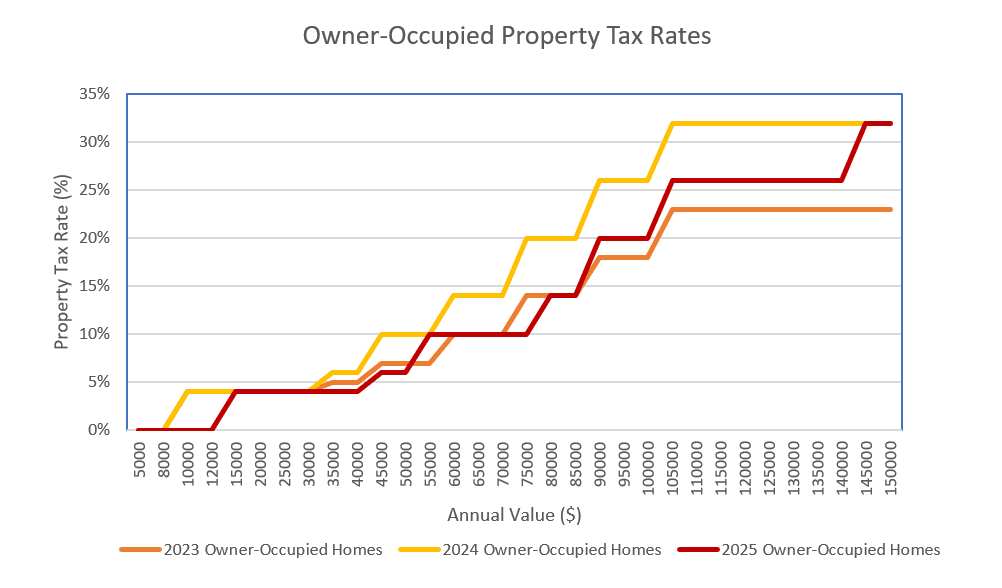
Your first property tax bill is probably the least dramatic letter you'll ever receive from a government agency. It's not the downpayment. It's not the renovation quote that somehow grew by 30% between the first site visit and the final invoice. For a lot of HDB owners, the annual property tax in Singapore comes to less than a month's phone bill.
Which is exactly why so many young homeowners ignore it — until they don't.
Property tax is the one cost of ownership that never goes away, that quietly resets itself every January, and that rises when the rental market around you rises, even if your salary hasn't moved and your flat looks exactly the same. It also has a habit of surprising people who rent out a spare room, or who buy a second property, or who assume the number on the letter is simply not worth arguing with.
This guide breaks down how property tax in Singapore actually works: what Annual Value means, how the 2024 rates differ for owner-occupiers and landlords, how to calculate your own bill, the narrow but real window to appeal an assessment, and how to plan for the increases that are quietly baked into the system.
Why Your Property Tax Bill Has Nothing to Do With What You Paid
Here's the mental model that trips up first-time buyers: they assume property tax scales with the price of the home. It doesn't. Not even close.
Two identical four-room flats on the same corridor pay the same property tax, even if one owner paid $450,000 for theirs in 2019 and the other paid $700,000 in 2023. Meanwhile, a flat two MRT stops away — same size, same age, same everything except the rental market around it — can pay a meaningfully different amount.
Property tax is a tax on value, but not on the value you transacted at. It is a tax on the Annual Value (AV) of the property: essentially, the rent the property could command if it were let out. That's a fundamentally different number from the price you paid, and once you internalise it, most of the confusion around property tax disappears.
It also explains why property tax is administratively cheap for the government to run and structurally hard for owners to game: your bill doesn't depend on what you did in the market, only on what the market around you is doing.
What Is Property Tax, and Who Pays It?
Property tax is an annual tax on property ownership in Singapore, levied under the Property Tax Act and administered by the Inland Revenue Authority of Singapore (IRAS). It applies to virtually every property in Singapore — HDB flats, private condominiums, landed homes, shophouses, offices, factories and vacant land.
Three inputs determine your bill:
- The Annual Value (AV) of the property for the year
- Whether the property qualifies for owner-occupier tax rates
- The tax rates in force for that year, which the government revises from time to time
For residential properties, the rates are progressive: they rise in bands as AV increases. For non-residential properties — shops, offices, industrial units — a flat rate of 10% of AV applies, with no owner-occupier concession. If you're a young investor eyeing a small commercial unit, that flat 10% is worth remembering, because it is applied bluntly and without the banded relief that homes enjoy.
The rule that catches people out: 1 January ownership
Property tax is payable by the person who owns the property as at 1 January of the tax year, and the bill covers the whole calendar year.
If you completed your resale flat purchase in March, you were not the owner on 1 January — the seller was, and IRAS will bill them for that year. From the following January, the bill lands with you. In practice, buyers and sellers commonly apportion the property tax in their completion accounts, but that is a private arrangement between the two of you. IRAS isn't a party to it, and it won't arbitrate it.
Two related points worth knowing:
- Property tax applies whether or not the property is occupied — and whether or not it is earning rent. An empty flat left unrented still generates a bill.
- For a new private development, the developer typically remains the owner until the project is completed and legal completion takes place, so your liability generally begins after that point. For a BTO flat, liability generally starts from when you take possession of the keys.
The difference between property tax and the taxes you met at purchase
Young buyers in Singapore often conflate four different taxes. They are not the same thing, and they operate on completely different timelines.
| Tax | When it applies | What it's charged on |
|---|---|---|
| Buyer's Stamp Duty (BSD) | On purchase | Purchase price or market value |
| Additional Buyer's Stamp Duty (ABSD) | On purchase | Purchase price or market value, at higher rates for certain buyer profiles |
| Seller's Stamp Duty (SSD) | On sale within the holding period | Sale price |
| Property Tax | Every year, for as long as you own it | Annual Value of the property |
ABSD is a one-off, transaction-level intervention designed to cool demand. Property tax is a recurring, ownership-level tax designed to raise revenue and — in its current shape — to tilt the burden towards higher-value properties and investment holdings rather than homes people actually live in.
Annual Value, Explained: The Number That Decides Everything
If Annual Value is the single number that determines your bill, it is worth understanding how IRAS arrives at it.
AV is the estimated gross annual rent your property could fetch if it were rented out, unfurnished, excluding furniture, fixtures and maintenance charges. IRAS assesses it as at 1 January each year, drawing on rental evidence from comparable properties — similar size, similar location, similar age and condition — transacted in the preceding period.
Three implications follow from that definition:
- Your AV is not your purchase price. It never was, and it never will be.
- Your AV is not based on your income, your mortgage, or your loan tenure. Your bank has no say here.
- Your AV is reviewed every year. It can rise or fall, and it generally tracks the broader rental market rather than any individual transaction.
IRAS issues a Notice of Assessment showing the AV and the tax payable. Under the definition, AV is gross rent — so if the comparable flats in your block are being let at, say, $2,600 a month unfurnished, the AV for a comparable unit would notionally be in the region of $31,200 a year.
In practice, the AVs applied to HDB flats tend to sit well below the headline rents you see on property portals, because the assessment weighs the rental evidence it has for that specific block and flat type rather than the newest listing in the estate. That's why the same four-room flat type can carry noticeably different AVs in Toa Payoh and Tengah. The market, not the floor plan, does the talking.
How AV becomes a tax bill
The mechanics are mechanical — and that's the point.
Once you have the AV, the calculation is arithmetic. What changes the outcome dramatically is step two: whether you qualify as an owner-occupier.
The 2024 Property Tax Rates: Owner-Occupier vs Non-Owner-Occupier
The 2024 tax year saw one of the most significant revisions to residential property tax rates in years, following the Budget announcements of 2022 and 2023. The revised schedule took effect from 1 January 2024, and it marked a clear directional shift: the low bands stayed where they were, while the upper bands were pushed up sharply.
Under the owner-occupier schedule, the first bands are unchanged and remain deliberately gentle:
| Band of Annual Value | Owner-occupier rate |
|---|---|
| First $8,000 | 0% |
| Next $22,000 | 4% |
| Next $10,000 | 6% |
| Next $15,000 | 10% |
| Next $15,000 | 14% |
| Higher bands | Stepping up progressively to a top marginal rate of 36% |
Two things to notice.
First, the first $8,000 of AV is taxed at 0%. That's a structural allowance, and it's the reason many smaller HDB flats pay little or nothing at all.
Second, the rates are marginal, not flat. If your AV is $30,000, you do not pay 4% of $30,000. You pay 0% on the first $8,000 and 4% on the remaining $22,000. Stacking bands on top of each other is the most common error people make when estimating their bill.
Why the top rate matters more than you think
The top marginal rate for owner-occupied homes was raised from 16% to 32% under the 2024 revision, with the highest band subsequently lifted further to 36%. Before the change, the very top of the owner-occupier schedule sat at a level most people would consider modest. After it, the steepest rates bite only on the portion of AV above the highest thresholds — which, for almost every young homeowner, is a portion they will never reach.
The practical effect is this: the 2024 changes were designed to leave ordinary homes largely untouched while materially raising the cost of owning very high-value property. Whether they achieved that in your specific case depends entirely on where your AV sits.
The landlord's version: non-owner-occupier rates
If you do not live in the property — because you've rented it out in full, or because you own it as an investment and live elsewhere — non-owner-occupier tax rates apply. These are significantly steeper across the board, and the gap has widened.
A rough sense of the difference: for a property with an AV of $36,000, an owner-occupier pays about $1,240 for the year. A landlord with the same AV can expect to pay somewhere in the region of three to four times that amount. Same property, same AV, same year — the only variable is whether someone lives in it.
That gap is the reason rental yield calculations for Singapore property are often overstated. Gross yield tells you what the rent is. It doesn't tell you what the tax, the maintenance and the vacancy periods take out of it.
The policy logic is straightforward: owner-occupier rates exist to protect housing as shelter. Non-owner-occupier rates exist to make property speculation carry an ongoing cost, not just a one-off stamp duty hit at purchase.
Owner-occupier status: don't assume it's automatic
Most homeowners are correctly flagged as owner-occupiers — HDB and URA records generally flow through — but the classification is not something you should simply trust forever.
Situations that can change your status, or create ambiguity:
- You rent out the whole flat or the whole unit. Owner-occupier rates no longer apply to that property.
- You rent out part of your home while continuing to live in it. In some circumstances the AV can be apportioned, and you may be able to apply for owner-occupier treatment on the portion you occupy. This is a detail worth checking with IRAS rather than assuming.
- You buy a second property and live in one of them. Only one can carry owner-occupier rates.
- Your occupancy arrangements change — for example, you move out of your flat but leave it furnished and unoccupied for an extended period.
If you suspect IRAS has you on the wrong schedule, applying to be placed on owner-occupier rates is a straightforward submission through the myTax Portal, and it can be backdated where the facts support it. Conversely, if you've been paying owner-occupier rates on a property you've been renting out in full, expect IRAS to catch up with you eventually — and expect the arrears to be assessed across the relevant years.
How to Calculate Your Property Tax in Singapore: Worked Examples
The clearest way to see how the bands work is to run the numbers at a range of AVs, using the owner-occupier schedule.
| Annual Value | First $8,000 | Next $22,000 @ 4% | Next $10,000 @ 6% | Total tax payable |
|---|---|---|---|---|
| $8,000 | $0 | — | — | $0 |
| $12,000 | $0 | $160 | — | $160 |
| $18,000 | $0 | $400 | — | $400 |
| $24,000 | $0 | $640 | — | $640 |
| $30,000 | $0 | $880 | — | $880 |
| $36,000 | $0 | $880 | $360 | $1,240 |
| $40,000 | $0 | $880 | $600 | $1,480 |
The shape of that progression is worth pausing on.
Owner-Occupier Property Tax Payable by Annual Value
The dollar amounts are, for most young homeowners, surprisingly small. A property with an AV of $24,000 — which in the HDB context is a fairly substantial assessment — attracts an annual bill of $640, or about $53 a month. For a $12,000 AV, the bill is $160, or roughly $13 a month.
Expressed as an effective rate on AV, the burden stays modest at these levels:
Effective Property Tax Rate on AV (Owner-Occupier, Lower Bands)
An effective rate of under 4% on AV is a very different number from the marginal rates you see quoted in headlines. That's the consequence of a banded structure with a 0% starting band: most of the AV sits in the cheap tiers, and only the last slice is taxed at the headline rate.
The picture changes as AV climbs. Beyond $40,000, the marginal rates step up through progressively higher tiers, and bills move from hundreds of dollars into thousands. A private condominium with an AV in the region of $60,000 faces an annual bill in the thousands of dollars, and homes at the very top of the market — AVs above $100,000 — sit in the twenties and thirties on the marginal scale. That is not a rounding error in anyone's budget, and it is precisely the segment the 2024 revision was aimed at.
A quick way to sanity-check your own bill
- Find your AV on your most recent Notice of Assessment.
- Deduct $8,000 (taxed at 0%).
- Apply 4% to the next $22,000.
- Apply 6% to the next $10,000.
- Keep stepping up through the bands if your AV exceeds $40,000.
If your number is dramatically different from what you expected, that's usually a sign that either your AV moved or your owner-occupier status changed — not that the arithmetic is wrong.
The 2024 Changes in Context: What Actually Moved
Three forces shifted property tax bills in 2024, and they are worth separating because only one of them is about rates.
1. Rate revisions. The revised schedule took effect from 1 January 2024, with the sharpest increases concentrated in the upper AV bands for both owner-occupier and non-owner-occupier properties. Homes in the lower bands — which includes most HDB flats — saw little or no change from the rate revision alone.
2. Rising Annual Values. Because AV tracks the rental market, and Singapore's rental market ran hot through 2022 and 2023 before cooling, many AVs were revised upwards for 2024. This is the mechanism most likely to affect an ordinary homeowner's bill, and it has nothing to do with tax rates. Your flat can pay more tax without any policy change at all, simply because rents nearby rose.
3. One-off rebates. To cushion the transition, the government provided property tax rebates for owner-occupied homes in 2024, with the largest relief directed at lower-AV properties. For many smaller HDB flats, the bill remained zero or close to it. Rebates are, by design, temporary.
That third point deserves emphasis. A rebate is not a rate change. If your 2024 bill was softened by relief, your 2025 and 2026 bills will be calculated on the underlying schedule. Budgeting off a rebated figure is one of the most common planning mistakes owners make — and it is entirely avoidable.
Paying Your Property Tax: Timeline, GIRO and Penalties
The annual rhythm is predictable, which makes it easy to plan around.
Key mechanics:
- Payment is due by 31 January for the full year's tax. Miss it and IRAS imposes a 5% late payment penalty on the outstanding amount, with further penalties possible if it remains unpaid.
- GIRO instalment plans let you spread the bill across monthly deductions instead of paying a lump sum in January — interest-free. If you're on GIRO, the January lump sum isn't the issue; your cash flow is smoothed automatically, which matters more than it sounds for a household carrying a mortgage.
- Multiple payment channels are available, including GIRO, internet banking, PayNow, and other electronic options. The days of queuing somewhere with a cheque are, mercifully, behind us.
- Non-owner-occupied properties are generally subject to the same payment timeline. If you own an investment property, diarise the January date — it's easy to forget when you're not living in the unit.
One practical tip for couples: if you own your home jointly, decide in advance whose GIRO account the deduction comes from and confirm it's set up before the first January bill. Joint ownership plus two sets of automatic payments is a recipe for a double deduction and a tedious refund process.
How to Appeal Your Property Tax Assessment
You can disagree with your property tax assessment — but the window is narrow, and the grounds are specific.
If you believe your AV is wrong, you may file an objection with IRAS within 30 days of the Notice of Assessment or the relevant valuation notice. Miss the window and the assessment generally stands, so if something looks off, act on it immediately rather than "getting around to it".
A successful objection usually rests on one of these:
- Comparable rental evidence. If similar units in your development or block are demonstrably letting at lower rents than the AV implies, that is the strongest possible argument. Screenshots of listings are weak; tenancy agreements and verifiable transaction records are strong.
- Factual errors in the property's attributes. Floor area recorded incorrectly, the wrong unit, the wrong floor, a property description that doesn't match reality. These are clean, resolvable corrections.
- A market shift IRAS hasn't yet reflected. If rents in your area have fallen materially and your AV hasn't been revised, that's a legitimate basis to ask for a review.
- A wrong owner-occupier classification. Sometimes the real problem isn't the AV at all — it's that you're being taxed on the non-owner-occupier schedule. Fix the classification rather than arguing the valuation.
What doesn't work: arguing that your mortgage is expensive, that your income has fallen, that you'd rather not pay, or that the flat was cheaper when you bought it. AV is about the rental market, and none of those facts change it.
A sensible pre-flight checklist before you file:
- Pull your Notice of Assessment and note the AV and the assessment date.
- Check the 30-day deadline from that date.
- Collect at least three comparable rental data points in your development or immediate area.
- Confirm your owner-occupier status is correctly reflected.
- Submit through the myTax Portal rather than by phone, so there's a clean record.
Planning Ahead: How to Budget for Future Property Tax Increases
Nobody enjoys planning for a tax, but property tax has one advantage over almost every other cost of ownership: it's foreseeable. Here's how to build it into your finances properly.
Budget off the underlying rate schedule, not the rebated amount. If 2024 brought you relief, treat the unreduced figure as your baseline.
Assume AV drifts upward over time. Rents in Singapore have historically moved in long cycles. AVs follow. A flat that carries an AV of $18,000 today could carry $24,000 in five years without a single policy change — that's the difference between a $400 bill and a $640 bill.
Run a stress scenario. Take your current AV, add 30%, and recalculate. For most HDB owners, the answer is still a number in the low hundreds of dollars a year, which is the reassuring part.
Rent out a room? Re-check your classification. Renting out part of your home can affect how the AV is apportioned and which rates apply. Do the maths on the tax before you assume the rental income is pure upside.
Own an investment property? Model the non-owner-occupier bill into yield. This is the one that genuinely moves investment returns. A unit that looks like a 3.5% gross yield can look considerably thinner once the landlord's property tax, maintenance and management fees are deducted. The tax gap between owner-occupier and non-owner-occupier rates is not a rounding error — it's a meaningful line item.
Diarise January. Specifically, diarise the week before 31 January. Set up GIRO once and the problem mostly solves itself.
Revisit whenever your circumstances change. Buying a second property, moving out, taking in tenants, or converting part of your home — each of these can change your tax position, and each is easier to handle before a bill arrives than after.
Food for Thought
-
If property tax is meant to target wealth, does a tax on notional rent actually do that? AV is based on what a property could earn, not what it does earn. An owner-occupier in a flat that has appreciated because an MRT station opened nearby pays more tax despite having more cash in hand. Is that the right signal to be taxing?
-
Has the 2024 revision changed the calculus on HDB rental as a retirement strategy? Renting out a flat flips the tax treatment from owner-occupier to non-owner-occupier rates. For owners counting on rental income decades from now, is that swing fully priced into their plans?
-
What happens to AVs in a prolonged rental downturn? The system adjusts downward in principle, but the administrative lag matters. If rents fall 15% across a district, how long before AVs reflect it — and who absorbs the difference in the meantime?
-
Should young buyers factor property tax into their affordability maths at all? At $160 a year for a modest flat, it barely registers next to a mortgage. At $1,500 a year for a city-fringe condominium, it's a real line item. Where's the threshold at which it starts to matter?
-
Is there a fairness argument for the flat 10% rate on non-residential property? Commercial and industrial owners get no banded relief and no owner-occupier concession. Small business owners operating out of a single shophouse unit face the same flat rate as a listed REIT's portfolio.