Two Singaporean couples, the same HDB flat, the same $1.8 million condominium, the same bank. One couple pays $59,600 in stamp duties. The other pays $419,600. The difference isn't income, credit score, or negotiation skill. It is the order in which they do two things: sell, and buy.
That is the strange, high-stakes arithmetic at the heart of Singapore's Additional Buyer's Stamp Duty (ABSD) regime. ABSD doesn't care how many homes you have owned in your life, how long you lived in them, or whether you ever made money on them. It cares about one thing and one thing only: how many residential properties you own at the moment you sign on the dotted line.
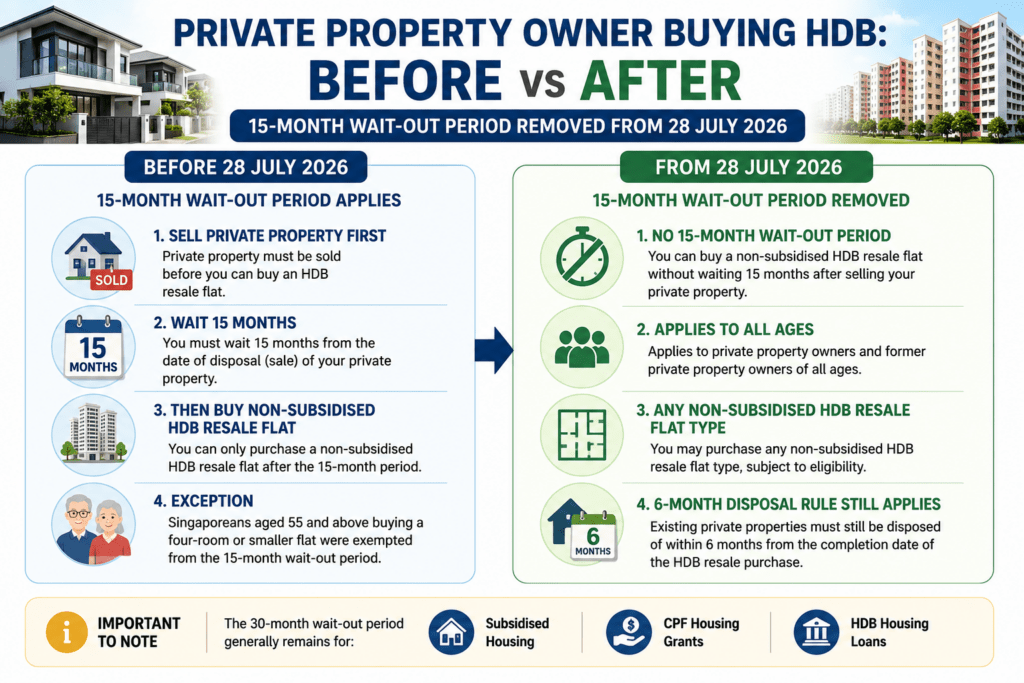
And in the opposite direction, there is a second rule that catches an entirely different group of people — former private property owners who want to move back into an HDB resale flat. They face the 15-month wait-out period, a rule introduced on 30 September 2022 that effectively freezes them out of the resale market for over a year.
This guide unpacks both. We'll walk through the ABSD rates for Singaporeans, PRs and foreigners, the six-month remission window that lets married couples buy first and sell later, and the practical sequencing playbook that determines whether you pay nothing, a little, or a genuinely life-altering amount of tax.
The Two Decisions That Cost Six Figures
Most property buyers in Singapore spend weeks agonising over which project, which floor, which facing, which district. They spend minutes on the question that can swing the cost of the transaction by a quarter of a million dollars: which transaction happens first.
There are really only three ways to move from one home to another:
- Sell first, buy later. You become temporarily homeless (or a tenant). Your ABSD bill is often zero.
- Buy first, sell later. You own two properties for a stretch. You pay ABSD upfront — and hope to claw it back.
- Sell and buy simultaneously. The ideal in theory, and the hardest to execute in practice, because HDB resale completions and private property completions run on different clocks.
Notice how much of that diagram is about timing, not about price. That's the whole point. ABSD is, functionally, a tax on transaction order.
How ABSD Actually Works in 2025
It's a count, not a history
The single most misunderstood feature of ABSD is that it is a point-in-time test. IRAS looks at the residential properties you own on the date you incur the liability — typically the date you exercise your Option to Purchase (for resale private property and HDB resale flats), or the date you sign the Agreement for Lease (for new launches and BTO flats).
Practical consequences:
- Past ownership is irrelevant. You can have owned five condos, sold them all, and made a fortune. If you own zero today, you buy at the first-property rate.
- A 1% share counts as a whole property. Joint ownership with a sibling, a parent, or a business partner still puts you on the tally. There is no "small share" exemption.
- Inherited property counts. If you inherited a share of a shophouse-adjacent residential unit, you are a property owner for ABSD purposes from the day the estate transfers it to you.
- Foreign property generally does not count toward the ABSD tally, which is based on Singapore residential properties. It does, however, matter enormously for HDB eligibility and for how banks compute your net worth and obligations.
- The liability crystallises early. ABSD is payable within 14 days of executing the document in Singapore (30 days if executed overseas). This is not a bill that waits for completion. It lands while you're still arranging your renovation.
Almost everything residential counts
The definition of "residential property" for ABSD is deliberately broad. It includes:
- HDB flats of every type
- Executive Condominiums (ECs)
- Private condominiums and apartments
- Landed homes — terraces, semi-detached, bungalows
- Strata-landed and cluster housing
- Mixed-use developments where the unit has a residential component
It does not include commercial shophouses (pure commercial), industrial property, or hotel units bought under specific schemes. This is why "buy commercial instead" is such a persistent piece of Singapore property folklore — and why the government periodically reviews the boundaries.
Who is "you"? Joint buyers and married couples
Where two or more people buy a residential property together, ABSD is generally charged at the highest rate applicable to any one of the buyers. This matters in mixed-status marriages, in parent-child purchases, and in any joint venture structure.
It also means the popular "just put it in my spouse's name" move is more complicated than it sounds. If the buying spouse owns nothing, they buy at the first-property rate — but the financing, CPF and legal consequences of single-name ownership (and of later "decoupling") can easily outweigh the stamp duty saved. Decoupling a private property involves a transfer of a legal share, which itself triggers Buyer's Stamp Duty, and possibly ABSD, depending on the transferee's profile.
ABSD Rates for Singaporeans, PRs and Foreigners
The current schedule took effect on 27 April 2023 and remains one of the most aggressive cooling measures Singapore has ever deployed. Rates are charged on the higher of the purchase price or market value.
| Buyer profile | 1st residential property | 2nd residential property | 3rd and subsequent |
|---|---|---|---|
| Singapore Citizen | 0% | 20% | 30% |
| Singapore PR | 5% | 30% | 35% |
| Foreigner (non-PR) | 60% | 60% | 60% |
| Entity / company | 65% | 65% | 65% |
| Trustee | 65% | 65% | 65% |
| Housing developer | 35% | — | — |
A few important footnotes:
- Nationals of certain countries with Free Trade Agreements — the United States, Iceland, Liechtenstein, Norway and Switzerland — receive the same ABSD treatment as Singapore Citizens for residential property purchases.
- The housing developer rate is 35%, of which a portion is remittable subject to conditions. It is designed to force developers to sell down inventory rather than sit on land.
- Trusts and entities face the flat 65% rate because the beneficial owner is opaque. There are limited remissions for certain trust structures.
ABSD Rate by Buyer Profile and Property Count (%)
The chart above makes the policy intent legible at a glance. The line between "Singapore Citizen" and "everyone else" is steep, and the line between "first home" and "second home" is a cliff.
To see how quickly this escalates over time, look at how the foreigner rate has moved since ABSD's introduction in December 2011.
ABSD Rate for Foreigners Buying Any Residential Property (%)
A 60% entry tax changes behaviour. At that rate, ABSD is not a deterrent so much as a prohibition — which is precisely the point.
ABSD stacks on top of BSD, not instead of it
This is where first-time buyers get blindsided. Buyer's Stamp Duty (BSD) applies to every property purchase, for every buyer profile, with no remission and no refund. It is charged on a tiered scale:
| Purchase price band | BSD rate |
|---|---|
| First $180,000 | 1% |
| Next $180,000 | 2% |
| Next $640,000 | 3% |
| Next $500,000 | 4% |
| Next $1,500,000 | 5% |
| Amount exceeding $3,000,000 | 6% |
So the full stamp duty bill on a $1.8 million condominium looks like this:
| Scenario | BSD | ABSD | Total stamp duty |
|---|---|---|---|
| SC, no other property | $59,600 | $0 | $59,600 |
| SC, 2nd property | $59,600 | $360,000 | $419,600 |
| SC, 3rd property | $59,600 | $540,000 | $599,600 |
| PR, 1st property | $59,600 | $90,000 | $149,600 |
| PR, 2nd property | $59,600 | $540,000 | $599,600 |
| Foreigner, any property | $59,600 | $1,080,000 | $1,139,600 |
Total Stamp Duty on a S$1.8m Condominium by Scenario (S$)
A Singaporean couple buying their second home before selling their first pays roughly seven times the stamp duty of a couple who sell first. That $360,000 difference is the entire conversation.
The Upgrade Maths: Selling Your HDB Before You Buy a Condo
Let's put this into a real HDB-upgrader scenario, because this is where the sequencing decision bites hardest.
Meet the Tans. They bought a 4-room BTO flat in Punggol in 2017 and have just cleared their five-year Minimum Occupation Period (MOP). The flat is worth around $650,000. They have about $300,000 in combined CPF Ordinary Account balances and savings, and a combined gross monthly income of $14,000. They want a $1.8 million resale condominium in a mature estate.
Route A: Sell first, then buy
- List the HDB flat. Assume it sells within two months at $650,000.
- Complete the HDB resale (HDB resale completions typically run about eight weeks from acceptance of the resale application).
- Move into temporary accommodation — renting at, say, $3,300/month for five months.
- Buy the condominium.
Cost: zero ABSD. Roughly $16,500 in rent, plus a double move and the emotional cost of living out of boxes. Total stamp duty: $59,600.
Route B: Buy first, then sell within six months
The Tans exercise the OTP on the condo while still owning the flat. Because they own a residential property at that moment, ABSD is charged at the second-property rate: 20%, or $360,000. This must be paid within 14 days.
If they are a married couple buying a replacement matrimonial home, they may qualify for the six-month ABSD remission — pay first, claim back after selling. But they must:
- Sell the HDB flat within six months of the condo purchase date (or within six months of the TOP/CSC date for an uncompleted unit, whichever is later);
- Meet IRAS's citizenship and ownership conditions for the remission;
- Fund the $360,000 from cash or CPF for however many months the process takes; and
- Not own any other residential property at the point of purchase.
Cost: $360,000 tied up temporarily, refunded later — assuming nothing slips. Total stamp duty if all goes well: $59,600. If the sale slips past the deadline: $419,600, permanently.
Route C: Buy first, sell never (or miss the window)
This is the scenario nobody plans for and everybody regrets. The HDB sale falls through, the buyer's HDB loan is delayed, the resale application runs into an issue — and the six-month clock runs out. IRAS is strict about the deadline. The $360,000 stays paid.
Cost: $419,600 in stamp duties, on top of the mortgage on a flat you didn't want to keep.
The financing sting you probably haven't considered
Here's the part most sequencing guides miss. Buying before selling doesn't just trigger ABSD — it also drops you down a loan-to-value (LTV) tier.
| Housing loan at the time of purchase | Max LTV (bank loan) | Minimum cash down payment |
|---|---|---|
| 1st housing loan | 75% | 5% of price |
| 2nd housing loan | 45% | 25% of price |
| 3rd housing loan | 35% | 25% of price |
If you buy the condo while your HDB mortgage is still outstanding, the bank may treat your new loan as a second housing loan — capping LTV at 45% and requiring 25% in cash on a $1.8 million purchase, which is $450,000 in cash. That is a different planet from a 5% cash requirement.
Sell first, fully discharge the HDB loan, and the new mortgage can be assessed as a first housing loan: 75% LTV, 5% cash.
For those using an HDB housing loan instead, the LTV is capped at 75% and the loan is stress-tested at an interest rate floor set by the authorities — so budget for a lower quantum than the headline suggests. Also note that on top of LTV, banks apply the Total Debt Servicing Ratio (TDSR) of 55% of gross monthly income across all property and non-property debt, and the Mortgage Servicing Ratio (MSR) of 30% applies to HDB flats and new ECs bought from developers.
The sell-first route is inconvenient. It is also, in most cases, worth roughly $300,000 to the Tans. Whether that's worth five months of rent is a personal question — but it should at least be an informed one.
The 15-Month Wait-Out Period, Explained
Now to the other half of the story, and the half that the headline rule is named after.
What it is
On 30 September 2022, the government introduced a 15-month wait-out period for private residential property owners and former owners. If you dispose of a private residential property on or after that date, you must wait 15 months from the date of disposal before you can buy a resale HDB flat.
That's it. That's the rule. But it lands like a hammer on a specific group: people who have sold a condominium, banked the proceeds, and want to right-size into a resale flat for retirement, for a lower monthly commitment, or simply for a different lifestyle.
Consider a realistic case. A 62-year-old sells his condominium for $2.2 million and completes the sale in March 2025. He wants a 4-room resale flat in Bedok. Under the rule, the earliest he can buy is June 2026. In the meantime, he rents, or moves in with family, or stays put. Fifteen months is a long time to be in limbo — and a long time for the resale flat he wanted to tick upward in price.
Why it exists
The measure was aimed squarely at the resale HDB market. Through 2021 and 2022, resale flat prices were climbing at a pace that alarmed policymakers, and a meaningful share of demand came from former private property owners flush with sale proceeds and able to pay above valuation — sometimes substantially above — in cash.
By imposing a 15-month cooling-off period, the government inserted friction between the sale of a private property and the purchase of a resale flat. The intent was to remove a lump of cash-rich demand from the resale market and let supply catch up.
What the 15-month rule does not do
It's worth being precise, because there's a common misconception that the 15-month wait applies to HDB owners upgrading to private property. It does not. There is no 15-month wait for a former HDB owner buying a condominium. The relevant constraints for that group are different:
- You must have met your five-year MOP before selling the flat.
- You face ABSD at the second-property rate if you buy before selling (or the remission route if you're a married couple replacing your home and you sell within six months).
- You face loan-tier and MSR/TDSR constraints depending on the order of transactions.
So if you're an HDB upgrader worried about a "15-month wait", relax — that rule isn't pointed at you. But if you're a private property owner thinking about buying a resale flat, it is the single most important number in your plan.
The 30-month rule, which is stricter still
For anyone who wants an HDB flat from HDB — a BTO, or a resale flat with a CPF Housing Grant — there is a longer clock. Private property owners and former owners must have disposed of their private residential property at least 30 months before they can apply.
That means the sequencing choice for a condo owner planning a BTO is roughly a two-and-a-half-year project, not a 15-month one. And note that the 30-month rule also affects eligibility for several housing grants, so it compounds.
The carve-out for older downsizers
The 15-month wait-out period drew sustained criticism from property agencies and from older Singaporeans who argued it penalised people doing exactly what policy ostensibly encourages: monetising a large private home and moving into a smaller, cheaper HDB flat.
Reportedly, the Ministry of National Development subsequently announced relief targeted at this group — an exemption for seniors aged 55 and above who sell their private property and buy a 4-room or smaller resale flat. Given how often policy parameters are adjusted, confirm the current status and the exact effective date directly with HDB before building a plan around it.
There are also limited avenues for appeal where there are extenuating circumstances, such as divorce, bankruptcy, or the administration of a deceased estate. These are considered case by case and are not a reliable planning assumption.
Timing Your Purchase: A Practical Playbook
Pulling the two rulebooks together, here is how the decision tree actually plays out for the main buyer groups.
For HDB upgraders moving to private property
Option 1 — Sell, rent, then buy. Cleanest from a tax and financing standpoint. Zero ABSD (as a Singapore Citizen first-property buyer), first-housing-loan LTV tier, no six-month deadline hanging over you. Cost: temporary rent and disruption. Watch out for CPF: when you sell your flat, the CPF principal you used plus accrued interest is refunded to your CPF Ordinary Account. That money is available for the next purchase, but it is not cash in hand, and if you're above 55 the refund rules interact with your retirement sum.
Option 2 — Buy first, sell within six months. Faster, more comfortable, and expensive if it slips. You need the $360,000 ABSD on a $1.8 million condo available in cash within 14 days of exercising the OTP. You need the sale to complete inside the window. And you should assume the bank will treat the new loan as a second housing loan in the interim, which can force a much larger cash down payment than you budgeted for.
Option 3 — Sell and buy back-to-back. Theoretically ideal. Practically, HDB resale completion timetables and private property completion timetables rarely align perfectly, and any delay on the HDB side pushes you into a rent-paying or bridging situation anyway.
For private property owners moving to HDB resale
The 15-month clock starts from the date of disposal — that is, legal completion of your private property sale, not the date you exercised the OTP or the date you received the money. Mark the date. Everything downstream depends on it.
If you're 55 or above and targeting a 4-room or smaller flat, check the current exemption status. If you're targeting a 5-room or Executive flat, or if you're below 55, plan for the full 15 months. And if you want a BTO or a resale flat with a CPF Housing Grant, plan for 30 months instead.
The bridging loan question
Some banks offer short-term bridging facilities to cover the gap between paying ABSD and receiving the remission refund. They are not always cheap, and they are not always available for this purpose. Treat them as a fallback, not a strategy.
A checklist before you commit
- Confirm your ABSD tier on the date of purchase, not on the date you first viewed the property.
- Check every co-owner's property count. A 1% share anywhere makes you a property owner.
- Price the cash requirement, not the loan quantum. The bank's valuation and your LTV tier determine how much cash you actually need on day one.
- Verify the remission conditions with IRAS in writing if you're relying on the six-month refund.
- Ring-fence your sale deadline with buffer. Six months is shorter than a contested resale transaction feels.
- Check the Seller's Stamp Duty position if you're selling within three years of buying — SSD runs at up to 12% on residential property held for one year or less, tapering to 8% and 4% in years two and three.
- Talk to a conveyancing lawyer before you sign anything. Stamp duty is assessed on documents, and documents are hard to unwrite.
Foreigners, PRs and the Long Game
For completeness, the foreigner picture deserves a paragraph of its own. A 60% ABSD on any residential property means a non-PR foreigner buying a $2 million condominium owes $1.2 million in additional stamp duty — before BSD. In practice, this has pushed most foreign demand into:
- Commercial and industrial property, which falls outside the residential ABSD net;
- Free Trade Agreement nationals — US, Icelandic, Liechtenstein, Norwegian and Swiss citizens are treated as Singapore Citizens for ABSD purposes;
- Rental, rather than ownership, for the duration of a posting; and
- Singapore Permanent Residence, where the first-property rate drops to 5%.
PRs sit in an interesting middle position. The 5% first-property rate makes settling down materially cheaper than it is for a foreigner, but the 30% second-property rate is steep enough that many PR families never buy a second home in Singapore at all — they upgrade instead, selling one to buy the next.
Food for Thought
-
If ABSD is fundamentally a tax on transaction order, what are we actually paying for? Not the property — that's the same either way. We're paying for the convenience of not moving twice. Is $360,000 the right price for six months of comfort?
-
Has the 15-month wait-out period achieved what it set out to do? It removed cash-rich downgraders from the resale market. But those sellers still need somewhere to live — so where did that capital go instead? Did it simply redirect demand into the private resale market, or into rental?
-
Should ABSD be calibrated on residency, or on how many homes you actually occupy? A Singaporean couple holding two properties pays 20%. A foreigner buying their only home pays 60%. Is residency the right proxy for the behaviour we're trying to discourage?
-
What does the sequencing tax do to life decisions? If upgrading requires you to rent for six months and downgrading requires you to wait 15, how many people simply... don't move? And what does that mean for the liquidity of the whole market?
-
If you're planning your "forever home" purchase at 55 and your first property at 35, does the order of your transactions matter more than the price you paid for either? For a great many Singaporean households, the honest answer is yes.
The Bottom Line
ABSD is one of the few taxes where the entire liability can hinge on a calendar date rather than a price. For a Singapore Citizen upgrading from HDB to condominium, the gap between selling first and buying first is roughly $360,000 on a $1.8 million home — plus a potential swing in your LTV tier and cash down payment requirement. For a private property owner moving into a resale flat, the gap between a clean purchase and a blocked one is 15 months, or 30 months if you're going after a BTO.
None of this is unknowable. The rules are published, the rates are fixed, and the deadlines are date-stamped. What makes sequencing hard is that it forces you to think about two transactions as one system — sale and purchase, cash flow and CPF, tax and financing — rather than as two separate decisions made weeks apart.