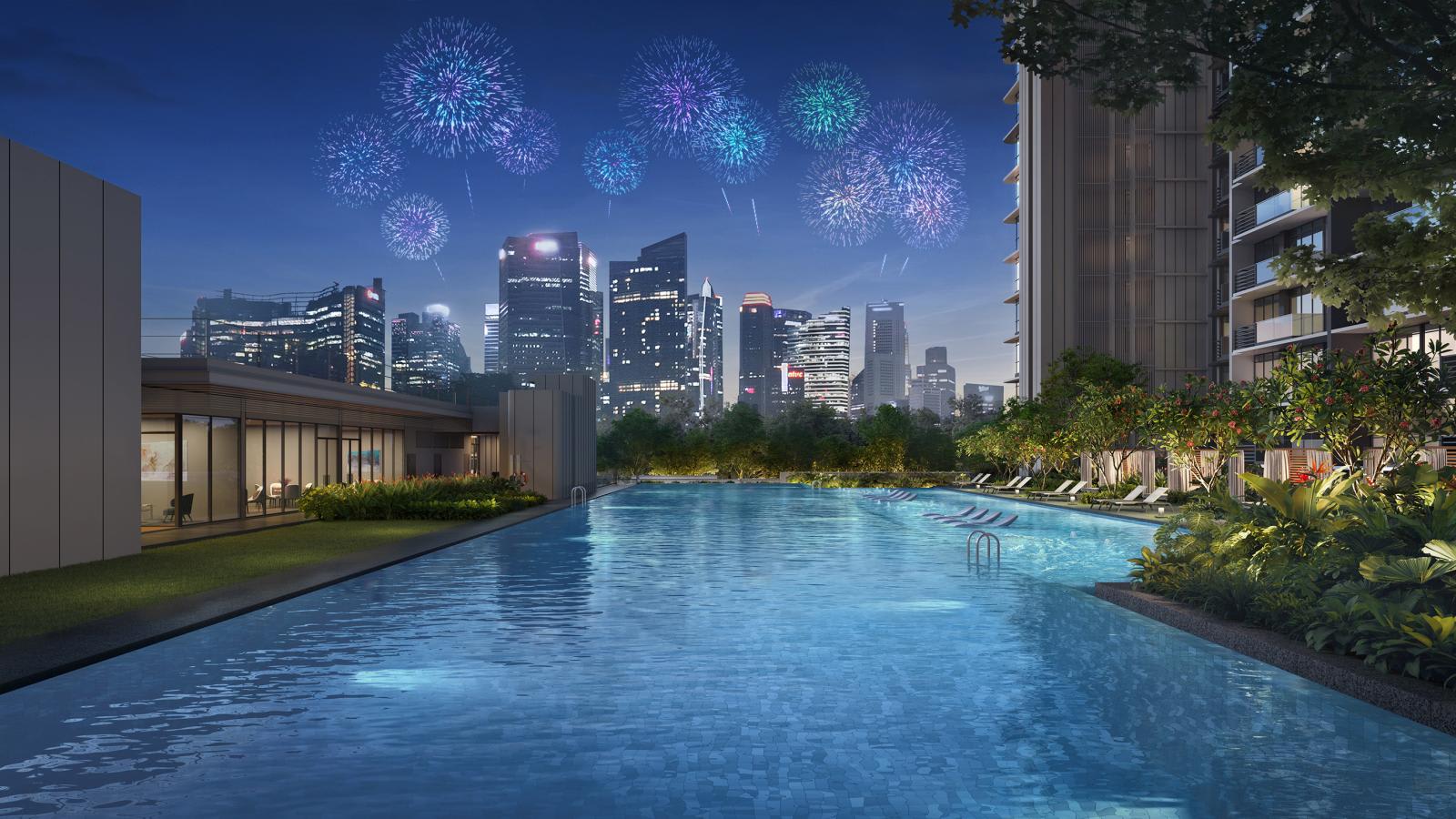
Imagine this: it is 7am on a Tuesday. You step out of your bedroom, the deck is still slick from last night's rain, and the CBD skyline is glinting across half a kilometre of open water. You have a coffee in one hand and absolutely no MRT crowd in your future.
Now the spreadsheet version: a berth fee that runs five figures a year, a 60% Additional Buyer's Stamp Duty bill if you hold the wrong passport, a haul-out every 18 months, an insurance premium pegged to hull value, and a marina waitlist that moves slower than the East Coast Parkway at 8am.
Both versions are true. Waterfront living in Singapore is one of the most romanticised and least accurately priced property categories in the country — partly because it is genuinely scarce, partly because most buyers conflate three very different things: a view of water, access to water, and the legal right to park a boat in it. Those three things cost wildly different amounts, and only one of them is protected by geography.
This piece unpacks the whole spectrum — from Sentosa Cove's private berths and the Libeskind towers at Keppel Bay, through the public waterway housing of Punggol and Pasir Ris, out to the Southern Islands and the long game being played along Singapore's southern coastline. And it asks the uncomfortable question the brochures never do: does the marina premium actually survive contact with the resale market?
The Maritime Backdrop: Why Waterfront Living Is Having a Moment
Singapore's relationship with the sea has always been economic before it was recreational. The republic is one of the world's busiest ports and the world's largest bunkering hub, with hundreds of thousands of vessel calls a year. For most of the city-state's history, "waterfront" meant cranes, containers and restricted-access terminals.
That is changing, and the change is structural rather than cosmetic.
The relocation of Singapore's city port terminals to Tuas is the single biggest urban-planning event of the coming two decades. As the Tanjong Pagar and Keppel terminals wind down — with Pasir Panjang following over the longer term — roughly 30 kilometres of prime southern coastline unlocks for redevelopment. The Urban Redevelopment Authority has signalled that the resulting Greater Southern Waterfront could eventually accommodate thousands of new homes, with a substantial public housing component — reportedly in the region of 9,000 units, the majority of them subsidised flats.
Alongside that, three other threads are pulling waterfront living into the mainstream:
- Long Island, a long-dated reclamation project off the East Coast, is being planned in tandem with coastal protection and could eventually host a new waterfront district, reportedly spanning several hundred hectares.
- Punggol Digital District and the Cross Island Line are converting Punggol from a remote north-eastern new town into a genuine waterfront-work-live proposition.
- The post-pandemic leisure boating boom pushed marina occupancy up globally, and Singapore's berth supply — measured in the low thousands across commercial marinas and sailing clubs — has not expanded meaningfully in years.
Put together, the pitch is simple: Singapore is about to have more water-facing real estate than at any point in its history, at the same moment that demand for lifestyle-led housing is rising. The catch is that not all of it is the same product.
The Three Tiers of Waterfront Living in Singapore
Before comparing prices, it helps to sort the market into three tiers. They behave like different asset classes, and confusing them is where most buyers go wrong.
| Tier | What you actually get | Representative examples | Typical tenure |
|---|---|---|---|
| Tier 1 — Berth at your door | A private or estate berth, direct water access, true marina lifestyle | Sentosa Cove waterway bungalows, Marina at Keppel Bay berth holders | Freehold / 99-year |
| Tier 2 — Water view and marina adjacency | Unobstructed or partial water views, walkable marina access, no guaranteed berth | Sentosa Cove condos, Reflections & Corals at Keppel Bay, Tanjong Rhu, Pebble Bay | Freehold / 99-year |
| Tier 3 — Waterway as amenity | Water is a landscaping feature, a park, a jogging route — not a mooring | Punggol Waterway, Punggol Northshore, Pasir Ris, Woodlands Waterfront | 99-year (HDB, EC, private) |
The premium you pay for each tier falls steeply as you move down the list. So, more importantly, does your exit liquidity. Here is the first decision point, laid out plainly:
Sentosa Cove: Singapore's Only Freehold Marina Address
Sentosa Cove is the outlier that defines the whole category. It is the only residential estate in Singapore where a non-citizen can buy a landed home — and only with approval from the Land Dealings (Approval) Unit under the Residential Property Act. Approval typically comes with conditions, including that the property is for owner-occupation rather than rental.
The estate was master-planned as an integrated waterfront community, with landed homes arranged along an internal waterway network so that many bungalows sit directly on the water with their own private berths. The rest of the inventory is condominium: The Oceanfront, Cape Royale, Seven Palms, Turquoise, The Coast, The Berth by the Cove, Marina Collection and the hotel-branded W Residences. Quayside Isle provides the retail spine, and ONE°15 Marina anchors the whole thing with club facilities and a large berth inventory.
What it costs
Indicative resale levels for Sentosa Cove condominiums have generally ranged from around S$1,700 to S$2,400 psf in recent years, depending on stack, view and age. Landed waterway bungalows are a different sport entirely — asking prices have commonly been quoted from the high teens of millions up past S$40 million for the best waterfront plots, with land-area pricing in the region of S$1,300 to S$1,800 psf on the plot itself.
For a foreign buyer, the arithmetic is brutal. At the 60% ABSD rate that applies to most foreign individuals, a S$25 million bungalow carries a S$15 million stamp duty bill before you have bought a single deck chair. That single line item explains why the Sentosa Cove landed market is dominated by Singaporeans, a handful of approved foreign families, and long-holding owners who bought before the current ABSD regime.
The hidden carry
The purchase price is only the entry ticket. Sentosa Cove owners also carry:
- Estate maintenance charges for the shared landscaping, waterway upkeep and security infrastructure, typically billed quarterly.
- Marina berth fees for those whose plots do not include a private berth, payable to ONE°15 or the estate operator.
- Island logistics — you are one bridge away from everything, which is charming until you need a plumber on a Saturday evening.
Sentosa Cove is, in effect, a small town with a gated mentality, an island address and a car-dependent daily rhythm. Buyers who love it, love it deeply. Buyers who buy it for the view alone often discover the practical friction later.
Marina at Keppel Bay: Leasehold with a Libeskind Skyline
If Sentosa Cove is the trophy, Keppel Bay is the sophisticated compromise — and arguably the better-designed piece of city.
The precinct is anchored by Reflections at Keppel Bay (1,129 units, completed around 2011), Corals at Keppel Bay (367 units, around 2016) and the older Caribbean at Keppel Bay (969 units, around 2004). Daniel Libeskind's twin glass towers at Reflections remain one of the most photographed residential silhouettes in Singapore, and the marina below holds a berth inventory widely cited at around 168 berths.
The trade-offs are clear and worth stating without varnish:
- Tenure is 99-year leasehold, typically counted from the early 2000s. That is a real difference in an asset class where freehold is the entire marketing argument elsewhere.
- Unit sizes at Reflections are large, which means the absolute quantum per transaction is high even when the psf is reasonable. A big three-bedroom can carry a headline price that feels like a penthouse elsewhere.
- Access is excellent — HarbourFront MRT, VivoCity, the Singapore Cruise Centre and the AYE are all close, which is more than can be said for Sentosa Cove.
- Marina day rates and long-term berth leases are separate from your maintenance fees. Buying a unit does not buy you a berth.
Indicatively, Reflections and Corals have transacted broadly in the S$1,900 to S$2,200 psf band in recent years, with Caribbean at Keppel Bay typically lower, in the S$1,600 to S$1,900 psf region. Keppel Land has also been progressively opening up the historic King's Dock as a public waterfront feature, which should deepen the precinct's appeal over time.
Tanjong Rhu and Kallang Basin: The City-Fringe Contender
The most underrated waterfront address in Singapore is not on Sentosa at all. The Tanjong Rhu stretch along the Kallang Basin — home to Pebble Bay, The Waterside, Costa Rhu, Concourse Skyline and Southbank — offers freehold and 99-year options with genuine water frontage, ten minutes from the CBD.
The opening of Tanjong Rhu MRT station on the Thomson-East Coast Line in 2024 materially improved the connectivity case, and the precinct sits directly adjacent to the Greater Southern Waterfront plans. If the southern coastline transforms over the next 15 to 20 years, Tanjong Rhu is the residential address that benefits earliest and most directly.
The catch: this is a narrow, low-supply strip of real estate. When a water-facing unit comes up, it prices accordingly, and the stock is dominated by older developments with larger floor plates.
Punggol Waterway and Pasir Ris: Public Waterfront Living at HDB Prices
Here is the part of the market most Singaporeans can actually access, and it is far more interesting than the "waterfront" label suggests.
Punggol
Punggol's transformation is the most complete in Singapore. The 4.2 km Punggol Waterway, opened in 2011, created a genuine waterside spine through a new town that had previously been a punchline. Around it: Waterway Point, the Punggol Waterway Park, Oasis Terraces, and a broadening of the town's housing mix from standard BTO blocks to the Northshore waterfront precinct, which includes projects such as Northshore Residences I & II, Northshore Cove and the Waterfront @ Northshore series.
Two further catalysts are not priced in everywhere yet:
- Punggol Digital District, with the Singapore Institute of Technology campus and JTC's business park, is converting the town into a genuine live-work cluster.
- The Cross Island Line Punggol Extension — with stations at Punggol, Riviera, Elias and Pasir Ris — is targeted for around 2032, which will connect Punggol's waterfront directly to Pasir Ris and, eventually, the east.
Indicatively, 4-room HDB resale flats in Punggol have been transacting around the S$600,000 mark in recent years, with newer waterfront-adjacent projects and 5-room units pushing higher. Private options on the waterway — Watertown above the mall being the obvious example — have transacted broadly in the S$1,550 to S$1,700 psf range.
Pasir Ris
Pasir Ris is Singapore's original seaside town, developed from the 1980s with a genuine beach, a mangrove boardwalk and one of the east's best-loved parks. The Cross Island Line will interchange with the East West Line at Pasir Ris, and the Punggol Extension will land there too, making it a future rail crossroads. Downtown East, Wild Wild Wet and the town centre provide the amenity base.
Private options are more affordable than the west or central districts: Coco Palms has traded indicatively in the S$1,400 to S$1,500 psf band, while older projects like Ripple Bay and Sea Esta sit lower. HDB 4-room resale flats in Pasir Ris have been transacting indicatively in the S$550,000 to S$600,000 range.
One caution worth flagging: Pasir Ris beach is not a swimming beach in the recreational sense, and water-quality advisories have been issued from time to time at certain stretches. Buy the lifestyle for the park, the cycling and the light, not for the snorkelling.
Indicative 4-Room HDB Resale Prices by Waterfront-Adjacent Town (S$)
Note the pattern in the chart above: Punggol and Pasir Ris are not trading at a dramatic premium to their non-waterfront neighbours. The water is a differentiator, but MRT lines, school proximity and mall access still do more heavy lifting in HDB pricing than a waterway view does.
Indicative Resale PSF by Waterfront Precinct (S$, rounded)
What a Marina Berth in Singapore Actually Costs
This is where the fantasy meets the invoice. Berthing in Singapore is quoted on a per-foot, per-month basis, and prices vary sharply by marina, tenure of the arrangement, and whether you are buying access via club membership or a berth lease.
Indicative Monthly Berth Fee for a 40-ft Boat (S$)
Those are indicative monthly figures for a 40-foot vessel on a typical annual contract. Add GST. Add utilities. Add the fact that popular marinas run waitlists, so "available" and "gettable" are not the same thing.
Beyond berthing, the ownership cost stack looks roughly like this:
Indicative Annual Cost Mix of a 40-ft Motor Yacht in Singapore
Some line items deserve translation:
- Insurance is typically priced as a percentage of hull value — commonly cited in the region of 1% to 2% per annum, higher for faster craft and longer-range cruising.
- Maintenance is the silent killer. Antifouling, engine servicing, teak, electronics, safety equipment and the periodic haul-out can plausibly consume 5% to 10% of the vessel's value each year.
- Fuel is diesel and depends entirely on how you use the boat. A lazy day around the Southern Islands and back might cost a few hundred dollars; a run to Tioman costs dramatically more.
- Depreciation is real. Mass-produced production boats depreciate materially in the first years; some premium brands and well-maintained classics hold value better, but a boat is not a property and should never be modelled as one.
Membership versus berth lease versus charter
There are three broad ways to get on the water in Singapore, and they are not equivalent:
- Buying gives total control. It also concentrates 100% of the cost, 100% of the depreciation and 100% of the maintenance headache on you.
- Club membership — at places such as ONE°15, Raffles Marina, the Republic of Singapore Yacht Club, the SAF Yacht Club and Changi Sailing Club — buys access and typically includes or discounts berthing. Entry fees vary enormously and secondary market transfers are common. Treat any quoted figure as indicative and verify current terms directly.
- Charter is the rational choice for anyone who actually sails or cruises a handful of times a year. A day charter with skipper is a rounding error against annual ownership costs.
And the liveaboard dream?
Be realistic: full-time liveaboard in Singapore is, in practice, extremely difficult. Most marinas permit only limited overnight stays rather than permanent residence, and there is no established framework in which a vessel is registered as a home address. There are also practical issues — pump-out facilities, shore power, mail, and what happens to your "home" during a haul-out.
If the dream is genuinely to live on the water, the more workable versions are: a waterway bungalow with its own berth at Sentosa Cove, a long-term berth lease paired with a nearby landed or condominium address, or basing the boat in Johor or Batam and treating Singapore as the mooring you commute from. Each has significant trade-offs, and none of them is the brochure version.
Does the Marina Lifestyle Premium Hold Up in Resale?
Now the question that matters to anyone with capital.
The honest answer is: partially, selectively, and with far more volatility than waterfront marketing implies.
Sentosa Cove is the clearest case study. The estate enjoyed a strong run through the late 2000s and early 2010s, when waterfront freehold was treated as an asset class in itself. It then went through a prolonged correction, with analysts repeatedly noting resale transactions at prices below what earlier buyers had paid. There have been high-profile loss-making exits. The market has recovered in phases since 2021 alongside the broader Singapore residential upswing, but the estate has not consistently outperformed the wider market, and transaction volumes remain thin.
Thin volume matters, because it cuts both ways: with only a handful of comparable transactions per quarter, indices can swing sharply on the mix of what happened to sell, and buyers have very little pricing anchor.
Keppel Bay tells a different story. Reflections and Corals have traded consistently, helped by strong fundamentals — location, MRT access, architectural profile, a broad tenant pool — rather than by the marina itself. The berth is a nice-to-have, not the thesis.
Punggol and Pasir Ris show almost the inverse. The water is a genuine lifestyle amenity and a defensible differentiator between competing blocks in the same town, but it does not override fundamentals. A 99-year flat's price is driven by its lease age, floor level, distance to MRT, and whether the mall is walkable — not by whether you can see a canal.
The structural bull and bear case, side by side
| Argument | Bull case for the premium | Bear case against the premium |
|---|---|---|
| Supply | Freehold waterfront is effectively unreplicable; the government is not creating more of it | Thousands of new water-adjacent homes are coming at the Greater Southern Waterfront and Long Island |
| Liquidity | Scarcity supports long-term land value | Thin transaction volumes mean slow, uncertain exits |
| Tenure | Sentosa Cove freehold has no lease decay | Keppel Bay, Punggol and Pasir Ris all carry 99-year clocks |
| Cost of carry | A berth-and-view lifestyle has real utility value | Berth fees, maintenance and estate charges are pure cost, not capital |
| Buyer pool | Foreign demand is theoretically deep | 60% ABSD has narrowed that pool to a sliver |
The verdict, from a pure data standpoint: the water view is a real amenity premium, but a modest and unstable one. The berth is a lifestyle expense, not an investment. Anyone underwriting a waterfront purchase as an outperforming asset is running a thesis that the last decade of Sentosa Cove transactions does not obviously support.
Leasehold Versus Freehold at the Water's Edge
This is the trade-off that decides most purchases:
| Factor | Freehold waterfront (e.g. Sentosa Cove, Pebble Bay) | 99-year waterfront (e.g. Keppel Bay, Punggol, Pasir Ris) |
|---|---|---|
| Entry price | Highest | Materially lower |
| Foreign ownership | Landed possible at Sentosa Cove with LDAU approval; condos open to foreigners at 60% ABSD | Condos open to foreigners at 60% ABSD; landed restricted |
| Financing over time | No lease-decay constraint | Banks tighten lending as the lease runs down; very old leases can become unfinanceable |
| En bloc potential | Rare for landed; possible for condos | Possible where the site is not land-scarce |
| Maintenance risk | Shared estate charges can rise | Same, plus the risk of major cyclical works on an ageing building |
| Exit buyer pool | Narrow but wealthy | Broader, but price-sensitive |
The rule of thumb worth internalising: a freehold waterfront property with a mediocre view usually beats a leasehold waterfront property with a spectacular one. Tenure is a 100-year variable; the view is what you see from your balcony, and it can be built out, blocked, or replaced by a construction crane for the next five years.
The Long Game: Southern Islands, Long Island and What's Coming
Singaporeans often ask whether the Southern Islands — St John's, Lazarus, Kusu, Sisters' Islands — could one day become residential addresses. The current answer is no, and there is no signal that this will change. The direction of travel is the opposite: these islands are being positioned as eco-tourism and recreation destinations, with coastal park enhancements and limited visitor infrastructure rather than housing.
The housing story is happening on the mainland coast instead:
The implications for buyers are worth thinking through carefully:
- Near-term (2025–2030): Tanjong Rhu and the city-fringe waterfront gain most from GSW anticipation and transport improvements. Punggol benefits from the digital district.
- Medium-term (2030–2035): Cross Island Line connectivity reshapes the relative value of Punggol, Pasir Ris and Elias. Waterfront-adjacent HDB flats in these towns should see the amenity premium reinforced.
- Long-term (2040s and beyond): The Greater Southern Waterfront delivers new supply to the market — and if a majority of that is public housing, the "waterfront premium" narrative becomes far more widely distributed and considerably less exclusive.
That last point is the most under-discussed in Singapore property. If tens of thousands of Singaporeans eventually live on the southern waterfront in subsidised flats, "waterfront living" stops being a luxury category and starts being infrastructure.
Who Should Actually Buy What
| Buyer profile | Sensible play | Why |
|---|---|---|
| First-timer, budget under S$700k | Punggol or Pasir Ris BTO/resale | Waterway amenity without a waterfront premium |
| Upgrader, S$1.5m–S$2.5m | Watertown Punggol, or Pasir Ris private | Waterway living with MRT and mall fundamentals |
| Affluent professional, S$3m–S$5m | Reflections or Corals at Keppel Bay | Marina adjacency, city access, better liquidity |
| Freehold purist | Tanjong Rhu / Pebble Bay, or Sentosa Cove condo | Tenure protection, GSW upside |
| UHNW with a boat | Sentosa Cove waterway bungalow | The only real private-berth landed product in Singapore |
| Casual boater | Club membership or charter | Avoid berth fees, depreciation and haul-out pain |
Food for Thought
-
If freehold waterfront is genuinely irreplaceable, why has Sentosa Cove struggled to outperform for a decade? Is the scarcity story real, or just a story about a market too thin to price itself efficiently?
-
What happens to the marina premium when the Greater Southern Waterfront delivers thousands of water-adjacent homes — many of them below market rate? Does exclusivity survive mass supply of the amenity, even if the address is different?
-
Would you rather own a berth or a view? A berth has an operating cost and no resale index. A view has no operating cost and no legal protection. Which one would you underwrite?
-
Is the real bottleneck Singapore's berths, not its waterfront homes? If total marina berth capacity cannot expand easily, the scarce asset may be the water access itself — and that is not something property ownership solves.
-
If you stripped the word "waterfront" out of a development's marketing, would you still pay the price? That is the cleanest test of whether you are buying an amenity or a narrative.
The Bottom Line
Waterfront living in Singapore spans an enormous range: a S$600,000 four-room flat beside the Punggol Waterway, a S$2,000 psf leasehold tower above a Libeskind marina, and a S$30 million freehold bungalow with a boat parked outside the living room. They share a word and very little else.
The data-driven read is this: water is a genuine amenity premium, but a fragile investment thesis. It holds best where it rides on top of strong fundamentals — MRT, tenure, building quality, district momentum — and worst where it is asked to carry the valuation alone. Sentosa Cove's decade of underperformance is the cautionary tale; Keppel Bay's steady trading is the corrective; Punggol's quiet rise is the reminder that in Singapore, connectivity usually beats scenery.
And if you are buying for the boat rather than the balcony, remember that you are underwriting two assets: a property with a resale market, and a vessel with a berth fee. Only one of them is indexed by URA.