A three-room flat in an older estate, listed at $438,000. Sixteenth floor, corner unit, seven minutes' walk to an MRT station. Across the road, on the ground floor of a neighbouring block, sits a KFC with a queue at 6pm.
"Got KFC downstairs, very convenient," the agent says. "Can add a bit."
That "bit" is the question this article tries to answer. In a market where HDB resale prices moved by double digits in 2021 and again in 2024, buyers are hungry for any edge — and amenity talk has become the lingua franca of the viewing. A neighbourhood McDonald's, a KFC, a food court, a 24-hour supermarket: these are the phrases that get sprinkled through listings and WhatsApp broadcasts.
But does an anchor like a fast-food outlet actually show up in transaction prices? And if it does, by how much — 2%? 8%? Or is the number so small that a good renovation and a south-facing unit would swamp it?
The honest answer, based on how appraisers and analysts decompose HDB resale prices, is that the anchor effect is real but modest — typically in the low single digits, not the double digits that listing copy implies. More importantly, the anchor is usually a proxy for something bigger: the health of the commercial node it sits in. Understanding that distinction is what separates a buyer who pays for convenience from one who pays for a story.
Why "Near KFC" Became a Selling Point in Singapore's HDB Resale Market
The amenity premium story, in one paragraph
Singapore's HDB resale market is not a free-for-all. Prices are bounded on one side by the BTO pipeline (why pay $600,000 resale when a new flat two MRT stops away is cheaper, if you're willing to wait?) and on the other by income ceilings, loan-to-value limits, the Mortgage Servicing Ratio, and CPF usage rules that thin out for flats with shorter remaining leases. Within that band, price differences between blocks come down to a fairly short list of structural factors — and amenities are the residual on top.
That residual is where agent narratives live. And of all the amenities, food is the one every buyer experiences daily. You can ignore a bad school catchment if you have no children. You cannot ignore lunch.
What buyers are actually paying for
When a buyer pays a premium for "near KFC", they are rarely paying for the brand. Chicken is available everywhere. What they are underwriting is a bundle:
- Walkability to a functioning commercial node — a place where you can buy dinner, top up your groceries, and pick up a parcel without taking a bus
- Extended operating hours — fast-food outlets keep the node lit and active past 10pm, when most HDB shops shutter
- Footfall that sustains other tenants — the moneylender, the bakery, the clinic, the bubble tea shop all depend on traffic the anchor generates
- A perception of safety and activity — a lit, populated ground floor at night changes how a neighbourhood feels to walk through
None of these are trivial. All of them are already captured, at least partially, by the price of flats in the area. The question is how much of the bundle remains unpriced.
What Actually Moves HDB Resale Prices — and Why Anchors Are the Last Slice
The structural factors that come first
Before you can isolate an amenity premium, you have to account for everything that isn't an amenity. In practice, a hedonic model of HDB resale prices — the kind appraisers and analysts use — controls for:
| Factor | Why it dominates | How much control a buyer has |
|---|---|---|
| Remaining lease | Directly affects CPF usage, loan tenure, and buyer pool; the single biggest non-location variable | Total — you choose the lease profile |
| Flat type and floor area | 3-room vs 4-room vs 5-room vs Executive sets the price band | Total |
| Floor level within block | Higher floors commonly command a premium; views and noise both change with height | Total |
| Town / planning area | Captures jobs access, school density, and mature-estate scarcity | Total |
| MRT and LRT proximity | Consistently the strongest single amenity signal in published analyses | Total |
| Transaction timing | The market moved a lot between 2021 and 2024 — two flats sold 18 months apart are not comparable | None |
| Renovation condition | Real money, but it depreciates fast | Partial |
| Ethnic Integration Policy / SPR quota | Can shrink your buyer pool overnight | None |
| Amenity density (incl. F&B anchors) | The residual — the thing this article is about | None |
The practical implication is uncomfortable for anyone hoping for a big number: by the time you've controlled for lease, floor, type, town, MRT distance and timing, there isn't much unexplained variance left for a fried chicken outlet to occupy.
Putting the market backdrop in perspective
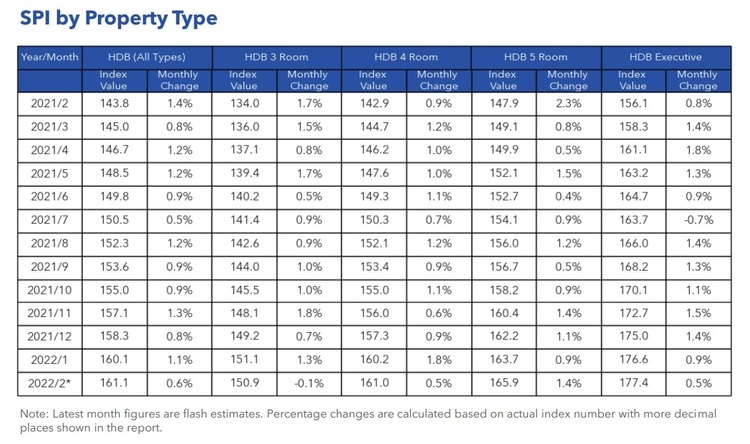
Singapore's HDB resale market has been volatile. According to HDB's Resale Price Index, annual changes over the last four years looked like this:
HDB Resale Price Index: Annual Change (%)
That context matters enormously. If the market itself swung from roughly +12.7% in 2021 to +4.9% in 2023 and back up to about +9.7% in 2024, then a two-to-three percent amenity effect is well inside the noise of a single year's market movement. A buyer who overpays 8% for "KFC downstairs" in a year when their town only rose 3% has effectively paid the premium twice.
The residual: where amenities live
Think of it as a layering:
The bottom box is thin. It is not zero — but it is the smallest slice of the stack, and it is the one most often sold as though it were the whole pie.
Anatomy of an Anchor: What a KFC or McDonald's Actually Brings to an HDB Block
The footfall flywheel
The reason a fast-food outlet matters is not the outlet itself. It's what the outlet does to the rest of the commercial cluster. HDB neighbourhood centres are fragile ecosystems: a single vacancy can cascade when the coffee shop loses traffic and the provision shop follows. An anchor tenant with national marketing, delivery integration and extended hours acts as a stabiliser.
That loop is the real mechanism. A KFC does not lift prices because people love chicken; it lifts prices because it keeps the rest of the cluster alive, and a live cluster is what buyers actually value.
The security and lighting dividend
One underrated effect: extended-hours operators change the evening character of a void deck. In older estates, an empty commercial row after 9pm feels very different from one with lit signage, staff, and delivery riders. Residents consistently report this in qualitative terms — and it can translate into a genuine, if small, willingness to pay.
The disamenity ledger
But every anchor comes with a ledger of costs, and these are the ones buyers underweight at the viewing:
- Extractor fan and compressor noise — low-frequency, constant, worst at night when ambient noise drops
- Cooking smell — usually fine at 200m, noticeable at 50m, unavoidable directly above
- Delivery rider traffic — scooters idling, headlights sweeping across lower-floor windows
- Litter and pest pressure — concentrated around bin centres serving the outlet
- Crowding at peak hours — lunchtime and 6-9pm congestion at the lift lobby and walkways
- Parking displacement — short-term parking churn that affects residents and visitors alike
For flats on the lowest floors of the nearest stack, the net effect of an anchor can be negative. This is the single most overlooked point in the "amenity premium" conversation.
The KFC Test: A 5-Point Framework for Buyers
Here is a practical way to run the analysis on any specific flat.
1. Node depth (not anchor presence)
Ask: how many other reasons are there to walk to this node? A single fast-food outlet in an otherwise dead row is worth far less than the same outlet inside a cluster with a supermarket, clinic, bakery and food court. Measure node depth by counting functional destinations within a 300m walk — not by counting brands.
2. The nuisance gradient
Walk the corridor at 11pm and again at 7am. Listen, and smell. The disamenity gradient in HDB blocks is steep: identical stacks 40m apart can differ meaningfully in liveability, and the market knows it. If you're buying in the nearest stack, you should be discounting against comparable flats further away, not paying up.
3. Stack position and height
Lower floors nearest the anchor absorb most of the noise and smell. Higher floors directly above sometimes get the best of both — convenience without the ground-level problems — though they may still catch exhaust plumes depending on wind direction and the position of the riser.
4. Anchor durability
Will the tenant still be there in ten years? A neighbourhood with a single anchor is exposed to that anchor's lease renewal. A node with several anchors of different categories is structurally more resilient. This is why "how many anchors" beats "which anchor".
5. Comparables discipline
This is the part most buyers skip. To isolate the amenity effect, pull recent transactions for flats matched on:
- Same town or adjacent block cluster
- Same flat type and approximate floor area
- Similar floor range (low / mid / high)
- Similar remaining lease band
- Sold within the last 6-9 months
- Comparable distance-to-MRT band
Only then compare the ones inside versus outside the node. If the difference is under 3%, the "KFC premium" is either already in your asking price or too small to negotiate around.
What the Premium Actually Looks Like: Single Digits, Not Double
The realistic range
Amenity premiums in HDB resale are consistently smaller than in private condominiums, for structural reasons we'll come to. Broadly, here's how the layers stack up in industry analyses and appraiser practice:
| Amenity layer | Typical influence on HDB resale price | Notes |
|---|---|---|
| MRT/LRT within a short walk | The largest single amenity factor | Widely cited as the dominant accessibility signal |
| Major mall / town centre | Meaningful but secondary | Overlaps heavily with MRT proximity |
| School within 1km, popular | Small but persistent | Buyer-pool effect, not universal |
| Neighbourhood centre with supermarket | Small | Partially captured by "amenity density" |
| F&B anchor (fast food, food court) | Low single digits at most | Only a fraction is unpriced |
| Park / waterfront adjacency | Variable, sometimes significant | Highly view-dependent |
| Hawker centre within short walk | Small, culturally weighted | Strong for older buyers |
These are indicative ranges, not precise estimates — any specific block can sit outside them. The direction is consistent, however: food anchors are the smallest meaningful line item in the stack.
What a few percent is actually worth
Percentages feel abstract until you convert them. Here's what a 3% premium translates to at different price points:
Illustrative Dollar Value of a 3% Amenity Premium by Flat Price
This chart is illustrative arithmetic — it applies a 3% uplift to a range of flat prices to show magnitude, not a measured effect from any specific block. The point stands: at $15,000 to $25,000, the premium is real money. It is also roughly the cost of a decent renovation, a service yard upgrade, or two years of mortgage interest. That's the scale you're actually negotiating over.
Why it can never be double digits for an HDB flat
There are hard ceilings on amenity pricing in the HDB market:
- The BTO ceiling. New flats are priced with a subsidy and are the marginal alternative. If resale prices in a town run too far ahead of the BTO price plus wait, buyers switch. Wait time is the price of the discount.
- Income ceilings and loan limits. The Mortgage Servicing Ratio caps how much of a borrower's income can go to housing. Buyers simply cannot stretch indefinitely for a nicer node.
- CPF and lease mechanics. For flats with shrinking leases, CPF usage thins, loan tenures shorten, and buyer pools narrow — this typically overwhelms any amenity effect.
- Supply within a town. HDB towns are large. Amenity access is rarely a monopoly. If Block A is near the food court, Blocks B, C and D are a five-minute walk away and compete for the same buyer.
- Repeat-sales evidence. When analysts run repeat-sales comparisons — the same unit before and after an amenity arrives — the measured uplift tends to be modest, and often statistically weak once timing is controlled for.
The last point is the most important and the most testable. If you want to know whether the KFC effect is real in your specific block, look for a repeat sale: the same unit transacted before and after the anchor opened, and compared against a control block that got no new amenity.
Where the KFC Premium Is Real — and Where It's Already in the Price
Already priced in: mature towns
In mature estates with dense existing amenity — think established town centres with malls, markets and multiple F&B clusters — a new fast-food outlet changes very little. The node was already deep. The marginal anchor is just another shop in a busy row, and the price of flats there already reflects a mature, convenient environment.
If an agent is asking you to pay up for "now got McDonald's" in a town that had twenty eating options before, you are being sold a refurbishment, not an amenity.
Genuinely incremental: newer estates with a thin base
The opposite case is where the effect is largest in relative terms. In newer non-mature estates where residents have historically had to travel for basic F&B, the arrival of the first serious commercial cluster — supermarket, food court, fast-food anchor — represents a genuine step change in daily life. That does show up in prices, though again as a node effect rather than a brand effect, and usually in the low single digits.
The nuance buyers miss: in these estates the increment is often already being priced in before the shops open, because everyone can see the hoarding and the render. By the time the KFC is serving chicken, the smart money has transacted.
The anchor lifecycle
Understanding where you are on this timeline is worth more than any scoring exercise. Buying at Year 1 means paying for hype. Buying at Year 3 means paying for a baseline that everyone now takes for granted — which is usually the better trade, because the hype premium has bled out.
The first-anchor effect and second-anchor dilution
Two patterns recur:
- First anchor effect. The first fast-food outlet in a previously under-served cluster tends to generate the largest observable change in footfall — and, arguably, the largest price effect. It converts a dead row into a destination.
- Anchor dilution. The second and third anchors add convenience but not proportionally to value. The node is already established; additional outlets mostly redistribute existing footfall. Price effects tend to flatten quickly.
This is a strong argument for buying near emerging nodes rather than saturated ones — but only if you're patient enough to hold through the flat part of the curve.
The Other Side of the Counter: What Living Above the Golden Arches Feels Like
Noise
Extractor fans and rooftop compressors run continuously. In HDB blocks where the commercial podium shares a structure with residential floors, low-frequency noise transmits through the building far more effectively than airborne noise. Bedroom windows on the affected side are effectively unusable at night for light sleepers.
Smell and exhaust
Cooking exhaust is usually directed upward and away, but wind direction, building geometry, and riser placement all matter. Visit on a still, humid evening — that's when the plume sits rather than disperses. If you can smell it from the corridor at 8pm, you will smell it from your kitchen.
Pest and litter
Commercial refuse attracts pests. The relevant question is not whether the outlet generates waste, but how the bin centre is managed — enclosed, chilled, and located away from residential stacks, or open and adjacent. This is visible on inspection and rarely mentioned in listings.
Crowds and parking
A popular anchor generates short-duration vehicle traffic: delivery riders, Grab pickups, patrons circling for lots. In estates with limited surface parking, this displaces residents. It is a small daily friction that accumulates into a real quality-of-life cost.
The 11pm test
If you take one thing from this article, take this: visit the flat at 11pm on a Friday. Stand in the corridor, stand in the master bedroom with the window open, and stand at the lift lobby. Everything the brochure calls "vibrant" reveals its true character after dark. Most buyers never do this. It is the cheapest due diligence available.
How to Run the KFC Test Yourself: A Due Diligence Checklist
Before the viewing
- Pull the last 12 months of transactions for the block and two comparable blocks without the node
- Filter to same flat type, similar floor range, similar remaining lease band, transactions within 9 months
- Note the distance from each block to MRT/LRT — the biggest confounder
- Check whether the anchor is on a fresh lease or a renewal cycle
At the viewing
- Walk the full route from the flat to the node at 8am, 3pm, and 11pm
- Stand directly under the exhaust riser
- Check the bin centre: enclosed? away from residential stacks?
- Ask residents in the lift — the fastest source of truth in Singapore
In the negotiation
- If the asking price implies more than a low-single-digit premium over matched comparables, ask what it's for
- If the flat is in the nearest stack to the anchor, argue the nuisance gradient and anchor to comparable flats further away
- Remember that condition, floor level and remaining lease are all more negotiable and more durable than amenity narrative
Food for Thought
-
If an anchor's value comes from keeping other shops alive, what happens when the node's ownership changes or a mall undergoes redevelopment? Does the premium you paid survive a two-year closure of the cluster?
-
Is the "convenience premium" a premium at all, or simply the absence of a discount? In estates where a node has existed for thirty years, buyers may not be paying extra for access — they may only be penalised for not having it.
-
How much of the amenity effect is actually a buyer-pool effect? A convenient node attracts a broader set of buyers, including those without cars. Is the price uplift simply the market clearing at a higher demand curve, rather than a genuine "value" for the existing resident?
-
Would you rather pay 3% more for a node you'll use weekly, or 3% less for a flat with a better floor and a fresher lease? Which of those depreciates faster over a 25-year hold?
-
If everyone can see the hoarding, who is left to sell the hype to? When an anchor's arrival is public knowledge years in advance, at what point does the market price it in completely — and leave nothing for the late buyer?
The Bottom Line
The KFC test is real, but it is not a jackpot. A fast-food anchor in an HDB neighbourhood is a useful signal — of node health, of daily convenience, of evening activity — and it can carry a genuine premium in the low single digits, especially in newer estates with a thin amenity base. In mature towns, it is almost entirely priced in already. And in the nearest stack, the disamenity ledger can flip the whole calculation negative.
Buyers who do well in this market are not the ones who spot the golden arches. They are the ones who control for the things that actually move the number — remaining lease, floor level, flat type, MRT distance, transaction timing — and then treat amenities as a small, negotiable residual on top.