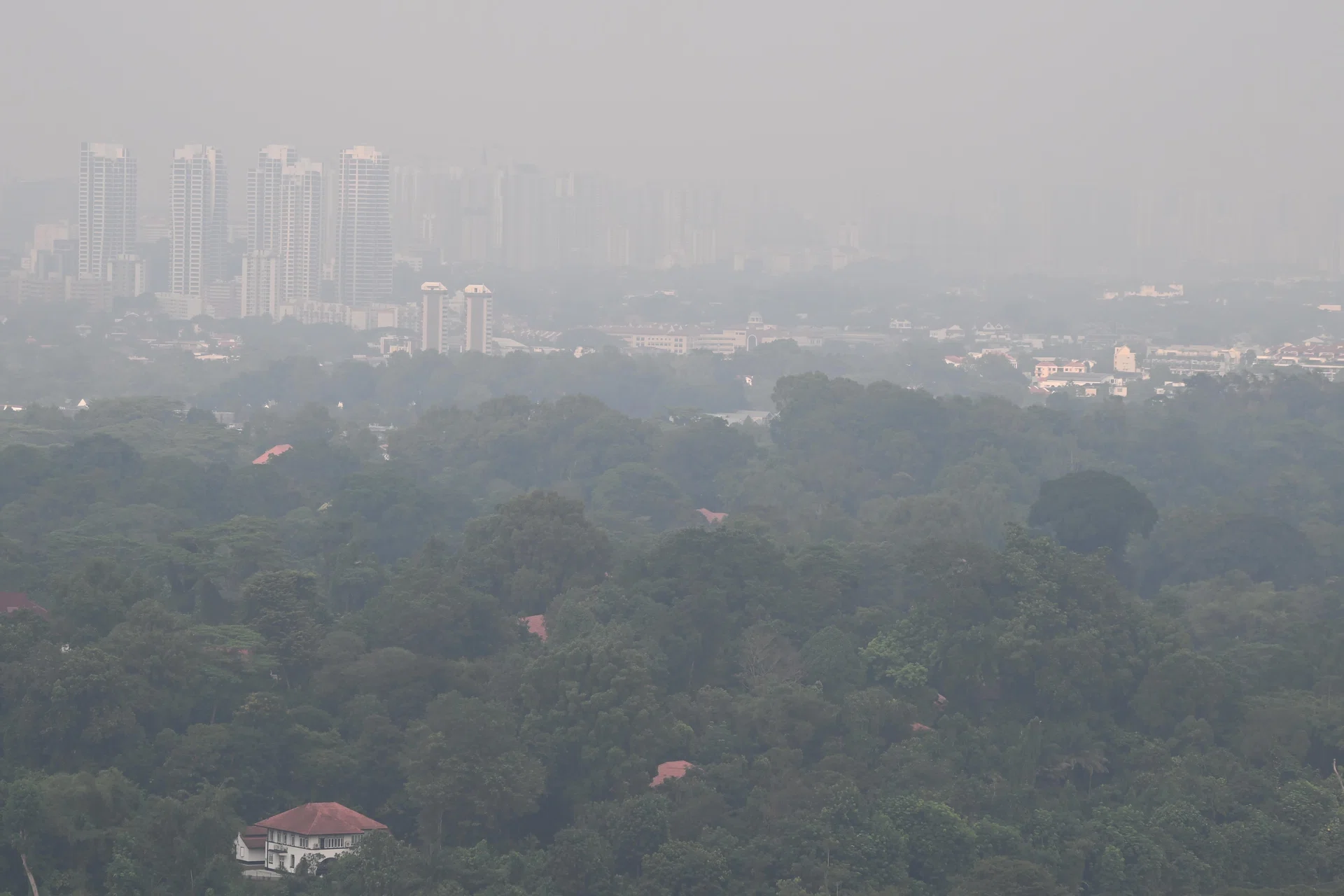
Every few years, Singapore wakes up to a sky the colour of wet newspaper. The 3-hour PSI climbs past 400, N95 masks sell out, schools close, and the island's most photographed skyline disappears behind a grey veil. Then the rain comes, the wind shifts, and within a fortnight everyone goes back to arguing about COE prices.
But in the middle of that fortnight, thousands of people are still going about the business of buying and selling homes. They are standing in living rooms with the windows shut, squinting at a "sea view" that looks like frosted glass, and quietly wondering: does any of this actually show up in the price I'm paying?
That is the question this piece tries to answer. We're looking at the haze and the Singapore property market — whether proximity to green space, a high floor, or a genuinely well-ventilated unit commands a premium when the air turns bad, whether buyers really pay a clean air premium, and whether haze season quietly shifts the balance of negotiating power between buyers and sellers. The short version: the premium is real, but it's almost certainly not for the reason most buyers think.
Haze Season and the Singapore Property Market: The Basics
Start with the physical facts, because they shape the economics.
Singapore's haze season typically runs from June to October, driven by the southwest monsoon. During that window, farmers and plantation operators in Sumatra and Kalimantan use fire to clear land, and prevailing winds carry the resulting smoke — fine particulate matter, largely PM2.5 — across the Strait of Malacca. The Meteorological Service Singapore and NEA monitor hotspot counts and wind patterns throughout the season, and the episodes are worse in El Niño years, when rainfall in the region drops and the fires burn longer. That is why 1997 and 2015 — both strong El Niño years — produced the two worst haze events on record.
The severity of any episode is communicated through the Pollutant Standards Index (PSI), a 24-hour average that NEA publishes, alongside a faster-moving 3-hour reading that captures sudden spikes.
| PSI Range | Descriptor | Public Health Advisory |
|---|---|---|
| 0–50 | Good | Normal activities |
| 51–100 | Moderate | Normal activities |
| 101–200 | Unhealthy | Reduce prolonged or strenuous outdoor exertion |
| 201–300 | Very Unhealthy | Avoid outdoor exertion; N95 masks advised for those who must go outside |
| 301–500 | Hazardous | Stay indoors; public advisories and possible school closures |
To put the worst episodes in context:
Peak 24-Hour PSI During Major Regional Haze Episodes
In June 2013, the 3-hour PSI hit 401 — a record — and the 24-hour reading peaked at 246. Pharmacies ran out of N95 masks, the government convened a crisis committee, and the episode became a genuine national conversation about transboundary pollution. In September 2015, the 24-hour PSI reached 341, the highest on record, and the Ministry of Education closed primary and secondary schools for a day.
That 2014 passing of the Transboundary Haze Pollution Act was in part a political response to how exposed Singaporeans realised they were.
So: haze is not a fringe concern. It is a recurring, foreseeable, nationally disruptive event. The obvious next question is whether that disruption leaves a fingerprint on property prices.
Why the Data Says "Probably Not Much" — And Why That's Interesting
Property markets capitalise permanent, visible, locally differentiated characteristics. That's why an unblocked sea view, a 5-minute walk to an MRT interchange, or a 99-year versus 999-year lease all move prices reliably. Each of those characteristics is:
- Persistent — it doesn't disappear for nine months of the year
- Visible — a buyer can see it in a 15-minute viewing
- Local — it varies from block to block, so buyers can actually choose between them
Haze fails all three tests.
It isn't persistent. A bad episode lasts days to a few weeks. Even a severe season is measured in weeks, not years.
It isn't local. When the southwest monsoon carries PM2.5 across the island, the difference in outdoor air quality between a flat in Punggol and a bungalow in Bukit Timah is measured in small percentages, not multiples. Regional haze is a city-wide event. There is no clean side of Singapore on 24 September 2015.
It isn't visible at the point of transaction. Resale transactions in Singapore are priced at the option stage, and completion typically follows 8 to 12 weeks later. A deal inked in a clear week of May closes during a hazy fortnight in August — or vice versa. The pricing decision and the haze event are rarely in the same room.
That combination — short, island-wide, and out of sync with transaction timing — is exactly the profile of a risk that markets under-price. Which cuts both ways. It means buyers today probably aren't paying a haze premium. It also means sellers probably aren't offering a haze discount. The risk sits unallocated between them.
What Actually Determines the Air Inside Your Home
If regional haze is a city-wide event, where does genuine variation in indoor air quality come from? This is where the conversation usually gets muddled, because buyers conflate outdoor air quality with indoor air quality and then assume the two are a function of address.
They aren't.
The diagram above shows the key point: haze is the input, but what a homeowner actually experiences is indoor air quality, and that is filtered through the building as much as the location.
The Fixed Factors You Can't Change
Some of the variation is genuinely baked into the property:
- Orientation and prevailing wind. Units that catch the southwest monsoon directly will, with windows open, pull in more outdoor air — which is a blessing in a clean week and a liability in a hazy one. Cross-ventilated corner units that flush hot air quickly in March may be the ones you're sealing shut in September.
- Local emission sources. Traffic corridors, industrial estates, and active construction sites contribute to baseline particulate and NOx levels year-round. These do vary meaningfully by location, and unlike haze, they are permanent fixtures. A unit overlooking a busy arterial road has a persistent air-quality disadvantage that shows up 365 days a year, not three weeks a year.
- Building envelope and seal quality. Newer developments with tighter window systems, better glazing and centralised cooling generally retain filtered air better than older blocks with timber-framed casement windows and generous gaps.
- Ventilation depth. How far a unit sits from the building's edge matters. A well-shaded, single-aspect unit may still beat a dual-aspect unit that opens onto a diesel-heavy service road.
The Variable Factors You Control Entirely
The uncomfortable truth about the haze premium is that most of the mitigation is portable:
- Air purifiers. A HEPA-grade purifier in the living room and master bedroom does more for indoor PM2.5 on a PSI 300 day than any residential address in Singapore.
- Air-conditioning with filtration. Running the air-con with windows shut is the default national haze response. Almost every household can do it.
- Mask discipline and behavioural change. Staying indoors, reducing outdoor exercise, and using N95s where required.
This matters for the pricing question because it means the hedge against haze is cheap and widely available. When a risk can be mitigated for a few hundred dollars and a behavioural adjustment, markets tend not to price it into six-figure asset values. Compare that to, say, noise from an expressway, which you cannot filter out of your living room no matter what you buy.
Do Buyers Pay a Clean Air Premium? Reading Singapore Resale Data
Here's where we have to be careful, because this is the part of the story most often told badly.
There is a well-established pattern in Singapore resale and new launch pricing: units adjacent to parks, park connectors, reservoirs and waterfronts trade at a premium to comparable units a few hundred metres away. This shows up across HDB resale, private resale and new launches, and it's consistent enough that property analysts, valuers and agents all treat it as a genuine pricing factor rather than anecdote.
It is tempting to read that premium as a clean air premium. It isn't.
The premium is for what a buyer can see and use:
| Feature | Is It Priced In? | Why |
|---|---|---|
| Unblocked view | Strongly | Permanent, instantly visible, supply-constrained |
| Park or waterfront frontage | Moderately to strongly | Permanent, visible, usable amenity |
| High floor | Generally yes | Views, breeze, noise, privacy |
| MRT or interchange proximity | Strongly | Transport utility, baked into district pricing |
| Local air quality | Weak or unclear | City-wide haze, not locally differentiated |
| "Haze resilience" | Very weak | Not measurable at the point of transaction |
The greenery premium is doing a lot of work in that table — but it's a liveability premium, not an air quality premium.
Think about what a park actually delivers to a household in Singapore, most of which has nothing to do with haze:
- Thermal relief. Vegetation and water bodies measurably reduce ambient temperatures and the urban heat island effect. In a city where "feels like" temperatures routinely cross 35°C, this is a daily, year-round benefit.
- Noise buffering. Green buffers between a block and a road attenuate traffic noise. This is persistent and tangible during a viewing.
- Recreation on your doorstep. The Park Connector Network has grown to several hundred kilometres of connected cycling and running routes, with a national target of 500 km by 2030. A PCN entrance at your back gate is a genuine lifestyle amenity.
- Visual and psychological value. Greenery sells. That has been true since the Garden City campaign began in the 1960s.
None of that depends on whether Sumatra is burning.
The Confounding Problem
There's a second reason to be sceptical of any "clean air premium" reading of resale data: the districts with the most greenery are also the districts with the most of everything else. Bukit Timah, Bishan, Queenstown, Marine Parade, and the Bukit Panjang–Dairy Farm belt all combine park access with established transport links, mature amenities, school proximity, or landed housing stock. Isolating an air-quality effect from that bundle is analytically very hard — and any study that claims to have done it cleanly should be read with a raised eyebrow.
If anything, the more defensible micro-level claim is the opposite direction: properties with a permanent air-quality disadvantage — directly fronting heavy industry or a major traffic artery — may carry a small persistent discount. But that discount is about noise, dust and visual blight as much as it is about health, and it doesn't move much when the haze arrives.
The High-Floor Premium: Ventilation, Views and the Haze Illusion
Ask any agent in Singapore what drives a premium within a single block, and "high floor" will come up fast. It's one of the most consistently observed price gradients in the market — units on upper floors routinely transact above otherwise identical lower-floor units in the same stack, and the spread widens dramatically when the upper floors have a view that the lower ones don't.
The listing reasons are familiar: better breeze, less street noise, more privacy, more light, and, above all, the view.
But when the haze rolls in, an uncomfortable thing happens: almost none of those advantages are about clean air.
- You seal the windows. The national haze response is to shut everything and run the air-conditioning. The moment you do that, an 18th-floor unit and a 3rd-floor unit in the same block are breathing broadly similar air, both filtered by the same type of equipment.
- The breeze stops being a benefit. The stack effect and wind exposure that make a high floor pleasant in July become irrelevant when you can't open anything.
- The view disappears. On a PSI 250 day, a 30th-floor sea view and a 3rd-floor car park view converge visually into the same grey rectangle. This is the one place where haze genuinely touches pricing — see the next section.
There is a nuance worth flagging. Vertical gradients in urban pollution are real: traffic-generated pollutants like nitrogen oxides and coarse particulates tend to concentrate closer to street level, so upper floors in dense, high-traffic locations can genuinely have lower exposure to local emissions. But regional haze PM2.5 from biomass burning is distributed through a much deeper atmospheric layer. Being 40 storeys up doesn't put you above it. It just puts you closer to the wind that delivers it.
So the honest framing is this: pay for the high floor for the 350 days a year when the sky is clear. Don't pay for it as a haze hedge, because it isn't one.
Green Spaces, Park Connectors and the Liveability Premium
If there's a premium in the Singapore property market that people mistake for clean air, it's the green premium. So it's worth understanding where it comes from and why it's likely to strengthen.
Singapore's green infrastructure isn't an accident of geography. It's a deliberate, decades-long planning project.
A few features of that pipeline matter for property:
- It's supply-constrained on the demand side. Green frontage is finite. You can build more condos; you cannot build more reservoir edge.
- It's being systematically expanded. The OneMillionTrees movement, the Green Plan 2030, and the continued build-out of the Park Connector Network all increase the number of addresses that enjoy genuine green access — which, over time, may dilute the scarcity premium in some areas even as it lifts the floor for the island as a whole.
- It's reinforced by regulation. URA's landscaping requirements for high-rise developments have made sky terraces, rooftop gardens and vertical greenery standard features in new launches rather than differentiators. That normalises greenery in the new-build segment while doing nothing for older stock.
- It's tied to measurable comfort outcomes. Shade, wind channelling, heat mitigation and noise attenuation are the mechanisms through which greenery converts into price — and all of them operate independently of the haze calendar.
The practical implication for a buyer: if you want to pay for clean air, you're chasing a signal that barely exists in the resale data. If you want to pay for green space, you're paying for something that has been repricing upward for decades.
Does Haze Affect Property Viewings and Negotiating Power?
Now to the part that is genuinely observable, because it's behavioural rather than statistical. Haze doesn't move median PSF, but it does move people — and occasionally, that matters.
What Happens to Viewings
During a significant episode, the practical experience of buying a home changes:
- Outdoor viewings get postponed. Nobody wants to walk a showflat in PSI 200 air, and agents know it.
- Viewing quality collapses. Windows stay shut, curtains stay drawn, and the session is compressed. A buyer who would normally spend 20 minutes absorbing the light, cross-breeze and street noise gets five minutes and a mask.
- Emotional attachment weakens. The whole point of a viewing is to imagine living there. On a hazy day, the emotional pitch lands flat — and that is a genuine, if temporary, negotiation advantage for the buyer.
- View-dependent stock suffers most. A sea-view or city-view unit is being sold on the thing the haze has erased. If the exclusive selling proposition is invisible during the viewing, the seller's leverage softens.
Who Feels It Most
| Property Type | Haze Sensitivity | Why |
|---|---|---|
| High-floor sea or city view units | High | The view is the product; haze erases it |
| Waterfront and Sentosa Cove stock | Moderate to high | View-led marketing; outdoor lifestyle pitch |
| Landed homes in green pockets | Moderate | Greenery still visible; air quality unchanged |
| Mass-market HDB resale | Low | Buyers price transport, size, lease, floor area |
| Older leasehold condos | Low | Pricing driven by lease decay, not weather |
Note the asymmetry. Haze doesn't reduce the value of a view — it reduces the value of a view right now. A buyer who negotiates a discount because the sea looked grey in September is buying the same permanent view that will be spectacular in February. That's a timing edge, not a market inefficiency.
The Counter-Argument: Why It Rarely Sticks
Three reasons haze rarely produces lasting pricing effects:
- Duration. Episodes last days to weeks. Sellers under pressure are a small subset, and most can simply wait.
- Timing mismatch. A discount negotiated in September shows up in the transaction records three months later, in a month that may have had pristine air. The data smears the effect away.
- Dominant drivers. Interest rates, ABSB and financing costs, land supply, BTO launch calendars, and cooling measures all move the market far more than a fortnight of poor visibility. Haze is a rounding error against those forces.
A Practical Playbook for Buyers
If you're in the market and the PSI is climbing, there are legitimate, non-speculative actions:
- Look during the haze, negotiate after it. Walking a unit in poor conditions tells you how the building performs under stress — noise through sealed windows, air-con adequacy, how dark the unit gets. That's genuinely useful information you'd never get on a bright day.
- Re-view the view-dependent stock in clear weather. Never buy a premium view at a discount without confirming you're actually getting the view.
- Test the ventilation properly. Ask to visit on a hot, still afternoon as well. Cross-ventilation is a year-round asset; haze season is a bad time to assess it.
- Separate permanent from temporary. Noise, orientation, lease, transport and greenery are permanent. Haze is not. Buy the first four, tolerate the fifth.
What Global Research Says About Air Quality and Home Values
There's a robust international literature on air quality and property prices, and it's worth understanding why it doesn't transfer cleanly to Singapore.
The general finding is real. Studies in the United States, Mexico City and across Chinese cities have repeatedly found that improvements in air quality are capitalised into residential values. The most cited strand of this work examines the US Clean Air Act amendments of 1990, which created sharp, geographically defined changes in regulated pollution levels. Researchers compared counties that were newly bound by regulation against those that weren't, and found that falling pollution was followed by rising housing values. The direction of causality is well established: cleaner air is worth money, and markets find a way to price it.
But the mechanism depends on three conditions that Singapore's haze doesn't satisfy:
- Permanence. Air quality improvements in those studies were structural — a factory closes, catalytic converters become mandatory, a fleet changes over. The improvement persists for decades and is visible in day-to-day living. Haze is a recurring shock, not a state change. Markets price states, not shocks.
- Local differentiation. US counties differ enormously in ambient pollution because of what's physically located in them — refineries, highways, power plants. Buyers can choose between a clean county and a dirty one. On a PSI 300 day, Singapore's districts are nearly indistinguishable, so there is nothing for the market to sort on.
- Buyer observability. American homebuyers can look up a county's regulatory pollution status fairly easily, and it's stable information. Singapore's equivalent signal during a haze episode vanishes within two weeks of the monsoon shifting.
There's a fourth factor specific to Singapore: the haze is transboundary, which means it isn't produced by anything adjacent to the property. Contrast this with the noise or dust from an MRT construction site next door, which buyers do discount. Haze has no local source to point at, no remediation the property owner can demand, and no meaningful variation across the island. There's simply no mechanism for it to be capitalised into a specific unit price.
The one scenario worth watching is a structural shift in haze frequency — for instance, more frequent strong El Niño events, as some climate research suggests. If severe episodes moved from "once every few years" to "every dry season, reliably," the market could eventually begin pricing a persistent amenity discount into outdoor-lifestyle products such as waterfront and high-floor view units. That's a hypothetical, not a trend, and there's no evidence in current transaction data that it has started.
Food for Thought
Stepping back from the data, a few questions are worth sitting with:
-
If clean air were genuinely priced into Singapore property, which data would prove it? Resale price indices are published at district and project level, but haze is a city-wide variable. Is there any realistic way the market could express a view on it — or is this a risk that simply cannot be hedged through housing at all?
-
How much of what we call an amenity premium is really a bundle? A flat beside a park also enjoys less noise, cooler shade, better running routes, and a nicer view. If you strip out everything green space does do and leave only "the air is marginally cleaner on nine days a year," how much premium is left — and does it matter that buyers aren't really paying for it separately?
-
Should haze resilience be a disclosure item? We accept that floor level, facing and lease are material facts about a unit. Air-conditioning capacity, window sealing quality, and building filtration standards are all checkable — but nobody asks. Would a standardised indoor-air specification, in the way that BCA Green Mark standardised energy performance, actually change buyer behaviour?
-
Is the haze discount a buyer's edge or a value trap? If you genuinely can negotiate on a sea-view unit during a hazy September, are you being rewarded for patience — or are you buying into a product whose best feature is only visible half the year anyway?
-
What happens if the haze gets worse? If the frequency of severe episodes increases, would the market reprice outdoor-frontage products downward, or would buyers simply upgrade to better filtration and carry on? The second outcome seems more likely in a country that has consistently chosen engineering over retreat.
The Bottom Line
The clean air premium, as most buyers imagine it, doesn't really exist in Singapore's resale data — and the reason is structural rather than surprising. Haze is short, island-wide, and badly misaligned with the timing of property transactions. It's precisely the kind of risk that markets leave unpriced. Where buyers do pay more — for parks, water, greenery and high floors — they're paying for things that show up every single day of the year: shade, quiet, breeze, light and view.
The practical takeaway is a separation exercise. Judge a property on its permanent characteristics, and treat haze as a household problem you solve with better windows, an air purifier and a sealed living room — not as a location attribute worth several percent of your purchase price. Then, when the haze does arrive, use it for what it's actually good for: a free stress test of how a building performs when you can't open the windows.