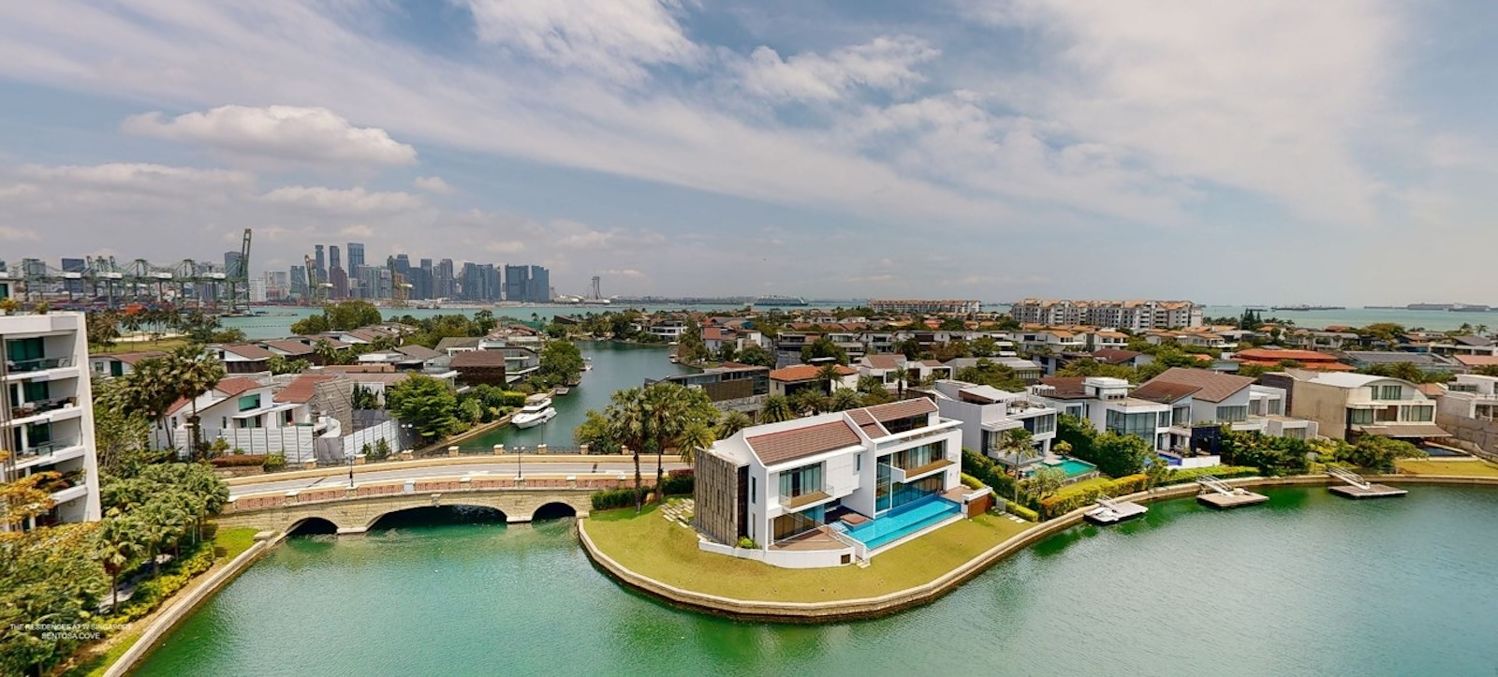
On any given weekend, a small armada of ferries leaves Marina South Pier for the Southern Islands. Divers head for the coral trails at Sisters' Islands Marine Park, day-trippers claim a stretch of sand on Lazarus, and kayakers paddle the sheltered channel between St John's and Seringat. For a country that packs 700-odd square kilometres of land into its borders, Singaporeans spend a surprising amount of their free time looking back at the island from the water.
That relationship with the sea has a price tag, and it is written into the resale market. Waterfront homes in Singapore — from the marina berths of Sentosa Cove to the canal-facing stacks at Punggol Waterway — routinely transact above comparable inland units in the same district. The gap is what the industry loosely calls the "sea view premium." It is real, it is measurable, and it is frequently misunderstood, because the view buyers pay for at launch is not always the view they still have a decade later.
This article unpacks what that premium actually buys, how it varies by cluster and by floor band, and where genuine water views can still be had without paying a Sentosa-sized price.
Why Singapore's marine scene keeps waterfront property in the spotlight
The marine park at Sisters' Islands was gazetted in 2014 as Singapore's first marine park, covering roughly 40 hectares of reef and surrounding waters. It sits within a wider cluster of southern islands — Pulau Hantu, Pulau Jong, Kusu, Lazarus, St John's, Seringat and Tekukor — that have quietly become the recreational backyard of a land-scarce city.
That matters for property because it changes what "near the water" means. Twenty years ago, a sea view was largely a status symbol. Today it is a lifestyle asset with an active use case:
- Diving and snorkelling at the marine park's dive trails, which require permits and a short boat ride from the southern piers
- Island-hopping ferries departing from Marina South Pier, which is itself an MRT stop on the North-South Line
- Kayaking and paddleboarding along the sheltered southern channel and, increasingly, along the Punggol and Kallang waterways
- Beach and picnic culture at East Coast Park, which serves as the de facto shoreline for the eastern half of the island
The result is a buyer profile that did not really exist in the 1990s: younger professionals who want water access as a weekly habit rather than an occasional spectacle. That demand is showing up in how waterfront stock is priced and, just as importantly, in which waterfront stock holds its value when the market turns.
What exactly is the "sea view premium"?
The sea view premium is the portion of a unit's price attributable purely to what you can see from the window — not to the location, the tenure, the finishings or the floor area. Isolating it is harder than it sounds, because view is bundled with everything else.
A practical way to think about it is as a pricing cascade. A unit is first priced as part of its project and district. Then adjustments are applied: floor band, orientation, stack, whether the view is permanent or exposed to future development, and how many other units in the project offer the same view.
The final number is what a valuer or an experienced agent would call the "view-adjusted" price. Strip out the other variables and what remains is the premium.
Analysts and market observers commonly cite a sea view premium in the range of 5 to 20 per cent over an equivalent inland-facing unit, with the upper end reserved for unobstructed, permanent, open-sea frontage. That band is wide because the premium is not one number — it is a spectrum that depends heavily on the cluster, the floor, and how defensible the view is.
Three things determine where a unit lands on that spectrum:
- Permanence: A view across a canal that is zoned for future residential development is a different asset from a view across open sea
- Directness: A "sea view" that requires you to lean over a balcony railing is not the same as a full frontal panorama
- Scarcity within the project: If 60 per cent of a development's stacks face the water, the premium compresses; if only 10 per cent do, it widens
Indicative Sea View Premium by Waterfront Cluster (% over inland-facing comparables)
The pattern above is indicative rather than transactional — it reflects how waterfront stock is typically priced relative to inland comparables within the same district. The important takeaway is the direction and the ordering: the premium is largest where the water is most exclusive and most permanent, and smallest where the "waterfront" is a landscaped canal shared by thousands of households.
The four waterfront archetypes
Singapore's waterfront residential stock is not one market. It is at least four, each with a different buyer, a different tenure profile and a different view durability.
| Cluster | District | Tenure mix | Waterfront character | Typical buyer | View durability |
|---|---|---|---|---|---|
| Sentosa Cove | D4 | Predominantly 99-year | Marina berths, open sea, Southern Islands | UHNW, foreign buyers of landed homes | High |
| Keppel Bay | D4 | 99-year | Marina, harbour, cruise terminal | Local upgraders, investors | Medium-high |
| East Coast | D15 | Freehold and 99-year mix | Open sea, reclaimed shore, ECP corridor | Families, long-hold owner-occupiers | Medium |
| Punggol Waterway | D19 | 99-year (HDB and private) | Canal and waterway, not open sea | Young families, BTO upgraders | Medium-high |
Sentosa Cove: the deepest premium, the most complicated exit
Sentosa Cove remains the only place in Singapore where a foreigner who is not a permanent resident can buy a landed home, subject to approval from the Land Dealings (Approval) Unit. That single policy fact underpins a large part of the premium. Add marina berths at ONE°15 Marina, open-sea frontage toward the Southern Islands, and a supply of landed homes that cannot be replicated anywhere else on the island, and you have the textbook definition of scarcity.
But Sentosa Cove also illustrates the risks that come with a view premium:
- Lease decay is a live issue. Most Sentosa Cove leases commenced in the 2000s. Buyers today are pricing in a shorter remaining term than the first generation of owners enjoyed, and the resale pool is narrow because the buyer universe is restricted
- The premium is not uniformly distributed. A unit facing the marina berths prices differently from one facing the internal waterway, which in turn prices differently from one facing another block
- Maintenance is material. Waterfront estates carry estate maintenance charges on top of individual unit costs, and the salt environment accelerates wear on fittings, railings and air-conditioning equipment
Keppel Bay: the harbour that keeps evolving
Keppel Bay is the closest thing Singapore has to a working harbour address. Reflections at Keppel Bay, Corals at Keppel Bay and Caribbean at Keppel Bay all sit within a short walk of HarbourFront MRT, the Southern Ridges and the Marina at Keppel Bay. The draw is that the water is genuinely in use — yachts, ferries, cruise ships — rather than decorative.
The premium here is more moderate than Sentosa Cove because supply is larger and the view is partly shared with the broader harbour. It is also more resilient to market cycles, because the fundamentals that support it are not purely aspirational:
- Transport access: HarbourFront interchange and Labrador Park MRT put two lines within reach, which broadens the buyer pool well beyond the ultra-wealthy
- Mixed-use amenity: VivoCity, the Singapore Cruise Centre and the Greater Southern Waterfront pipeline give the area a redevelopment narrative
- Rental depth: Harbourfront and the CBD commuter belt provide a steady tenant base, which supports yields even when capital values stall
East Coast: the long shoreline with the most variety
District 15 is where the premium becomes genuinely negotiable. The East Coast spans Tanjong Rhu, Meyer Road, Amber Road, Marine Parade and the Bayshore precinct, and it contains everything from freehold boutique blocks to large 99-year condominiums and, increasingly, new BTO supply.
Two structural facts shape pricing here:
- The Marine Parade MRT station on the Thomson-East Coast Line opened in 2024, which materially improved connectivity for a stretch of shoreline that had been bus-dependent
- Reclamation has pushed the shoreline outward over decades, which means older sea-facing blocks now sit further from the water than they did when they were built — and some "sea view" claims have quietly eroded
That erosion cuts both ways. It caps the premium on older stock but creates a genuine opportunity for buyers who can see past a stale view label and identify units whose sightlines are still intact.
Punggol Waterway: the accessible waterfront
Punggol is the outlier in this list, and arguably the most interesting. The waterway is a constructed canal rather than open sea, but it is heavily used — jogging, cycling, kayaking, dining at Waterway Point — and the residential density around it is the highest of any cluster here.
The premium is the smallest of the four, typically in the mid-single digits when comparing waterway-facing to inward-facing stacks within the same project. But that also makes it the most accessible entry point into waterfront living, particularly for HDB upgraders moving from a BTO flat to a private condo in the same estate.
The long-term story leans on infrastructure: Punggol Coast MRT station opened at the end of 2024, the Punggol Digital District is being built out, and the Cross Island Line will eventually connect the town eastward. Each of those reduces the "fringe town" discount that has historically compressed Punggol prices relative to the East Coast.
The vertical premium: how much does a higher floor really add?
Within a single waterfront project, the sea view premium is not flat. It is distributed vertically, and the shape of that distribution is one of the most consistent patterns in the resale market.
A low-floor unit in a waterfront-facing stack may see trees, a promenade, a car park roof or a neighbouring podium. A mid-floor unit clears most of those obstructions. A high-floor unit sees open water, and often the horizon. The price difference between these bands can exceed the difference between the project and an inland one.
| Floor band | Typical share of full view premium | What usually obstructs or reveals the view |
|---|---|---|
| 1 to 5 | 0 to 40% | Landscaping, promenade furniture, car park roofs, low-rise neighbours |
| 6 to 10 | 40 to 70% | Partial water view; clears low structures but not mid-rise blocks |
| 11 to 20 | 70 to 95% | Full water view in most orientations |
| 21 and above | 95 to 100% | Panoramic; buyers also pay separately for height and wind |
Indicative View Premium by Floor Band (% of full view premium captured)
Those figures are indicative ranges rather than transactional medians, and the exact shape differs by project. But the general rule holds: the marginal value of each additional floor is highest in the middle bands and lowest at the top, because once the horizon is fully visible, further height adds wind, sun exposure and price — not view.
This creates a practical arbitrage that experienced buyers look for. A unit on floor 12 with a clean sightline may capture the overwhelming majority of the view premium at a fraction of the price of the penthouse. The penthouse buyer is paying for scarcity and prestige as much as for the water.
The costs that eat into the sea view premium
A premium is only worth paying if it survives the holding period. Four costs systematically erode it.
Maintenance and the salt tax
Waterfront buildings face a harsher environment. Salt-laden air corrodes railings, window frames, air-conditioning condenser units and external fittings faster than inland equivalents. Facilities that face the water — pools, decks, gyms with glass frontage — need more frequent attention. Larger waterfront developments with extensive common areas typically carry higher monthly maintenance contributions than compact inland projects of similar age.
For landed homes in waterfront estates, there is an additional estate maintenance charge layered on top. Buyers comparing a waterfront landed property against an inland one should model that recurring cost over a 10 to 20 year hold, not just the purchase price.
Lease decay
Almost all of the private waterfront stock in Sentosa Cove, Keppel Bay and Punggol is 99-year leasehold. The East Coast has meaningful freehold supply, which is one reason it commands a structural premium of its own.
The interaction between lease decay and view premium is often overlooked. As a lease shortens, the pool of buyers who can finance the purchase with a bank loan shrinks, and CPF usage becomes constrained. A waterfront unit that looks affordable at 70 years remaining may be considerably harder to sell at 55 years remaining — regardless of how good the view is. The view does not decay. The financing does.
Transport access
Access is where Sentosa Cove pays its biggest penalty. The estate is reached via Sentosa Gateway, with the Sentosa Express monorail connecting to HarbourFront. There is no MRT station within walking distance of most of the cove. For a household with two working adults commuting to the CBD, that is a daily cost in time.
Keppel Bay and the East Coast are substantially better served. Punggol sits at the other end: historically peripheral, now rapidly improving with Punggol Coast station and the future Cross Island Line.
Noise and environmental factors
Waterfront does not automatically mean quiet. The East Coast sits under approach paths to Changi, and Punggol is exposed to aircraft noise from the same flight corridors. Keppel Bay contends with ferry and cruise terminal activity. Sentosa Cove is the quietest of the four, but the island's attractions generate weekend traffic.
There is also the sun. A west-facing sea view means afternoon heat and glare for most of the year; an east-facing one means early morning sun. In Singapore's climate, orientation is not a minor detail — it is a daily experience that no amount of premium can offset if it is wrong for you.
Where genuine water views are still relatively affordable
If the premium is largest at the top of the market, the opportunity sits where the market under-prices a genuine view. Four patterns are worth watching.
1. Older East Coast blocks with intact sightlines. Reclamation has eroded the view from some older sea-facing developments, but not all. Blocks along the Amber and Meyer corridor that remain close to the shoreline and are not blocked by newer towers can still offer real water views at resale prices well below new-launch levels. The trade-off is building age, larger maintenance exposure and, in some cases, smaller unit sizes by modern standards.
2. Mid-floor rather than top-floor units. As the floor band analysis suggests, floors in the 11 to 20 range capture most of the view premium without the top-floor scarcity pricing. This is the single most reliable way to reduce the cost of a water view.
3. Punggol waterway stacks facing the canal rather than the road. Waterway-facing units in Punggol command a modest premium over inward-facing stacks, and the underlying infrastructure story — Punggol Coast MRT, the Digital District, the Cross Island Line — gives the town a growth narrative that is independent of the view.
4. Keppel Bay units facing the inner harbour rather than the open sea. The full open-sea frontage is priced accordingly. Inner-harbour facing units still get water, boats and evening light at a lower entry point, and they benefit from the same HarbourFront connectivity.
A shortlist framed that way is not a list of specific projects — it is a filter. The projects that qualify will change as new launches complete and as infrastructure lands. What stays constant is the logic: buy the view that will still exist when you sell, at a floor that captures most of it, in a location that a broad pool of buyers can commute from.
Due diligence: how to verify a view before you pay for it
Most buyers overpay for views not because they misjudge the market, but because they misjudge the view. A five-step check closes most of the gap.
- Check the URA Master Plan for the land between you and the water. Anything zoned for residential or commercial development at a higher plot ratio is a future obstruction. This is the single most common reason a premium evaporates
- Visit at multiple times of day. Morning, late afternoon and evening reveal sun exposure, glare off the water and noise patterns that a single weekend viewing will miss
- Stand in the actual unit, not the showflat. Showflats are frequently located on high floors with unobstructed sightlines that bear no relation to the stack you are buying
- Ask which stack, not which project. Premiums are stack-specific. Two units in the same development can differ by a double-digit percentage purely on orientation
- Model the holding cost. Maintenance, estate charges, property tax and any lease-related financing constraints should be added to the purchase price before you decide the view is worth it
Food for Thought
1. If a view can be built out by a future development, is it an asset or a lease on a landscape?
Every sea view in a dense city is a temporary arrangement between you and the planning authority. Buyers who treat the premium as a permanent attribute of the property, rather than a condition that can be revoked, are the ones most exposed when the skyline changes.
2. Why does Singapore price open sea frontage so much higher than canal frontage, when the canal is arguably more usable?
The Punggol Waterway delivers daily recreational value — running, cycling, kayaking — in a way that an open-sea horizon mostly does not. Yet the premium runs in the opposite direction. Is the market pricing utility, or is it pricing exclusivity?
3. Does the Sentosa Cove premium reflect the view, or the foreign-buyer loophole?
Sentosa Cove is the only place a non-PR foreigner can buy landed property in Singapore. That policy carve-out is inseparable from the pricing. If the rule changed tomorrow, how much of the sea view premium would survive?
4. As leases on waterfront projects shorten, who buys them in 2040?
The view will still be there. The financing options will not. Waterfront leasehold stock faces a financing cliff that is entirely disconnected from how desirable the view remains — and the market has not fully priced that divergence.
5. Is a sea view worth more to an owner-occupier than to an investor?
For an owner-occupier, the view is consumed daily. For an investor, it is a resale attribute that must be re-monetised at exit, into whatever buyer pool still exists. Those two valuations can diverge sharply, and the gap widens as a lease shortens.
The bottom line
The sea view premium in Singapore is real, but it is neither uniform nor permanent. It is largest where the water is scarcest and the buyer pool is most restricted — Sentosa Cove — and smallest where the waterfront is shared and constructed, as at Punggol. It is distributed vertically, with the sharpest value in the middle floor bands. And it is steadily eroded by maintenance costs, lease decay, transport friction and noise, all of which compound over a holding period.
The buyers who do best are not the ones who pay the most for the best view. They are the ones who correctly identify which part of the view they are actually buying, how long it will last, and whether the premium they are paying reflects the residual lifestyle value rather than the launch-day marketing.