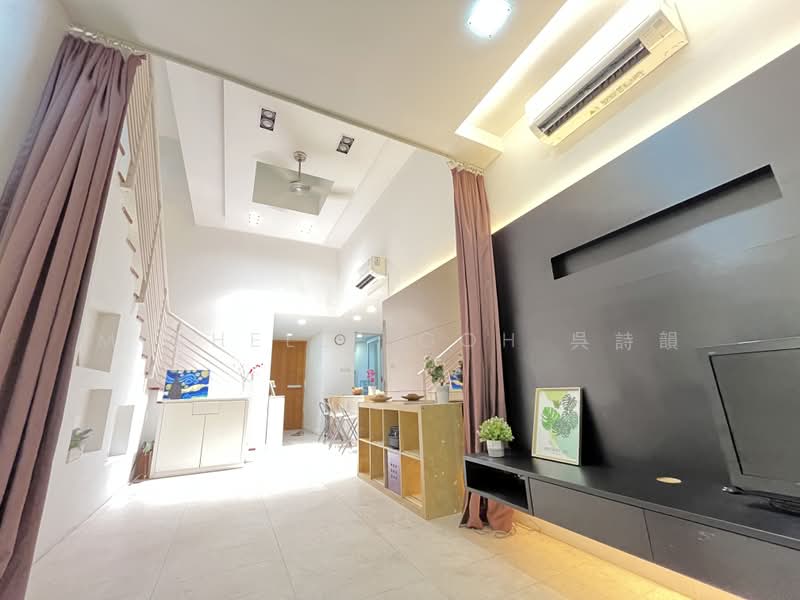
Some condominiums ask you to squint and call a 12-minute bus ride "walking distance to the MRT." The Centris doesn't need that kind of marketing gymnastics. It sits roughly 100 metres from Boon Lay MRT station on the East-West Line and about the same distance from Jurong Point, one of the largest suburban shopping malls in Singapore. You can leave your flat, buy groceries at the NTUC FairPrice downstairs, catch a train to Raffles Place, and be back before dinner — all without an umbrella.
That location has done quiet, unglamorous work for the last decade. Between 2021 and the latest quarters in Hiva's dataset, transacted prices at The Centris have climbed from an average of around $1,135 psf to roughly $1,603 psf — a compound annual growth rate of about 6.5%, which is genuinely strong for a 99-year leasehold project that has already burnt through 20 years of its lease.
But there's a twist worth understanding before you get excited. The Centris is an Apartment classification (not a Condominium), it has 610 units, it was completed in 2009, and its rental market has been remarkably — almost stubbornly — flat for three years even as prices ran. That combination tells a very specific story about who this project serves and what it's actually worth.
This deep dive unpacks the full picture: transaction history, rental economics, the neighbourhood that surrounds it, and what a resale buyer or investor should realistically expect over the next decade. Hiva's composite screen places The Centris in the top 12% of all private residential projects nationally, and 8th out of the 29 tracked projects in District 22 — a strong but not exceptional district standing, which itself is informative.
Project Overview: The Facts on the Ground
The Centris is a 99-year leasehold apartment development sitting on Jurong West Central 3, in the heart of the Boon Lay / Jurong West residential belt. The lease commenced in 2006, and the project obtained its Temporary Occupation Permit in 2009, making it about 17 years old as a built asset and 20 years into its lease term.
| Attribute | Detail |
|---|---|
| Project name | The Centris |
| Address | Jurong West Central 3 |
| District | 22 (OCR — Outside Central Region) |
| Property type | Apartment |
| Tenure | 99 years leasehold, commencing 2006 |
| Lease remaining | ~79 years |
| Total units | 610 |
| TOP year | 2009 |
| Developer | Prime Point Realty Development Pte Ltd |
| Google rating | 4.1 / 5 from 685 reviews |
| Nearest MRT | Boon Lay (EW27) — ~100 m |
| District 22 tracked projects | 29 |
| District 22 average PSF | $1,566 |
A few of these deserve unpacking.
The "Apartment" label. In Singapore's regulatory taxonomy, "Apartment" and "Condominium" are distinct classifications tied largely to site area and facility provisions. An Apartment typically has a leaner facility footprint than a full-fledged Condominium. For a 610-unit development, that means less land per unit — but it also means lower maintenance contributions and a more efficient use of the site. In practice, buyers at The Centris are trading sprawling clubhouse culture for doorstep transport connectivity. That's a trade many families make willingly.
The 610-unit scale. Oddly, 610 units is large for an Apartment classification and, more importantly, it's the right size for liquidity. A development with 60 units might see three resales a year. The Centris has logged 123 resale transactions across the quarters Hiva tracks — an average of roughly 5.4 per quarter. That means realistic comparables, credible valuations, and a functioning market where you're rarely the only seller on the block.
The developer. Prime Point Realty Development Pte Ltd is not a headline-grabbing brand, and The Centris carries none of the "branded developer" premium that some buyers chase. What matters more at this age is how the estate has been maintained, and the fact that the project has held a 4.1-star rating across 685 Google reviews suggests the physical environment has aged reasonably.
District positioning. District 22's 29 tracked projects average $1,566 psf. The Centris is currently transacting in the $1,500–$1,700 psf band, which puts it right at — or marginally above — the district mean. It is not a discount play. It is a convenience play.
The Centris: Average PSF by Year (2026 = 3 quarters only)
Transaction Analysis: Five Years of Consistent Re-Rating
Hiva's dataset captures 123 transactions at The Centris spanning from Q1 2021 through Q3 2026. Every single transaction in the recent bucket is classified as a resale — there is no primary market left here, and no sub-sale noise. What you're looking at is a pure secondary market, which makes the price signals cleaner than in a project still competing with its own developer.
Yearly Overview
| Year | Transactions | Avg Price | Avg PSF | PSF Change YoY |
|---|---|---|---|---|
| 2021 | 24 | $1,366,283 | $1,135 | — |
| 2022 | 30 | $1,463,493 | $1,195 | +5.3% |
| 2023 | 18 | $1,643,704 | $1,366 | +14.3% |
| 2024 | 13 | $1,889,921 | $1,516 | +11.0% |
| 2025 | 23 | $1,856,002 | $1,547 | +2.0% |
| 2026 (3 quarters) | 15 | $2,023,792 | $1,603 | +3.6% |
The story here is not linear. It comes in three acts.
Act One (2021–2022): the post-Covid floor. Prices hovered in the low $1,100s psf with quarterly averages bouncing between $1,106 and $1,230 psf. Volume was healthy — 54 transactions across eight quarters — as buyers rushed back into the market after the pandemic-era restrictions. This was the last window in which The Centris was available at genuinely sub-$1,200 psf.
Act Two (2023–2024): the sharp re-rating. This is where the project found its true level. Average PSF jumped +14.3% in 2023 and another +11.0% in 2024, taking the yearly average from $1,195 to $1,516 psf. Volume, tellingly, halved — 18 and 13 transactions respectively. That's the classic signature of a seller's market: fewer units changing hands because owners had no reason to sell into a rising tide, and buyers paying up for scarcity.
Act Three (2025–2026): consolidation with continued drift upward. Price growth moderated to +2.0% and +3.6%, but volume recovered strongly — 23 transactions in 2025 including a spike of 11 in a single quarter (2025 Q2). Rising volume with slowing price growth is the signature of a maturing, liquid market rather than a stalling one. Buyers and sellers are finding each other more easily.
The Quarterly Path
The Centris: Average Resale PSF by Quarter (2021–2026)
A word of caution about this chart: quarterly averages at The Centris are noisy because the sample sizes are small. Several quarters register only two or three transactions. The Q1 2024 print of $1,623 psf came off just three deals. The Q3 2026 print of $1,309 psf came off a single transaction — and that transaction was a very large unit (approximately 1,895 sqft, priced at $2.48 million), which naturally trades at a lower per-square-foot rate.
This is the single most important thing to understand about pricing at The Centris: unit size drives PSF far more than any other factor. Look at the evidence below.
Like-for-Like: The Cleanest Signal Available
| Date | Price | Area (sqm) | Area (sqft) | PSF | Floor |
|---|---|---|---|---|---|
| Dec 2025 | $1,530,000 | 87 | ~936 | $1,634 | 06–10 |
| Nov 2025 | $1,790,000 | 99 | ~1,066 | $1,680 | 06–10 |
| Dec 2025 | $1,910,000 | 107 | ~1,152 | $1,658 | 11–15 |
| Dec 2025 | $2,228,888 | 162 | ~1,744 | $1,278 | 16–20 |
| Dec 2024 | $1,400,000 | 87 | ~936 | $1,495 | 06–10 |
| Dec 2023 | $1,650,888 | 99 | ~1,066 | $1,549 | 11–15 |
| Dec 2023 | $1,900,000 | 115 | ~1,238 | $1,535 | 06–10 |
| Dec 2022 | $1,700,000 | 120 | ~1,292 | $1,316 | 11–15 |
| Dec 2022 | $1,320,000 | 91 | ~980 | $1,348 | 06–10 |
| Dec 2021 | $1,770,000 | 134 | ~1,442 | $1,227 | 06–10 |
Two comparisons here are gold-standard.
First: the ~936 sqft stack on floors 06–10. A unit in this exact size and floor band sold for $1,400,000 ($1,495 psf) in December 2024, and another sold for $1,530,000 ($1,634 psf) in December 2025. That's +9.3% in price and +9.3% in PSF in twelve months on a genuinely comparable unit. This is far more meaningful than any quarterly average.
Second: the ~1,066 sqft unit on floors 11–15. It traded at $1,650,888 ($1,549 psf) in December 2023 and at $1,790,000 ($1,680 psf) in November 2025 — roughly +8.4% in price and +8.5% in PSF across 23 months. An annualised rate of about 4.3%, which is solid but notably below the headline yearly averages.
The gap between those two figures is instructive. Much of the "growth" in the district-level averages is being driven by mix shift — more larger units trading at higher absolute prices — rather than pure per-square-foot appreciation. If you're underwriting The Centris, use ~4–6% annual PSF growth as your base case, not the 6.5% headline CAGR.
The Size Discount Is Real — And It's Big
Look at the December 2025 spread: a 936 sqft unit cleared at $1,634 psf, while a 1,744 sqft unit on a higher floor (16–20) cleared at $1,278 psf. That's a 22% PSF discount for nearly double the space. On an absolute basis, the large unit cost $2.23 million versus $1.53 million for the small one.
This pattern recurs throughout the dataset — the 1,442 sqft unit in December 2021 at $1,227 psf, the 1,292 sqft unit in December 2022 at $1,316 psf. Larger units at The Centris consistently transact 15–22% below the project's smaller-format PSF.
Volume Profile
The Centris: Transaction Volume by Quarter
Turnover at The Centris runs at roughly 5.4 transactions per quarter, or about 2.2% of the 610-unit stock annually. That is a healthy but not frenetic churn rate — enough to establish pricing benchmarks, not so much that the project feels transient. The trough in 2023–2024 (3–4 deals per quarter) reflects the classic "locked-in" dynamic after a sharp price run, and the recovery to 7–11 deals per quarter in 2025–2026 suggests owners have begun to accept the new price level as the new normal.
Rental Performance: Flat Rents, Compressing Yields
Here's where The Centris gets interesting — and where a lot of buyers get the story wrong.
Hiva's rental dataset for The Centris covers 12 quarters from Q3 2023 through Q2 2026.
| Quarter | Median Rental PSF | 25th Percentile | 75th Percentile |
|---|---|---|---|
| 2023 Q3 | $4.73 | $4.44 | $5.03 |
| 2023 Q4 | $4.84 | $4.52 | $4.95 |
| 2024 Q1 | $4.92 | $4.57 | $5.15 |
| 2024 Q2 | $4.65 | $4.33 | $4.98 |
| 2024 Q3 | $4.79 | $4.43 | $5.07 |
| 2024 Q4 | $4.66 | $4.38 | $5.01 |
| 2025 Q1 | $4.79 | $4.28 | $5.08 |
| 2025 Q2 | $4.78 | $4.54 | $4.89 |
| 2025 Q3 | $4.85 | $4.65 | $5.11 |
| 2025 Q4 | $4.91 | $4.52 | $5.29 |
| 2026 Q1 | $5.02 | $4.78 | $5.25 |
| 2026 Q2 | $4.79 | $4.20 | $5.04 |
The Centris: Median Rental PSF by Quarter
The Headline Number Is Boring. The Implication Is Not.
Rental PSF has moved from $4.73 to $4.79 across three years — a gain of roughly 1.3% in total, or about 0.4% annualised. In nominal terms, rents at The Centris have been essentially flat since 2023.
Meanwhile, capital values rose from roughly $1,316 psf (2023 Q3) to $1,597 psf (2026 Q2) — a gain of about 21%.
That divergence has a direct, arithmetic consequence for yields.
| Point in time | Avg Capital PSF | Median Rental PSF | Implied Gross Yield |
|---|---|---|---|
| 2023 Q3 | ~$1,316 | $4.73 | ~4.3% |
| 2024 Q3 | ~$1,484 | $4.79 | ~3.9% |
| 2026 Q2 | ~$1,597 | $4.79 | ~3.6% |
Gross yield estimated as (median rental PSF × 12) ÷ transacted capital PSF. This excludes maintenance, property tax, agent fees, vacancy and furnishing costs.
So gross rental yields at The Centris have compressed from roughly 4.3% to about 3.6% over three years. Net yields after realistic expenses and vacancy would likely land in the 2.7% to 3.1% range.
What That Means In Dollars
Take the ~936 sqft (87 sqm) unit that traded at $1,530,000 in December 2025.
- At a median rental PSF of $4.79, monthly rent ≈ $4,483
- Annual gross rent ≈ $53,800
- Gross yield ≈ 3.5%
Now consider the larger 1,066 sqft unit that traded at $1,790,000 in November 2025:
- Monthly rent ≈ $5,106
- Annual gross rent ≈ $61,270
- Gross yield ≈ 3.4%
Notice how similar the two yields are, despite the very different PSF. The rental market has effectively "priced in" the size discount — larger units rent at a lower PSF per month, roughly mirroring the lower capital PSF. That's actually a healthy sign: it means the rental market isn't mispricing large units relative to how the sales market prices them.
The Rent Band Is Unusually Tight
One more detail worth flagging. Look at the 25th–75th percentile spread in recent quarters: $4.20 to $5.04 in 2026 Q2, $4.78 to $5.25 in 2026 Q1. The interquartile range is narrow — typically $0.40–$0.70 psf. That tightness tells you the rental market at The Centris is highly standardised. Tenants are paying for the location first and the unit second. Floor level, facing and renovation matter, but not enough to break the band.
For a landlord, that cuts two ways. It means rent is predictable and easy to benchmark. It also means you can't out-renovate your neighbours — you're competing on a commodity.
Neighbourhood & Lifestyle: The Real Reason People Pay Up
If the transaction data explains what The Centris is worth, the neighbourhood explains why. This is a project where the amenity map does an enormous amount of the valuation work.
Transport
| MRT Station | Line | Distance |
|---|---|---|
| Boon Lay (EW27) | East-West Line | ~0.1 km |
| Pioneer | East-West Line | ~1.0 km |
| Lakeside | East-West Line | ~1.7 km |
At 100 metres, Boon Lay is not "near" The Centris — it is effectively at The Centris's doorstep, part of the same integrated transport node as the Boon Lay bus interchange. This is the single strongest attribute in the project's profile, and it's what anchors both the owner-occupier and tenant demand.
From Boon Lay, you're on the East-West Line with direct connectivity west to Joo Koon and east through Jurong East, Clementi, Buona Vista, Queenstown, Raffles Place and beyond. For anyone working in the CBD, one-north, or Jurong East, this is an unusually frictionless commute for an OCR address.
Shopping & Daily Errands
| Amenity | Type | Distance |
|---|---|---|
| Jurong Point | Mall | ~0.1 km |
| NTUC FairPrice | Supermarket | ~0.1 km |
| NTUC FairPrice (2nd outlet) | Supermarket | ~0.1 km |
| Song Fish Dealer | Wet market / fresh produce | ~0.1 km |
| Pioneer Mall | Mall | ~1.0 km |
| Cold Storage | Supermarket | ~1.0 km |
| Boon Lay Shopping Centre | Mall / hawker | ~1.1 km |
| Sheng Siong | Supermarket | ~1.1 km |
| Gek Poh Shopping Centre | Mall / hawker | ~1.4 km |
| Taman Jurong Shopping Centre | Mall | ~1.7 km |
This is an exceptionally dense retail envelope. Jurong Point alone is one of the largest suburban malls in the country, with a full department-store anchor, a supermarket, a cinema, extensive F&B and a library. Combined with two NTUC FairPrice outlets and a Song Fish Dealer within 100 metres, the everyday grocery and errand load is essentially zero-effort.
Boon Lay Shopping Centre and Gek Poh Shopping Centre add the older-school, hawker-centric layer — the kind of places where you get your kway chap and your wet-market fish at 2015 prices.
Parks & Recreation
| Green Space | Distance |
|---|---|
| Jurong Central Park | ~0.3 km |
| Lakeside Grove Fitness Corner | ~1.2 km |
| Lakeside Grove Playground | ~1.4 km |
| Yunnan Park | ~1.5 km |
| Westwood Park Playground | ~1.5 km |
Jurong Central Park at 300 metres is the standout — a genuine multi-hectare park with lawns, a pond, jogging paths and fitness corners. It's the kind of amenity that makes a difference to families with young children, and it's walkable without planning.
Schools
This is where The Centris quietly outperforms its price point.
| Primary School | Distance |
|---|---|
| Frontier Primary School | ~0.7 km |
| Jurong West Primary School | ~0.8 km |
| Boon Lay Garden Primary School | ~0.9 km |
| West Grove Primary School | ~1.0 km |
| Westwood Primary School | ~1.1 km |
Five primary schools within 1.1 km is a genuinely unusual concentration. Add the secondary options in the immediate area — Jurong West Secondary School and Boon Lay Secondary School among them — and you have a family-formation package that many condominiums in more central districts simply cannot match.
For parents thinking about Primary 1 registration, being within 1 km of five schools materially increases the odds of landing a place at a school you actually want, rather than settling for whatever's left. That's a real, quantifiable benefit that shows up in resale demand.
Connectivity by Road
The Centris is accessible via Jalan Boon Lay, Pioneer Road North, and the Ayer Rajah Expressway (AYE), with the Pan-Island Expressway (PIE) also within reach. For drivers heading to the CBD, one-north or the western industrial and logistics belt around Tuas, the road network is workable — though the AYE at peak hour is the AYE at peak hour.
Daily Life, Rendered
Picture a Tuesday. You leave your unit at 8:10am, walk 100 metres to Boon Lay MRT, and are at Raffles Place by 8:50. Your spouse drops the kids at Frontier Primary, 700 metres away, then picks up groceries at the NTUC FairPrice on the way back. Saturday morning is Jurong Central Park, followed by lunch at Boon Lay Shopping Centre's hawker centre. Sunday is a movie at Jurong Point.
That is the actual product The Centris sells. Not prestige, not architecture, not a panoramic view. Frictionless ordinary life.
Community Pulse: What 685 Reviews Tell Us
The Centris carries a Google rating of 4.1 out of 5 across 685 reviews. That is a solid, not spectacular, score — and in a dataset this large, the number itself is informative.
A few observations on how to read a 4.1:
685 reviews is a very large sample. Most private residential projects in Singapore accumulate a few dozen to a few hundred Google reviews. A volume this high typically reflects a large resident base (610 units helps), a steady stream of short-term tenants, and — importantly — a lot of people who use the address as a landmark rather than a home. Reviewers include residents, tenants, delivery riders, and people who transited through the integrated hub. That dilutes the signal somewhat but also means the rating isn't gamed.
A 4.1 is the score of a convenience-first project. Projects scoring in the 4.5+ range are usually newer, more visually striking, or have exceptional facilities. Projects scoring in the 3.5–3.8 range typically have visible maintenance or management complaints. A 4.1 sits in the zone of "does exactly what it promises, with a few grumbles" — which is precisely the profile the transaction and rental data describe.
What the underlying numbers suggest residents value most, and what they're most likely to grumble about, follows directly from the project's design:
Likely pros, based on the fundamentals:
- Unbeatable MRT and mall proximity — this is the dominant theme in any project this close to a transport node
- Mature landscaping and a settled estate that has had 17 years to bed in
- Genuine rental demand keeping common areas occupied and reasonably maintained
- A broad mix of unit sizes supporting families at different life stages
Likely cons:
- Density — 610 units on an Apartment-classified site means sharing facilities with a lot of neighbours
- Facility depth is shallower than a full Condominium; don't expect multiple pools and a sprawling clubhouse
- Integrated-hub locations always bring foot traffic, noise and parking pressure
- Aging common areas — at 17 years old, lifts, pools and gyms need proactive management
Hiva's review corpus for this project surfaced the aggregate rating but not verbatim snippets, so we're reading the score rather than quoting residents. The honest framing: 4.1 from 685 reviewers is a "good, not exceptional" verdict — and it lines up exactly with everything the price and rental data says about this project.
Future Outlook: What Happens Next
Lease Decay: The Slow Clock
The Centris's 99-year lease commenced in 2006, leaving roughly 79 years on the clock. Here's the practical breakdown of how that matters:
| Milestone | Remaining Lease | Practical Implication |
|---|---|---|
| Now (2026) | ~79 years | No financing friction. Full CPF usage. |
| 2046 | ~59 years | Still broadly bankable; buyer pool begins to narrow |
| 2056 | ~49 years | Financing constraints emerge; significant price discount |
| 2066 | ~39 years | Limited buyer pool; largely cash or alternative financing |
| 2085 | 0 years | Lease expiry |
For any buyer planning a 5–15 year hold, lease decay is essentially a non-issue. At the point you'd sell, the project would still have 64–74 years remaining — comfortably within normal financing parameters. The decay only becomes a pricing problem for buyers planning to hold past the 2050s, and even then the impact is gradual rather than cliff-edged.
Where lease decay does matter is in the rate of appreciation. Older leasehold properties in Singapore historically appreciate more slowly than younger ones, particularly once they cross the ~60-year remaining threshold. The Centris's strong 2021–2026 run happened while it still had 75+ years left. Expect the growth rate to moderate gently as the remaining term shrinks.
The Jurong Region Line: The Big Structural Catalyst
This is the most consequential item in The Centris's forward outlook — and it's positive.
The Jurong Region Line (JRL) is a fully elevated MRT line designed to serve the western region, connecting Choa Chu Kang, Boon Lay, Jurong East, Tengah and the industrial areas around Jurong Pier. Critically for this analysis, Boon Lay is planned as a JRL interchange station, with stages of the line scheduled to come online starting in the late 2020s.
For The Centris, this transforms Boon Lay from a single-line suburban station into an interchange node. That has three effects:
- Connectivity expansion. Residents gain direct rail access to Tengah, the Jurong Innovation District, Nanyang Technological University, and the Jurong East commercial core without going through the East-West Line.
- Catchment widening. Interchange stations pull rental demand from a broader geographic area. Tenants who work in Tengah or the western industrial belt become viable prospects without a car.
- Structural re-rating. Interchange proximity is one of the most durable value drivers in Singapore residential real estate. Projects within a short walk of a future interchange typically see a step-change in both capital and rental values as the infrastructure comes online.
Jurong Lake District & the Western Transformation
Larger-scale, the western region is undergoing the most significant transformation of any part of Singapore outside the city centre.
Jurong Lake District is being developed as Singapore's second central business district — a mixed-use precinct spanning commercial towers, residential, retail, and a substantial waterfront park network around Jurong Lake. It sits roughly a short MRT ride from Boon Lay, and the planned Cross Island Line will serve it directly.
Tengah — Singapore's newest HDB town, immediately north of Jurong West — is adding tens of thousands of new homes and a growing population base to the western catchment. New town populations are net generators of both rental demand and eventual upgrading demand into nearby private housing.
Jurong Innovation District adds an employment anchor, drawing engineers, researchers and tech workers into the western corridor — exactly the demographic profile that rents 936–1,152 sqft units near an MRT station.
The compound effect: The Centris sits at the intersection of a new MRT interchange, a new CBD, a new town and a new employment cluster. That's an unusually strong structural tailwind for an OCR leasehold apartment.
Supply Pipeline: What's Competing
The counterweight is supply. District 22 currently has 29 projects tracked in Hiva's database, averaging $1,566 psf. The western region more broadly has seen a steady stream of new launches in recent years — including projects near Jurong Lake, in Bukit Batok, and around the Tengah fringe.
New launches matter here in two specific ways:
They compete for tenants. A new project with a fresh pool, a modern gym and a 2027 TOP can command rental PSF that The Centris cannot match. Given that Centris rents have been flat for three years, this competition is a plausible partial explanation. Landlords here should assume rent growth tracks inflation, not capital growth.
They reset buyer expectations. If a nearby new launch prices at $2,100 psf, The Centris at $1,600 psf starts to look like relative value. If that launch prices at $1,700 psf and offers a fresh 99-year lease, The Centris's ~79 remaining years become a harder sell.
The good news is that The Centris's location is not replicable. Boon Lay's integrated hub — MRT, bus interchange, Jurong Point, and two NTUC FairPrice outlets all within 100 metres — cannot be rebuilt by a new developer on a greener plot. The Centris's moat is its address, and that moat deepens as the JRL interchange activates.
The Rental Outlook
Three more years of roughly flat rental PSF is the reasonable base case. The JRL activation is the most likely catalyst for a genuine rental step-up — and even then, expect it to be a step, not a ramp.
Landlords who bought at the 2021–2022 price points (sub-$1,200 psf) are still achieving healthy yields. Landlords buying today at $1,600 psf should underwrite to a ~3.5% gross yield and hold primarily for capital appreciation and leasehold inflation hedging — not for income.
Overall Assessment: A Well-Located, Liquid, Mid-Tier OCR Workhorse
The Centris is not a trophy asset, and it doesn't pretend to be. Hiva's composite screen places it in the top 12% of all private residential projects nationally — a genuinely strong national standing — while its 8th place among 29 tracked District 22 projects reflects a district that contains its own stronger competitors.
Here is the honest assessment.
Where The Centris excels:
- Transport connectivity — arguably exceptional for an OCR location, with an MRT station and bus interchange essentially at ground level
- School access — five primary schools within 1.1 km is a rare concentration
- Everyday retail depth — Jurong Point plus multiple supermarkets within walking distance
- Market liquidity — 123 resale transactions and a steady ~5.4 per quarter means credible pricing and easy exits
- Structural tailwinds — JRL interchange, Jurong Lake District, Tengah and Jurong Innovation District all in the catchment
Where it gives ground:
- Lease decay — 79 years remaining is comfortable now but will compress long-horizon appreciation
- Rental stagnation — three years of flat rental PSF with yields compressing from ~4.3% to ~3.6% gross
- Apartment classification — leaner facilities than a full Condominium
- Density — 610 units sharing a compact site
- PSF positioning — at ~$1,600 psf it trades at or slightly above the District 22 average of $1,566 psf, so you are not buying a discount
Who this suits. A family upgrading from HDB in the west who wants MRT connectivity, good schools and a real retail ecosystem without paying for a brand name. A landlord targeting the western employment corridor who wants reliable, standardised rental demand rather than trophy rents. A 5–15 year hold investor comfortable with a moderate growth profile.
Who this doesn't suit. A buyer chasing pre-TOP capital gains, a prestige-address investor, or someone planning a multi-decade hold where lease decay becomes material.
The verdict: The Centris is a solid, liquid, well-located mid-tier OCR apartment with an unusually strong infrastructural tailwind and a fundamentally mature — not explosive — financial profile. It's a workhorse, not a racehorse. And in the western corridor, workhorses with MRT interchanges attached tend to age very well.
Food for Thought
1. How much of the premium over District 22's average PSF is actually the MRT? The Centris trades at roughly $1,600 psf against a district average of $1,566 psf. That's only a ~2% premium for one of the best transport locations in the district. Is that premium too small (a mispricing) or is it correctly telling you that the lease, density and Apartment classification offset most of the location advantage?
2. Rents have been flat for 12 quarters while prices rose 21%. If yields keep compressing, at what point does The Centris stop working as a rental investment and become a pure capital-appreciation bet? And if it's the latter, are you comfortable underwriting the full exit price to a future buyer?
3. The large units trade at a 15–22% PSF discount to the compact ones. Is the 1,744 sqft unit at $1,278 psf a genuine bargain, or is it telling you that large OCR leasehold units have a structurally thinner buyer pool? Check how long the big units sit on the market before you assume it's a steal.
4. Boon Lay becomes a JRL interchange in the coming years. How much of that is already priced in? Infrastructure benefits are often anticipated long before they arrive — and if the market has already paid for the JRL, the actual opening may bring no further uplift.
5. You're buying 79 years of lease. If you sell in a decade, your buyer gets 69. If you sell in two decades, they get 59. At what remaining-lease threshold does The Centris's buyer pool narrow enough to hurt your exit price — and does your intended holding period fit comfortably inside that window?