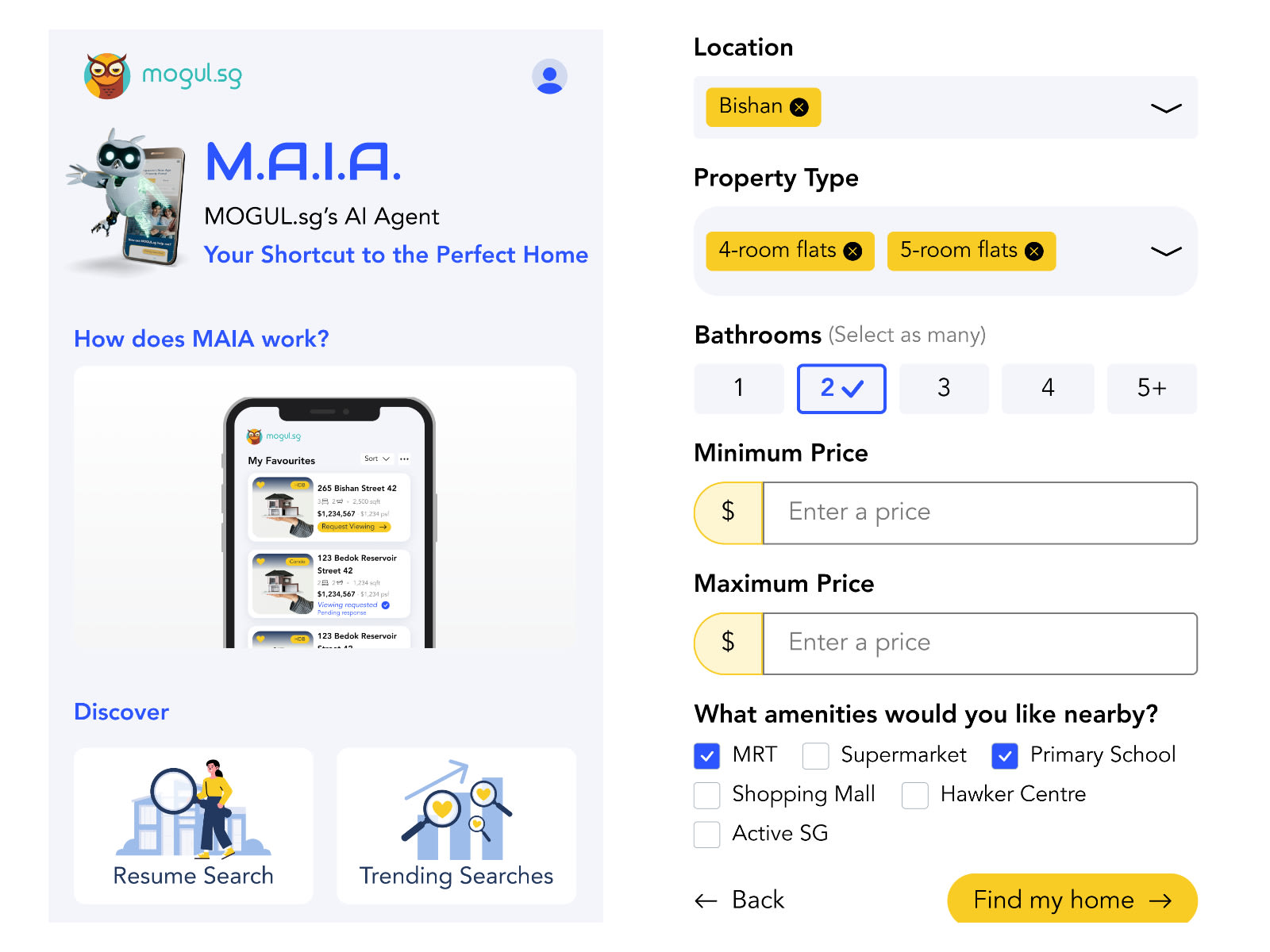
Ask ChatGPT whether Tampines or Punggol suits a young family with a $700,000 budget and a toddler, and you will get an answer in seconds. It will be structured. It will be confident. It will cite MRT lines, school proximity, and rough price bands. And it will be right just often enough to be dangerous.
That is the new reality of AI property search in Singapore. The largest financial decision most of us will ever make — a flat or condo costing six to seven figures, financed over 25 to 30 years — is increasingly being researched the same way we research a holiday itinerary: by typing a question into a chatbot and trusting the summary.
Since OpenAI folded real-time web search into ChatGPT in late 2024, and Google began rolling AI-generated overviews into search results, the front door to property information has quietly changed. Buyers now arrive at viewings with AI-generated shortlists, AI-summarised policy explanations, and occasionally, AI-invented numbers. Agents are noticing. Platforms are adapting. And the data underneath all of it — the caveats, the transactions, the lease decay, the actual unit-level differences — has not changed at all.
This article looks at what OpenAI-style AI tools genuinely do well in a Singapore property search, where they fail badly, what the market data says about why precision matters so much here, and what all of it means for buyers and the agents who serve them.
From Forum Threads to Chat Windows: How Property Search Is Changing
For most of the 2010s, the Singapore property research journey looked like this: open a listings portal, set filters, scroll, open a forum thread, skim 14 pages of conflicting opinions, message three agents, and eventually form a view. It was slow, noisy, and heavily socialised.
The AI era compresses the first three steps into one. A conversational tool can now:
- Translate a vague preference into structured criteria. "Near an MRT line, no west-facing afternoon sun, under $800k, three-room, not too far from my parents in Bedok" becomes an actual filtering problem.
- Summarise across sources. Instead of opening six tabs, you get one paragraph comparing two towns.
- Explain policy on demand. ABSD, SSD, TDSR, MSR, the HFE letter, CPF usage rules, grant tiers — all of this is text-heavy, rule-based material, which is exactly the kind of content large language models handle well.
- Draft the paperwork. Emails to agents, questions for viewings, comparison tables.
OpenAI's product trajectory has pushed further in this direction. The search feature brought live web results into the chat window. So-called agentic tools, which can operate a browser and complete multi-step tasks on a user's behalf, point toward a near future where an AI could filter listings, cross-reference them against transaction data, and book viewings — with the buyer only stepping in at the decision point.
The direction of travel is clear. What is far less clear is whether the answers are any good.
Why Property Is an Unusually Hard Test for ChatGPT-Style Search
Property is not a trivia domain. It is a domain where being 90% right is a failing grade, because the errors cluster exactly where the money is.
There are four structural reasons AI property search struggles more than AI travel planning:
1. The data is fragmented across authorities, and none of them are conversational. Transaction data sits with URA for private property and HDB for resale flats. Planning and land use sit with URA and SLA. Property tax sits with IRAS. Agent conduct sits with CEA. Maps and locality data sit with OneMap. No single source speaks plainly, and each updates on its own schedule.
2. The unit is the asset, not the project. Two three-room flats in the same block, one floor apart, can transact 8% apart. A chatbot that knows the project-level average does not know your unit.
3. Policy changes faster than model training cycles. Cooling measures, loan limits, grant tiers, and eligibility rules have all shifted repeatedly in the last five years. A model relying on learned associations rather than live retrieval will confidently cite last year's rules.
4. The stakes create asymmetric downside. A wrong restaurant recommendation costs you dinner. A wrong grant assumption costs you a five-figure shortfall at a moment when you cannot easily reverse course.
The practical rule that falls out of this is simple: AI is excellent at generating hypotheses and terrible at being the final source of truth.
What AI Does Well in a Singapore Property Search
Discovery: Turning Vague Wants Into a Shortlist
The strongest use case is the earliest and fuzziest stage. Most buyers do not start with a district, a flat type, and a budget. They start with a feeling: "I want somewhere that feels less crowded but is still convenient."
A conversational tool is genuinely good here. It can:
- Reconcile competing constraints. Space versus centrality, lease length versus price, older estate amenities versus new estate supply.
- Surface options you would not have filtered for. Ask about "walkable to a hawker centre and a park connector" and you may get neighbourhoods you had not considered.
- Explain trade-offs in plain language. Why a 99-year leasehold project 400m from an MRT station might behave differently from a freehold project 1.2km away.
This is low-risk, high-value work. A bad shortlist costs you an hour, not a hundred thousand dollars.
Explanation: The Policy Decoder
Where AI earns its keep is in decoding rules. Singapore's property framework is dense, and much of it is written for regulators rather than residents.
An AI tool can give you a fast, readable explanation of:
- ABSD — how Additional Buyer's Stamp Duty differs by residency profile and property count
- SSD — Seller's Stamp Duty and the holding period it imposes
- TDSR and MSR — the debt-servicing ratios that cap how much you can borrow
- LTV limits — how much of the price you can finance
- The HFE letter — the HDB Flat Eligibility letter that now gates resale purchases
- CPF usage rules — including the lease-coverage conditions that affect how much CPF Ordinary Account savings you can deploy
Treat this as a study aid, not a syllabus. Use it to learn which questions to ask, then confirm the numbers on HDB, URA, IRAS, or CEA directly. Policy pages change; a chatbot's summary can lag them by months.
Estimation: The Weakest Link
Ask an AI what a specific flat is worth and you will get a number with two or three significant figures. That number is the least reliable output the tool produces, and the one buyers most want.
Project-level averages are broadly knowable. Unit-level value is not, and the difference is where money is won and lost.
Where AI Search Goes Wrong — and Why It Matters More Here
The Confident Hallucination
Language models generate plausible text, not verified facts. In property, plausible and correct are very different things. Common failure modes include:
- Invented distances. "A 5-minute walk to the MRT" when the actual route is 14 minutes through two underpasses.
- Wrong lines or stations. Confusing one interchange with another, or naming a station that does not exist on that line.
- Stale grant figures. Quoting a grant ceiling from a year or two ago.
- Phantom projects. Describing a development with plausible-sounding details that were never built.
- Averaged-in nonsense. Blending a District 9 freehold condo with a suburban leasehold flat because both appeared near the same phrase in training data.
None of these errors announce themselves. They arrive in the same confident tone as the correct answers.
The Staleness Problem
Anything not retrieved live is frozen at training time. In a market where loan limits, stamp duties, and eligibility rules have all been adjusted within the last three years, that freeze matters. If a tool cannot cite a live page, assume the details may be out of date.
The Averaging Problem
This is the subtlest and most expensive failure. AI systems reason from patterns. Property value is driven by specifics:
| Unit-level factor | Why AI typically misses it |
|---|---|
| Floor level | Rarely stated consistently in listings; effect varies by project and view |
| Facing and sun exposure | Depends on actual orientation and surrounding blocks |
| Renovation quality | Highly subjective; photos lie |
| Remaining lease | Affects CPF usage, loan tenure, and buyer pool in non-linear ways |
| Noise and privacy | Road, lift lobby, refuse chute, neighbouring units |
| View corridor | Can change with future development in the area |
| Stack and layout efficiency | Same square footage, very different usable space |
A model that has never seen the unit cannot price the unit. It can only price the idea of the unit.
The Privacy Exposure
Buyers casually paste things into chatbots: payslips, CPF statements, HFE letters, tenancy agreements, NRIC numbers, bank statements. Personal data entered into a third-party AI service is no longer under your control in the way a document in your own folder is. Under Singapore's PDPA, organisations have obligations around personal data — but the practical discipline of not uploading sensitive documents to a consumer chatbot is entirely on you.
The Accountability Gap
A CEA-registered agent operates under a regulatory framework: duties of care, prohibitions on false or misleading statements, and consequences for breaching them. A chatbot has none of that. If it gives you a wrong number and you act on it, there is no recourse, no ombudsman, and no licence to revoke.
Singapore's Market in Numbers: What the Data Actually Shows
To understand why precision matters, look at how sharply the market has moved — and how much of that movement buyers are now trying to interpret through AI summaries.
HDB Resale Price Index: Annual Change (%)
According to HDB's Resale Price Index, the resale market went from near-flat in 2019 to double-digit growth in 2021 and 2022, cooled to under 5% in 2023, then re-accelerated to roughly 9.7% in 2024. A buyer who anchored on a 2023-era assumption of "roughly 5% a year" would have badly misjudged 2024 pricing.
The private market tells a different, more moderating story.
URA Private Residential Price Index: Annual Change (%)
URA's private residential price index shows growth decelerating from 10.6% in 2021 to 3.9% in 2024 — a marked slowdown, but still positive. Two markets, two directions of travel, and both commonly summarised by chatbots in a single sentence.
Meanwhile, the demand-side rules that govern what any buyer can actually afford have hardened considerably:
ABSD Rates by Buyer Profile (% of price)
For a Singaporean buying a first home, ABSD is zero. For the same buyer purchasing a second property, it is 20% — payable in cash within a short window, on top of the downpayment. For a foreign buyer, it is 60%. These are the numbers that determine what a buyer can realistically do, and they are precisely the numbers a stale AI answer gets wrong.
Add to that environment the reported surge in million-dollar HDB resale transactions — reportedly breaching the 1,000-unit mark in 2024, up sharply from a few hundred a year earlier — and you get a market where a "typical" answer is increasingly meaningless. Averages hide the very outliers that dominate headlines and buyer anxiety.
What This Means for Property Agents
The uncomfortable truth for agents is that the most easily automated part of the job is the part many agents spend most of their time on.
| Task | AI substitutability | Why |
|---|---|---|
| Explaining ABSD, SSD, loan limits | High | Rule-based, text-heavy, well documented |
| Summarising districts and amenities | High | Public information, easily aggregated |
| Generating a shortlist from criteria | High | Structured filtering |
| Writing listing descriptions | High | Already happening at scale |
| Scheduling and follow-ups | High | Repetitive administrative work |
| Pricing a specific unit | Low | Requires unit-level judgement and comparables |
| Negotiation strategy | Low | Depends on seller motivation, competing offers, timing |
| Reading a room at a viewing | Low | Human, contextual, non-verbal |
| Handling a failed valuation or loan shortfall | Low | High-stress problem-solving with real consequences |
| Accountability and licensed advice | None | Regulatory, non-delegable |
The rational response is not to compete with AI on information delivery. It is to move up the value chain into the parts that are judgment-heavy, relationship-based, and accountable.
A few specific implications:
- The FAQ layer is gone. Agents who built their value on knowing policy talking points will find that layer commoditised. Buyers now arrive pre-briefed.
- Ground truth becomes the differentiator. Knowing that a particular stack faces west, that a valuation came in low last month, that the seller has a timeline — that is not in any training set.
- AI-assisted agents will outcompete AI-only buyers. The agents who use these tools to prepare faster and better will gain hours per week for the work that actually closes deals.
- CEA obligations do not change. Any AI-drafted listing, advertisement, or client communication remains the agent's responsibility. A misleading statement generated by a tool is still a misleading statement.
- Trust becomes scarcer and more valuable. As AI-generated information floods the market, buyers will pay increasing attention to who is standing behind a claim.
A Practical Playbook for Buyers Using AI
If you are going to use AI in your property search — and you almost certainly will — use it deliberately.
Step 1: Use AI to build the question list, not the answer sheet
Ask it: "What are the 15 things I should verify before buying a 25-year-old leasehold resale flat in Singapore?" That is a task it performs well. Then go verify each one yourself.
Step 2: Anchor every number to a primary source
| Claim type | Verify at |
|---|---|
| HDB resale prices and index | HDB resale portal and Resale Price Index |
| Private transaction prices | URA transaction data |
| Agent conduct and advertising rules | CEA |
| Stamp duties and property tax | IRAS |
| Distance, route, amenities | OneMap, on foot |
| Loan limits and eligibility | HDB and your bank or financial adviser |
Step 3: Force the counterargument
Ask the AI to argue against your preferred option. "Give me the strongest case against buying this flat." This is where chatbots are surprisingly useful — not because their reasoning is authoritative, but because it surfaces considerations you had not weighed.
Step 4: Never accept an AI valuation as a valuation
Use it for a rough sanity-check band. Use actual comparables, adjusted for floor, facing, condition, and lease, for a real view.
Step 5: Keep sensitive documents out of consumer chatbots
Payslips, CPF statements, and HFE letters do not belong in a prompt box.
Why AI Still Cannot Price a Flat
Automated valuation models are real, and banks and lenders use them. But there is a crucial distinction between a proper AVM and a chatbot.
A production AVM is built on structured transaction data — the actual caveats, with unit attributes, over long time series. It is trained and validated on a specific market, typically produces a range rather than a point estimate, and is used with human oversight and clear caveats about confidence.
A chatbot answering "what is this flat worth?" is doing something entirely different. It is generating plausible text about value, drawing on whatever prose happened to be in its training data. It cannot see the caveats. It cannot adjust for the fact that this unit is on a low floor beside a refuse chute while the comparable on the same floor is corner-facing and renovated.
The attributes that move price most are the ones least visible in public text:
- Floor and stack position — often a several-percent swing within a single block
- Remaining lease — non-linear effects on CPF usage, loan tenure, and future buyer pool
- Orientation and heat load — the west-facing premium problem
- Condition and renovation — a coin flip until you see it in person
- View and future development risk — what is currently unblocked may not stay unblocked
- Transaction recency — a comparable from eight months ago is not a comparable in a fast market
Where a system can measure, model, and validate these factors against out-of-sample data, it produces something a buyer can actually use. Where a system simply talks about them, it produces comfort, not accuracy.
What to Expect in the Next Two Years
Agentic browsing will arrive properly. AI that can navigate listing portals, filter on your behalf, and summarise differences is a matter of time. Expect this to change the browsing experience significantly and the pricing experience barely at all.
Structured data will become the moat. As AI-generated content proliferates, the scarce asset is verified, structured, transaction-level data. Whoever holds it — and can query it well — wins.
Listing quality will degrade before it improves. AI-written descriptions are already flooding portals. Expect generic, over-optimistic copy, and eventually, AI-generated or heavily edited imagery. Verification becomes a skill.
Agent roles will bifurcate. Transaction administration will compress. Advisory, negotiation, and accountability will not.
Regulation will lag. Rules around AI-generated property advertising and disclosure will likely trail the technology by years, as they usually do.
Food for Thought
-
If an AI gives you confident, wrong advice and you lose money, who is responsible? The model developer, the platform, the agent who repeated it, or the buyer who acted on it? Singapore's regulatory framework currently has no clean answer.
-
Does AI make the market more efficient, or just more uniform? If thousands of buyers use the same few models, do they converge on the same districts, the same unit types, and the same price expectations — and what happens to the buyers who think differently?
-
What happens to the "unpolished" listing? A flat with an awkward layout or an honest description of road noise may be harder to sell when AI-summarised comparisons flatten everything into a score.
-
Is convenience worth the loss of friction? Some of the most important property decisions come from the discomfort of reading the actual caveat, visiting at 4pm to feel the sun, and standing in the corridor at 8am to hear the traffic. AI removes friction. Is all friction bad?
-
When everyone has the same analytical tools, where does the edge come from? Probably the same place it always did: ground-level knowledge, patience, timing, and the willingness to do the unglamorous verification.
The Bottom Line
AI has not changed what determines property value. It has changed how quickly and how confidently buyers form an opinion about it — which makes the underlying data more important, not less.
Use AI to ask better questions, generate hypotheses, and decode policy. Use primary data to decide. And when the two disagree, believe the data.