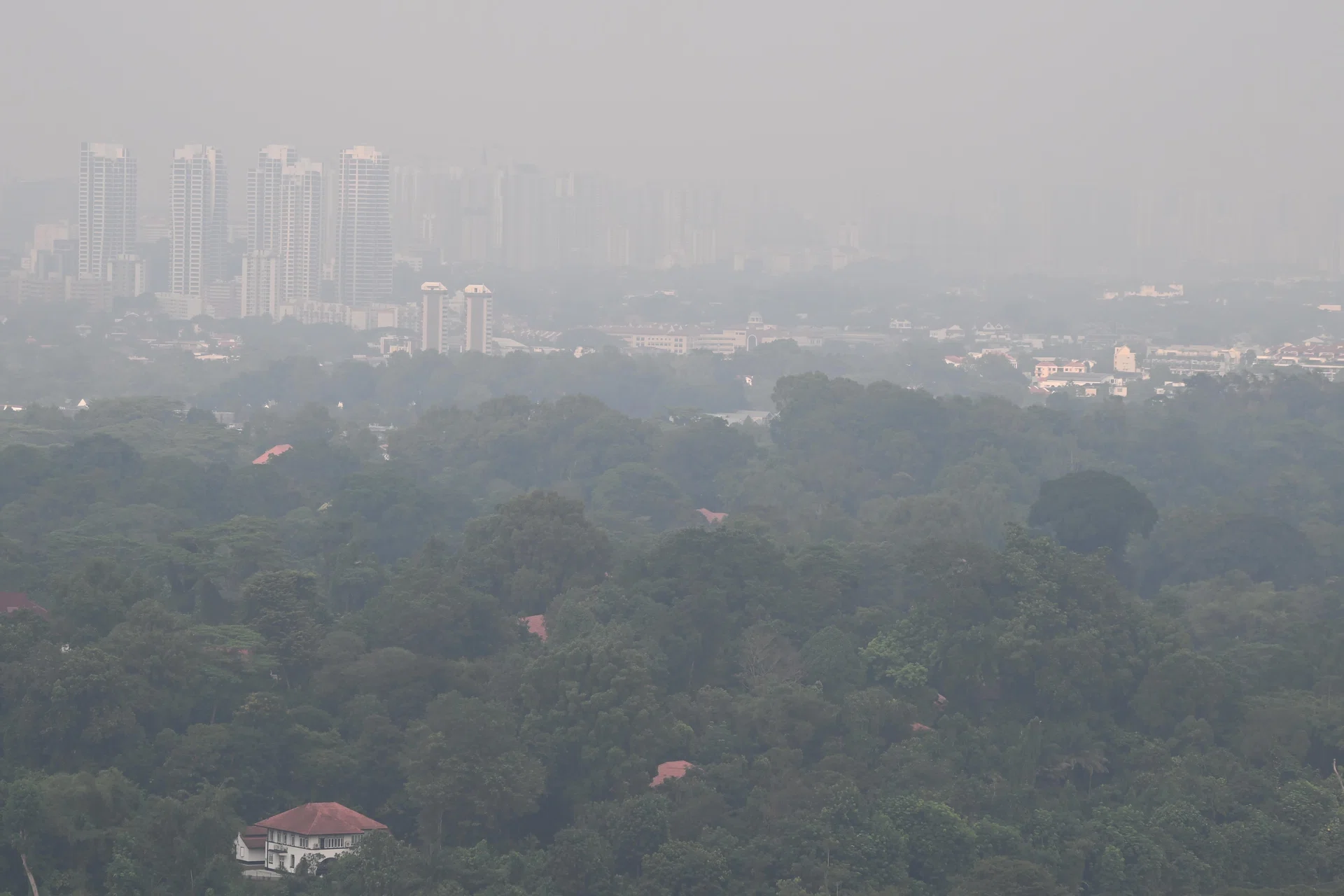
There's a specific rhythm to a haze week in Singapore. You wake up, open the myENV app before you open the curtains, and the number sitting at the top of the screen quietly reorganises your day — whether you run, whether you walk the dog, whether you leave the windows open, whether you bother to hang the laundry outside. If you happen to be browsing property listings at the same time, a second, stranger thought tends to follow: does this number have anything to do with what these homes are worth?
That's the question this piece tries to answer honestly. PSI Singapore readings move around a lot — from Good to Moderate and, in bad years, well into the Unhealthy range — but the property market moves on a much slower clock, driven by MRT lines, school distances, lease decay and supply pipelines. Working out where haze sits in that hierarchy, and where it genuinely doesn't, is more useful than either panicking or dismissing it.
The short version: haze is real, it changes how you live inside your home, and it has a cost. But it is almost certainly not something that shows up as a line item in the price you pay for an HDB flat or condo — and understanding why is the key to making sensible decisions with the money you actually control.
What the PSI Actually Measures — And What It Doesn't
Before you can reason about haze and property, you need to know which number you're looking at. Singapore's Pollutant Standards Index is published by the National Environment Agency (NEA), and it is not a single measurement. It's a composite: NEA computes sub-indices for six pollutants — PM10, PM2.5, sulphur dioxide, carbon monoxide, ozone and nitrogen dioxide — and the PSI you see is the highest of those sub-indices. Whichever pollutant is having the worst day sets the headline number.
Since April 2014, fine particulate matter (PM2.5) has been included in the PSI computation, which matters because PM2.5 — particles under 2.5 micrometres across, small enough to travel deep into the lungs — is the pollutant that does most of the work during a transboundary haze episode.
NEA reports the PSI in bands:
| 24-hour PSI | Descriptor | General health advisory |
|---|---|---|
| 0–50 | Good | Normal activities |
| 51–100 | Moderate | Normal activities |
| 101–200 | Unhealthy | Reduce prolonged or strenuous outdoor exertion |
| 201–300 | Very Unhealthy | Avoid prolonged or strenuous outdoor exertion |
| 301–500 | Hazardous | Minimise outdoor activity; N95 masks advised if you must be outdoors for hours |
NEA 24-hour PSI Bands and Their Upper Thresholds
The chart makes one thing obvious: the scale is heavily back-loaded. The Unhealthy band spans 100 points, the Very Unhealthy band spans 100 more, and the Hazardous band runs all the way to 500. A reading of 150 sounds alarming but sits mid-way through the second-lowest of the five bands — it is a long way from the readings that made June 2013 memorable, when the 24-hour PSI famously hit a record 401.
The Two Numbers You Should Actually Track
Here's where most people get confused, and where property viewings get misjudged:
- The 24-hour PSI is a moving average. It lags. A reading of 90 at 3pm can be the residue of a genuinely unpleasant morning, and a reading of 120 at 8am may already be improving.
- The 1-hour PM2.5 concentration is faster and noisier, and NEA publishes it alongside its own bands.
| 1-hour PM2.5 (µg/m³) | Descriptor |
|---|---|
| 0–55 | Normal |
| 56–150 | Elevated |
| 151–250 | High |
| 251–350 | Very High |
| Above 350 | Extremely High |
NEA 1-hour PM2.5 Bands (micrograms per cubic metre)
A practical rule: the 1-hour PM2.5 tells you about now; the 24-hour PSI tells you about the day; and the NEA forecast tells you whether to reschedule anything. For a property viewing, "now" is what matters most, because you'll be standing in a flat with the door open.
Haze in Singapore Is Seasonal and Regional — Not a Property Attribute
This is the single most important idea in this article, so it's worth being blunt about it.
Haze in Singapore is a transboundary phenomenon. It arrives when peatland and forest fires in the region — most commonly in parts of Sumatra and Kalimantan — burn during the local dry season, and prevailing winds carry the smoke across the Strait. The traditional haze season runs roughly June to October, coinciding with the Southwest Monsoon. Outside that window, the Northeast Monsoon and its rain tend to keep things clean.
Three consequences follow from that structure, and they explain almost everything about how (and whether) haze touches property values:
- It is citywide, not neighbourhood-specific. On a bad day, Pasir Ris and Jurong East are both breathing the same air mass. There is no "haze belt" in Singapore the way there is a flood-prone belt or a noise corridor.
- It is temporary and unpredictable. Some seasons pass with barely a flicker above Moderate. Others produce days that dominate the news. Buyers cannot underwrite a risk that has no reliable frequency.
- It is legally and politically live. Singapore's Transboundary Haze Pollution Act was passed in 2014, following regional agreements dating back to the 2002 ASEAN Agreement on Transboundary Haze Pollution. That's a signal of how the issue is framed here: as a regional and diplomatic problem, not a local planning one.
Contrast that with the risks that do get priced into Singapore homes. Noise from an expressway is permanent, daily and audible in a 20-minute viewing. A 60-year-old lease is on a clock. A 900-metre walk to the MRT is a fact that repeats every single morning. Haze is none of those things. It's weather with a geopolitical cause.
How Haze Changes Life at Home
None of the above means haze doesn't matter. It means haze matters at the household level rather than the valuation level. And at the household level, it changes quite a lot.
The Air Purifier Becomes a Fixture, Not an Accessory
In a bad week, an air purifier stops being a gadget and becomes infrastructure. Three things determine whether it actually helps:
- Filtration. "True HEPA" filters are defined by an industry standard of capturing 99.97% of particles at 0.3 microns — comfortably in the size range of haze particulates.
- Sizing. A widely cited rule of thumb is that a purifier's Clean Air Delivery Rate should be roughly two-thirds of the room's floor area in square feet. Undersized units circulate the same dirty air more energetically.
| Room | Approximate floor area | Illustrative CADR target (rule of thumb) |
|---|---|---|
| Small bedroom | ~10 sqm (108 sq ft) | ~70 cfm |
| Typical HDB bedroom | ~12–14 sqm (130–150 sq ft) | ~90–100 cfm |
| Living room (4-room flat) | ~20 sqm (215 sq ft) | ~145 cfm |
| Open-plan living/dining (5-room) | ~30 sqm (320 sq ft) | ~215 cfm |
- Noise and hours. The purifier only works while it's running. That means overnight noise, and it means electricity.
Sealing Is the Half of the Job Nobody Talks About
A purifier in a leaky room is a losing battle. Haze particles enter through paths that are easy to miss:
- Sliding window tracks — the gap between panels and the frame is rarely airtight, and the rail itself collects grit.
- Door undercuts and gaps — especially in older flats, where doors have settled.
- Bathroom and kitchen exhaust fans — when off, many are not sealed; backdraft can pull outdoor air in.
- Air-conditioning fresh-air intakes — some systems draw in outdoor air by design, which is fine on a clean day and unhelpful on a bad one.
- Open service yards, drying racks and balconies — the laundry drying outdoors is the classic tell.
The trade-off nobody enjoys: sealing a flat to keep haze out also keeps heat, cooking smells and humidity in. That's why air-conditioning and filtration are effectively a single system in a haze-ready home — you're not just cooling, you're recirculating and filtering.
The Cost Stack: What Haze Readiness Actually Costs
Rather than pretend to a precise national average, it's more honest to describe the categories and what drives them.
| Cost category | What drives it | Owner's control |
|---|---|---|
| Air purifiers | Number of rooms, CADR needed, filter type | High |
| Replacement filters | Runtime hours, filter grade, particle load | Medium |
| Electricity | Purifier runtime, aircon runtime, tariffs (EMA reviews household tariffs quarterly) | Medium |
| Window and door sealing | Window type, age, number of panels | Medium |
| Aircon servicing | Frequency of coil cleaning in dusty conditions | Medium |
| Cleaning and laundry | Dust film on surfaces, indoor drying, extra vacuuming | Low |
| Masks and consumables | Episode severity, household size | Low |
Two things are worth flagging. First, electricity is the sleeper cost — a purifier running 24/7 through a long episode adds to a bill that is already rising because you're closing the windows and running aircon instead of relying on cross-ventilation. Second, maintenance frequency rises: in dusty conditions aircon coils and filters clog faster, and humidity from drying laundry indoors creates its own problems.
HDB vs Condo: Different Envelopes, Different Problems
| Factor | Typical HDB flat | Typical private condo |
|---|---|---|
| Windows | Casement or sliding, often older seals | Full-height glazing, larger panels, tighter frames |
| Ventilation | Relies heavily on cross-breeze | Often aircon-led, sometimes with fresh-air provision |
| Air-conditioning | Split units, room by room | Split or VRF systems; some units aircon in every room |
| Balcony / service yard | Service yard with open louvres | Balcony doors, wider openings |
| Sealing difficulty | High in older blocks; many small gaps | Moderate; fewer but larger openings |
| Main haze complaint | Draughts and gaps, dust ingress | Heat when sealed, aircon dependence |
| Sound trade-off | Sealed windows often mean less street noise and less breeze | Full-height glass can amplify heat gain |
The counterintuitive takeaway: newer, heavily glazed condos are often easier to keep clean during haze but harder to keep comfortable without aircon, while older HDB flats are cooler and better ventilated but leakier. Neither is strictly better; they fail in different ways.
Do Buyers Discount Haze-Prone Homes? What the Evidence Suggests
Here's where we have to be careful, because the honest answer is: there is no established haze discount in Singapore residential pricing, and there are good structural reasons why.
Why Haze Doesn't Show Up in Transaction Data
- No labelling exists. Neither HDB resale data nor URA caveats carry an air-quality attribute. There is no variable to regress against.
- The exposure is regional, not project-level. Since a bad air day covers the whole island, there is no "control group" of clean districts to compare against.
- Frequency is too low to capitalise. Property prices capitalise recurring, predictable costs. A risk that appears in some years and not others, for a few weeks at a time, is very hard for a market to price.
- Buyers price permanence. What consistently moves Singapore resale values — MRT proximity, school distance, remaining lease, floor level, facing, noise — all share one property: they persist after you sign.
Where Air Quality Does Correlate With Price
This is the nuance that matters for a buyer. Air quality as a local, permanent characteristic absolutely does get priced — it's just not driven by transboundary haze. It's driven by things like:
- Proximity to industrial estates and workshops, which generate dust, odour and traffic independently of the haze season.
- Major road and expressway frontage, where particulate levels and noise both rise.
- Ground-floor units facing food centres, loading bays or bin centres, where cooking fumes and refuse odour are a daily reality.
- Poor internal ventilation — a unit that can only be cooled by opening windows is a unit that has no defence during a haze episode.
Those factors show up in the price you pay, because they are the same every week of the year. Haze simply amplifies them.
Where Haze Might Move Money Later
Two slow-burn channels are worth watching:
- The "shelter premium." As remote and hybrid work persists, the quality of the indoor environment becomes more economically relevant. A home you can comfortably spend three consecutive days inside — with aircon coverage in the room you work in, sealable windows and reasonable layout — is worth more to a remote worker than to someone who leaves at 8am.
- Episodic transaction friction. During a severe episode, viewings get postponed, open houses thin out and deals slip. That's a timing effect, not a pricing effect, but it's real if you're trying to sell.
The diagram above is the whole argument in one picture: seasonal haze should change how you prepare, while permanent local air-quality factors should change how you negotiate.
Reading a Home Through a Hazy Day: A Buyer's Checklist
A hazy day is, oddly, one of the most informative days to view a property. The air outside is a controlled stress test: you can see exactly how the building behaves when you'd rather keep it out.
Before You Book: Check the Advisories
- Open NEA's haze information on the myENV app or the NEA website. Look at the current 24-hour PSI, the 1-hour PM2.5, and the PSI forecast for the next 24 hours — all three, not just the headline.
- Check the regional picture. NEA's haze page includes hotspot counts and wind direction during the season. Hotspots plus a prevailing south-westerly is the combination that matters.
- Check school and workplace advisories. Under MOE's haze management measures, schools take action based on PSI thresholds, and MOM publishes guidance for outdoor work. If advisories are active, expect agents, sellers and other buyers to be distracted — reschedule if you can.
- Time it deliberately. If you have flexibility, viewing on a Moderate day tells you what the home is like most of the time. Viewing on a bad day tells you what it's like at its worst. Both are useful; know which one you're getting.
- Bring an N95 mask if the advisory level warrants it, and plan to spend limited time outdoors.
During the Viewing: What to Look At
| What to check | Why it matters | What it tells you |
|---|---|---|
| Aircon in every room | Rooms without aircon have no defence on a bad day | Directly affects habitability and future cost |
| Window type and condition | Seal quality determines infiltration | Older sliding tracks leak; gaskets degrade |
| Balcony and service yard doors | Wide openings are hard to seal | Check door sweeps and track condition |
| Cross-ventilation | Good airflow reduces aircon dependence on clean days | A trade-off against sealability |
| Floor level and orientation | Exposure to road dust, heat gain | Low floors face more road-level particulate and grime |
| Nearby sources | Industrial premises, workshops, eateries, loading bays | Permanent, priceable disamenity |
| Visible dust film and grille grime | Proxy for how the home has been maintained | Suggests cleaning and servicing frequency |
| Aircon servicing records | Filter and coil hygiene | Ask the seller or agent directly |
| Noise when windows are closed | The sealed-flat trade-off | Some units become noticeably stuffier and hotter |
Questions Worth Asking the Agent
- Does the unit have air-conditioning in every bedroom, and has it been serviced regularly?
- How old are the windows, and have the seals or gaskets ever been replaced?
- Is there any mechanical ventilation or fresh-air system, and can it be shut off?
- Has the unit been lived in full-time, or is it vacant part of the year?
- For higher floors facing open space: how much dust accumulates on the balcony or service yard ledges?
None of these questions are haze-specific in a narrow sense. They're questions about how well a home manages its boundary with the outdoors — which is exactly what haze forces you to think about.
The Equity Angle: Clean Air Is Purchasable
There's an uncomfortable thread running through all of this. The standard advice during a bad episode — stay indoors, close the windows, run an air purifier, keep the aircon on — quietly assumes a household can afford all three. NEA's advisories correctly single out vulnerable groups: children, the elderly, pregnant women and people with chronic heart or respiratory conditions.
But the practical ability to follow that advice is unevenly distributed:
- Air purifiers, filters and electricity are a recurring cost, not a one-off purchase.
- Homes without aircon in every room have fewer options when windows must stay shut.
- Smaller flats mean less buffer space — no spare room to retreat to, more reliance on shared air.
- Rental and older flats are more likely to have worn window seals that nobody is incentivised to fix.
This is a livability question with real weight, and it's one of the reasons housing analysis is more useful when it looks beyond price per square foot. Two flats can transact at the same PSF and offer completely different experiences of a bad week in September.
Food for Thought
- If haze episodes become more frequent or longer because of changing land-use and climate patterns, at what point does a recurring seasonal cost start behaving like a permanent one in buyers' minds — and would the market notice before the data does?
- Every dollar you spend on filtration, sealing and air-conditioning is a dollar that doesn't go into your down payment. How should a first-time buyer weigh resilience spending against purchase price?
- If a hazy day is the best day to inspect a home, why do almost all viewings happen on weekends regardless of air quality — and what does that say about how buyers actually make decisions?
- Should air quality be part of how we compare districts at all, given that transboundary haze is regional but local pollution is not?
- When you sell, will the next buyer care more about the MRT line or about how the flat behaves when the windows must stay closed?
The Bottom Line
PSI Singapore readings will keep fluctuating, and haze will keep arriving in some seasons and skipping others. It is a genuine household cost — in purifiers, filters, electricity, servicing and the everyday friction of sealed windows — and it's a genuine livability issue for households who can least afford to work around it.
But it is not, on current evidence, a district discount. It doesn't appear in the caveats or the resale index, because it isn't permanent, isn't local, and isn't predictable enough for a market to capitalise. What does get capitalised is the underlying hardware of comfort: aircon coverage, window quality, ventilation, layout, and the permanent local sources of poor air that sit down the road. Shop for those, and haze takes care of itself.