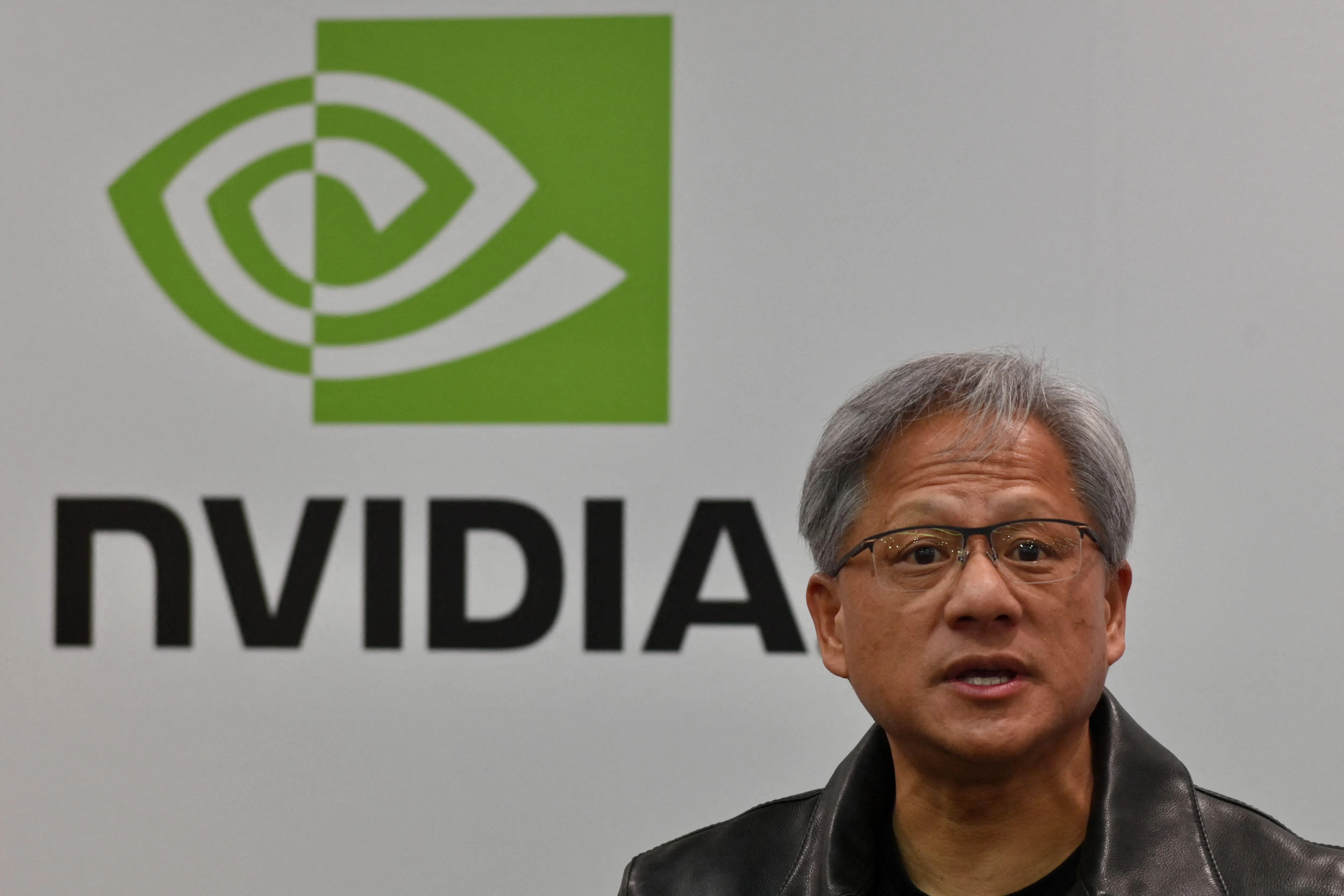
Jensen Huang rarely talks about real estate. He talks about tokens, teraflops, and "AI factories" — the phrase he has used repeatedly to describe what a modern data centre actually is. But strip away the jargon and the Nvidia chief executive's message translates into something very concrete for Singapore: the AI boom has a physical footprint, and that footprint is measured in megawatts, floor area, and industrial land leases.
Every headline-grabbing AI model — every chatbot answer, every generated image, every autonomous system trained on millions of hours of video — is manufactured inside a building. That building needs power, cooling, fibre, and a plot of land zoned for heavy industrial use. In Singapore, where land is scarce and the grid is finite, that combination has turned data centres into arguably the hottest segment of the industrial property market.
This is the story of how an American chip designer's rhetoric became a Singapore land-use story — and what it means for rents, REITs, and anyone watching the city-state's property market from the outside.
Why an AI Boom Is Really a Property Boom
Huang's core argument, made across a string of appearances through 2024 and 2025, is that the world is at the beginning of a multi-year build-out of computing infrastructure. He has described data centres not as cost centres but as factories — facilities that manufacture intelligence as an output. That reframing matters because factories are, by definition, industrial property.
The logic chain is short:
- AI models get bigger, so they need more compute to train.
- More compute means more GPUs, which means more racks, more power draw, and more heat to remove.
- More racks and heat mean purpose-built buildings — high floor loading, liquid cooling infrastructure, redundant power feeds, and enormous substation capacity.
- Those buildings need land in places with reliable electricity, strong connectivity, and political stability.
That last point is where Singapore has historically punched far above its weight — and where it recently ran into its own limits.
The diagram above is essentially the transmission mechanism. It explains why a semiconductor company's product roadmap shows up, eventually, in Singapore's industrial rental index and in the unit prices of SGX-listed REITs.
There is one more layer that makes Singapore's case unusual: power. Data centres are among the most electricity-intensive buildings on earth. Singapore's data centre sector has been reported to account for roughly 7% of national electricity consumption — a strikingly high share for a single property type, and one that explains why the government treated the sector's growth as a national infrastructure question rather than a routine planning matter.
Reported Share of Singapore Electricity Consumption (c.2021 estimates)
That single number — around 7% — is the reason Singapore's data centre story has been shaped as much by energy policy as by property policy. It is also why the sector's expansion since 2022 has been choreographed rather than unrestricted.
From Moratorium to Roadmap: How Singapore Reopened the Tap
To understand today's data centre property market, you have to go back to 2019. That year, Singapore imposed a moratorium on new data centre construction — a pause that surprised many in the industry given how central the city-state had been to the region's connectivity map.
The rationale, as explained by the authorities at the time, was straightforward: the sector's electricity and water demands were growing faster than the grid and sustainability commitments could comfortably absorb, and Singapore wanted time to work out a framework that allowed growth without undermining its climate targets.
The pause was never intended to be permanent, and in 2022 it was lifted — but on new terms. New projects would need to be demonstrably efficient, with operators reportedly required to meet stringent power usage effectiveness standards and to demonstrate a pathway towards greener operations. Capacity was released selectively rather than by open floodgate.
Then came the more consequential step. In May 2024, Singapore's Infocomm Media Development Authority published its Green Data Centre Roadmap, setting out a plan to add at least 300MW of data centre capacity in the near term, with a further up to 200MW to be unlocked through green energy deployment. In a market where power, not land, is the binding constraint, that 300MW figure was the equivalent of a major rezoning announcement.
Singapore's Planned Data Centre Capacity Additions (MW) — IMDA Green Data Centre Roadmap, 2024
Put in context: industry estimates typically put Singapore's existing installed data centre capacity in the region of 1 gigawatt, depending on how capacity is counted. Adding several hundred megawatts is therefore not a marginal adjustment — it is a material expansion of one of the most concentrated digital infrastructure clusters in Asia.
The sequencing is important for property watchers. A moratorium suppresses supply. Suppressed supply, in the face of growing demand, compresses vacancy. And compressed vacancy, in any property sector, is the classic precondition for rental growth. Singapore's industrial landlords spent those years holding an asset class that could not be built — which is a very good position for an incumbent to be in.
| Period | Policy stance | Implication for industrial property |
|---|---|---|
| 2019–2021 | Moratorium on new data centres | New supply frozen; incumbent capacity became scarcer |
| 2022–2023 | Selective approvals with green criteria | Only the most efficient, best-capitalised operators could build |
| 2024 onward | Green Data Centre Roadmap; 300MW + up to 200MW | Controlled release of new supply, still gated by power and efficiency |
| Ongoing | Regional grid imports and green energy sourcing | Long-term constraint remains energy, not land alone |
Where Singapore's Data Centres Actually Are
Data centres are not evenly distributed across the island. They cluster, and they cluster for reasons that property investors should understand: proximity to substations and transmission infrastructure, dense fibre routes, industrial zoning, and — increasingly — the availability of land parcels large enough to host a modern hyperscale campus.
The commonly identified clusters include:
- Loyang and the eastern industrial belt — one of Singapore's most established data centre corridors, benefiting from industrial land, proximity to Changi, and access to submarine cable landings that connect the island to the wider region.
- Tai Seng, MacPherson and the central-east industrial estates — older flatted factory and industrial stock that has been progressively upgraded or redeveloped, sitting close to the city and to major fibre routes.
- Serangoon North and the north-east — an established data centre presence within industrial estates, close to residential catchments and key power infrastructure.
- Jurong and the western industrial heartland — historically Singapore's manufacturing spine, with heavy power infrastructure that suits large-scale facilities.
- City-fringe and Kallang-area locations — valuable for low-latency workloads serving financial services and enterprise clients, though land constraints here are the tightest of all.
| Cluster | Typical appeal | What constrains it |
|---|---|---|
| Loyang / eastern belt | Large industrial parcels, cable connectivity | Longer distance from the CBD |
| Tai Seng / MacPherson | Central location, older stock ripe for redevelopment | Site sizes are small by hyperscale standards |
| Serangoon North / north-east | Established cluster, power access | Limited room to expand materially |
| Jurong / west | Power infrastructure, industrial zoning | Competing demand from advanced manufacturing |
| City fringe | Lowest latency | Scarce and expensive land |
What unites these clusters is a shared constraint: the grid. Singapore's power system is gas-dominated, and the country's carbon tax is scheduled to rise from S$25 per tonne of emissions in 2024 and 2025 towards S$45–50 per tonne in 2026 and 2027. For an industry that consumes electricity in vast quantities, a rising carbon price is not an abstraction — it is an operating cost line that shapes where and how new capacity gets built.
That is why the 2024 roadmap's emphasis on green energy is not merely reputational. It is the mechanism by which additional megawatts become politically and economically viable.
The Industrial Property Ripple: Rents, Land, and the Scarcity Premium
Here is where the story stops being about technology and starts being about property economics.
Singapore classifies data centres as industrial property. That means they sit inside the same broad asset class as factories, warehouses, and business parks — and they compete for the same land, the same JTC-administered leases, and the same pool of industrial-zoned sites. When data centre operators bid for a site, they bid against logistics developers and advanced manufacturers.
Three dynamics follow:
1. A two-tier industrial market emerges. Generic older flatted factories in peripheral locations face soft demand and long lease-up periods. Purpose-built, power-rich, connectivity-rich data centre facilities face something closer to the opposite. The industrial rental index smooths this out, but underneath it, the divergence is real — the gap between a twenty-year-old factory unit and a modern high-specification data hall has widened.
2. Land values reflect power and connectivity, not just location. In most real estate, the mantra is location, location, location. In data centres, it is power, power, power — followed closely by fibre. A site with an available substation and diverse fibre routes can command a substantial premium over a nominally similar plot without them.
3. Lease structures suit long-duration capital. Data centre leases to hyperscale tenants tend to be long, with contractual escalation built in. That income profile is precisely what REIT investors chase: predictable, inflation-linked, and backed by tenants with investment-grade balance sheets.
Singapore's data centre rents have been reported among the highest in Asia-Pacific — a function of scarcity, land cost, and the premium tenants place on latency and jurisdiction. Operators can accept those rents because their end customers — banks, cloud providers, AI labs — value proximity to Singapore's financial and connectivity ecosystem more than they value a cheaper square metre somewhere else.
Where Johor Fits In
No discussion of Singapore data centres is complete without Johor. The Malaysian state bordering Singapore has become a magnet for data centre investment, drawn by cheaper land, cheaper power, faster approvals, and — critically — proximity to Singapore's cable landings and talent pool.
Jensen Huang's own regional footprint has touched this dynamic directly. Nvidia's partnership with YTL Power to build AI infrastructure in Johor — an arrangement announced in late 2023 and developed through 2024 — put a Nvidia-powered AI supercomputer in Kulai, on Singapore's doorstep. Other hyperscalers and operators have announced projects in the state as well, and Johor's pipeline has been reported in the gigawatts.
The practical division of labour that has emerged looks like this:
That division is not zero-sum. A healthier Johor ecosystem can take pressure off Singapore's grid while keeping the region's overall compute capacity growing — and Singapore retains the high-value, high-rent, interconnect-dense workloads that justify its cost base. For Singapore industrial landlords, the risk is not Johor's rise in the abstract; it is the specific scenario in which bulk AI training demand shifts north faster than premium enterprise demand can backfill.
How Investors Get Exposure: Singapore's Listed Data Centre Vehicles
For most young Singaporean investors, direct ownership of a data centre is not on the table. The realistic route is through listed vehicles — and Singapore happens to be one of the best markets in the world for this, having pioneered the data centre REIT structure in Asia.
| Vehicle | Listing | Nature of data centre exposure | Why it matters to the sector |
|---|---|---|---|
| Keppel DC REIT | SGX, listed 2014 | Pure-play data centre REIT | Widely regarded as Asia's first pure-play data centre REIT; diversified across Asia-Pacific and Europe |
| Digital Core REIT | SGX, listed 2021 | Pure-play, US and Canada focused | Sponsored by a major global data centre operator; gives Singapore investors direct exposure to US carrier-hotel assets |
| Mapletree Industrial Trust | SGX | Diversified industrial REIT with substantial data centre weight | Expanded into US data centres from 2019, shifting its income mix towards digital infrastructure |
| CapitaLand Ascendas REIT | SGX | Diversified REIT with data centre assets | Holds data centre properties in Singapore and Europe alongside business parks and logistics |
Several themes run through this group:
- Pure-plays versus diversified exposure. Keppel DC REIT and Digital Core REIT offer the most direct read on data centre fundamentals. The diversified REITs offer the same theme with a cushion of warehouse, business park, and factory income alongside it.
- Geography matters enormously. A portfolio concentrated in Singapore and Europe behaves very differently from one concentrated in the United States, where power availability, lease structures, and tenant concentration all differ.
- Income quality is the selling point. Long leases with contractual escalations to large, creditworthy tenants produce the kind of visible cash flow that income-focused investors prize.
What data centre REITs are not, however, is a pure play on Jensen Huang's keynote rhetoric. They are leveraged, rate-sensitive, listed vehicles whose unit prices respond to interest rates and financing costs as much as to AI enthusiasm. That distinction has burned investors before and will again.
Beyond the REITs, there is a deep bench of private and sponsor-backed operators active in Singapore — including the data centre arms of Singapore-headquartered groups and global players such as Equinix, Digital Realty, and AirTrunk, alongside regional operators expanding across Southeast Asia. Their expansion decisions are, in effect, the demand signal that feeds back into industrial land values.
Land Allocation, Power, and the Policy Balancing Act
Singapore's approach to data centres is best understood as an attempt to have it both ways — and, to a large degree, to succeed at it.
The country wants the economic value: high-skilled jobs, digital infrastructure that attracts financial services and cloud investment, and the strategic importance of hosting critical compute onshore. It does not want an unbounded electricity bill or a carbon problem it cannot meet under its net-zero by 2050 commitment.
The policy levers available are few and blunt:
- Land release. Industrial land is controlled through state planning and JTC-administered leases, typically far shorter than freehold. That gives the state the ability to shape where data centres go and how long they stay.
- Power allocation. Electricity supply, not floor area, is the true gate. A roadmap that speaks in megawatts is a roadmap that rations the actual scarce input.
- Efficiency standards. Requiring best-in-class power usage effectiveness effectively selects for well-capitalised operators who can afford advanced cooling, liquid cooling readiness, and energy-efficient designs.
- Green energy sourcing. Regional grid imports and renewable energy partnerships are the mechanism by which the next tranche of capacity becomes defensible.
For the industrial property market, this produces a distinctive pattern: supply growth that is real but deliberately paced. That is a far more comfortable environment for landlords than either a hard freeze or an unrestricted boom. It supports rents without creating the kind of gluttonous oversupply that has periodically wrecked other industrial sub-sectors.
It also raises the value of existing, already-powered capacity. A facility that secured its grid allocation before the current framework tightened is, in effect, holding a licence that cannot be easily replicated.
The Risks Worth Watching
Any analysis that presents data centres as a one-way bet is incomplete. Four risks deserve attention:
- The AI capex cycle. Hyperscaler capital expenditure has been extraordinary, but it is not infinite. If AI monetisation disappoints, the growth rate of new capacity commitments could slow sharply — and property markets price the second derivative, not just the direction of travel.
- Rate sensitivity. Data centre owners and REITs are heavy users of debt. Higher-for-longer financing costs compress both valuations and distributions, regardless of how full the racks are.
- Regional competition. Johor's cheaper cost base is a genuine structural competitor for bulk workloads. The question is whether Singapore's premium positioning holds if the mix of AI workloads shifts towards training and away from latency-sensitive inference.
- Resource intensity. Water for cooling and electricity for compute are both under scrutiny. Public tolerance for resource-heavy development is a variable that no financial model captures well.
What This Means for Young Singaporeans
If you are in your late twenties or thirties, watching property prices with a mixture of ambition and resignation, the data centre story may feel remote. It is worth connecting the dots.
- Industrial property is not just factories. The segment now contains some of the most sophisticated, best-capitalised, longest-leased assets in the country. Its performance has become a meaningful driver of listed REIT returns that many Singaporeans hold through their CPF Investment Scheme portfolios and brokerage accounts.
- Jobs follow the clusters. Data centre operations, network engineering, cloud architecture, and increasingly AI infrastructure roles cluster geographically. Where capacity is built shapes where these careers are based.
- Policy allocation is a signal of national priority. When a government publishes a roadmap measured in megawatts and ties it to green energy, it is signalling that this sector sits close to the centre of its economic strategy — alongside advanced manufacturing and financial services.
- Scarcity is the whole thesis. Singapore's data centre market is fundamentally a scarcity story: scarce power, scarce land, scarce approvals. Scarcity is what makes assets valuable — and also what makes them politically sensitive.
The uncomfortable question for a young investor is whether the AI enthusiasm embedded in today's data centre valuations is a durable structural shift or a cyclical peak dressed up as a paradigm change. Both possibilities are live.
Food for Thought
- If power, not land, is the true constraint on Singapore's data centre growth, what happens to industrial land values if grid capacity stops being the bottleneck — say, through large-scale regional green energy imports?
- Johor can build faster and cheaper. As the regional compute map matures, which Singapore data centre workloads are genuinely defensible — and which are simply waiting for a cheaper alternative to appear?
- Data centres reportedly consume around 7% of Singapore's electricity. Is there a share at which the public conversation shifts from "strategic asset" to "resource burden" — and what would that do to rents?
- Data centre REITs are income vehicles that trade like rate-sensitive bonds. If you bought the AI narrative through them in 2024, did you actually buy AI — or did you buy duration?
- Singapore's state-controlled industrial land lease system gives policymakers extraordinary leverage over this sector. Should that leverage be used to prioritise AI compute, advanced manufacturing, or something else entirely?
The Building Behind the Boom
Jensen Huang's stagecraft makes the AI revolution feel like software — weightless, instant, infinite. The reality in Singapore is the opposite. It is substations and cooling towers, thirty-year leases and power purchase agreements, industrial land tenders and urban planning consultations.
That contrast is precisely why the data centre segment has become the most interesting corner of Singapore's industrial property market. It sits at the intersection of a global technology cycle, a national energy strategy, and a land-scarce city-state's determination to stay relevant in both. The rents reflect it. The REIT portfolios reflect it. And the policy roadmap, measured in megawatts, reflects it most of all.