Two Singaporean couples, both buying their first home, both signing for a four-room resale flat in the same block on the same weekend. One ends up servicing a mortgage of roughly $340,000. The other borrows closer to $460,000. Nothing about the flat changed — only the stack of HDB subsidies each couple claimed.
That gap is not a hypothetical. It is the arithmetic of Singapore's housing grant system as it stands for buyers entering the market in 2026, where the headline numbers were recently raised, several ceilings moved, and a handful of quiet conditions can still quietly strip tens of thousands off what lands in your CPF Ordinary Account.
This is a practical guide to HDB grants in 2026: what each one actually does, which ones you can legitimately combine, which ones are mutually exclusive, and how to work out your true effective purchase price before you sign anything.
Why 2026 Is a Different Grant Year
If your mental model of HDB grants was formed before late 2024, it is out of date. The October 2024 BTO exercise marked the biggest reset of first-timer support in years, and those parameters are the baseline that carries into 2026.
The three big shifts:
- The Enhanced CPF Housing Grant (EHG) was raised to up to $120,000, from a previous maximum of $80,000 — a 50% increase in headline support.
- The EHG income ceiling moved from $9,000 to $14,000 in monthly household income, which pulled a large band of middle-income households back into eligibility for the first time.
- The income ceiling for buying a new BTO flat rose to $14,000 for families, with a higher ceiling of $21,000 for extended and multi-generation families.
At the same time, the loan side tightened. The Loan-to-Value (LTV) limit for HDB concessionary loans was cut from 80% to 75%, which means a bigger share of your purchase must come from CPF savings, grants or cash. The Mortgage Servicing Ratio (MSR) — which caps your HDB flat mortgage at 30% of gross monthly income — remains in force, as does the 55% Total Debt Servicing Ratio (TDSR).
The net effect for 2026 buyers is this: grants are more generous, but leverage is more constrained. That combination makes grant stacking disproportionately valuable. Every dollar of grant is a dollar you do not need to borrow, and it is also a dollar that helps you clear the MSR hurdle.
Since 2024, new flats have also been sold under the Standard, Plus and Prime classification framework rather than the old mature/non-mature split. Standard flats carry a five-year Minimum Occupation Period (MOP) and no subsidy clawback. Plus and Prime flats come with a 10-year MOP, resale eligibility conditions, rental restrictions, and a subsidy recovery clawback when you eventually sell. That is a genuine trade-off against a lower launch price — and it changes the lifetime value calculation in ways a simple "cheaper flat" comparison misses.
A necessary caveat: HDB reviews grant parameters at each BTO launch, and individual eligibility depends on your citizenship mix, income, flat type, lease length and family circumstances. Treat every figure below as a planning baseline and verify the current numbers on HDB's official pages or calculators before committing.
The HDB Grants You Can Stack, Explained Plainly
There are four core grants in the stack, plus a smaller scheme for singles and one for families in rental housing. Each one is designed for a different buyer profile — and that is exactly why they can be combined.
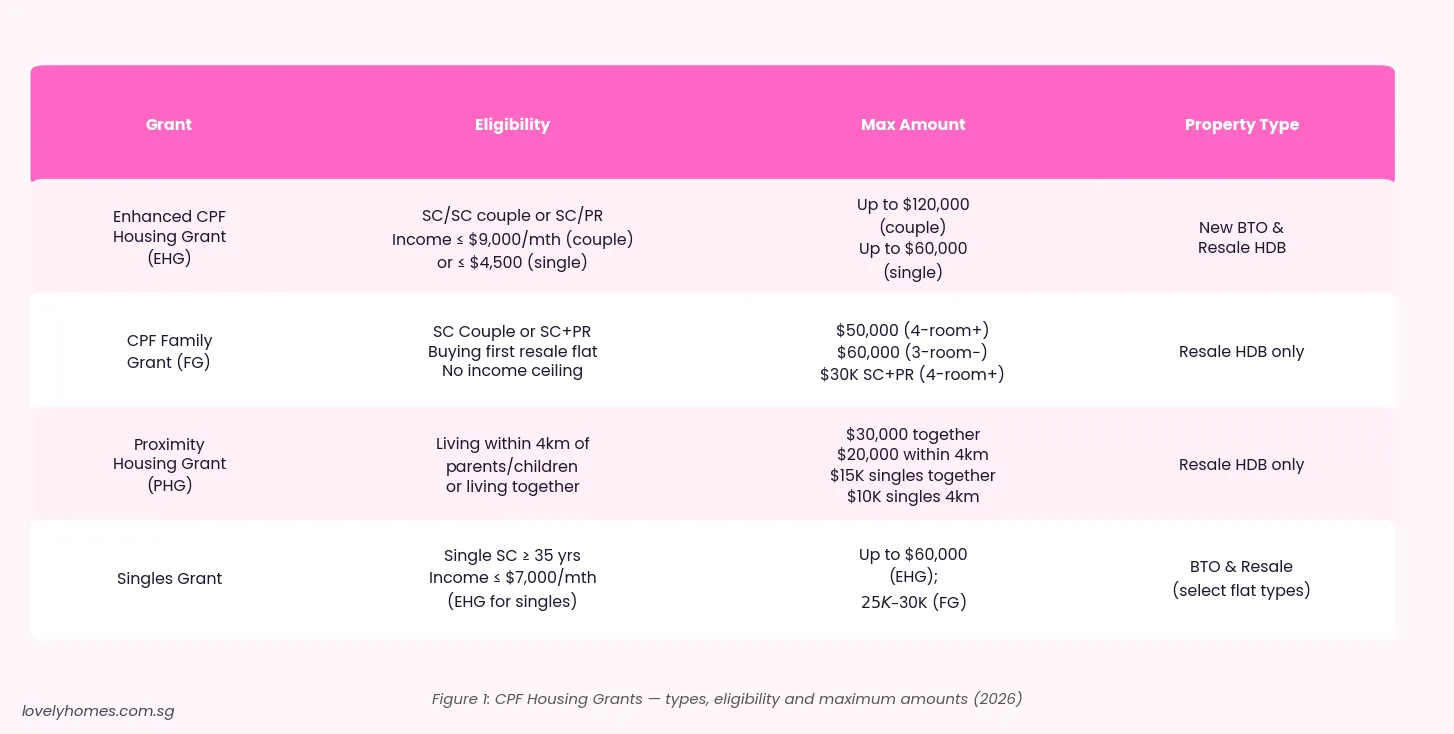
1. Enhanced CPF Housing Grant (EHG)
What it is: The broadest, largest and most stackable grant available. It applies to both new BTO flats and resale flats.
Who gets it: First-timer households. For families, the maximum is up to $120,000, with the exact quantum tapering down as household income rises, and eligibility ending at the $14,000 monthly income ceiling. For single Singapore Citizens aged 35 and above, the equivalent maximum is up to $60,000 against a $7,000 income ceiling.
How it is paid: Credited into your CPF Ordinary Account and applied to the flat purchase. It is not cash in hand, and it is not repayable.
Key detail: The EHG has no restriction on flat size. A five-room resale flat qualifies just as a three-room does.
2. CPF Housing Grant for Families — the "Family Grant"
What it is: The resale-specific grant for first-timer families. It does not apply to new BTO flats, because the subsidy for new flats is already baked into the launch price.
How much: $80,000 for a four-room or smaller resale flat, and $50,000 for a five-room or larger flat, including executive flats. The income ceiling is $14,000.
How it is paid: Into CPF OA, applied to the purchase.
Key detail: The size distinction is the single most overlooked detail here. Two households with identical incomes and similar flats can differ by $30,000 purely because of the room count on the title.
3. Proximity Housing Grant (PHG)
What it is: A grant for buying a resale flat to live with or near your parents or your married child. It is open to first-timers and second-timers alike, and there is no income ceiling.
How much:
- $30,000 if you live together with your parents or child
- $20,000 if your flat is within 4km of theirs
- For singles: $15,000 and $10,000 respectively
Key detail: The PHG is the most commonly forfeited grant in Singapore, almost entirely because buyers do not measure the distance. Four kilometres is measured as the crow flies, not by road. If you are anywhere near the boundary, check it properly before shortlisting.
4. Step-Up CPF Housing Grant
What it is: A $15,000 grant for eligible second-timer families upgrading from a smaller flat (a two-room Flexi or three-room flat in a non-mature estate) to a four-room or larger resale flat in a non-mature estate.
Who gets it: Second-timers only — the group that otherwise receives nothing from the EHG or Family Grant.
Key detail: This is the grant most second-timers have never heard of. It exists specifically to keep the upgrading ladder moving at the lower end of the market.
The singles stack
Single Singapore Citizens aged 35 and above buying a resale flat have their own combination: the EHG at their own tier, plus the CPF Housing Grant for Singles on flats of four rooms or smaller, plus the Proximity Housing Grant at the singles' tier if they live with or near their parents. Since the October 2024 changes, singles can also apply for two-room Flexi BTO flats in all locations rather than only in non-mature estates.
Fresh Start Housing Scheme
A separate scheme exists for second-timer families with children who are currently living in public rental housing, designed to help them buy a two-room Flexi flat. It has been progressively enhanced in recent years. If you know anyone in that situation, it is worth a direct conversation with HDB rather than a general read of the grant pages.
The summary table
| Grant | First-timer families | Second-timer families | Singles 35+ | New BTO | Resale | Income ceiling |
|---|---|---|---|---|---|---|
| Enhanced CPF Housing Grant | Up to $120,000 | No | Up to $60,000 | Yes | Yes | $14,000 / $7,000 singles |
| CPF Housing Grant (Family) | $80,000 / $50,000 | No | Variant applies | No | Yes | $14,000 |
| Proximity Housing Grant | $30,000 / $20,000 | Yes | $15,000 / $10,000 | No | Yes | None |
| Step-Up CPF Housing Grant | No | $15,000 | No | No | Yes | Conditions apply |
| Fresh Start Housing Scheme | No | Qualifying families | No | Two-room Flexi | No | Conditions apply |
Which HDB Grants Stack? The Combination Rules
This is where most of the money is won or lost. The rules are less complicated than people assume — but they are structured around one distinction that determines everything: are you a first-timer or a second-timer?
The maximum stacks, illustrated
Maximum HDB Grant Stack by Scenario (SGD)
Read that chart carefully, because it makes three points that matter.
First, resale can beat BTO on grant volume — by a wide margin. A first-timer family buying a four-room resale flat within 4km of their parents can theoretically stack $220,000. A BTO buyer tops out at the EHG of $120,000, because the Family Grant and PHG are resale-only instruments. The BTO buyer's compensation is a lower launch price, which is real but opaque; the resale buyer's compensation is visible, stackable, and immediate.
Second, the room count matters enormously. Dropping from a four-room to a five-room resale flat reduces the maximum stack from $220,000 to $190,000 in the same location with the same income. That is a $30,000 swing for one extra bedroom.
Third, second-timers operate in a completely different market. With a maximum stack of roughly $35,000 (PHG plus Step-Up), they are largely self-funding. This is by design — the system prioritises first-timers — but it is also why so many upgraders are surprised by their numbers.
The rules in plain language
- EHG and the Family Grant stack with each other for first-timer families buying resale. They are separate grants with separate eligibility criteria that happen to have the same income ceiling.
- The PHG stacks with both. It is the most combinable grant in the system, because it has no income ceiling and is open to second-timers.
- The EHG and Family Grant do not apply to second-timers at all. There is no partial version.
- The Step-Up grant does not combine with the EHG, because the Step-Up grant is restricted to second-timers and the EHG to first-timers. The two groups never overlap.
- The PHG is resale-only. There is no proximity grant on a new BTO flat.
The timing point is worth dwelling on. Grants are credited at completion, not at application. You still need to fund the option fee and exercise fee in cash up front (typically up to $1,000 plus up to $4,000 on the resale market, and part of the purchase price). Your grants arrive as a credit against the price at the end, not as cash you can deploy along the way.
The Fine Print That Quietly Shrinks Your Grant
Here is where the "money on the table" problem actually lives. Four conditions routinely reduce or eliminate grants that buyers believed they had already secured.
1. The lease-to-95 rule
If the resale flat's remaining lease does not cover your youngest buyer to age 95, both your CPF usage and your grants are pro-rated. A flat with a 60-year lease remaining, bought by a 35-year-old, is a straightforward case. A flat with 40 years remaining, bought by someone in their late forties, is not — and the reduction is proportional, not trivial.
This is also the reason very old flats with short leases trade at a steep discount. Part of that discount is the market pricing in the fact that the next buyer will face the same pro-ration, and may not be able to use their full CPF or receive full grants.
2. Valuation versus price
Your HDB loan is capped at 75% of the lower of the purchase price or the HDB valuation. If you agree to pay above valuation, the excess — the Cash Over Valuation, or COV — must be paid in cash, and it is not covered by grants or CPF. In a rising resale market, COV reappears quietly, and it can undo a meaningful chunk of your grant stack.
3. The resale levy
Second-timers buying a second subsidised flat pay a resale levy, which is a fixed amount based on the type of your first subsidised flat. It is not a grant reduction on paper, but it is a direct deduction from the proceeds of your first flat. For upgraders, the levy should be subtracted before you compare any grant package. The Step-Up grant and the PHG can be worth less than the levy you owe, depending on what you are selling.
4. The private property wait-out period
If you or your spouse owned private residential property, you generally must observe a wait-out period before buying a resale HDB flat, and grants are typically unavailable unless you meet the first-timer definition (which requires no prior property ownership within the prescribed lookback). Buyers who assume that selling a condo instantly resets them to first-timer status are frequently wrong.
5. The Plus and Prime clawback
If you buy a Plus or Prime BTO flat, the lower launch price is real — but a portion of the subsidy is clawed back when you first sell, calculated as a percentage of the resale price with interest applied. Plus and Prime flats also carry a 10-year MOP, tighter rental rules and resale buyer eligibility conditions. The lower price is not free money; it is a deferred, conditional subsidy. Compare it against a Standard flat's full resale upside, not against the headline price alone.
How to Calculate Your Effective HDB Purchase Price, Step by Step
Most buyers compare flats on the sticker price. That is the wrong number. The number that determines your monthly cash flow is the effective purchase price: the agreed price, minus your grant stack, plus unavoidable transaction costs.
Step 1: Establish the real price
Take the lower of the agreed price and the HDB valuation as the base for your loan calculation. Any COV is a separate cash line.
Step 2: Subtract your grant stack
Work through the eligibility table above in order: first-timer status, then flat size, then proximity, then whether you are upgrading from a small flat.
Step 3: Add the unavoidable costs
Buyer's Stamp Duty on a residential property follows the current schedule: 1% on the first $180,000, 2% on the next $180,000, 3% on the next $640,000, rising in bands above that. On a $560,000 flat, that works out to $11,400. Add legal conveyancing fees and the valuation fee, typically in the low thousands combined.
Step 4: Split the funding
Your LTV cap is 75% for an HDB loan. The remaining 25% must come from CPF OA (including grants) or cash. Your grants are credited to CPF OA, so in practice a large grant stack can cover the entire downpayment requirement and then some.
Step 5: Stress-test against MSR and TDSR
The MSR caps your HDB flat mortgage at 30% of gross monthly income. The TDSR caps all your debt obligations at 55%. A big grant stack lowers the loan you need, which directly raises your maximum affordable price.
Step 6: Confirm the lease runs to 95
If it does not, redo Step 2 with pro-rated grants.
Worked example: four-room resale flat at $560,000
Assumptions: first-timer Singaporean couple, combined income within the EHG-eligible band, buying a four-room resale flat in a non-mature estate, living within 4km of one set of parents.
| Line item | Amount |
|---|---|
| Agreed resale price (four-room, non-mature estate) | $560,000 |
| Less: CPF Housing Grant (Family Grant, four-room or smaller) | −$80,000 |
| Less: Proximity Housing Grant (within 4km) | −$20,000 |
| Less: Enhanced CPF Housing Grant (top tier shown) | −$120,000 |
| Effective purchase price | $340,000 |
| Plus: Buyer's Stamp Duty | +$11,400 |
| Plus: Conveyancing and valuation | +$2,000–$3,000 |
| All-in outlay | ≈$353,000–$354,000 |
Financed as a $340,000 HDB loan at the concessionary rate, plus the grants sitting in CPF OA. On a 25-year tenure, that loan services at roughly $1,540 a month, which would require gross household income of about $5,100 to satisfy the 30% MSR.
Now run the sensitivity. Your EHG quantum depends on your assessed income, and it is the one line in that table you cannot control by choosing a different flat.
Effective Purchase Price vs EHG Quantum (4-Room Resale at $560,000)
The spread between the top and bottom of that chart is $120,000 on the same flat. That is the scale of the "money on the table" question — and it is why the income ceiling change from $9,000 to $14,000 mattered so much. Households that were previously locked out of the EHG entirely are now somewhere on that curve rather than off it.
The impact on MSR
Because the MSR is a ratio, grants do double duty. Every $100,000 of grant reduces your required loan by $100,000, which reduces your monthly instalment by roughly $450 on a 25-year tenure, which reduces the income you need to qualify by roughly $1,500 a month. On a $220,000 stack, that is the difference between qualifying and not qualifying for a large share of Singaporean households.
What to Watch in 2026
Three things will shape how the grant stack behaves over the next twelve months.
The resale market's momentum. HDB resale prices have risen sharply over the past five years, and the compounding effect is significant:
HDB Resale Price Index, Annual Change (%)
Source: HDB Resale Price Index, annual changes. Reported figures through 2025 point to continued but more measured growth.
Here is the subtle point about grants in a rising market: grant quantums are fixed in dollars, but flat prices are not. A $220,000 stack covers a materially smaller share of a flat that has appreciated than it did when the parameters were set. If prices keep climbing, the real value of the stack declines — which is an argument for acting on eligibility sooner rather than later, and an argument for paying close attention to whether HDB revises the quantums at the next launch.
Interest rates and the HDB loan comparison. The HDB concessionary loan is pegged at the CPF Ordinary Account rate plus 0.1 percentage point. When market rates fall, bank packages can become competitive with it; when they rise, the HDB loan's stability becomes valuable. The relevant point for grant planning is that the HDB loan is not automatic. It has eligibility conditions including income ceilings and citizenship requirements, and switching from a bank loan back to an HDB loan is not straightforward. Check your eligibility before you assume you have the option.
Supply and the Standard/Plus/Prime framework. The ongoing BTO pipeline and the Standard/Plus/Prime classification continue to reshape what "good value" means. A Prime flat with a lower price, a 10-year MOP and a subsidy clawback is not straightforwardly better than a resale flat with a $220,000 stack and a five-year MOP. The comparison depends on your holding horizon, your income trajectory, and whether you intend to sell into the same market you bought from.
Five Ways Buyers Leave Money on the Table
- Not measuring the 4km. The PHG is worth $20,000 for families and it is lost entirely by distance. Measure it properly before you set your shortlist, because it can change which flats are worth viewing at all.
- Assuming they earn too much. The EHG income ceiling moved to $14,000. Households that self-excluded under the old $9,000 ceiling have left substantial sums unclaimed.
- Buying a five-room when a four-room would do. The Family Grant drops from $80,000 to $50,000 above four rooms. That is $30,000 for one additional bedroom.
- Ignoring the lease-to-95 rule until after the Option to Purchase is signed. Pro-ration is assessed on the flat you actually buy. Older flats in mature estates can look like bargains until the grant arithmetic is run.
- Second-timers assuming there is nothing for them. The Step-Up grant and the PHG both remain available. Add them up before you decide you are paying full freight.
Food for Thought
- If a $220,000 grant stack is available on resale but only $120,000 on a new BTO, at what point does the resale premium stop being a premium — and start being the better deal?
- Grant quantums are fixed in dollars while flat prices are not. If resale prices keep rising, is the subsidy actually shrinking in real terms, and what does that mean for waiting another year?
- The Plus and Prime framework gives you a lower price today in exchange for a 10-year MOP and a clawback tomorrow. Which side of that trade are you actually on — and does your answer change if you might emigrate, upsize, or need to rent the flat out?
- Most buyers optimise for the monthly instalment. Should the decision instead be optimised for the total interest paid over 25 years, and does the grant stack change that calculation more than the loan package does?
- If the 4km boundary determines $20,000, how many other decisions in a property purchase are being made on assumptions rather than measurements?