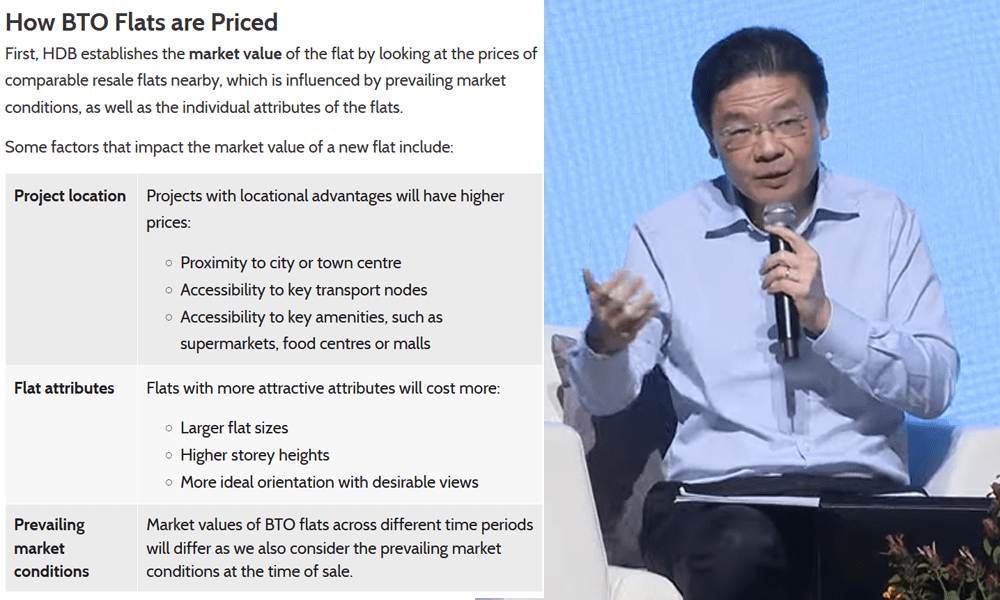
Somewhere between a Budget speech and a BTO application form, there is a spreadsheet. It has your combined income in one cell, your CPF Ordinary Account balance in another, and a row of grants you may or may not qualify for depending on which month you got engaged, which estate you're eyeing, and whether your parents live within four kilometres. That spreadsheet is the real policy document — the one that decides whether a 30-year-old couple in Singapore can buy a home this year or in 2028.
Since Lawrence Wong became Prime Minister in May 2024, that spreadsheet has been rewritten more times than at any point since 2019. The journey from Budget to BTO — from fiscal announcement to balloting queue number — now runs through a different set of gates: a raised Enhanced CPF Housing Grant, a new Standard–Plus–Prime framework, a lower loan-to-value limit, and a set of income ceilings that have stayed stubbornly still while almost everything around them moved.
This is what those changes mean for first-time buyers, how they've reshaped application behaviour, and what a young Singaporean household should actually be planning for.
A note on figures: grant amounts, income ceilings and eligibility rules below reflect publicly announced HDB and Ministry of Finance positions. Parameters are reviewed periodically — always confirm current numbers on HDB's website before you commit to a flat.
Why the Last Two Years Rewrote the First-Timer Playbook
To understand where things stand, it helps to see the sequence. Housing policy for first-timers did not change in one dramatic move. It changed in a series of adjustments, each solving a specific problem the previous one created.
Three phases matter.
Phase 1 — The affordability patch (2023). Budget 2023, delivered by Lawrence Wong in his then-capacity as Finance Minister, raised the CPF Housing Grant for families buying resale flats by $30,000, and the equivalent grant for singles by $15,000. The logic was simple enough: resale flats were the pressure valve for buyers who could not wait three to four years for a BTO, and that valve was overheating. Pumping more grant money into the resale market was designed to close the cash gap between the two options.
Phase 2 — The structural redesign (August 2024). At the National Day Rally, in his first major housing speech as PM, Wong announced the biggest shift in HDB classification in decades. The mature-versus-non-mature estate binary — a distinction that had shaped buyer expectations since the 1990s — was replaced with Standard, Plus and Prime, categories defined not by geography but by how much subsidy a project carries and how tightly it is ringed with resale conditions.
Alongside it came a significant top-up: the Enhanced CPF Housing Grant (EHG) for first-timer families rose from up to $80,000 to up to $120,000, and for singles from up to $40,000 to up to $60,000. Singles aged 35 and above were also allowed to apply for 2-room Flexi BTO flats in any location, not just in non-mature estates.
Phase 3 — The supply and demand balance (2024–2025). Running underneath all of this is the supply pledge: the government has committed to launching more than 100,000 BTO flats between 2021 and 2025, a volume that dwarfs any five-year stretch in the preceding decade. Supply is the slowest lever to move and the one that ultimately determines whether all the grant-tweaking matters.
The through-line across all three phases is a single idea: separate the subsidy from the speculation. Grants are meant to help a household buy a home. They are not meant to hand that household a windfall when it sells.
The Grant Stack: What a First-Timer Actually Gets
Here is where the headline numbers and the reality diverge most sharply.
Singapore does not have one housing grant. It has a stack. For a first-timer family buying a resale flat, three grants can apply simultaneously:
| Grant | Who it's for | Maximum amount | Income ceiling |
|---|---|---|---|
| Enhanced CPF Housing Grant (EHG) | First-timer families and singles, BTO or resale | Up to $120,000 (families), up to $60,000 (singles) | Tightly means-tested — see below |
| CPF Housing Grant for Families | First-timer families buying resale | $80,000 for 4-room or smaller; $50,000 for 5-room or larger | $14,000 |
| Proximity Housing Grant (PHG) | Families buying resale to live with or near parents/child | $30,000 (live together) or $20,000 (within 4km) | No income ceiling |
| Singles Grant | Single citizens 35+, buying resale | Up to $40,000 for 4-room or smaller | $7,000 |
Stacked up, the maximum grant support for a first-timer family has moved meaningfully over three policy windows.
Maximum Combined EHG + Family Grant for a First-Timer Family Buying a Resale 4-Room or Smaller Flat (S$)
That is a 54% increase in maximum grant support in under two years — an extraordinary move by the standards of housing policy anywhere.
But the chart hides the most important detail, and it is a detail that catches out a lot of buyers.
The EHG taper is the real policy
The EHG is not a flat $120,000 cheque. It is a sliding scale. A household only receives the full $120,000 if its average gross monthly household income is around $1,500 or less. From there, the grant tapers downward in steps as income rises, reaching a floor of a few thousand dollars at the upper end of the eligibility band, at roughly $9,000 a month for families.
Read that again: a couple earning $9,000 a month gets a small fraction of the $120,000 headline figure. A couple earning $1,500 a month gets all of it — but is unlikely to be buying a resale 4-room flat in most of Singapore without substantial other resources.
The $120,000 number is therefore best understood as a maximum, not a typical. For a household on a combined income of $8,000 to $9,000 — a very ordinary dual-income profile for a young Singaporean couple — the realistic EHG is in the low tens of thousands, supplemented by the $80,000 Family Grant.
There is also a sequencing quirk worth noting: the EHG is assessed on average gross monthly income, which for salaried employees means the average over the preceding 12 months, including bonuses. A promotion, an annual bonus, or a switch from one job to another can move a household down the taper — sometimes right after they've already started planning around a higher grant figure.
Who gets in, and by which door
Income Ceilings: The $14,000 Line That Decides Everything
If grants are the carrot, income ceilings are the fence. And the fence has not moved.
The household income ceiling for buying a new BTO flat from HDB remains at $14,000 per month for families. It has sat there since 2019. Over the same period, the median household income in Singapore has risen, resale flat prices have climbed, and the maximum grant has nearly doubled.
| Buyer profile | Income ceiling | What it gates |
|---|---|---|
| First-timer family (BTO) | $14,000 | New flats, and most new-flat grants |
| Extended / multi-generation family | $21,000 | Larger BTO flats, multi-gen priority |
| Single citizen, 35+ (2-room Flexi BTO) | $7,000 | New 2-room Flexi flats |
| First-timer family (resale grants) | $14,000 | Family Grant, Singles Grant |
| Executive Condominium | $16,000 | New ECs from developers |
The cliff-edge problem
The most analytically interesting thing about a hard ceiling is what happens just above it.
A household earning $14,000 a month can buy a BTO flat, access the full Family Grant on the resale side, and in principle benefit from subsidies that can run well into six figures. A household earning $14,100 — a difference of roughly a hundred dollars a month, or about $1,200 a year — cannot buy a BTO flat at all, and loses access to the Family Grant entirely.
In economic terms, that is a cliff, not a slope. A marginal dollar of income can cost a household tens of thousands of dollars in foregone subsidy. This creates a well-documented set of distortions:
- Deliberate income suppression. Couples approaching the ceiling have an incentive to time promotions, decline overtime, or arrange for one spouse to work part-time during the 12-month income assessment window.
- The "just over" penalty. Households marginally above the line are pushed toward the resale market or private condominiums, often at significantly higher cost despite earning only slightly more.
- A narrowing middle. The gap between what a $13,000 household can access and what a $15,000 household can access is far wider than the income difference suggests.
Raising or indexing the income ceiling is one of the most frequently raised suggestions in housing policy discussions. It has not happened. Whether that reflects a deliberate desire to cap subsidy exposure, or simply the difficulty of moving a number that sits at the intersection of fiscal policy and electoral politics, is a fair question to ask.
Standard, Plus, Prime: The New Map of the BTO Market
The August 2024 announcement that arguably matters most over a 10-year horizon is not a grant. It is a reclassification.
Under the old system, a BTO project was either in a "mature" or "non-mature" estate. That label was descriptive — it told you roughly how built-up the surroundings were. It did not meaningfully change what you could do with the flat afterward.
Under the new framework, every BTO project is sorted into one of three categories, and the category carries real, enforceable consequences.
Maximum Subsidy Recovery on First Resale of Plus and Prime Flats (% of resale price or valuation, whichever is higher)
| Feature | Standard | Plus | Prime |
|---|---|---|---|
| Minimum Occupation Period | 5 years | 10 years | 10 years |
| Rent out whole flat | Allowed after MOP | Not allowed | Not allowed |
| Subsidy recovery on first sale | None | 6% of resale price or valuation | 9% of resale price or valuation |
| Typical location | Most estates | Attractive, well-connected non-central sites | City centre and surrounds |
What this does to the buyer's calculation
The new framework deliberately decouples "good location" from "good investment." A Prime flat in a central area is priced with a deeper subsidy, but the owner surrenders a share of the upside when they sell. A Standard flat in a suburban estate gets less subsidy on the way in, but keeps everything on the way out.
For a first-time buyer, this means the old instinct — "buy the most central flat I can afford because location always wins" — is no longer automatically correct. The right framing is a three-way trade-off:
- Standard suits buyers who want flexibility: to rent out the flat after MOP, to sell without clawback, and to treat the flat as a home rather than a leveraged position on land value.
- Plus suits buyers who genuinely want the location for the long haul — a 10-year MOP is a decade of your life, not a line item.
- Prime suits buyers who value centrality enough to accept both the decade-long lock-in and the clawback, and who are unlikely to need to move for work, family or school reasons.
A ten-year minimum occupation period is not a technicality. For a couple who buy at 30, it means the next time they can freely transact is at 40 — usually the decade in which careers shift, children arrive, and parents' care needs change.
The Financing Twist: LTV Cut to 75%
On the same day as the Standard–Plus–Prime announcement, one more change landed that gets less attention than it deserves: the Loan-to-Value limit for HDB-guaranteed housing loans was cut from 80% to 75%.
This is a smaller move than it looks on paper and a larger move than it looks in your bank account.
| Metric | Before 21 Aug 2024 | From 21 Aug 2024 |
|---|---|---|
| Maximum HDB loan | 80% of price/valuation | 75% of price/valuation |
| Minimum down payment | 20% | 25% |
| HDB loan interest rate | 2.6% p.a. | 2.6% p.a. |
| TDSR limit | 55% | 55% |
| MSR limit (HDB flats) | 30% | 30% |
For a flat priced at $500,000:
- Old: loan up to $400,000; down payment $100,000.
- New: loan up to $375,000; down payment $125,000.
- Extra upfront capital required: $25,000.
Because HDB loans permit the down payment to be paid entirely from CPF Ordinary Account, the immediate cash impact may be zero for households with sufficient CPF savings. But the monthly instalment changes too. On a 25-year HDB loan at 2.6% per annum:
| Loan amount | Monthly instalment | Interest paid over 25 years (approx.) | |
|---|---|---|---|
| 80% LTV | $400,000 | ~$1,815 | ~$144,500 |
| 75% LTV | $375,000 | ~$1,701 | ~$135,500 |
The 75% rule actually reduces the monthly instalment by roughly $114 and cuts lifetime interest by around $9,000 — because you're borrowing less. The cost is entirely in the upfront capital requirement.
That is the trade: less leverage, more upfront capital, lower ongoing servicing cost. For a household with a healthy CPF OA balance, it is close to neutral. For a household that was counting on stretching to 80% LTV to afford a particular flat, it is a hard constraint that arrived with no phase-in period.
It is also, in the broader macroprudential sense, a deliberate cooling of demand at the exact moment grants were being increased — a pairing that only makes sense if the objective is to raise purchasing power for genuine owner-occupiers while simultaneously limiting the total amount of credit flowing into the market.
Did It Work? What Happened to Application Rates
Grants raise purchasing power. Purchasing power raises demand. Demand, when supply is fixed in the short run, raises prices. This is the central tension of every housing subsidy programme in the world, and Singapore is not exempt from it.
The evidence so far points to three observable effects.
1. Application intensity has cooled from its 2020–2022 peak
At the height of the pandemic-era property boom, BTO application rates for some projects ran into double digits — more than ten applicants per flat for the most sought-after five-room and mature-estate units. That era has passed. Between the very large supply ramp-up and the October 2024 introduction of the Standard–Plus–Prime framework, first-timer application rates in the Standard estates have moderated substantially, with HDB repeatedly emphasising that first-timer families stand a strong chance of securing a flat.
The nuance: a healthy overall application rate can mask extreme concentration. When Plus and Prime projects launch, they attract outsized demand because they are the only new flats available in those locations. A launch can look calm in aggregate and be fiercely competitive in one or two projects.
2. The resale market absorbed the grant increase quickly
An $80,000 grant for a 4-room resale flat, available to households earning up to $14,000, is a large and predictable subsidy. Sellers priced against it. The HDB Resale Price Index rose sharply in 2024, after a comparatively subdued 2023.
HDB Resale Price Index: Annual Change (%)
Source: HDB Resale Price Index. Note that 2023's moderation coincided with the period before the October 2024 grant increase; the 2024 acceleration followed a year of strong demand and increased buyer purchasing power. Correlation is not causation, but the direction of the relationship is hard to miss.
This is the classic grant capitalisation problem: when a subsidy is available to almost every buyer in a market segment, it tends to be priced into the asset rather than captured by the buyer. The grant helps the individual household in the moment of purchase, but over time the market adjusts upward.
3. The Standard–Plus–Prime framework is an attempt to break that loop
The clawback mechanism is the most analytically interesting part of the whole reform. By recovering 6% or 9% of the resale price or valuation on the first sale of Plus and Prime flats, the government is effectively saying: we will subsidise your home, but we will not subsidise your capital gain.
If it works as designed, it should do two things. First, it should allow the initial price of Plus and Prime flats to be set lower without generating an enormous windfall for the first buyer. Second, it should reduce the intensity of speculative demand for those projects, because the upside is capped.
Whether it works in practice depends on something no policy can fully control: how much buyers value the location relative to the flexibility they give up. Early indications from the first Standard–Plus–Prime launches suggest demand for the Plus and Prime categories remains strong — as you would expect for flats in genuinely attractive locations being sold below the surrounding market.
What It Means for Different Buyers
Policy changes land differently depending on who you are. Here is how the current landscape reads across five common profiles.
The dual-income couple earning $9,000, buying a resale 4-room
Position: stronger than at any point since 2019. They qualify for the $80,000 Family Grant, a meaningful EHG component, and effectively unlimited options on the resale market outside the $14,000 ceiling. The trade-off is that the grants they're receiving have likely already been priced into the flats they're viewing — HDB resale prices rose strongly through 2024. The practical advice is to treat the grant as a budget input, not a discount, and to run the numbers on three or four specific flats rather than on a market average.
The couple at $15,000, shut out of BTO
Position: the hardest in the system. They earn enough to be excluded from almost all new-flat subsidy but not enough to comfortably absorb condominium pricing. Their realistic options are a resale flat without the Family Grant (if above the ceiling), a resale flat with partial grant access depending on structure, or the private market. This is the group most exposed to the cliff-edge design of the $14,000 ceiling.
The single citizen aged 35+, earning $5,500
Position: meaningfully improved, still constrained. The August 2024 change allowing singles to apply for 2-room Flexi BTO flats in any location — not just non-mature estates — is a genuine expansion of choice, and the EHG top-up to $60,000 helps. But the $7,000 income ceiling for the Singles Grant and 2-room Flexi eligibility means a single earning above that line is effectively working with resale-market economics and no first-timer grant support. For singles, the ceiling is the binding constraint, not the grant.
The couple planning around Plus and Prime
Position: a different kind of decision. A 10-year MOP and a clawback change the meaning of "buying well." The flat is a home first and an asset second. Buyers should stress-test the decision against a decade of possible life changes — a job move to the other end of the island, a second child, ageing parents needing to move in. If any of those is plausible, a Standard flat with a 5-year MOP and no clawback may outperform a Plus flat on a risk-adjusted basis even if it looks worse on a price-per-square-foot comparison.
The private-property owner aged below 55 considering a downgrade
Position: more fluid than it was. The 15-month wait-out period that previously applied to private residential property owners aged 55 and below buying a resale HDB flat was lifted in August 2024. For a household looking to right-size from private to public housing, the timeline has compressed considerably — though the Standard–Plus–Prime framework means the flat they buy may now carry resale conditions that did not exist when they last owned HDB.
The Wider Picture: Supply Is Still the Only Real Answer
Everything above is demand-side policy. Grants raise demand. LTV cuts suppress demand. MOP extensions slow the recycling of supply. Income ceilings cap the eligible pool.
None of it changes the fundamental arithmetic that has governed Singapore housing since 1960: the price of a home is set by the relationship between the number of households and the number of homes, in the places those households want to live.
The supply pledge — more than 100,000 BTO flats between 2021 and 2025 — is the single most consequential housing policy of this period, and it is the one that generates the fewest headlines. It takes years to convert a land parcel into a completed block, which means the flats launching now were planned under a previous political cycle and the flats that will matter in 2030 are being planned today.
There is a reasonable case that the moderation in application rates over 2024 and 2025 is the first visible sign that supply is finally catching up with the demand surge that began in 2020. If that reading is correct, the grant increases of 2023 and 2024 were a bridge — a way of supporting buyers through the years when supply was still tight — rather than a permanent feature of the landscape.
There is also a case that demand is structurally higher than it was a decade ago: more singles forming separate households, more dual-income couples with higher purchasing power, and a persistent preference for larger flats. If that reading is correct, supply will need to keep running just to stand still.
Which reading is right will be determined by what HDB launches between now and 2028 — and by whether the $14,000 ceiling is still sitting exactly where it is today.
Food for Thought
1. If the $120,000 EHG headline only reaches households earning around $1,500 a month, is the story the top-line number or the taper curve? The maximum grant is a useful political headline but a poor planning assumption for almost every actual buyer. Should the communication be more honest about the typical, rather than the maximum, amount?
2. Does a 10-year MOP on Plus and Prime flats protect the neighbourhood from speculation, or does it trap the first cohort of owners? A decade is a long time. If the first generation of Plus and Prime owners find themselves unable to move for family or career reasons, what happens to the resale market for those flats in 2034?
3. When grants rise, who ultimately captures the value — the buyer or the seller? HDB resale prices rose sharply through 2024, following a year of policy support for buyers. Is there a version of grant policy that doesn't get capitalised into prices, or is that simply how subsidies work in a supply-constrained market?
4. Should the $14,000 income ceiling be indexed to median household income? A fixed dollar threshold set in 2019 covers a shrinking share of households every year. If the ceiling had been indexed, where would it sit today — and would that be better policy, or just a slower version of the same capitalisation problem?
5. Does a 75% LTV limit shift risk from the household to retirement adequacy? A larger down payment drawn from CPF Ordinary Account reduces leverage and monthly servicing cost — but it also permanently removes capital from the CPF pool that funds retirement. Is that a good trade for a 30-year-old?