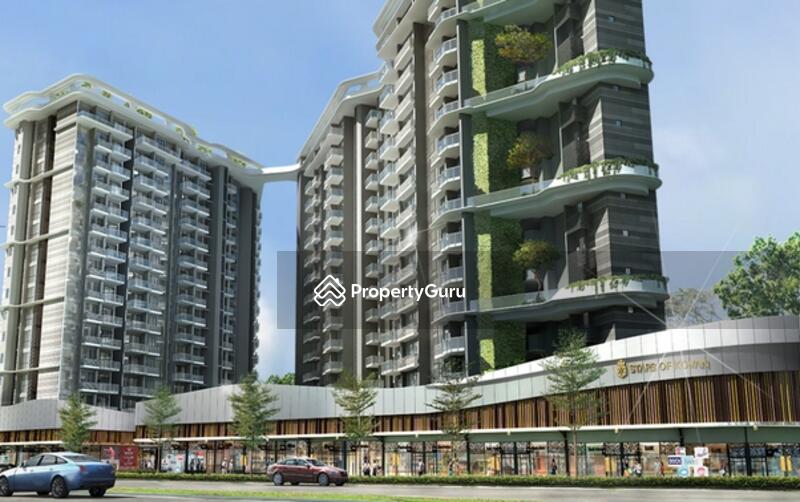
Scan the Kovan listings on any property portal on a weekday morning and you will notice something odd for a district that is supposed to be sleepy: a freehold boutique development with a handful of units, sitting almost directly on top of a North East Line station, quietly generating more clicks than projects three times its size. The Aster Kovan — a small-format freehold condominium in the heart of the Kovan enclave in District 19 — has a habit of resurfacing in buyer conversations every few months, usually right after a resale transaction prints at a number that makes people sit up, or right after a nearby leasehold project pushes its asking prices up another notch. This article unpacks the structural reasons this particular development keeps returning to the spotlight: its tenure profile, its unit mix, the rental economics of small freehold stock next to an MRT station, and the competitive set it is fighting against within a one-kilometre radius.
One housekeeping note before we go further: this is an analytical framework piece. Where figures appear, they are indicative ranges compiled from public listing platforms and general market commentary, presented to illustrate relative patterns rather than to serve as a valuation. Anyone making a decision should verify at the project level against URA caveats and the developer's or MCST's own records.
Why Kovan Keeps Showing Up on Buyer Shortlists
To understand why a single boutique development matters, you first have to understand the geography it sits in. Kovan is not a headline district. It does not have the marina views of District 4 or the landed prestige of District 10. What it has is something arguably more durable in Singapore's property market: positional efficiency.
The connectivity case, in plain numbers
Kovan MRT station sits on the North East Line (NEL), which opened in 2003. From Kovan:
- One stop to Serangoon, which is an interchange with the Circle Line — the single most useful rail upgrade in the area, linking the NEL to Bishan, Botanic Gardens, Paya Lebar and eventually the eastern corridor.
- Four stops to Punggol, home to the Punggol Digital District, a JTC-led business park cluster anchored by the Singapore Institute of Technology campus.
- Direct, no-transfer access to Chinatown, Dhoby Ghaut, Little India and HarbourFront on the NEL.
That last node matters more than most buyers realise. The Cross Island Line will add an interchange at Hougang, one stop away, with the first phase of the CRL targeted to come online around the end of this decade. Singapore's rail map is being redrawn around the north-east, and Kovan sits inside the polygon rather than on the edge of it.
The supply story is the real story
Here is the structural fact that makes Kovan interesting: the area is overwhelmingly 99-year leasehold. The established condominiums clustered around the station are largely leasehold developments from the 1990s and 2000s, and the newer launches in the broader Hougang and Serangoon North corridors follow the same template. Freehold residential land in this pocket is scarce, fragmented, and almost never released as a large site.
That scarcity is the entire thesis behind boutique freehold stock. When a buyer looks at a freehold development with a small unit count next to an MRT station, they are not buying square footage. They are buying a tenure profile that cannot be replicated by new supply, because no developer can conjure freehold land that does not exist.
The lifestyle layer
Kovan also benefits from a food and amenity reputation that punches well above its price tier. Heartland Mall and the adjacent Kovan Market and Food Centre anchor the immediate area; Serangoon Gardens and NEX are one stop away; the Hougang and Serangoon North corridors supply the schools, clinics and daily-needs retail. For a couple in their early thirties, this is exactly the pitch: an older, greyer, more established neighbourhood with mature trees and hawker food, sitting on top of a fast rail line.
What "Freehold Boutique" Actually Buys You
The phrase gets used loosely, so it is worth being precise. A boutique freehold development combines two characteristics: perpetual tenure and a small unit count, typically under 100 units, often well under. Each of those has a distinct effect on your ownership experience, and they interact in ways that are not always positive.
Tenure: what freehold does and does not do
Freehold removes lease decay from the equation. That sounds like a simple benefit, but its real-world consequences are specific:
- Financing and CPF eligibility. For leasehold properties, CPF usage is tied to the remaining lease — broadly, the lease must have at least 20 years remaining and must cover the youngest buyer to age 95 for the property to be fully usable with CPF. As a lease runs down, buyers face shrinking CPF-usable balances, shorter loan tenures and a smaller pool of future purchasers. Freehold sidesteps this entirely.
- Exit pool. Freehold properties, all else equal, remain financeable and CPF-eligible indefinitely, which preserves the pool of buyers who can transact on them decades from now.
- Collective sale optionality. A freehold site can theoretically be redeveloped without the lease-decay discount that suppresses land value in older leasehold estates. This optionality is real but should never be the reason you buy — it is a lottery ticket, not a plan.
What freehold does not do is guarantee price appreciation. A freehold unit in a poorly located, poorly maintained development with a dysfunctional management committee can underperform a well-run leasehold project. Tenure is one variable. Location, maintenance quality, unit efficiency and supply competition are the others.
Boutique: the double-edged sword
Small developments have a distinct economic profile that buyers frequently underestimate.
| Factor | Boutique freehold effect | What it means for you |
|---|---|---|
| Maintenance fees | Fixed costs shared by fewer units | Per-unit share is often higher than in a 500-unit project |
| Facilities | Typically a pool, gym, a small function room | Fewer amenities to fund, but also fewer to enjoy |
| Management committee | Small pool of owners to volunteer | Governance quality can be uneven; meetings matter more |
| Transaction volume | Few sales per quarter | Price data is noisy; a single deal can distort the average |
| Rental competition | Many similar units in one block | Your unit competes with your neighbours on rent |
| En bloc potential | Requires high consent from a small group | Easier to organise, but also easier for one holdout to block |
The maintenance fee point deserves emphasis. In a 50-unit development, a S$200,000 lift replacement is S$4,000 per unit. In a 500-unit development, it is S$400 per unit. That is not a criticism of boutique living — it is simply the arithmetic of shared costs, and it shows up in your monthly outlay.
The Unit Mix Question: Small Units, Big Rental Logic
Boutique developments in Singapore almost always skew small. The land parcel is too small for a wide product spread, so developers optimise for the buyer profile that can absorb the units fastest: one- and two-bedroom layouts, with a thin tail of larger stock.
Why the mix matters more than the size
For an owner-occupier, a compact two-bedroom in Kovan is a perfectly reasonable long-term home — close to the MRT, close to food, close to the parents' place in Hougang. For an investor, the same unit is a rental product competing in a specific market segment.
That segment has three characteristics worth understanding:
- Demand is deep but price-sensitive. Small-unit tenants in the north-east tend to be singles, young couples, and employees at Seletar Aerospace Park, Punggol Digital District and the industrial corridors along Hougang and Defu. They compare rent across a wide radius because they are mobile.
- Supply is concentrated. Because the project is small, all the small units are identical to each other. When three one-bedders come up for rent in the same quarter, the landlord who prices last usually accepts the lowest rent.
- Layout quality is the differentiator. In boutique projects, efficient layouts — no wasted corridor space, a proper enclosed kitchen, genuine two-bedroom usability rather than a "plus study" — rent faster and hold rent better than superficially similar units with awkward geometry.
The indicative yield gradient
Across the OCR, gross rental yields on small units generally sit higher than on larger units, because rent does not scale linearly with floor area. A 500 sq ft one-bedder might command roughly two-thirds the rent of a 1,000 sq ft three-bedder, but it costs closer to half as much — which compresses the yield gap in favour of the smaller unit.
Indicative Gross Rental Yield Midpoints by Unit Type - Boutique Condo, District 19
The chart illustrates a well-documented pattern rather than a promise about any specific project: smaller units typically show higher gross yields, and lower absolute monthly income. A 3.9% yield on a S$900,000 unit produces less rent than a 2.8% yield on a S$1.8 million unit. Which is "better" depends entirely on whether you are optimising for yield or for absolute income and capital preservation.
The financing footnote nobody mentions
Small units have a second, quieter constraint. Some banks apply more conservative loan-to-value treatment to very small units — sometimes framed around the 500 sq ft threshold — because their resale liquidity is thinner. If you are buying a compact unit, it is worth checking lender appetite before you commit, not after. Under current MAS rules, bank loan LTV caps sit at 75% for a first housing loan, 45% for a second and 35% for a third, with TDSR at 55% of gross monthly income.
Reading the Transaction History Like an Analyst
Here is where most buyers go wrong with boutique freeholds: they look at the average price per square foot, see a number, and treat it as a valuation. In a project with a handful of transactions per year, the average is not a valuation — it is a rumour with a decimal point.
What the caveats actually tell you
URA's caveat data is the closest thing Singapore has to a transparent transaction record. In a boutique development, you should read it along four axes:
- Volume over time. Two sales in a year is noise. Fifteen sales over three years starts to be a pattern.
- PSF versus quantum. A high PSF on a small unit tells you the buyer paid for efficiency, not that values have risen. A high quantum on a large unit tells you an owner-occupier with a family bought it, which is a different signal.
- Time on market. A caveat does not tell you how long the unit was listed. Ask the agent, or cross-reference listing history if available.
- Direction of the trend, not the level. Are successive resales in the project printing higher, flat or lower? That is the only comparison that matters within a single development.
The volume trap, illustrated
Consider a hypothetical but realistic pattern, typical of small freehold projects post-TOP: a burst of subsale and resale activity in the first three years after completion as the initial buyer pool turns over, followed by a thinning into single-digit annual transactions as long-term owner-occupiers settle in.
Illustrative Transaction Volume Pattern - Boutique Development Post-TOP
The takeaway from this shape is not "the project is cooling". It is that a maturing boutique development becomes illiquid by design, because the people who bought to live in it stop selling. Illiquidity is not inherently bad — but it does mean your eventual sale may take longer, and your pricing power depends on being the best-presented unit available when a buyer finally appears.
A checklist for reading any boutique project's data
The step most people skip is the second one. Tracking the same unit across two resales gives you a clean read on appreciation, stripping out the distortion caused by different units trading at different sizes and floor levels.
Rental Yield: Running the Real Math
Gross yield is a marketing number. Net yield is the number that pays your bills. The gap between them is where boutique freehold ownership gets interesting — and occasionally uncomfortable.
From gross to net
The arithmetic is straightforward: annual rent divided by purchase price, then subtract the costs of ownership. For a boutique freehold unit, the cost stack looks roughly like this:
Where a Month of Gross Rent Typically Goes - Leveraged Owner, Indicative
A few things to note about that breakdown:
- Maintenance fees take a bigger bite in boutique projects. A larger share of the rent goes to the MCST than it would in a 500-unit development, purely because the shared cost base is divided among fewer owners.
- Property tax on rented property is materially higher than owner-occupied. Non-owner-occupied residential tax rates run from 12% to 36% of annual value under the current schedule, compared with a progressive owner-occupier schedule starting at 0%. This is a structural drag on investment yield that many first-time landlords discover late.
- Vacancy allowance is not optional. Budget one month of vacancy per year as a baseline. In a boutique building where all your units are similar, vacancies cluster.
- Rental income is taxable, though you can deduct allowable expenses or apply the deemed expense option. Speak to a tax professional; the treatment depends on your circumstances.
The worked example, with a caveat
Take a hypothetical 700 sq ft two-bedroom in a District 19 freehold boutique development at an indicative S$1,600 psf — around S$1.12 million. If it rents for an indicative S$3,400 a month, gross yield is roughly 3.6%. After maintenance of, say, S$400 a month, one month of vacancy, agent commission on renewal and property tax on the assessed annual value, the net yield before financing could compress to the low-to-mid 2% range. Leverage changes the picture in both directions — it amplifies returns and magnifies the cost of vacancy.
The key insight: in a high-interest-rate environment, the spread between gross and net yield is not a rounding error. It is the difference between a property that services itself and one that requires a monthly top-up.
Why freehold rental stock holds up differently
Rental demand is driven by absolute rent levels, not tenure. A tenant does not pay more because your land is freehold. But freehold does affect the composition of your tenant pool over time, because leasehold properties approaching the CPF-eligibility horizon become harder for some owners to hold, which can push more stock onto the rental market in older leasehold estates. Freehold boutique stock competes on location and quality instead of on lease-length friction.
The Competition: What Else a Kovan Buyer Is Looking At
No property exists in isolation. Anyone considering The Aster Kovan is realistically weighing it against four distinct alternatives. Here is the honest comparison.
1. Established 99-year leasehold condominiums near the station
The Kovan and Hougang corridors have a deep bench of mature leasehold condominiums, most of them larger than a boutique project, with fuller facilities and more liquid transaction records. Their advantages: more comparable sales data, lower PSF entry points, bigger amenity footprint, larger owner communities. Their disadvantage: the countdown clock. A 99-year lease from the 1990s has already consumed roughly a third of its term.
2. Newer leasehold launches in the wider north-east
New supply in the Serangoon North, Hougang and Punggol corridors continues to come online, and the URA Master Plan has earmarked new residential areas around the Serangoon North and Tavistock area in connection with the Cross Island Line. New launches offer modern layouts, warranty coverage, and deferred payment structures — at PSF levels that are typically well above resale comparables in the same district. Buyers are effectively paying a premium for newness and progressive payment.
3. HDB resale in Hougang and Kovan
This is the alternative that Kovan buyers under-examine. A four-room HDB resale flat in the area costs a fraction of a private condominium, offers larger usable area, and — for a first-time Singapore Citizen household — unlocks CPF Housing Grants and the Enhanced CPF Housing Grant, subject to eligibility conditions. It also comes with a Minimum Occupation Period of five years, which is a real constraint if your plans are uncertain. The trade-off is tenure and amenities, not liveability; the HDB heartland around Kovan is exactly why people want to live there in the first place.
4. Other boutique freeholds in the north-east
Boutique freehold stock is scattered across the north-east, but rarely at this kind of rail adjacency. The comparison set is thin, which cuts both ways: less competitive supply, but also fewer data points to anchor your own pricing when you sell.
| Option | Tenure | Typical buyer | Core trade-off |
|---|---|---|---|
| Boutique freehold near MRT | Freehold | Long-hold owner-occupier or yield-focused investor | Higher maintenance share, thin transaction data |
| Mature leasehold condo | 99-year, aging | Value-seeking owner-occupier | Lease decay, CPF eligibility horizon |
| New leasehold launch | 99-year, fresh | Buyer wanting new and deferred payments | Highest PSF in the district |
| HDB resale | 99-year, from 1970s onward | First-time household, grant-eligible | MOP, no private facilities, income ceiling for grants |
The district-level price picture
The chart below shows indicative PSF midpoints across the tenure profiles competing for the same buyer dollar in the north-east. It is a relative comparison, not a valuation of any specific project.
Indicative PSF Midpoints by Tenure Profile - North-East Corridor
The gap between freehold boutique stock and mature leasehold resale is the "tenure premium" in the market's pricing. Whether that premium is worth paying is the single most important judgement call a Kovan buyer makes.
What Would Change the Thesis
Every investment case has conditions under which it breaks. For a boutique freehold near an MRT station, there are five.
Bull case — what strengthens it:
- The Cross Island Line interchange at Hougang comes online and pulls the whole north-east corridor closer to the rest of the island.
- Punggol Digital District and Seletar Aerospace Park continue to add employment density within a short commute radius, deepening tenant demand.
- Freehold land in the Kovan pocket remains unconsolidated, so no new freehold supply competes directly.
Bear case — what weakens it:
- A wave of new leasehold supply in the Serangoon North and Hougang corridors resets buyer expectations on PSF and pulls demand away from resale stock.
- Interest rates remain elevated for longer than expected, compressing the net-yield spread and forcing yield-driven owners to sell.
- Maintenance fees escalate faster than rents, particularly if the development's common property reaches a major renewal cycle — a lift, a roof, a repainting — without adequate sinking fund reserves.
- Rental supply within the same boutique block floods the market as several investors exit simultaneously.
- Cooling measures: additional buyer's stamp duty currently stands at 0% for a first property for Singapore Citizens, 20% for a second and 30% for a third, with higher rates for PRs and foreigners. A further tightening would thin the investor pool and lengthen selling timelines.
Two questions to answer before you buy anything boutique
- What is the sinking fund balance, and when was the last major capital works programme completed? This single question separates buyers who have done the work from buyers who have not.
- How many units in this project are owner-occupied versus rented? A high owner-occupier ratio usually correlates with better upkeep and a more stable pricing environment.
Food for Thought
-
If freehold is purely about avoiding lease decay, and a well-located 99-year project with 60 years left on the clock will comfortably outlive your holding period, what exactly are you paying the tenure premium for — optionality, psychology, or exit liquidity?
-
Boutique projects are praised for exclusivity and criticised for high maintenance shares. At what point does "intimate" become "expensive to keep alive" — 40 units, 60, 100?
-
In a district dominated by 99-year stock, does a single freehold outlier in a small project actually command a premium in the resale market, or does thin transaction volume erase the advantage at the point of sale?
-
If the Cross Island Line interchange at Hougang arrives around 2030, is the correct strategy to buy before the announcement premium, or to wait for the infrastructure to be priced in and buy the fundamentals instead?
-
Rental yield in the north-east is largely a function of how many similar units are chasing the same tenant. Is a small development with 50 identical one-bedders a rental asset or a rental liability?
The Bottom Line
The Aster Kovan is back in the spotlight for reasons that are structural, not promotional. A freehold development next to an NEL station in a district dominated by leasehold stock is a genuinely scarce configuration, and scarcity is the one thing Singapore's property market reliably rewards. But scarcity is not a strategy. The boutique format brings high per-unit maintenance shares, thin transaction data, and rental competition from within your own building — three factors that punish buyers who did not do the arithmetic.
The disciplined approach is unglamorous: pull the caveats, isolate same-unit resales, cross-check live rental listings within a one-kilometre radius, and compute net yield rather than gross. Do that, and the decision becomes a lot clearer than the listing photos suggest.