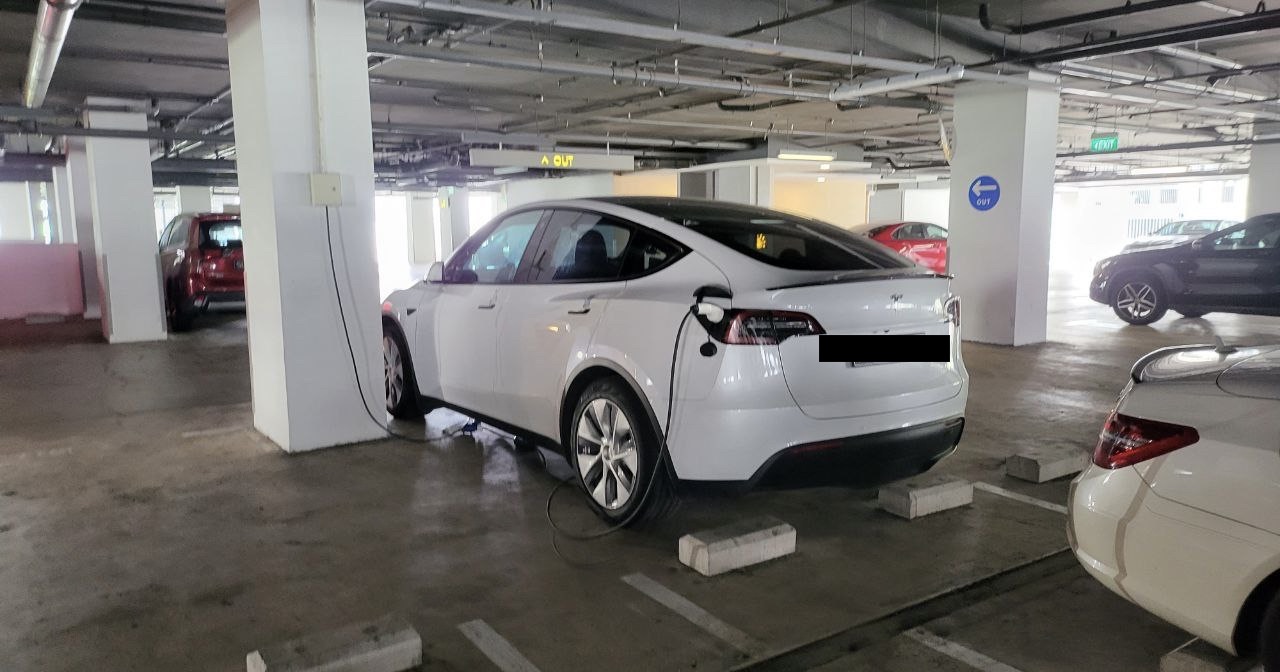
One clip, one Tesla, and a comment section that turned into a referendum on whether Singapore is actually ready for electric cars. The viral private-hire driver saga — a Tesla in PHV service, a driver defending his numbers, and thousands of strangers arguing about whether the maths works — was never really about one person. It was about a structural question that tens of thousands of Singapore households are about to confront: EV charging in Singapore is straightforward if you live in a landed property or a condominium with chargers already in the basement. It gets considerably messier if you don't.
That's the real story hiding behind the outrage. Singapore has committed, in public policy terms, to an electric future. The charging infrastructure to support that future is being built — but at very different speeds in public carparks versus private residential developments. And the private residential segment runs through a governance layer most buyers never think about until they need it: the Management Corporation Strata Title, or MCST.
This piece unpacks what rising EV adoption means for condo charging infrastructure, why strata rules make this harder than it looks, and whether an "EV-ready" development actually commands a premium today — or whether that premium is still mostly speculation.
The Backdrop: Singapore's EV Pivot Is Policy-Led, Not Consumer-Led
Singapore didn't arrive at electric vehicles by accident. The shift is the product of a deliberate policy stack built over roughly half a decade, and understanding it explains why the charging question is now urgent rather than theoretical.
The anchor is the Singapore Green Plan 2030, which set a national target of 60,000 EV charging points by 2030. Critically, that target is split: 40,000 in public carparks and 20,000 in private premises. That second number is the one that should interest anyone buying or owning a condominium, because "private premises" is essentially code for the places where the government cannot simply tender out a deployment contract — malls, office buildings, hotels, and residential developments under private and strata title.
Singapore's 60,000 EV Charging Point Target by 2030 (LTA / Green Plan 2030)
Layered on top of the charging target is a vehicle-side mandate. Singapore has signalled that from 2030, all new car and taxi registrations must be cleaner energy models, with a longer-run ambition of a 100% cleaner energy vehicle fleet by 2040. New diesel car and taxi registrations were already stopped from 2025. On the cost side, incentives such as the EV Early Adoption Incentive and the Vehicular Emissions Scheme have been used to narrow the price gap between an EV and an equivalent petrol car, while LTA has also adjusted how EVs are classified for COE purposes — raising the power-rating ceiling for Category A so that a wider band of mainstream EVs lands in the cheaper certificate category.
The technical plumbing has been standardised too. Singapore's TR25 technical reference specifies Type 2 connectors for AC charging and CCS2 for DC fast charging, which is why almost every charger you'll encounter locally uses the same plug.
Here's the runway in visual form:
The implication is uncomfortable but simple: the policy has already committed Singapore to an EV-majority future. The infrastructure build-out in private residential developments has to catch up, and it has to do so through strata governance rather than central planning.
The Charging Gap: Public Networks Are Scaling, Private Premises Are Struggling
It's tempting to assume that public charging growth solves the condo problem. It doesn't, for a reason that has nothing to do with charger count and everything to do with time.
Public charging is a substitute, not a replacement
Public chargers in Singapore are being rolled out nationally, with HDB carparks a major focus of the deployment and several commercial operators — SP Mobility, Charge+ and others among them — running networks across malls, office buildings and industrial estates. That's genuinely useful. But most of these chargers are AC chargers in the 7kW to 22kW range, and AC charging is slow by design.
Consider the arithmetic for a typical 60 kWh battery, charging from 10% to 80% — roughly 42 kWh delivered:
Approximate Time to Charge a 60 kWh EV from 10% to 80%
Illustrative arithmetic assuming ideal conditions, no charging taper, and a vehicle whose onboard charger can accept the full rated power. Real-world times vary by vehicle and state of charge.
The chart makes the core point: a 7kW charger means hours, not minutes. For a landed property owner who plugs in overnight, that's fine — the car sits idle for eight hours anyway. For a condo dweller with no home charger, it means either parking at a DC fast charger (expensive per kWh, and often occupied) or leaving the car at a public AC charger and finding another way home.
Why the "20,000 in private premises" target is the hard half
The public half of the target can be delivered by government agencies and appointed operators with a contract and a budget. The private half depends on individual property owners, MCSTs, and commercial landlords deciding to act — and paying for it.
The main lever here is the EV Common Charger Grant, introduced in 2021 and administered by LTA, which co-funds the cost of installing shared chargers in non-landed private residential developments and other qualifying premises. The grant reportedly covers a substantial share of eligible installation costs, subject to a per-charger cap, and it exists precisely because the economics of installing a handful of chargers in a single condo rarely work without support.
That subsidy structure reveals the underlying problem: in a single condominium, the cost per charger is high because the fixed costs — electrical upgrading, cabling, switchgear, approvals, project management — are spread across very few bays. A 500-unit development installing 20 chargers can absorb that. A 60-unit boutique development installing three cannot, and often won't.
Inside the Condo: Where EV Charging Meets Strata Law
This is where the conversation gets genuinely complicated, and where the viral Tesla argument quietly has the most substance. Installing a charger in a condominium is not a purchase decision. It's a governance decision, wrapped around an engineering constraint.
The MCST approval maze
Almost every parking lot in a strata development sits on common property. That single fact determines everything. Under the Building Maintenance and Strata Management Act (BMSMA), works on common property generally require approval from the Management Corporation, typically by resolution at a general meeting. Depending on how the works are classified — routine maintenance versus an improvement — the threshold can range from a decision at a general meeting to a higher, supermajority resolution, with the improvement route demanding the steepest approval.
In practice, that means one enthusiastic EV owner with a proposal paper is not enough. The typical path looks like this:
Even when a vote succeeds, MCSTs typically want several things nailed down first:
- Who pays. The owner, the MCST, or a shared arrangement? If the MCST pays, non-EV owners are subsidising EV owners — a live political issue at many AGMs.
- Who owns the asset. An MCST-owned charger is common property and must be maintained, insured and eventually replaced. An owner-owned charger on common property needs a licence or lease agreement, plus a mechanism to remove and make good when the owner sells.
- Who carries liability. If an owner's charger causes a fault or a fire, the insurance and indemnity position needs to be explicit.
- What happens on resale. A charger licensed to a specific owner creates a transfer problem when the unit changes hands.
The three technical constraints nobody mentions at the AGM
Approval is only the first gate. The engineering is often the harder one.
1. Electrical capacity. A residential development's power supply was sized for lifts, lighting, water pumps, air-conditioning and general household load — not for 20 cars drawing 7kW each. Twenty chargers running simultaneously could demand 140kW of additional load. Upgrading the supply may require works with SP Group and, in some cases, a new substation — an expensive, slow, and physically constrained proposition.
The standard workaround is load management: a system that dynamically distributes available power across connected chargers, so a site with 60kW of spare capacity can still serve 20 bays, just not all at full rate at once. In practice, for overnight charging, this is usually fine. It is also something an MCST must understand before it can vote intelligently.
2. Cable routing. Getting power from the substation or riser to individual parking bays involves running cables through common property. Cost scales with distance, and distances in older developments — where the substation is at one corner and the carpark is at another — can be brutal.
3. Fire safety and placement. EV charging in carparks brings fire safety considerations, and guidance from SCDF, BCA and the technical reference framework covers expectations around placement, ventilation and equipment standards. MCSTs will reasonably want to see that addressed before approving installations.
None of these are insurmountable. All of them are reasons a committee might vote "not now" — and "not now" is functionally "no" for a buyer who needs charging today.
Is an EV-Ready Condo Now Worth a Premium?
This is the question every buyer, seller and agent is quietly asking. The honest answer: probably yes eventually, but the premium is not yet showing up cleanly in transaction data, and it is more likely to appear as liquidity than as headline PSF.
Three tiers of EV readiness
"EV-ready" is an unregulated marketing term. In practice, developments fall into roughly three buckets — and the gap between them matters enormously to a buyer.
| Tier | What it means | What to look for | Practical risk |
|---|---|---|---|
| EV-installed | Live chargers already operating in the carpark | App access, tariff rate, number of bays per unit, whether bays are reserved or shared | Low — you can charge tonight |
| EV-capable | No chargers, but the building has the electrical headroom, ducting and a live MCST discussion | Spare capacity, existing cable routes, an EV item on recent AGM minutes | Medium — a vote and a budget away |
| EV-hostile | No capacity, no policy, no appetite | Old infrastructure, no EV item ever tabled, prior disputes on cost sharing | High — plan to charge elsewhere for years |
Most of the market sits in the middle bucket, which is precisely why it's hard to price. The middle bucket is a promise, and promises in property are worth something only when someone credible is committed to delivering them.
What the transaction data can and cannot show
There is, at present, no credible large-sample evidence that the presence of EV chargers in a condominium translates into a measurable PSF premium in Singapore. A few structural reasons why:
- No data field. URA caveats record price, area, floor level and tenure. They do not record whether the basement has chargers. Any premium claim is built on manual cross-referencing, not a clean dataset.
- Small sample. Only a minority of Singapore's private residential developments have live chargers today, so any "EV-ready premium" is estimated off a handful of projects in a handful of districts.
- EV owners are still a minority of car owners. The premium depends on enough buyers caring. That pool is growing fast, but it isn't yet large enough to move district-level medians.
- Confounding factors. The developments installing chargers today tend to be newer, better managed, larger and better located. Any apparent premium may simply be the premium for being new, well-managed, large and well-located.
Where the EV effect should show up first is in saleability rather than price: fewer viewings needed, shorter time on market, less discounting at the negotiation table. That's a real economic effect, but it's invisible in a PSF chart.
The contrarian case: older developments may surprise you
There's a counterintuitive argument worth weighing. Older, larger, lower-density developments — particularly ones with generous surface parking or spacious covered lots — often have more physical room for cable routing and switchgear than a sleek new high-rise with a tightly packed basement carpark and a power supply sized to the millimetre. A well-organised MCST in a 1990s freehold project with spare capacity can retrofit chargers more cheaply than a 2022 development with none.
The risk, then, cuts both ways. The genuinely "stranded" assets may not be the oldest buildings — they may be mid-aged, high-density, electrically tight developments where the retrofit cost per bay is highest and the MCST's willingness to spend is lowest.
The rental and landlord angle
For investors, the EV question shows up on the income side rather than the capital side. A tenant who drives an EV and cannot charge at home will discount your unit against one where they can — or simply won't shortlist it. As more of the tenant pool shifts to EVs, "charging available" edges from a nice-to-have into a screening criterion, in the same way "near MRT" or "has good fibre" did before it.
The Private-Hire Angle: Why PHV Drivers Feel This First
Private-hire drivers are the leading edge of this problem, which is why the Tesla PHV saga resonated so widely. A PHV driver covers far more distance per day than a typical household car — often several times the national average — and has a hard commercial constraint: downtime is unbilled time. For a PHV driver, charging is not a convenience question. It's a line item in a profit-and-loss statement.
That produces a distinctive set of economics:
- Home charging is the single biggest cost lever. Charging at home on a residential electricity tariff is typically the cheapest way to run an EV in Singapore. A driver with no home charger is pushed onto public DC networks, where the per-kWh price is materially higher.
- Charging speed has a dollar value. For a driver doing high mileage, a 50kW DC session at lunch versus a 7kW AC session that takes five hours is not a marginal difference — it's the difference between doing three more rides and doing none.
- Public charger availability is a scheduling problem. Peak-hour queues at high-traffic chargers eat directly into earning hours.
This is the tension the viral clip surfaced, whether or not every participant in the argument realised it: the EV business case is strongest for people with off-street home charging and weakest for exactly the people who drive the most. Resolving that gap is a policy question about public DC density, workplace charging, and fleet depots — not just about how many AC points are installed in condos.
A Buyer's Checklist: What to Actually Ask Before You Sign
Abstract analysis is useful, but this is a decision buyers make with a cheque. Here's a practical sequence for anyone purchasing a condominium with an EV — or an EV in their near future.
Before you make an offer:
- Count the chargers against the unit count. Ten chargers in a 500-unit development is a demonstration, not infrastructure. Ask whether bays are shared, bookable, or assigned.
- Ask what the tariff is. Chargers in condos are typically run by a third-party operator. Look for the per-kWh rate and any idle or overstay fees — the effective cost per kilometre can vary significantly.
- Read the AGM minutes. Search for "EV", "charger" and "electrical". A tabled proposal that was deferred is very different from a proposal that has never been raised.
- Ask about electrical headroom. The MCST or managing agent should be able to say whether a load study has been done. If nobody knows, assume it hasn't.
- Check whether chargers are on common property or licensed to individual owners. This determines transferability when the unit is sold.
- Look at nearby public charging. If there's a DC hub within a short walk or drive, the absence of an in-building charger is a smaller problem than it sounds.
- Ask about the insurance and indemnity position. Who covers a fault originating from a charger?
- Interrogate the "EV-ready" claim. Ask specifically: ducting installed? Capacity reserved? Operator appointed? A developer's marketing brochure is not an engineering study.
- Think about the vehicle you'll own in five years, not the one parked outside today. AC charging is enough for most overnight use cases; but if your next car is a high-mileage one, DC access nearby matters.
- For investors, consider tenant screening. A simple line in your listing — "charger in carpark" — may materially widen the pool of tenants who shortlist your unit once the relevant infrastructure is in place.
Food for Thought
The EV transition in Singapore is often framed as a technology story. It's really a property story — and property moves slowly. A few questions worth chewing on:
-
If private residential charging depends on MCST votes, what happens to the units whose owners never vote yes? Do they become permanently discounted stock, or does regulation eventually override strata inertia?
-
Is the EV premium actually a "management quality" premium in disguise? A building that installs chargers quickly is a building that makes decisions well. Should buyers be pricing the governance, not the chargers?
-
Who should pay for charging infrastructure in a strata development — the EV owner, the MCST, or the developer at the point of construction? The answer changes the economics of every condo in Singapore.
-
If PHV drivers are the heaviest users of public charging, should public DC deployment be prioritised around fleet depots rather than residential carparks? And if so, what does that mean for the condo dweller who just wants to charge overnight?
-
Could a "no charging, no sale" dynamic emerge in older developments faster than anyone expects? If it does, it will show up in transaction volume long before it shows up in median PSF — and most buyers won't see it coming.
The Bottom Line
The Tesla PHV saga will be forgotten within a news cycle. The question underneath it won't be. Singapore has committed to an electrified vehicle fleet by 2040, backed by a 60,000-charger target for 2030, an EV Common Charger Grant to subsidise private-premises deployment, and a 2030 cleaner-energy mandate for new cars and taxis. What it has not yet done is solve the strata governance problem — the fact that the hardest 20,000 chargers to install sit behind a vote, a budget, an electrical load study, and a committee's appetite for change.
For buyers, that means the practical answer today is not "is this development EV-ready?" but "how far away is this development from being EV-ready, and who is going to close the gap?" The projects with live chargers, spare capacity, and an MCST that has already tabled the issue carry a real but quiet advantage. The ones with none of the three carry a risk that isn't in the price yet.