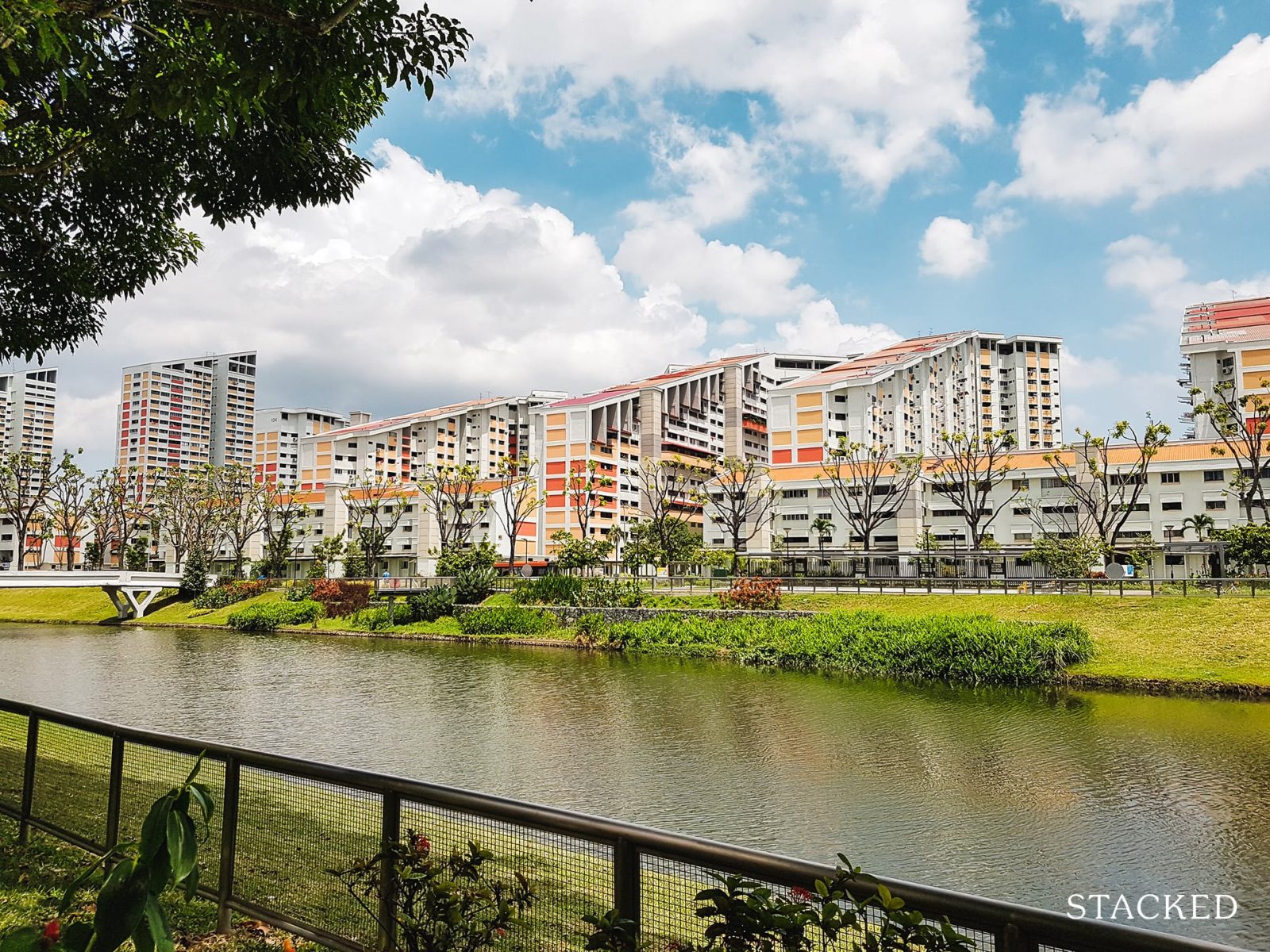
Potong Pasir has spent most of its modern life being the neighbourhood Singaporeans drive past on the way to somewhere else. Sandwiched between Toa Payoh and Serangoon, it was for years a low-rise enclave of semi-detached houses, small walk-up apartments and one very recognisable MRT station on the North East Line. Then the cranes arrived.
This The Aster condo review takes a close look at the project that has arguably become the benchmark address in District 13 — a 99-year leasehold condominium at 66 Potong Pasir Avenue 1, developed by a joint venture between Hoi Hup Realty and Sunway Developments. Completed around 2021, The Aster is now firmly in its resale phase, which means buyers finally have something better than a showflat brochure to work with: actual transactions, actual rents, and actual neighbours.
So the real question is no longer "is this a nice project?" It almost certainly is. The question is whether The Aster still makes sense at today's prices — against Poiz Residences next to the MRT, against The Venue down the road, and against everything else your $1.5 million to $2 million could buy in Singapore's Rest of Central Region (RCR).
Let's work through it properly.
Why Potong Pasir Is Suddenly Interesting Again
To understand The Aster, you first have to understand what happened to the estate around it.
Potong Pasir sits in District 13, an unusual district that stitches together Toa Payoh East, Braddell, Macpherson and Potong Pasir itself. Historically it has been the quiet cousin of Districts 12 and 15 — cheaper than Novena, less trendy than Katong, and far less talked about than anything with a "city fringe" label attached.
Three things changed that.
1. The North East Line matured. Potong Pasir MRT is four stops from Dhoby Ghaut and two stops from Serangoon, which is an interchange with the Circle Line. That is a genuinely convenient commute profile for a district that trades at a meaningful discount to the city fringe.
2. Bidadari and Woodleigh grew up next door. The redevelopment of the former Bidadari cemetery into a new HDB town — with Woodleigh MRT one stop away — brought footfall, retail and infrastructure to an area that previously had very little of all three. The Woodleigh Mall and surrounding integrated developments are now part of the daily fabric of the neighbourhood.
3. Government Land Sales (GLS) sites in the area kept getting taken up. The Aster's site itself came through the GLS programme, awarded to the Hoi Hup–Sunway joint venture. When developers pay serious money for land in a district, the downstream effect is a wave of new, higher-specification product — and that wave pulls the whole neighbourhood's price floor up with it.
The result is a Potong Pasir that is still quiet, still relatively low-density compared with Toa Payoh proper, but no longer cheap in the way it was in 2010.
The Aster at a Glance
| Attribute | Detail |
|---|---|
| Address | 66 Potong Pasir Avenue 1, Singapore 358389 |
| District | D13 (Toa Payoh / Potong Pasir) |
| Developer | Hoi Hup Realty & Sunway Developments (JV) |
| Tenure | 99-year leasehold (commencing 2017) |
| Completion (TOP) | Around 2021 |
| Scale | Large-format development, reportedly over 600 units |
| Nearest MRT | Potong Pasir (NEL), roughly an 8–10 minute walk |
| Unit Types | 1-bedroom to 4-bedroom, plus larger penthouse formats |
Two things stand out immediately. First, the 99-year leasehold from 2017 — a 30-year-old leasehold project still has roughly 70 years left, but the clock started more recently than it did for Trevista or Sennett Residence. That matters less than lease decay alarmists suggest, but it does mean The Aster is not a lease-decay play.
Second, the scale. A development with more than 600 units behaves differently from a boutique 100-unit block: more liquidity on resale, more rental competition, and a strata management budget that can support genuinely good facilities — but also more supply pressure when the market turns.
The Unit Mix: Who Exactly Was The Aster Built For?
The Aster's unit mix tells you a lot about the developer's read of this market. Potong Pasir is an HDB-upgrader catchment — Toa Payoh and Serangoon are full of families sitting on flats that have appreciated substantially — but it is also a rental catchment, thanks to the NEL and proximity to the city.
The mix reflects both.
The Aster — Indicative Unit Mix by Share of Total Units
(Shares are indicative and rounded; refer to the project's approved plans for exact figures.)
An indicative 24% one-bedroom composition is the tell. That is a rental-first footprint. One-bedders in an MRT-adjacent RCR project are the highest-yielding unit type in any development — small absolute quantum, strong tenant demand from young professionals, and a rental pool that renews frequently.
The 37% two-bedroom segment is the workhorse. It is the unit type that appeals to young couples, to single upgraders, and to investors who want a tenant profile slightly more durable than the one-bedder crowd.
The 28% three-bedroom and 11% larger formats are aimed squarely at owner-occupiers — families who need the third bedroom, the second bathroom, and a proper kitchen, and who value proximity to St Andrew's Village and a manageable commute.
Layout and Efficiency Notes
A few practical observations that show up repeatedly in feedback on The Aster:
- Compact but functional footprints. The one- and two-bedroom stack sizes are typical of the 2017–2018 GLS cycle — efficient, with minimal balcony bloat. Buyers looking for the cavernous layouts of 1990s condos will be disappointed; buyers who hate wasted corridor space will be pleased.
- Balcony and air-con ledge treatment. As with most projects of this era, air-con ledges form part of the strata area, which inflates the "saleable" figure slightly. When you compute your effective PSF, do it on the internal area, not the advertised area.
- Dual-key and study-style layouts. Some two-bedroom-plus-study configurations exist within the mix and have historically performed well on rental, since they can be split between two tenants or used as a home office.
- Stack orientation matters more here than usual. Given the low-rise surroundings on one side and Potong Pasir Avenue 1 on the other, noise and afternoon sun vary sharply between stacks. Two units on the same floor with the same size can differ meaningfully in liveability — and eventually, in resale price.
Facilities
The Aster is a full-facility condominium, not a minimalist one. A development of this scale typically carries a lap pool, a children's pool, a gymnasium, clubhouse and function rooms, BBQ pavilions, a tennis or multi-purpose court, playgrounds, and landscaped and wellness decks, plus the usual security and concierge provision. The strata maintenance fee is at the higher end of the RCR range because of this — budget for it in your affordability maths, especially on a one-bedroom unit where the monthly fee is spread over a smaller floor area.
Practical tip: On a large development, the sinking fund is your friend. Because there are many units sharing the cost of a common-property upgrade — repainting, lift replacement, pool retiling — a >600-unit project can typically absorb major works without the painful special levies that cripple smaller boutique blocks.
Connectivity and the Neighbourhood: Living in Potong Pasir
The Aster's location is good, but it is not perfect, and it's worth being precise about that.
Potong Pasir MRT is roughly a 600–800 metre walk — call it 8 to 10 minutes at a normal pace, depending on which block you exit from and which station entrance you use. That is a comfortable walk in dry weather and a slightly annoying one in a thunderstorm. This is the single biggest structural difference between The Aster and Poiz Residences, which is effectively integrated with the station.
What you get in return is a quieter, more residential setting further from Upper Serangoon Road traffic.
That commute profile is the core of the investment case. Two stops to an interchange, four stops to the city centre is a genuinely competitive rail proposition — and it is why tenant demand in the area has stayed consistently firm despite the volume of new supply nearby.
Schools, Food and Daily Errands
Potong Pasir's ace card for families is St Andrew's Village, home to St Andrew's Junior School, St Andrew's Secondary School and St Andrew's Junior College, clustered along Potong Pasir Avenue 1 and Francis Thomas Drive in the immediate vicinity. Pei Chun Public School in Toa Payoh is also widely cited as being within reach.
Important caveat: Primary school admission in Singapore depends on MOE's official 1km and 2km home-school distance calculation based on your registered address. Always verify specific schools against the MOE SchoolFinder tool before you commit — do not rely on estate agent marketing.
For daily errands, the neighbourhood has grown up considerably:
- The Poiz Centre provides supermarket and F&B convenience directly at the MRT station.
- Potong Pasir Market & Food Centre remains the old-school heart of the estate and a genuine lifestyle amenity — one of the reasons long-time residents refuse to move.
- NEX at Serangoon is two MRT stops away and remains the dominant regional mall in the north-east.
- Woodleigh Mall is one stop away, serving the new Bidadari catchment.
Price Analysis: What Are Units at The Aster Actually Selling For?
This is where the review gets concrete. The Aster launched in the GLS upcycle, and its resale market has now had several years to establish a price level.
Based on URA caveat data and prevailing market listings, the following ranges are indicative — actual prices vary significantly by stack, floor, facing, renovation quality and lease commencement date.
Indicative Resale Price Ranges — The Aster
| Unit Type | Typical Size | Indicative Resale Price | Indicative PSF |
|---|---|---|---|
| 1-Bedroom | ~450–550 sq ft | $0.85m – $1.05m | ~$1,750 – $1,950 |
| 2-Bedroom | ~600–780 sq ft | $1.20m – $1.55m | ~$1,800 – $2,000 |
| 3-Bedroom | ~850–1,150 sq ft | $1.65m – $2.20m | ~$1,750 – $1,950 |
| 4-Bedroom / Penthouse | ~1,200–1,600 sq ft | $2.30m – $3.20m | ~$1,800 – $2,100 |
The headline takeaway: The Aster trades around the $1,800–$1,900 PSF mark, with smaller units skewing higher on a per-square-foot basis — a pattern consistent with almost every RCR project in Singapore.
The Trajectory Since TOP
The Aster — Indicative Average Resale PSF by Year
(Indicative averages derived from caveated resale transactions; individual transactions vary considerably.)
Two things are worth noting about this curve.
First, it is remarkably smooth. The Aster did not experience the violent price swings that some suburban mega-developments saw during the 2021–2022 frenzy. Prices climbed steadily rather than spiking, which usually indicates a market driven by genuine owner-occupier and long-hold investor demand rather than speculative flipping.
Second, launch buyers have done well. Buyers who entered at launch in the region of $1,550–$1,650 PSF are, on paper, sitting on gains in the order of 15% gross over roughly six to seven years. That is not spectacular by 2021 standards, but it is solid, and importantly it is a gain that has been realised on the resale market rather than merely paper.
What Drives the Price Variance Within the Project
Not every unit at The Aster is equal. Based on transaction patterns, the biggest price differentiators are:
- Floor level — expect a meaningful premium above roughly the 8th storey where views open up.
- Stack orientation — pool-facing and inner-facing stacks with afternoon shade command stronger prices than outward-facing, west-sun stacks.
- Renovation quality — a well-executed renovation on a 2021-completed unit can add meaningful value at resale, since buyers avoid the renovation cash outlay and the wait.
- Quantum psychology — units priced under round-number thresholds (e.g. under $1.3m, under $1.5m) tend to move faster because they stay within comfortable loan and CPF limits for the buyer pool.
The Aster vs Poiz Residences vs The Venue: Head-to-Head
This is the comparison that actually determines whether The Aster is the right buy.
Indicative Average Resale PSF — D13 Comparables
(Indicative mid-points; comparables will vary by transaction date and unit characteristics.)
Side-by-Side Comparison
| The Aster | Poiz Residences | The Venue | |
|---|---|---|---|
| TOP | ~2021 | ~2018 | ~2019 |
| Tenure | 99-year from 2017 | 99-year | 99-year |
| Format | Pure residential, large-scale | Mixed-use with retail podium | Mixed-use with shops |
| MRT proximity | ~8–10 min walk | Effectively integrated | Short walk |
| Scale | 600+ units | Around 330 residential units | Around 266 residential units |
| Indicative Resale PSF | ~$1,800–$1,950 | ~$1,850–$2,000 | ~$1,750–$1,900 |
| Best for | Families and yield investors wanting facilities | Convenience-first buyers, tenants | Buyers wanting a smaller, quieter block |
What Each Project Gets Right
Poiz Residences wins on pure convenience. Living above a retail podium with an MRT connection is a lifestyle advantage that is genuinely hard to replicate, and it shows in both rents and resale PSF. The trade-offs: more transient foot traffic, a smaller overall unit count relative to The Aster, and a slightly higher PSF entry price. For a tenant, Poiz is hard to beat. For an owner-occupier who values the ability to walk out of the lift and into a supermarket, likewise.
The Venue is the quieter, more boutique option. With roughly 266 units and a retail component at ground level, it offers a lower-density feel and typically trades at a modest discount to Poiz. It suits buyers who want the address and the convenience but not the crowd.
The Aster sits between them. It cannot match Poiz on doorstep convenience, but it offers more facilities, a larger and more liquid resale market, and a marginally lower entry PSF. For a family that wants a proper condo lifestyle with a lap pool and a tennis court, that trade is usually worth it.
The Leasehold Question
All three are 99-year leasehold, and the lease start dates differ by only a few years. Over a 10-year holding period, the difference in remaining lease between The Aster (2017 start) and Sennett Residence (mid-2010s start) is negligible for financing purposes — banks are generally comfortable financing leasehold properties with more than 60 years remaining, and all of these clear that bar comfortably.
Rental Yields: Does The Aster Work as an Investment?
Let's build the yield picture properly rather than quoting a headline number.
Indicative Rental Rates — The Aster
| Unit Type | Typical Size | Indicative Monthly Rent | Implied Gross Yield |
|---|---|---|---|
| 1-Bedroom | ~450–550 sq ft | $2,800 – $3,300 | ~3.4% – 3.8% |
| 2-Bedroom | ~600–780 sq ft | $3,500 – $4,200 | ~3.2% – 3.5% |
| 3-Bedroom | ~850–1,150 sq ft | $4,300 – $5,300 | ~2.9% – 3.2% |
| 4-Bedroom / Penthouse | ~1,200–1,600 sq ft | $5,800 – $7,000 | ~2.7% – 3.0% |
(Indicative gross yields calculated as annual rent divided by indicative purchase price. Actual yields depend on your entry price.)
The familiar pattern holds: smaller units deliver higher gross yields, larger units deliver better absolute rent and a more stable tenant profile.
Indicative Gross Rental Yield — D13 Comparables
From Gross to Net: The Real Numbers
Here is where most yield discussions fall apart. Take a two-bedroom at $1.35 million renting at $3,800 per month:
| Line Item | Annual Amount |
|---|---|
| Gross rental income | $45,600 |
| Less: property tax (non-owner-occupied rates) | –$3,600 (approx.) |
| Less: strata maintenance | –$4,800 (approx.) |
| Less: agent commission on renewal (amortised) | –$1,900 (approx.) |
| Less: repairs, replacement, minor works | –$1,200 (approx.) |
| Net income before mortgage | ~$34,100 |
| Net yield on $1.35m | ~2.5% |
A 2.5% net yield in a market where a Singapore Savings Bond or T-bill can pay a comparable or better return on a fraction of the capital is not compelling on yield alone. That is the honest truth about almost every Singapore residential investment in the current environment.
So why do investors still buy? Three reasons:
- Leverage. With a bank loan at the prevailing floating or fixed rates and a loan-to-value of up to 75% for a first housing loan, the return on equity rather than total capital is a different number entirely. If the mortgage rate is below the net yield after all costs, the investor is being paid to hold.
- Capital appreciation. The Aster's resale PSF has moved from roughly $1,680 to around $1,890 since 2021. Over a typical 10-year hold, that compounding matters far more than the rental line.
- Currency and stability hedge. For foreign and PR investors especially, Singapore residential is a store of value first and an income asset second.
The Regulatory Layer You Cannot Ignore
Any rental yield calculation must sit on top of the current policy environment:
- Additional Buyer's Stamp Duty (ABSD) applies on top of purchase price, with rates that escalate sharply for second and subsequent properties and for foreign buyers. This is the single largest drag on investment returns.
- Seller's Stamp Duty (SSD) applies if you sell within the first three years of purchase, at a declining rate.
- Total Debt Servicing Ratio (TDSR) caps total monthly debt obligations at 55% of gross monthly income.
- Mortgage Servicing Ratio (MSR) caps the housing loan instalment at 30% of gross monthly income — but this applies to HDB flats and Executive Condominiums, not to private condominiums like The Aster.
The practical implication: a 2-bedroom at The Aster held for seven to ten years with a manageable loan is a reasonable, if unspectacular, investment. The same unit flipped in year two after paying stamp duties and transaction costs is usually a losing trade.
Who Should Buy The Aster — and Who Should Walk Away
<mermaid>graph TD A["Is The Aster right for you?"] --> B["Buying for own stay"] A --> C["Buying for investment"] B --> D{"Need a school within 1km?"} D -->|Yes| E["Strong fit · St Andrews Village nearby"] D -->|No| F["Compare Poiz Residences for MRT doorstep"] C --> G{"What gross yield do you need?"} G -->|"3.5% or more"| H["Look at smaller units at Poiz Residences"] G -->|"3.0% to 3.5%"| I["The Aster one and two-bedders are competitive"]
Strong Fit If You Are…
- An HDB upgrader from Toa Payoh, Serangoon or Bishan who wants to stay in the north-east, keep the parents nearby, and move into a full-facility condo without paying city-fringe prices.
- A family with school-age children who values the St Andrew's Village cluster and a genuine neighbourhood feel over mall-adjacent convenience.
- An investor targeting the one- or two-bedroom segment who wants a large, liquid development where finding a tenant is a matter of listing well rather than luck.
- A buyer planning a long hold of seven to ten years or more, for whom a 99-year lease from 2017 is not a concern.
Think Twice If You Are…
- Chasing the highest possible gross yield. Poiz Residences will generally edge The Aster out because of its integrated MRT connection.
- Looking for a short-term flip. Transaction costs, SSD and a flattish short-term price curve make this a poor strategy here.
- Wanting a boutique, low-density building. With 600-plus units, The Aster is a community, not a retreat. On weekends, the pool deck will be busy.
- Relying on a very short walk to the MRT. If 300 metres matters more than 800 metres to you, you are shopping in the wrong project.
Food for Thought
1. If The Aster delivers roughly a 2.5% net yield before financing, is the real return here the rent — or is it your view on District 13's PSF ceiling over the next decade? Be honest about which one you are actually buying.
2. Poiz Residences trades at a premium of roughly $50–$100 PSF over The Aster. Is doorstep MRT access worth that premium over seven years of ownership — or is that premium better spent on a larger unit further from the station?
3. The Aster's 99-year lease began in 2017. Does a newer lease actually protect you, or does it simply mean you paid for a longer runway that you will never personally use?
4. When Woodleigh, Bidadari and the broader Serangoon corridor complete their build-out, does Potong Pasir get pulled up with them — or does the new supply compete directly with The Aster for the same tenant pool?
5. Most buyers compare PSF. Almost nobody compares maintenance fees, sinking fund health and the age of the lift system. On a ten-year hold, which of those actually costs you more?