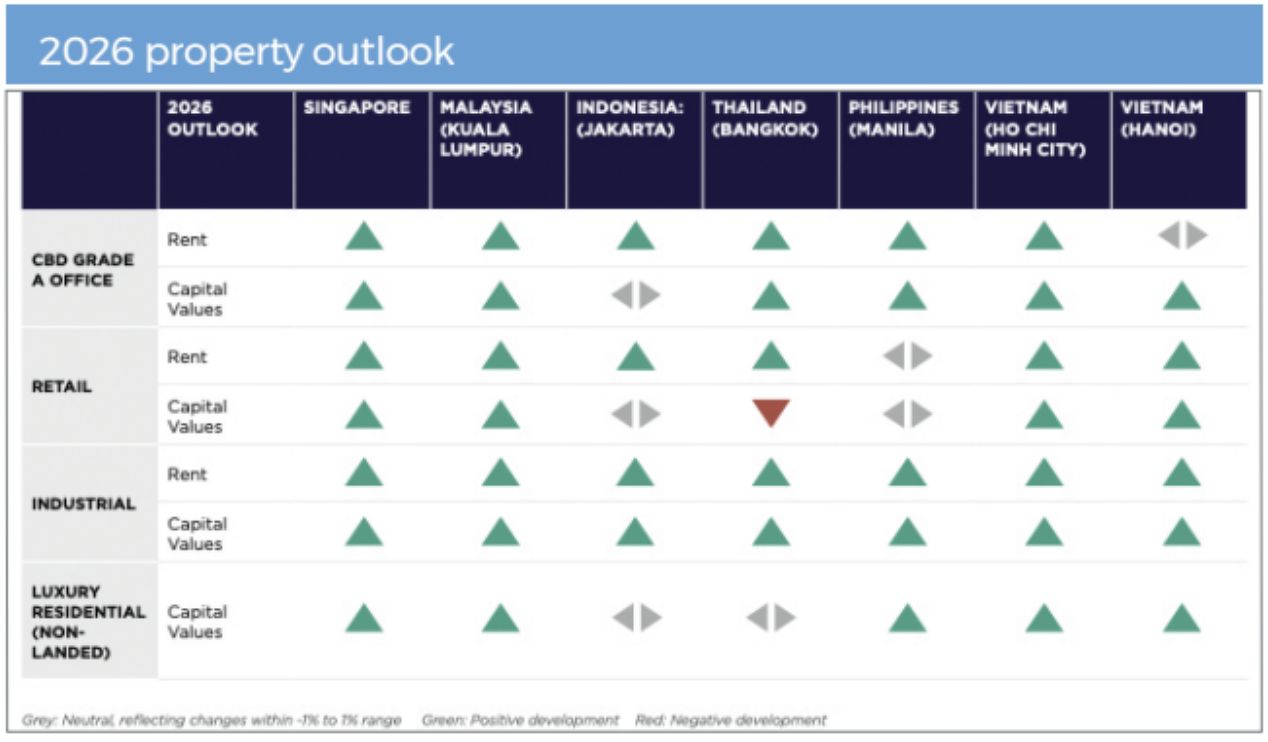
Ask a Singaporean in their thirties about property and you'll usually get the same resigned shrug: "Can afford one, maybe two. After that, the ABSD kills you." That shrug is exactly why the Southeast Asia property outlook has become a live conversation in Singapore living rooms, WhatsApp groups and wealth-management meetings over the past three years.
Because the maths of expanding a property portfolio inside Singapore has become genuinely punishing. A citizen buying a second residential property pays 20% Additional Buyer's Stamp Duty. A permanent resident pays 30%. A foreigner pays 60%, on any residential property, full stop. On a S$1.5 million condominium, that is S$900,000 of stamp duty before you have paid a single legal fee.
Meanwhile, one MRT stop and a causeway away, the same capital buys a freehold-equivalent condominium in Kuala Lumpur, a Bangkok unit inside the foreign quota, or two apartments in Ho Chi Minh City. The Singapore dollar has been one of Asia's strongest currencies for half a decade. And the region's infrastructure build-out — new metros, a new cross-border rail link, a new capital city in Indonesia — is doing to regional property markets what the MRT did to Singapore's suburban HDB estates in the 1990s.
This article is a practical Southeast Asia property outlook for Singapore-based investors: what you can legally own in Malaysia, Thailand, Vietnam and Indonesia, what it yields, what it costs to get in and out, and where the growth stories are real versus where they are marketing.
Why Singaporeans Are Looking Beyond the Causeway
The push factors are policy. The pull factors are currency and connectivity. It is worth separating them, because they behave very differently over a ten-year holding period.
The push: Singapore's stamp duty wall
Singapore's cooling measures have been ratcheted up repeatedly since 2011, with the most severe tightening in April 2023, when the ABSD rate for foreigners was doubled from 30% to 60%.
| Buyer profile | 1st residential property | 2nd | 3rd and subsequent |
|---|---|---|---|
| Singapore Citizen | 0% | 20% | 30% |
| Singapore PR | 5% | 30% | 35% |
| Foreigner | 60% | 60% | 60% |
| Entity / trust | 65% | 65% | 65% |
| Housing developer | 35% (plus 5% non-remittable) | — | — |
Source: IRAS, rates effective 27 April 2023.
Three consequences follow, and they matter more than the headline rates:
- ABSD is a Singapore stamp duty on Singapore property. Buying a Kuala Lumpur condominium or a Bangkok apartment does not trigger it. There is no offshore equivalent.
- CPF savings cannot be used for overseas property. Your Ordinary Account balance stays locked to Singapore residential purchases (and a narrow list of approved instruments). Overseas buyers use cash or offshore financing.
- There is no capital gains tax in Singapore, and foreign-sourced income is generally not taxed in the hands of an individual (with exceptions, notably income received through a partnership). Gains on an overseas property sold by an individual are, in most straightforward cases, outside the Singapore tax net. This is a meaningful structural advantage the Singapore market itself cannot offer, since gains there are simply embedded in price.
The pull: a strong dollar and a building boom
The Singapore dollar has appreciated substantially against most regional currencies since 2019. That cuts both ways — it makes entry cheaper today and creates a headwind when you eventually repatriate proceeds if the trend reverses.
The other pull factor is physical infrastructure:
These are not abstract. A cross-border rail link that moves people between Bukit Chagar and Woodlands North in about five minutes changes the catchment area of every condominium within walking distance of the Johor station. Whether it changes the price is a separate question — and one we will get to.
The Regional Scoreboard: Yields, Ownership, and Growth
Before looking at each market individually, it helps to see them side by side. The figures below are indicative city-wide gross rental yields for residential property. Treat them as a starting point for a conversation, not a valuation.
| Market | Typical gross rental yield | Foreign ownership structure | Foreign quota per building | Typical entry ticket (foreign buyer) |
|---|---|---|---|---|
| Singapore (private non-landed) | ~3.0–3.5% | Freehold / 99-year leasehold | Not applicable | Any price, plus 60% ABSD |
| Kuala Lumpur, Malaysia | ~4.0–5.0% | Freehold strata, subject to state price floor | No statutory quota | From RM1m (~S$290k) in most states |
| Bangkok, Thailand | ~4.0–5.5% | Freehold condominium only | 49% of total floor area | No statutory minimum |
| Ho Chi Minh City, Vietnam | ~4.0–6.0% | 50-year leasehold, renewable | 30% of units in a block | No statutory minimum |
| Jakarta, Indonesia | ~5.0–6.5% | Hak Pakai use-right, 30+20+20 years | No unit quota | Provincial price floors in the billions of rupiah |
| Bali, Indonesia (villa, short-stay) | ~7.0–10.0% (high variance) | Hak Pakai or leasehold | No unit quota | As above |
Yields are indicative ranges compiled from regional brokerage and yield-tracker estimates. Actual yields vary enormously by project, floor, furnishing standard and tenancy type. Short-stay villa yields carry materially higher operational and vacancy risk.
Indicative Gross Residential Rental Yields (%)
Two things jump out. First, the yield gap between Singapore and the region is real but not enormous — roughly one to two percentage points on a like-for-like gross basis. Second, and more importantly, the ownership caps differ wildly, and that single variable drives more of your long-run return than the headline yield does.
Statutory Cap on Foreign Ownership in a Condominium Development (%)
Malaysia and Indonesia impose no quota on the share of a building that foreigners may own — but Indonesia restricts the tenure instead. Thailand and Vietnam cap the share, which creates a two-tier market inside a single building. That two-tier structure is where some of the best and worst deals in the region hide.
Malaysia: The Closest Market, and the One That Has Changed Most
Malaysia is where the majority of Singapore-based overseas property capital has historically gone, for obvious reasons: proximity, language, familiarity, and a long-established financing and legal ecosystem that Singapore banks understand.
What foreigners can actually own in Malaysia
Malaysia's rules are set at state level, not federal level, which is why you will hear three different "minimum prices" from three different agents.
- Strata title (condominiums and apartments): foreigners may generally purchase freehold strata property. Most states impose a minimum purchase price, commonly RM1 million in Kuala Lumpur, Penang and Johor, though several states set higher floors for landed property.
- Landed property: generally subject to higher thresholds and, in some states, restrictions related to Malay reserve land and Bumiputera quotas. Approvals can be slower and less predictable.
- No statutory cap on the number of units a foreigner may own in a development. This is a meaningful structural difference from Thailand and Vietnam.
- Malaysia My Second Home (MM2H): the programme was restructured in 2024 into three tiers — Silver, Gold and Platinum — each requiring a fixed deposit and a qualifying property purchase. Reported requirements include fixed deposits in the region of US$150,000 / US$500,000 / US$1,000,000 and property purchases of roughly RM600,000 / RM1,000,000 / RM2,000,000 respectively. Rules have been revised repeatedly; verify current terms before committing.
The Johor catalyst stack
No market in the region has a denser pile of Singapore-linked catalysts than Johor Bahru right now:
- The JB–Singapore RTS Link, a roughly 4km cross-border rail shuttle between Bukit Chagar and Woodlands North, is targeted to begin operations around the end of 2026, with capacity designed for thousands of passengers per hour in each direction and a journey time of about five minutes.
- The Johor–Singapore Special Economic Zone, formally agreed in January 2025, covers a large swathe of Johor and targets a substantial pipeline of investment projects and skilled jobs over the coming decade.
- Forest City's designated financial zone introduces corporate and personal tax incentives aimed at drawing regional offices and talent to the development.
Where the yields are — and where they aren't
Kuala Lumpur's inner-city condominium market has been the region's cautionary tale for a decade: strong gross yields on paper (roughly 4–5%), but persistent oversupply of small units in corridors like Mont'Kiara, Cheras and parts of the KLCC fringe. Malaysia's national residential overhang — completed but unsold units — has run into the tens of thousands in recent years according to National Property Information Centre data, with Johor and Kuala Lumpur among the largest contributors.
The practical read:
- Well-located, larger-format units near a completed MRT or RTS station have shown more resilient rents than the 500 sq ft studio segment, which is heavily investor-owned and competes on price.
- Johor yields look attractive on paper but carry a vacancy question — much of the new supply is aimed at a tenant pool that does not yet exist at scale.
- Penang offers a more mature, manufacturing-anchored rental market but lower liquidity and, in some areas, sharper restrictions.
The exit tax
Malaysia's Real Property Gains Tax (RPGT) is the single largest cost most Singaporean sellers overlook. For non-citizens and non-PRs, disposals within the first five years typically attract 30% of the chargeable gain, dropping to 10% thereafter. On a short hold, that is a bigger number than most buyers model.
Thailand: Freehold Condominiums, and a Quota That Shapes Pricing
Thailand is the most straightforward of the four markets to enter — and one of the most nuanced to exit.
Ownership rules in plain English
- Condominiums: foreigners may own units on a freehold basis, provided total foreign ownership in the building does not exceed 49% of the total floor area. This is the cleanest foreign ownership structure in the region.
- Land and landed houses: foreigners cannot own land freehold. Structures are typically acquired via 30-year registered leases (renewable only if the lease agreement provides for it, and renewals beyond 30 years are contractual, not statutory), or via structures such as usufruct or superficies rights.
- Company structures using Thai nominee shareholders to hold land are illegal. This is actively enforced and is not a grey-area workaround worth gambling on.
- Funds must be remitted into Thailand in foreign currency and converted to baht, with the bank issuing a Foreign Exchange Transaction (FET) form. Without that paper trail, repatriating sale proceeds becomes difficult.
- Long-stay visas: the Long-Term Resident (LTR) visa, introduced in 2022, offers a ten-year renewable stay for qualifying wealthy, retired or remote-working applicants. The Thailand Privilege Card offers paid long-stay packages that reportedly start in the region of THB 900,000 for a five-year tier.
The two-tier building problem
Because only 49% of a building's floor area can be foreign-owned, many Bangkok and Phuket developments contain two price tiers for identical units. Foreign-quota units typically trade at a premium to Thai-quota units in the same building — sometimes a meaningful one.
This creates a specific trap: you may buy at a foreign-quota premium and later discover your resale buyer pool is restricted to other foreigners, while the Thai-quota unit next door sells faster and cheaper. When evaluating any Thai condominium, ask explicitly how much of the foreign quota remains unsold and what the developer's Thai-quota pricing looks like.
Where to look
- Bangkok: yields in the 4–5.5% range in well-connected areas along the BTS Skytrain and MRT network. The market has been soft since 2023, with high household debt and tight mortgage lending squeezing domestic demand — which cuts both ways for a cash buyer.
- Phuket and Chiang Mai: rental demand is more seasonal and more tourism-dependent. Yields can be higher but so is vacancy variance.
- Rayong / Eastern Economic Corridor: an industrial and petrochemical employment story rather than a lifestyle one. Longer tenancies, less glamour.
The exit tax
Thailand's exit costs are layered rather than headline-grabbing: a 2% transfer fee on appraised value, a 0.5% stamp duty, a 3.3% Specific Business Tax if the property is held for less than five years, and withholding tax which for foreign sellers is typically levied at 15% of appraised value rather than on the actual gain. That last point matters: a foreign seller can owe withholding tax even on a break-even sale.
Vietnam: The Fastest Growth Story With the Tightest Gate
Vietnam is the market that generates the most FOMO among Singaporean investors, and with good reason. It also has the most restrictive ownership regime of the four.
Ownership rules
- The Law on Housing opened the door to foreign ownership from 2015. Eligible foreigners — broadly, those with valid entry documentation — may purchase apartments in approved commercial developments, and in limited cases landed houses within approved projects.
- A 30% cap applies per condominium block on the number of units foreign-owned, and no more than 250 houses per ward in the rare cases where landed homes are permitted.
- Ownership is on a 50-year leasehold basis, extendable once by a further 50 years. This is not freehold and should not be marketed as such.
- Foreigners cannot buy in areas designated as sensitive for national defence or security.
- Financing is the practical bottleneck. Vietnamese banks rarely extend mortgages to foreign buyers, so most foreign purchases are cash-settled. Repatriation of sale proceeds generally requires documentary proof that funds were originally remitted in.
The growth story
Vietnam's residential market has been the region's standout for capital appreciation. Hanoi in particular saw sharp price growth through 2024, with Ho Chi Minh City's primary apartment prices rising strongly in prime districts. New legislation — the 2024 Land Law and the revised Law on Real Estate Business and Law on Housing, effective from 2024 and 2025 — is intended to improve land pricing transparency and unlock stalled projects, which is a structural positive for liquidity.
The visible infrastructure milestone came in December 2024, when Ho Chi Minh City's first metro line entered commercial service. Metro line extensions and a broader urban rail programme are in various stages of planning and construction. If the Singapore experience is any guide, walkable distance to a rail station is the single most durable driver of residential rent and price in a fast-growing Asian city.
The risk side
Vietnam has real friction that a glossy brochure will not mention:
- Cash-intensive entry. No leverage, no CPF, no local mortgage in most cases.
- Tiered pricing. Many developers restrict foreign buyers to specific towers and price them at a premium.
- Currency controls. VND is not fully convertible, and repatriation requires clean documentation from day one.
- Title and completion risk. Project delays and developer financing stress have been a recurring theme. Buying off-plan from a developer with weak balance sheet visibility is a genuine risk in this market.
Indonesia: Complexity Is the Entry Fee
Indonesia is the largest market in Southeast Asia by population and one of the hardest to enter cleanly.
Hak Pakai, explained without jargon
Indonesia operates a layered land rights system. Foreigners cannot hold Hak Milik — freehold title, reserved for Indonesian citizens. The principal route for foreigners is Hak Pakai, a right-of-use title:
- Typically granted for 30 years, extendable by 20 years, and further extendable by another 20 years.
- Applies to landed houses and to strata-titled apartment units (HMSRS) in approved developments.
- Requires minimum purchase price thresholds set by province, which are commonly cited in the range of billions of rupiah and vary substantially between Jakarta, Bali and other provinces.
- Nominee arrangements — using an Indonesian citizen as a front — are illegal, notwithstanding how commonly they are still discussed.
Two very different markets
Jakarta is a large, mature, corporate rental market. Gross yields in the 5–6.5% range are commonly reported for well-located apartments, with expatriate and senior-local tenancy demand concentrated in the CBD and along the MRT corridor. It is also a market with significant existing supply and a history of soft absorption in the mid-tier segment.
Bali operates almost as a separate country. Villa rental yields for short-stay accommodation can reportedly reach 7–10% or more in strong locations, but the variance is enormous and the operational intensity is high: marketing, housekeeping, guest turnover, seasonal vacancy, and a regulatory environment that has been tightening. Indonesian authorities have stepped up enforcement against foreign-owned villas operating outside permitted structures, and buyers using leasehold overlays on agri-designated land have found themselves exposed.
For a Singaporean investor, Bali is a hospitality business dressed as a property investment. That is not disqualifying — but it should be priced as such.
Nusantara, Indonesia's new capital in East Kalimantan, is a genuine long-horizon story with government land allocation and investment incentives. It is also a project where the timeline is measured in decades, not years, and where secondary-market liquidity is close to nil today.
Currency Risk: The Silent Lever on Your Returns
Here is the number most overseas property marketing in Singapore quietly skips.
Over the past five years, the Singapore dollar has appreciated against every major Southeast Asian currency. That is excellent news when you are buying and a headwind when you are selling.
Approximate SGD Appreciation vs Regional Currencies, 2019 to 2024 (%)
Estimated from average annual exchange rates; rounded to the nearest percentage point. The ringgit and baht have since recovered part of this move, so current spot rates differ.
Consider a worked example. You buy a Bangkok condominium at THB 8 million when the rate is 26 THB to the dollar — a cost of roughly S$308,000. Five years later you sell at THB 9 million, a 12.5% gain in local currency. But the baht has strengthened to 24 THB to the dollar. Your proceeds convert to roughly S$375,000.
Now run the opposite case. You sell at THB 9 million but the rate has moved to 28. Proceeds: S$321,000 — a 4% return over five years on a 12.5% local-currency gain.
Currency movement can be larger than your capital gain. For a Singapore-based investor, the relevant return is not the local-currency return. It is the SGD return, net of all costs, at the moment the money comes home.
Two practical principles follow:
- Buy for income, not for currency appreciation. Rental income in local currency, reinvested or converted over time, smooths the entry and exit rate risk in a way a single lumpy capital transaction never can.
- Ask what a 15% adverse currency move does to your return. If the answer is "it wipes out the investment", the deal is a currency bet, not a property bet.
The Real Cost Stack: Taxes, Fees, and Getting Your Money Out
Rental yield is the number everyone quotes. Net yield after acquisition, holding and exit costs is the number that actually matters.
| Country | Acquisition costs | Annual holding | Exit costs (typical) |
|---|---|---|---|
| Malaysia | Stamp duty on transfer, legal fees; foreign buyers pay market-rate stamp duty | Assessment tax, quit rent, maintenance | RPGT for non-citizens: 30% of gain within 5 years, 10% thereafter |
| Thailand | 2% transfer fee, 0.5% stamp duty, legal fees | Common area fees, property tax | 2% transfer fee, 0.5% stamp duty, 3.3% SBT if held under 5 years, withholding tax at 15% of appraised value for foreign sellers |
| Vietnam | 10% VAT (usually built into developer price), 2% registration, 0.5% maintenance contribution | Management fees, land use levy | Personal income tax typically 2% of the sale price for individuals |
| Indonesia | BPHTB acquisition tax of up to 5%, notary and registration fees | Land and building tax, management fees | Final income tax of 2.5% of the sale price for foreign sellers |
Indicative, widely-cited rates. Individual circumstances, treaty positions and state or provincial rules vary; confirm with a locally qualified adviser.
Note the asymmetry. Thailand and Indonesia tax the transaction value on exit rather than the gain. That means you can pay a tax bill on a loss-making sale. Vietnam's 2% sale-price levy works the same way. Malaysia's RPGT is gain-based but punitive at 30% in the early years — which is a strong argument against treating Malaysian property as a three-year flip.
The buying process, step by step
The sequence below is the generic shape across all four markets. The friction is always in the middle steps.
Three steps deserve extra emphasis:
- Title due diligence is not a formality. In Vietnam and Indonesia in particular, confirming that a specific unit can lawfully be sold to a foreigner — not just that the building can — is the difference between a clean purchase and an unwinding mess.
- The remittance trail is your exit ticket. Thailand's FET form, Vietnam's inward-remittance proof and Indonesia's foreign-currency documentation all exist because authorities want to verify funds entered the country legitimately. Lose that paper trail and repatriation can take months.
- Financing is market-specific. Singapore banks offer overseas property loans for some markets — Malaysia most readily, with loan-to-value ratios typically more conservative than for Singapore property and interest rates generally higher. Overseas mortgages are not subject to the 55% TDSR cap in the same way Singapore mortgages are, but any overseas loan you carry will typically be counted against you when you next apply for a Singapore property loan. Plan the sequencing.
Which Market Fits Which Investor?
There is no single "best" market. There is only the market that matches your objective, your holding horizon and your tolerance for illiquidity.
Matching personas to markets:
| Investor profile | Best-fit market | Why |
|---|---|---|
| First overseas purchase, wants familiarity and Singapore-bank financing | Malaysia | Closest legal and banking ecosystem; no foreign quota; but budget for a long hold to clear the RPGT window |
| Wants clean freehold and a liquid rental market | Thailand | Freehold condo ownership is genuinely available; watch the foreign-quota premium |
| Highest risk tolerance, wants maximum capital growth | Vietnam | Strong structural growth, but cash-only, leasehold and tighter exit mechanics |
| Wants higher headline yield and can handle complexity | Indonesia (Jakarta) | Highest reported gross yields, but Hak Pakai tenure and provincial price floors |
| Treats property as a hospitality business | Bali | Highest gross returns, highest operational intensity, active regulatory scrutiny |
A Short Risk Checklist Before You Commit
Run every deal through these questions. If you cannot answer three or more, you are not ready.
- What is the exit buyer pool? Can a local citizen buy your unit? Another foreigner? Only a foreigner who fits the same quota? The narrower the pool, the wider the discount you will need to offer.
- What is the net yield after every cost? Subtract acquisition taxes, annual management fees, agent commissions, vacancy allowance, withholding tax and currency spread. The gap between gross and net in this region is routinely 2 to 4 percentage points.
- Who is the developer and can you verify their balance sheet? Off-plan purchases in Vietnam and parts of Indonesia carry real completion risk.
- What happens if the currency moves 15% against you? Model it explicitly.
- What is your holding period, and does it clear the tax cliff? Malaysia's 5-year RPGT step, Thailand's 5-year SBT threshold and Indonesia's transaction-based exit tax all punish short holds.
- Who manages the property locally? A Singapore-based owner with a Bangkok or Jakarta unit needs a reliable local agent, and that fee comes out of your yield.
- Can you sell without repatriating? In some markets, proceeds can be redeployed locally more easily than they can leave the country.
Food for Thought
1. If the regional yield premium is only one to two percentage points, is the real motivation diversification — or simply an escape from Singapore's ABSD wall? Both are legitimate, but they lead to very different purchase decisions. A diversification motive argues for liquid, well-located, easily tenanted assets. An escape motive can tempt buyers toward the segment with the highest headline yield, which is usually the least liquid.
2. What happens to Johor property prices if the RTS Link opens on schedule — and what happens if it slips again? Every infrastructure-linked market prices in certainty before it arrives. The buyers who do best are usually the ones who can hold through a delay.
3. Thailand and Vietnam both cap foreign ownership per building. Does that protect foreign buyers from oversupply, or trap them in a smaller resale pool? There is a real argument for both, and the answer probably depends on how much of the foreign quota is still unsold when you buy.
4. If the Singapore dollar reverses a decade of strength, how much of your regional return evaporates? Most Singaporean buyers treat the current exchange rate as a permanent feature of the world. Currencies do not work that way.
5. At what point does owning four properties in four countries become a job rather than an investment? Cross-border ownership means four tax filings, four sets of tenancy rules, four currencies and four legal systems. The management overhead is real, and it is rarely costed.
The Bottom Line
Southeast Asia's property markets have never been more accessible to Singapore-based buyers. Malaysia offers proximity and no ownership quota, Thailand offers genuine freehold condominiums at scale, Vietnam offers the region's strongest capital-growth narrative, and Indonesia offers the highest headline yields behind the most complex ownership structure.
What has changed is not the opportunity — it is the sophistication required to capture it. Yields quoted without exit taxes, ownership quotas and currency drag are marketing. The investors who do well in this region over the next decade will be the ones who underwrite the net, in-Singapore-dollar, after-every-cost return, and who can hold long enough to clear the tax and liquidity cliffs.
The regional opportunity is real. The discipline required to capture it is the same discipline that has always separated a good property decision from an expensive one.