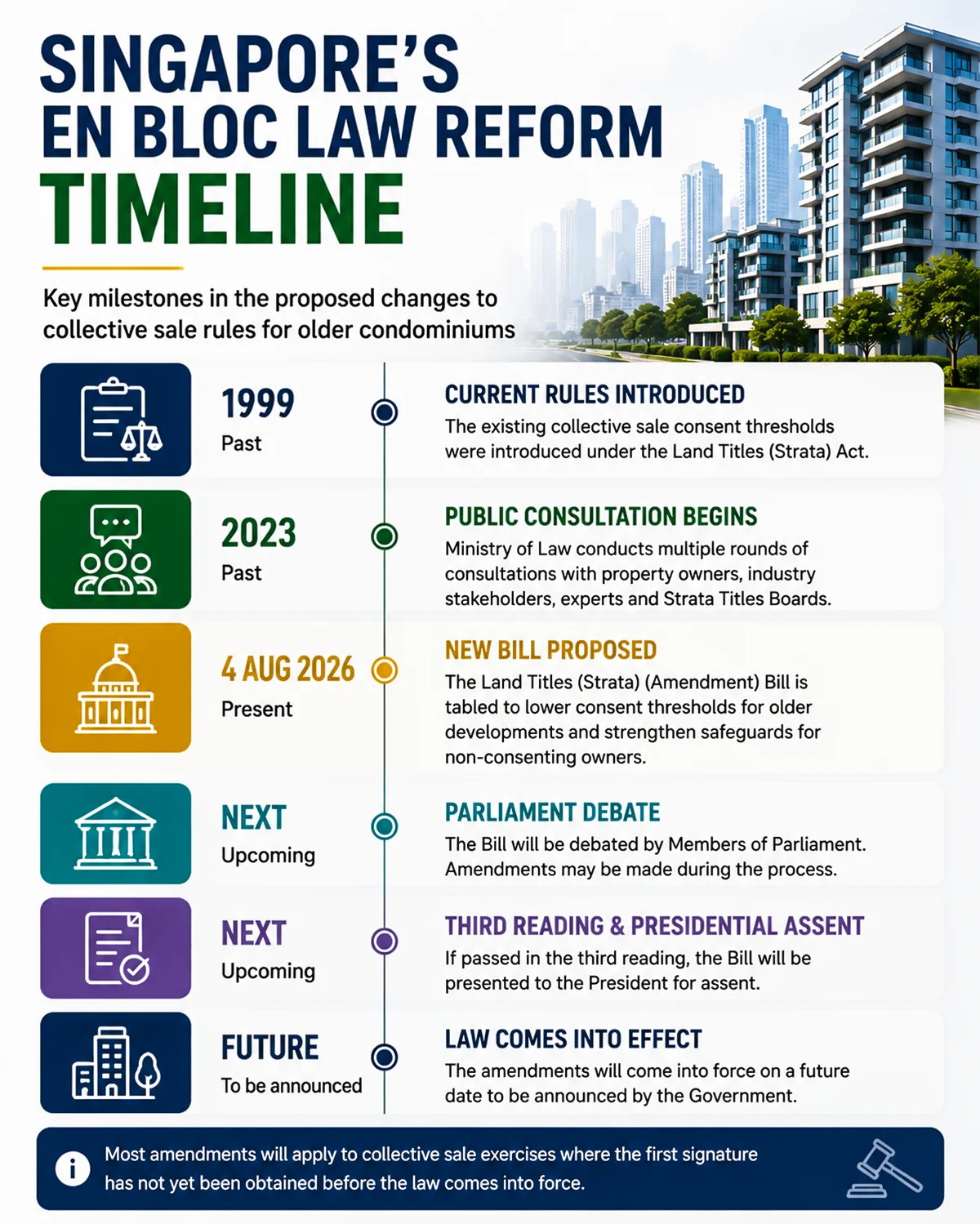
For a certain generation of Singaporeans, the collective sale — or en bloc — letter in the mailbox is either a lottery ticket or a source of years of acrimony. In 2017 alone, collective sale deals worth roughly S$8 billion reportedly changed hands, reshaping entire neighbourhoods from Amber Road to Tampines. Then the July 2018 cooling measures landed, developers' appetite collapsed, and the en bloc machine sputtered down to a trickle of headline deals such as Golden Mile Complex (reportedly around S$700 million in 2022) and Chuan Park (reportedly about S$890 million in 2024).
But the rules governing collective sales never stopped moving. The Land Titles (Strata) Act — the statute that governs how a group of strata owners can force the sale of an entire development — has been progressively tightened, with the Ministry of Law signalling clearly that the priority is protecting minority owners while keeping the redevelopment pipeline alive.
This piece breaks down the collective sale rules as they stand: the consent thresholds, the timelines, the procedural safeguards that have been strengthened, and what all of it means for owners, objectors, developers and buyers. If you own a unit in a development old enough to be interesting to a developer, this is the version of the rules you should actually understand.
Why Collective Sale Rules Matter More Than Ever
Singapore's land story is a redevelopment story. With limited greenfield land, much of the city's future housing supply has to come from tearing down what already exists — and strata developments are the hardest to assemble because they have dozens or hundreds of separate owners with different life stages, holding periods and price expectations.
Three structural forces keep collective sales relevant:
- Lease decay. Most leasehold strata developments are on 99-year leases. As the lease shortens, financing gets harder, the pool of buyers shrinks, and the value gap between a fresh 99-year lease and a 60-year-old one widens.
- Land value uplift. Sites that were built at low plot ratios decades ago can often be redeveloped at higher intensity, and that gap between existing built-up value and redevelopment potential is the money that funds an en bloc premium.
- Government Land Sales as the benchmark. Developers price private land against state tenders in the same area. If a GLS site is cheaper, better shaped, or has cleaner title, the private site has to beat it — which is why en bloc activity often tracks GLS supply more closely than it tracks owners' hopes.
Against that, the law has to solve a genuinely hard problem: how do you let a sufficiently large majority decide, without letting that majority steamroll the minority who have to leave homes they may never be able to afford to replace?
The rules that answer that question have three moving parts — thresholds, process, and remedies — and all three have seen tightening over the past several years.
The Consent Thresholds: The Two-Tier Test That Decides Everything
The single most important number in any en bloc conversation is the consent threshold. Under the Land Titles (Strata) Act, a collective sale requires a two-limb test to be satisfied: the requisite percentage must be met both by share value and by the number of units in the development. One limb alone is not enough.
Share value is the weight allocated to each lot in the management corporation's share value schedule — generally larger units carry higher share values. This dual-limb structure exists precisely so that a handful of giant units cannot carry a sale on their own, and so that a mass of tiny units cannot force out a large minority.
The threshold itself depends on the age of the development:
Consent Threshold Required for a Collective Sale
| Age of Development | Consent Required (Share Value) | Consent Required (Number of Units) |
|---|---|---|
| 10 years or older | 80% | 80% |
| Less than 10 years | 90% | 90% |
The logic is deliberate: a building that has already delivered a meaningful portion of its useful life to its owners should not be locked indefinitely by a stubborn minority, but a nearly-new development should require something close to unanimity before being torn down.
How the 10-year clock is counted
This is where many owners get it wrong. The age of a development for threshold purposes is generally measured from the date the development obtained its first Temporary Occupation Permit (TOP) or Certificate of Statutory Completion — not from the date you bought your unit, not from the date the developer sold the last unit, and not from the date the management corporation was formed.
Practically, this matters enormously:
- A development that received TOP in 2016 crosses the 10-year line in 2026, at which point the threshold drops from 90% to 80%.
- Owners who bought resale in 2019 at a "fresh lease" price may find their building being marketed for redevelopment sooner than they expected.
- Conversely, a development from 2019 is locked behind the 90% wall until about 2029 — which is why many sale committees spend the first year simply doing arithmetic on dates.
The exact reference date is a technical point that depends on the certificate in question, and it should be confirmed against the development's records and with legal advice before anyone commits money to a sale committee.
What the thresholds look like as a blocking minority
Flip the numbers and the political reality of a sale committee meeting becomes obvious.
10-Year-Old or Older Developments: Consent vs Blocking Minority
For an older development, just over one-fifth of share value and units can stop a sale. For a newer one, one-tenth can. That is a very small number of people holding a very large amount of leverage — which is exactly why the procedural rules around disclosure, valuation and the Strata Titles Board have been the focus of recent reform.
The En Bloc Timeline, Stage by Stage
Beyond thresholds, timing is the other thing that repeatedly trips owners up. A collective sale is not a single decision — it is a multi-year project, and the rules govern when money can be spent, when signatures can be collected, and when an application can be made.
Stage 1: Forming the sale committee
Owners who want to pursue a collective sale must first requisition a general meeting of the management corporation and elect a Collective Sale Committee, typically by ordinary resolution. Some owners think this is a formality; it is not. It sets the mandate, defines who has authority to sign documents and engage professionals, and — in the reform environment — subjects those people to governance obligations.
A practical point: the committee members are volunteers, often neighbours, and they are the ones who will be signing engagement letters with lawyers, valuers and marketing agents. The rules increasingly require transparency about who is being paid what, and about any personal interest a committee member may have.
Stage 2: Professionals and the valuation
The committee engages a lawyer and a marketing agent, and commissions an independent valuation from a licensed valuer. The valuation matters far more than owners often realise: it establishes the reserve price and forms part of the evidence base that the Strata Titles Board will examine.
Stage 3: The Collective Sale Agreement
The Collective Sale Agreement (CSA) is the contract each owner signs. It typically sets out:
- the reserve price and methodology for distribution of proceeds
- the apportionment method — by share value, by strata area, or a hybrid
- the terms governing the marketing process and the tender closing date
- the fees of the lawyer, valuer and marketing agent, and how they are paid
- the expiry or validity of the agreement
The distribution method is the single most contested clause in any CSA. Two identical-sized units can end up with materially different payouts depending on whether the method is share-value-based or area-based, which is why valuation and apportionment arguments end up before the Board more often than price arguments do.
Stage 4: Marketing and tender
Once the requisite consent level is reached, the committee can run the tender. This is where the market speaks. Recent years have seen repeated cases of tenders closing with no bids, being relaunched at lower reserve prices, or being awarded only after months of negotiation.
Stage 5: Application to the Strata Titles Board
If the consent threshold is met, the sale committee applies to the Strata Titles Board (STB) for an order. This is the part of the process most owners misunderstand. The Board does not simply rubber-stamp the deal — it is the statutory safeguard for objecting owners.
Broadly, where objections are filed, the Board will:
- Direct parties to mediation, which resolves a large share of cases without a full hearing
- Examine whether the transaction was conducted in good faith, including whether the sale process was proper and the proceeds fairly apportioned
- Consider whether objectors would suffer financial loss — which historically includes the cost of finding a comparable replacement home
- Consider whether any owner received a private benefit that was not disclosed to everyone else
If the Board is not satisfied, it can refuse the order. That refusal is the most powerful minority protection in the entire regime, and it is why procedural cleanliness has become the central concern of every committee's legal advisers.
Stage 6: Completion and payout
Once an order is granted — or the sale proceeds with everyone's consent — completion follows, proceeds are distributed, and owners face the practical scramble: buy a replacement home, manage the ABSD and stamp duty implications, and decide whether to stay in the area.
One often-overlooked detail: owners who receive a payout and buy a replacement home generally need to move within a fairly short window to preserve ABSD remission treatment as a "replacement" purchase. The window is commonly cited as six months, and buyers should check current IRAS guidance for their specific situation, because the clock is unforgiving.
What Has Changed: The Safeguards That Have Been Strengthened
The direction of travel in Singapore's collective sale regime has been consistent: keep the majority mechanism, tighten the process around it. Several themes dominate the reform landscape.
1. Transparency around private benefit agreements
Historically, one of the most corrosive features of en bloc sales was the "side deal" — an arrangement between a developer and an individual owner for extra compensation, better apportionment, or a sweetener, kept hidden from everyone else. When other owners eventually found out (usually after the fact), trust in the whole process collapsed.
The rules now push hard toward mandatory disclosure. Any agreement conferring a benefit on an owner or a related party in connection with the sale is expected to be disclosed to the sale committee and, in effect, to all owners. Undisclosed arrangements are the kind of thing that can derail a Board application, and in the reform discussion they have been treated as a governance failure rather than a private matter.
For owners, this is the most consequential change of the last few years. If someone is offering you something that isn't in the CSA, assume it will be visible — and assume the Board will ask.
2. Better governance of the sale committee
Sale committees operate with enormous power over other people's largest asset. Reforms have focused on:
- Conflicts of interest, including where a committee member or their relative stands to earn fees from the transaction
- Disclosure of remuneration, so owners can see who is being paid and how much
- Record-keeping and reporting back to the management corporation and owners
- Terms of mandate, so a committee cannot indefinitely pursue a sale on behalf of owners who have moved on
In practice, a well-run committee now keeps a paper trail: minutes of meetings, records of tender close dates, correspondence with the marketing agent, and a written explanation of how the reserve price was set.
3. A cooling-off window on signing
One of the recurring complaints from owners was pressure — the sense that they had to sign the CSA at a general meeting, in a room, with neighbours watching. Recent tightening has introduced a short cooling-off period after signing the CSA, allowing owners to withdraw their signature within a defined window before the agreement becomes binding.
The precise mechanics matter enormously, and the number of days should be verified against the current statutory provisions and the CSA itself. But the principle is now embedded: signing an en bloc agreement is no longer meant to be an irreversible act performed under social pressure.
4. Longer restriction periods after failure
If a collective sale fails — consent is not reached, the tender draws no bids, or the Board refuses an order — there is a restriction period during which a fresh attempt cannot be launched. This exists to stop owners being trapped in a permanent, exhausting campaign.
The length of the restriction period varies with how the attempt failed, with refusals by the Board or courts historically attracting a longer bar than a simple failure to reach the consent threshold at a general meeting. Owners should confirm the applicable period against the current legislation, because it determines when a new sale committee can even be formed.
5. A more active Strata Titles Board
The Board's role as the arbiter of good faith, financial loss, and fairness of apportionment has become the de facto quality control for the entire industry. The practical effect is that the quality of the CSA, the transparency of the tender, and the conduct of the committee matter just as much as the headline price — arguably more.
A summary of what has shifted and what has not:
| Element | Status |
|---|---|
| Consent thresholds (80% / 90%) | Unchanged — the two-tier, two-limb test remains |
| Share value + number-of-units dual test | Unchanged |
| Private benefit / side deals | Tightened — disclosure expected; undisclosed deals are a serious risk |
| Sale committee conduct | Tightened — conflicts, fees and accountability under scrutiny |
| Owner pressure at signing | Softened — cooling-off window after signing |
| Restriction period after failure | Retained and refined — delays a fresh attempt |
| Strata Titles Board scrutiny | More active on good faith, financial loss and apportionment |
Why Fewer En Blocs Succeed: The Developer's Arithmetic
Rules determine whether a sale is allowed. Economics determines whether it happens. And since 2018, the economics have become genuinely difficult. A developer underwriting a collective sale site must clear a stack of costs and risks before it can bid.
The cost stack a developer runs
- Land betterment charge. Since 2022, this has replaced the old development charge and differential premium regime, payable when a site is redeveloped at higher intensity or to a higher-value use. For en bloc sites, it is often a large line item and it is calculated off the uplift in value.
- Additional Buyer's Stamp Duty on the acquisition. Developers acquiring residential land for development face a substantial ABSD, which is remittable only if they complete the development and sell every unit within a stipulated window (commonly cited as five years). This single rule makes developers deeply allergic to slow-selling projects.
- Construction costs. Post-pandemic, build costs rose materially. A collective sale site means demolishing an existing building, managing a longer project timeline and absorbing more uncertainty than a clean GLS site.
- Financing costs. Interest rates rose sharply from 2022 and, while they have eased from the peak, the holding cost of a large land parcel for four to five years is not trivial.
- Unit size and layout constraints. Planning rules governing average unit sizes in new private developments affect how many units a redevelopment can yield — and therefore how much revenue a developer can model from a given plot ratio.
The land rate conversation
En bloc negotiations almost always come down to one number owners have never heard before: the land rate per square foot per plot ratio. It is calculated by working backwards from the expected selling price of the new development, subtracting construction, financing, professional fees, marketing, the land betterment charge, and the developer's required margin.
Owners' reserve prices, by contrast, are usually anchored on what they need to buy a comparable replacement home nearby — often a much higher number. When those two figures diverge, the project fails. This is the structural reason Singapore has seen so many relaunches at reduced reserve prices in recent years.
The practical implication is uncomfortable but important: a collective sale is not a negotiation between owners and a developer. It is a negotiation between owners' expectations and the price of state land.
What It Means for You: Owners, Objectors, Buyers
If you own a unit in a 30-plus-year-old development
Your building is the natural candidate. You should:
- Know whether you are past the 10-year mark, because the difference between 90% and 80% consent is often the difference between a deal and no deal
- Understand your share value and what it implies for your share of proceeds under both share-value and area-based apportionment
- Keep in mind that a payout is not profit until you have priced your replacement home — and that timing matters for ABSD and stamp duty treatment
If you intend to object
Objections are not automatically fatal, but they are also not ignored. The Board is the forum where financial loss, good faith and apportionment are genuinely examined, and mediation resolves many cases. If you object:
- Document everything — valuations, comparable sales, correspondence, minutes
- Be clear about the financial loss you would suffer, not just your preference to stay
- Engage your own lawyer early; the timetable moves faster than most owners expect
If you are buying a resale unit in an older development
Buying specifically to "catch" an en bloc is a well-known strategy, but the recent rules make it more speculative than it used to be:
- You may need to hold for several years through a failed attempt and a restriction period before a fresh attempt can begin
- Even a successful attempt can take years to reach completion
- Side deals are now exposed, so the "insider" advantage some buyers hoped for has been substantially reduced
If you are buying a new launch built on an en bloc site
You are, indirectly, buying the output of this entire system. En bloc land tends to be bought at pricing that requires a certain selling price to clear the developer's margin, and the 2018-tightened rules designed to keep that pricing disciplined are still working through the pipeline. Comparing the land rate a developer paid with the PSF it is now asking is one of the most useful sanity checks a buyer can run.
Wider market effects
Collective sales are a supply mechanism as much as a pricing event. When they run hot, they inject a wave of new units into the market three to five years later. When they go quiet — as they largely have since 2018 — that future supply thins out, and pressure builds on prices in established districts with limited new launches.
Food for Thought
1. If 80% can force 20% out of their homes, what is the right compensation for "financial loss"? Replacement cost is not just the price of a similar unit — it is the price of a similar unit in the same neighbourhood, in the same school district, at the same stage of life. Should the Board be required to guarantee like-for-like replacement rather than simply an absence of demonstrable loss?
2. Does the cooling-off window actually change behaviour? A few days is a meaningful protection when you are signing alone at a desk. Is it meaningful when you are signing at a general meeting where your neighbours are watching, and where the whole campaign has been framed as a collective decision?
3. Has the transparency push solved the side-deal problem or simply driven it further underground? Mandatory disclosure of private agreements only works if the disclosure is complete and verifiable. Who audits it before the Board stage?
4. Is the 10-year rule the right line? Ninety per cent, or eighty — the difference is a cliff. A development one month younger than the threshold faces a materially harder task than one a month older. Is an age-based switch the most sensible way to calibrate minority protection?
5. With en bloc activity subdued for years, who supplies Singapore's next generation of family-sized homes in mature districts? If private redevelopment cannot pencil out, the burden shifts to state land sales and the HDB upgrading cycle — a very different geography of supply.
The Bottom Line
The collective sale rules are not about to become friendlier to sellers. The direction is set: majority power preserved, minority protection strengthened, process made more transparent, and the economics left to the market. For owners in older developments, that means the deal you get will depend less on how loudly your committee negotiates and more on how cleanly your process is run and how competitive your land rate is against the next GLS tender.
The rules are technical, but the stakes are personal — your home, your payout, your replacement plan. The best protection is the same in 2025 as it has always been: understand your share value, understand the apportionment method, and read the CSA before you sign anything.