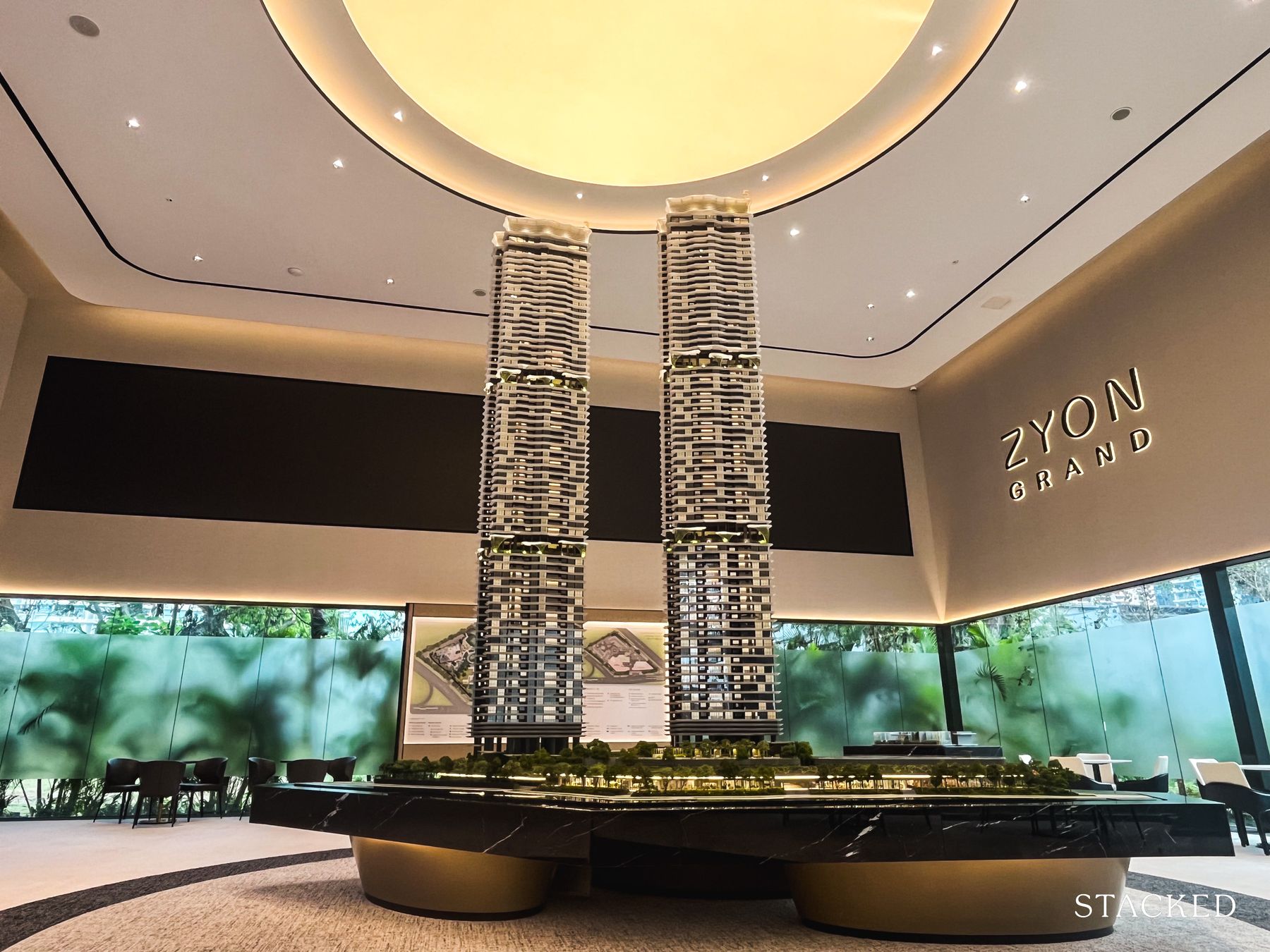
Imagine a Saturday that looks nothing like your parents' Saturday. You wake up at 9am, still in shorts, take the lift down to the ground floor, walk through a sheltered link bridge into an air-conditioned mall, grab a flat white from the cafe that just opened, catch a 12pm movie, and pick up groceries on the way home before the afternoon rain starts. You never touched a car key. You might not have even gone outdoors — and you're perfectly fine with that.
Welcome to "mall-side living", the quiet plot twist in Singapore's property story. For a generation of buyers aged 25 to 40, the dream home is no longer the one closest to the CBD or the one with the shortest commute to Raffles Place. It's increasingly the one sitting on top of — or directly connected to — a shopping mall, an MRT station, and a bus interchange, all stacked into a single integrated development.
This article looks at how that shift is reshaping buyer behaviour and property values in Singapore. We'll zoom into two of the trend's most visible battlegrounds — the Jurong Lake District and Punggol — and examine why young buyers are treating lifestyle amenities as a form of infrastructure worth paying for. We'll also look at how the price-per-square-foot (psf) story of mall-integrated projects compares with standalone condos in the same neighbourhood, and what that tells us about the future of Singapore property.
Let's start with why the rules of home-buying changed in the first place.
Background: The Generation That Stopped Commuting (Every Day)
For decades, the golden rule of Singapore property was simple: buy near your office. The Central Business District was the gravitational centre of the property universe, and districts 1, 2, and 9 commanded prices that reflected their commute-time supremacy.
Then three things happened almost at once.
First, hybrid work became normal. The pandemic-era experiment with work-from-home matured into a permanent feature of white-collar life. When you only need to be in the office two or three days a week, living 25 minutes from Raffles Place loses some of its magic — and living 25 minutes from a really good mall, a park connector, and a gym gains a lot of it.
Second, town centres grew up. Jurong East, Punggol, Sengkang, and Woodlands are no longer dormitory towns with a token food court. Master plans by the Urban Redevelopment Authority (URA) deliberately clustered retail, employment, and housing around transport hubs, creating genuine "second CBDs" and self-contained regional centres.
Third, expectations changed. Younger Singaporeans grew up in a city where the MRT covers nearly the whole island, e-commerce delivers in hours, and the concept of a "15-minute city" is aspirational urban planning in most of the world but simply... Tuesday in Singapore. When everything is accessible, what differentiates one home from another is no longer distance to work — it's quality of everyday life at your doorstep.
This is the quiet engine behind the mall-side living trend. It's not laziness. It's a rearrangement of priorities: convenience is the new commute. And the property market is paying attention.
Planned job creation in growth districts (URA/JTC masterplan figures, thousands)
As the chart above shows, the government's own planning documents project massive employment growth in precisely the areas where integrated, mall-linked housing is being built. When you put 100,000 future jobs next to a lakeside mall district, the "lifestyle vs commute" trade-off starts to dissolve entirely — the lifestyle is where the jobs are going.
What "Mall-Side Living" Actually Means
Before we dig into the price data, let's define the asset class properly. "Mall-side living" refers to homes that are part of, or physically connected to, a retail and transport complex — usually an integrated development where a residential tower sits above a shopping mall, which in turn sits above or beside an MRT station and often a bus interchange.
These developments are sometimes called "mixed-use" in official URA language, but the buyer experience is much more specific. You don't just live near amenities — you live inside the amenity ecosystem. The lift that takes you home also takes you to a supermarket, a cinema, a clinic, a childcare centre, and a train platform.
A few well-known examples show the spread of this model across Singapore:
| Development | Integrated Retail | Transport Node | Region | Launch Era |
|---|---|---|---|---|
| J Gateway | Westgate | Jurong East MRT (NSL/EWL, future JRL) | Jurong Lake District | Mid-2010s |
| Watertown | Waterway Point | Punggol MRT/LRT | Punggol | Mid-2010s |
| Hillion Residences | Hillion Mall | Bukit Panjang MRT (DTL) | Bukit Panjang | Mid-2010s |
| Sengkang Grand Residences | Compass One | Sengkang MRT/LRT/bus interchange | Sengkang | Late 2010s |
| Woodleigh Residences | The Woodleigh Mall | Woodleigh MRT (NEL) | Bidadari area | Late 2010s |
| J'den | New retail complex (ex-JCube site) | Jurong East MRT | Jurong Lake District | 2023 |
The anatomy of a typical integrated development looks something like this:
What this diagram doesn't show is the psychological effect. Integrated living compresses your entire week into a very small radius. Work, meals, exercise, entertainment, school runs, medical appointments — all of it is reachable without crossing a road, waiting at a bus stop in the rain, or calculating whether the parking season ticket is worth it.
For young buyers, that compression has a specific value: time. A standalone condo in the same town might have a bigger pool or a better layout for the same price. But it can't give you back two hours a week of errand-running, or turn a boring "trip to the pharmacy" into a pleasant air-conditioned stroll.
Case Study One: Jurong Lake District — The Second CBD That Sells Itself on Lifestyle
If there is one address that symbolises mall-side living, it's Jurong East.
The Jurong Lake District (JLD) has been designated by URA as Singapore's largest business district outside the city centre — a planned "second CBD" with as many as 100,000 future jobs and 20,000 new homes. But here's the interesting part: when you talk to the young professionals actually moving there, very few mention the job numbers. They mention the mall cluster.
Jurong East has quietly assembled one of the most formidable retail ecosystems on the island: JEM, Westgate, IMM, and the newly redeveloped J'den complex all sit within a few minutes' walk of each other, anchored by Jurong East MRT interchange. In retail terms, this is a super-regional magnet that draws shoppers from across the west of Singapore — and if you live in a condo directly above Westgate, you are essentially living in the centre of that gravity.
J Gateway: The Early Proof Point
J Gateway, completed in the mid-2010s, was the first major residential project to ride this wave. Sitting above Westgate mall and linked to Jurong East MRT, it offered buyers something rare at the time: hotel-grade lifestyle amenities with mall-level convenience in the heart of an HDB heartland town.
When media reports of its launch compared J Gateway's pricing with neighbouring standalone condos in the Lakeside and Chinese Garden area, the integrated premium was already visible. Resale transactions in J Gateway have consistently traded at a level that analysts and property journalists have repeatedly flagged as a marker of how much buyers value the "above-the-mall" status — even as newer, sleeker options arrived next door.
J'den: The 2023 Statement
Then came J'den. Built on the site of the former JCube mall, J'den is an integrated development from CapitaLand Development that fuses residences with a new retail complex and direct connectivity to Jurong East MRT. Its launch in late 2023 was arguably the clearest signal yet of mall-side living's mainstream arrival.
Media reports at launch placed J'den's average pricing in the region of S$2,500+ psf — a striking figure for the Jurong area, and one that would have been unthinkable a decade earlier. For context, buyers in 2013-2014 were paying well under half that for new launches in the same broader neighbourhood. The price leap wasn't because Jurong suddenly became Orchard Road. It was because J'den offered something that felt future-proof: a home inside a 24/7 lifestyle machine, on top of an interchange that will eventually connect three MRT lines when the Jurong Region Line and Cross Island Line phases arrive.
What's notable is who the launch attracted. Property journalists covering the launch noted strong interest from young owner-occupiers — not investors hunting for rental yield, but couples in their 30s who openly described the appeal in lifestyle terms: being able to step out of their flat and into a cinema, a supermarket, and a train platform without breaking stride.
The PSF Question in Jurong
A common analytical question is whether mall-integrated projects like J Gateway and J'den outperform standalone condos in the same postcode on a psf basis. The honest answer is: it depends on the timeframe you choose.
When projects launch, integrated developments typically price in a premium upfront — buyers pay for the convenience from day one. That means their percentage growth from launch to resale can sometimes look flatter than a comparable standalone project that launched at a more conservative price. But look closer at the numbers that matter:
- Total quantum appreciation: In absolute dollar terms, the capital gain on a well-located integrated unit has compounded strongly because the base itself was higher.
- Resale liquidity: Mall-linked projects tend to see brisk viewing activity, because the buyer pool isn't limited to people who work nearby — it includes anyone who loves the lifestyle.
- Rental resilience: Short-term lettings and expat tenants place a premium on convenience; integrated projects near major transport interchanges rarely sit vacant for long.
Analysts who follow the Jurong micro-market have also pointed to a "halo effect": when J'den achieves S$2,500+ psf at launch, it quietly resets the reference point for older resale condos in District 22. Owners of standalone projects around Lakeside suddenly find their asking prices looking comparatively reasonable — which is how a single integrated launch can lift an entire neighbourhood's price perception.
Case Study Two: Punggol — From Water Town to Digital District
If Jurong East is the story of an existing regional centre supercharged by integration, Punggol is the story of a town built from the start around the mall-side lifestyle concept.
Punggol's modern identity was shaped by the "Punggol 21" vision and its later refinements, which planned housing around a waterway, parks, and a town centre designed for pedestrian convenience. The crown jewel of that plan is Waterway Point — a large mall integrated with the Punggol MRT and LRT station cluster — and above it sits Watertown, the condominium that effectively introduced integrated living to the northeast.
When Watertown launched in 2013-2014, media reports cited average launch prices around the S$1,200 psf range. At the time, that felt like a bold ask for Punggol, a town better known for its HDB flats and weekend cycling crowds than for luxury condominium living. In hindsight, the launch price now reads like an early bargain.
What Watertown sold was not a flat — it was a calendar. Live above a mall where the supermarket is open late, the cinema is a lift ride away, and the LRT station delivers you to the main MRT line without ever stepping into tropical weather. For young families priced out of the city centre, that package was an easier sell than any floor plan.
Punggol Digital District Changes the Math
Now add employment to the equation. The Punggol Digital District (PDD), a JTC-led development slated to host the Singapore Institute of Technology (SIT) campus and a cluster of tech, media, and digital companies, is planned to generate around 28,000 jobs. The opening of the Punggol Coast MRT station on the North East Line extension in December 2024 further tightened the connection between Punggol and the rest of the island.
For young buyers, this transforms the risk calculus. Buying a mall-integrated condo in Punggol is no longer a lifestyle bet on a "far-flung" town — it's a bet on a district that the government is deliberately filling with exactly the kind of companies that employ exactly the kind of people who want cinema-and-coffee living.
The demographic pipeline is also self-reinforcing. Punggol's population skews young and family-oriented. Those families need childcare, tuition centres, supermarkets, and weekend entertainment — all of which the mall provides. In turn, the retail offering improves, which attracts more young buyers, which supports prices. This is the flywheel that mall-side living sets in motion, and it's running at full speed in Punggol.
Watertown's Resale Arc
While precise psf comparisons between Watertown and standalone Punggol condos vary depending on block, floor, and facing, the directional story is consistent: Watertown units have commanded a premium over non-integrated condominiums in the same town, even as Punggol overall has seen a strong price run. Part of that is the convenience premium; part is scarcity. When a good unit in an integrated project is put up for sale, the queue of prospective buyers is not limited to Punggol residents — it includes young couples from elsewhere who want Watertown specifically because it's an integrated address.
That "specifically" is the tell. Buyers of standalone condos are frequently choosing between dozens of comparable projects; buyers of integrated developments are often choosing between very few. Scarcity compounds desirability, and desirability compounds price support.
Does Lifestyle Really Beat Commute Time in Price?
This brings us to the central question bold enough for its own heading: in Singapore property, can lifestyle amenities genuinely outperform proximity to work — and what does the psf evidence show?
The Shifting Geography of "Good Location"
Ten years ago, "good location" meant central. Today, the definition has split. For a buyer whose office is in one-north, choosing a condo at the doorstep of Jurong East's mall cluster may actually produce a shorter commute than living in, say, Kallang — while adding 400,000 square feet of retail to the doorstep equation. Location value has become personal, not absolute.
This is where a data-driven view matters. Property analytics platforms like Hiva evaluate projects on a range of validated factors — connectivity to transport and retail, neighbourhood momentum, district-level pricing trends, and the liveability of the surrounding area — to give buyers a sense of where a project sits on the spectrum. Notice that "proximity to Raffles Place" is no longer the automatic king. For many young households, a high-scoring lifestyle district can outweigh a technically shorter commute to the CBD — especially when that commute happens only three days a week.
What the PSF Data Tends to Show
The developments above show three patterns worth internalising:
-
Integrated projects launch with a visible premium — but that premium is not uniform. Early movers (Watertown, J Gateway, Hillion Residences) launched at levels that seem modest today precisely because the market hadn't yet fully priced in the integrated lifestyle model.
-
The premium widens rather than erodes over resale cycles — as broader prices rise, the absolute gap between integrated and standalone resale prices in the same area has generally held or widened, because the pool of willing buyers remains larger for the integrated address.
-
Percentage growth isn't the only scoreboard. It's easy to say a S$1,200 psf standalone condo that rises to S$1,700 psf "outperformed" a S$1,500 psf integrated condo that rose to S$1,900 psf. But the buyer who lived in the integrated condo experienced higher absolute equity growth, stronger rental demand, and a better daily life. Price growth is a statistic; wealth creation is a bank balance.
Media-reported average launch prices of selected integrated developments (S$ psf, rounded)
The chart above shows the rising entry ticket for integrated-living across different launch vintages, based on reported average pricing at launch. Two things stand out. First, even older integrated projects have seen their resale values climb well past their launch benchmarks as the broader market re-rated. Second, the newest generation — J'den being the clearest example — is being priced at levels that assume the lifestyle model is the future, not a niche.
The Standalone Counter-Argument
None of this is to say standalone condos are bad investments. A standalone condo in the same neighbourhood can offer:
- More space per dollar — because you're not paying the integration premium
- Better facilities — integrated projects often skimp on sprawling resort-style grounds because land is consumed by the mall
- Quieter surroundings — living above a mall means dealing with crowds, festive season noise, and retail delivery traffic at dawn
The trade-off is real, and plenty of buyers make the rational choice to sacrifice doorstep convenience in exchange for a larger balcony or a bigger pool. But the key insight from recent market behaviour is that on average, the premium paid for integration has proved sticky — it doesn't evaporate when the next new launch appears. That stickiness is the market's way of saying that lifestyle amenities are not a fad; they're a durable form of value.
As the decision tree above suggests, there is no universally "right" answer — only the answer that matches your budget, your commuting reality, and your tolerance for crowds. But for the 25-to-40 demographic that this trend is named after, the integrated column is winning an outsized share of attention.
The Deeper Forces Making Mall-Side Living a Structural Trend
It's tempting to frame this as a generational preference — "young people are lazy and want the mall downstairs" — but that undersells the structural forces at work.
1. Transport Master Plans Have Rewritten the Map
Every new MRT line — the Downtown Line, the Thomson-East Coast Line, the upcoming Jurong Region Line and Cross Island Line — effectively creates new "centres" where previously there were only suburbs. Integrated developments are deliberately placed at the intersections of these networks. As the MRT map densifies, the number of places where a home can be "20 minutes to everywhere" grows. The mall-side model is simply the residential expression of this new transport geography.
2. Retail Itself Has Become an Anchor of Community
In a high-density city with limited land, shopping malls have evolved from pure retail into de facto community centres — housing clinics, libraries, childcare, co-working spaces, and hawker centres alongside the shops. A home above a mall is therefore not just a home above shops; it's a home above the neighbourhood's social infrastructure.
3. The Weather Factor Is Permanent
Singapore's climate isn't changing anytime soon. The heat, the humidity, and the unpredictable afternoon downpours make sheltered connectivity a genuine quality-of-life asset. Buyers are increasingly willing to capitalise that benefit into property prices — which is why a direct sheltered link to an MRT station and mall can matter more than an extra 50 square feet of space.
4. Older Buyers Sell; Younger Buyers Trade Lifestyle
There's also a demographic transfer happening. As older homeowners downgrade or right-size, younger buyers are acquiring their first properties — and they're doing so with a different set of preferences. Many grew up in HDB towns where the neighbourhood centre was already the focal point of daily life. For them, living above a mall isn't a lifestyle upgrade — it's the continuation of a familiar pattern, just with better finishes and a condo facilities block attached.
What to Check Before Paying the Mall-Side Premium
If the trend has convinced you to shortlist integrated developments, let's end the analytical section with a practical checklist. Not every mall-side project is created equal, and the premium you pay should be earned by real, durable convenience.
Check 1: Is the connection sheltered and direct? A condo that is a five-minute covered walk from a mall is nice. A condo physically stacked above the mall is a different product class. Read the site plan carefully. Does the link bridge deposit you at the mall entrance or at a carpark corner?
Check 2: What is the retail mix actually like? A mall full of dining and fast fashion supports one lifestyle. A mall with a supermarket, a clinic, a pharmacy, and childcare supports another. For young families, the second mix is worth materially more. Look at the anchor tenants and the occupancy rate.
Check 3: How deep is the transport node? A two-line interchange with future lines on the way is a stronger long-term proposition than a single line with no expansion planned. Jurong East's multi-line future and Punggol's new Coastal station are precisely the kind of infrastructure pipelines that underwrite prices.
Check 4: What's the psf premium vs. the standalone alternative? Compare recent resale or launch transactions of integrated projects against non-integrated condos within the same 1km radius. Ask yourself: how many years of that premium would the standalone's extra space or better facilities take to "pay back" in lifestyle terms? There's no single right answer — but you should know the number before you commit.
Check 5: What do district-level data and per-project pricing signals say? This is where platforms like Hiva earn their keep. Instead of relying on a single agent's anecdote or a developer's brochure, look at how the project scores on connectivity to retail and transport, how its resale pricing trend compares to its neighbours, and where the district sits in the wider market cycle.
Food for Thought
Before we wrap up, here are some questions worth sitting with — whether you're a first-time buyer, an upgrad-er, or just a property observer:
- If hybrid work became fully remote tomorrow, would every home effectively become a "mall-side home" — and how would that change what you pay for location?
- The integrated premium is visible at launch and in resale. At what psf level would you personally say "this convenience is not worth it anymore" — and how would you know when that threshold has been crossed?
- Jurong Lake District and Punggol are the two poster children of this trend. Which other Singapore town centres have the ingredients to become the next mall-side darling — and what early signals would you look for?
- Does living directly above a mall erode the boundary between "home" and "public space"? For introverts, could the constant crowd energy be a hidden cost that no psf chart captures?
- If the government continues to release more integrated development sites, will the current premium compress as supply grows — or will buyers simply re-rate all of them upward?
Conclusion
Mall-side living is no longer a niche preference. It's a structural response to a city that has gotten more convenient, more connected, and more lifestyle-focused — and to a generation of buyers who have redefined what "proximity" means. They're not abandoning the city centre because they don't care about location. They're abandoning it because they've found locations that care about them — where the morning coffee, the evening cinema, the weekend groceries, and the Monday train are all one sheltered walk away.
The psf data, imperfect as it is, keeps telling the same story: buyers will pay for lifestyle, and that premium has proven resilient across market cycles. Whether you choose integrated, standalone, or HDB, the trend is worth understanding — because it's quietly rewriting the price map of Singapore.