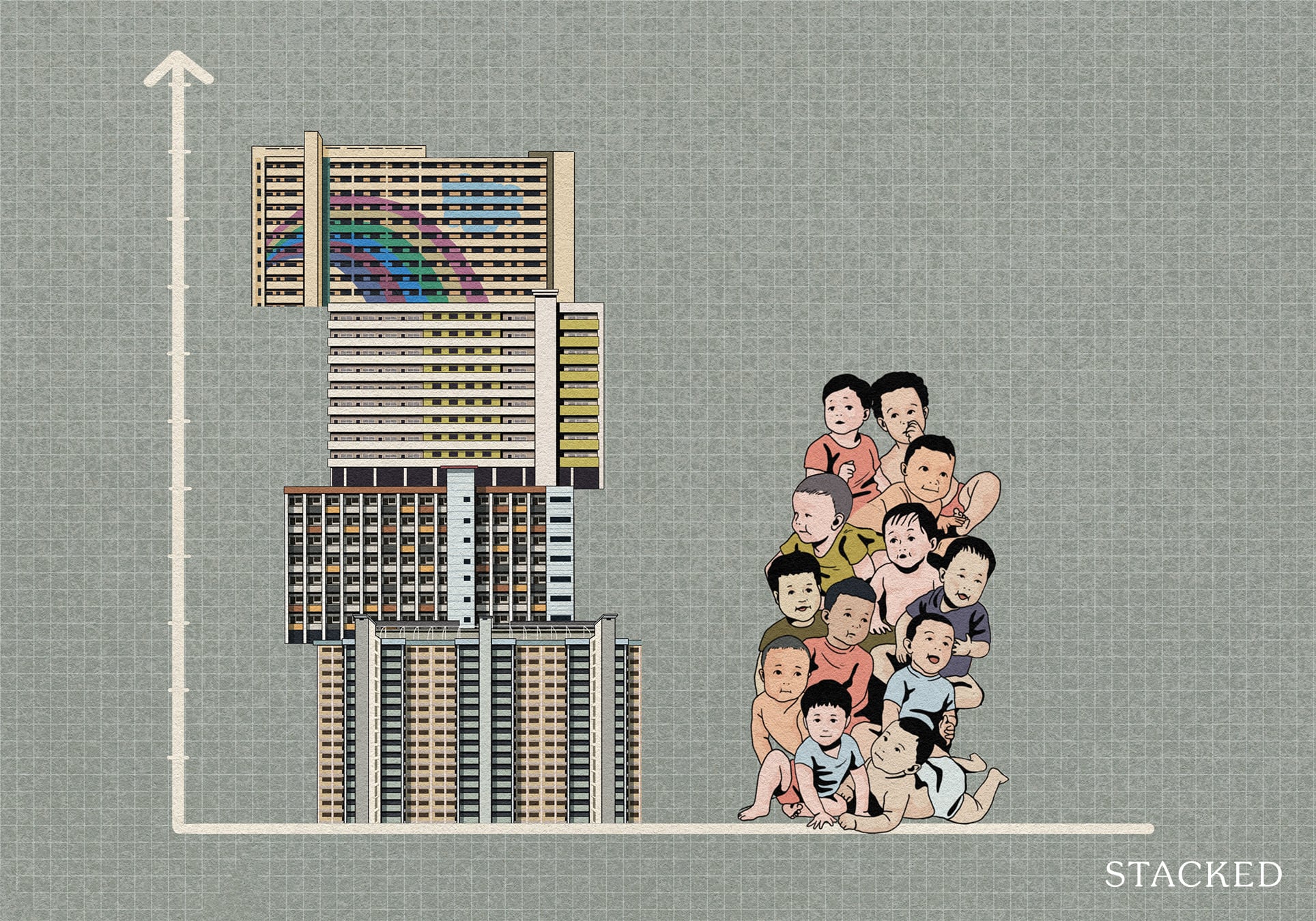
Walk past almost any new condo launch in Singapore today and you will see the same pattern: a model unit dressed up as a hotel suite, a sales gallery selling lifestyle rather than floor space, and a floor plan that would have shocked a property agent in 2010. A one-bedder with a pocket study. A "two-bedroom plus flex." A compact three-bedroom where the dining room has been merged into the living area.
This is not a design fad. It is the most direct response Singapore's property market has ever made to a demographic statistic — and that statistic just hit a fresh milestone.
Singapore's resident total fertility rate has dropped to 1.00, the lowest on record. In plain language, the average resident woman is having one child over her lifetime, or slightly less. The replacement level — the rate at which a population sustains itself without migration — is 2.1. The city-state is now producing families at barely half the rate needed to replace itself.
For condo developers, that number changes everything: what they build, how big they make it, how many bedrooms they put in, and ultimately, what your home is worth on the resale market. This article unpacks what the birth-rate slump means for new launches, which developers are shifting their unit mixes fastest, and where buyers might find pricing pressure as Singapore's family-sized condos collide with a population that is simply no longer growing nuclear families the way it used to.
The Fertility Cliff, in Numbers
The fertility decline is not new. Singapore's resident TFR has been drifting downward for decades. What is new is the psychological threshold it has breached.
A TFR of 1.00 means the average woman is having one child. It does not mean that every woman has one child — some have two or three, an increasing number have none — but the average has dropped to a point where each generation is roughly half the size of the one before it, before migration is factored in.
Singapore Resident Total Fertility Rate
A few things stand out in the trend:
- The long slide: In 2000, the resident TFR was about 1.60. Today's figure is roughly a third lower.
- The Dragon year whimper: In Chinese culture, Dragon years typically produce a baby boomlet. The last few Dragon years saw temporary upticks. The most recent one did not reverse the slide — an unmistakable signal that cultural incentives are no longer moving fertility.
- The collapse of the "two-child norm": Singapore's social policy has long assumed two children per family. The data now says one child — or no children at all — is becoming the practical norm.
- The regional pattern: Singapore is not alone. South Korea's fertility rate has fallen to roughly 0.7, and Hong Kong sits near similar lows. But Singapore's property market is uniquely exposed because of its small land area, high home values, and the sheer dominance of private condominiums in its housing stock.
This is not merely a social statistic. It shapes the single most important input into housing demand: household formation.
From "Number of People" to "Number of Households"
Population forecasts often treat housing demand as a simple headcount equation. But the real insight demographers and property analysts have learned is that housing demand follows households, not total population. A city of one million people living as couples needs more homes than a city of one million people living as multi-generational families.
Singapore is shifting decisively from the second model to the first.
Families are smaller. More adults are single for longer. More couples are choosing not to have children, or to have exactly one. The result is a housing market where the fundamental unit of demand — the household — is shrinking in size even as total housing stock continues to expand.
Condo Developers Built for a Family That No Longer Exists
To understand why the birth-rate drop matters so much for developers, you have to understand what Singapore's private condominium was designed to sell.
The classic Singapore condo product, refined over the 1990s and 2000s, assumed a very specific buyer: a married couple in their late thirties, two children, possibly one helper, one car, and a vague aspiration to upgrade to a landed property later. The floor plan was engineered around that assumption.
The formula went something like this:
| Design Assumption | The Classic Family Condo |
|---|---|
| Core unit | Three-bedroom, 1,000–1,200 sq ft |
| Upgrade unit | Four-bedroom, 1,300–1,500 sq ft |
| Target buyer | HDB upgraders with growing children |
| Layout priority | Separate living and dining, two bathrooms, a helper's room, a yard or balcony for storage |
| Peak usage | Evenings, weekends, school holidays |
| Resale logic | Family sells to a bigger family, or a family from an older condo |
This product worked when Singapore's families were growing from two children to three. But look at the demand side today:
- Fewer families have two or more children. A family of three — two parents, one child — does not need a dedicated helper's room, a spare bedroom for a future sibling, or four bathrooms.
- More households have zero children. For a dual-income couple, the spare bedroom is not a nursery; it is a home office, a walk-in wardrobe, or a rental income opportunity.
- More buyers are single. Singles buying before marriage are a growing segment, and they are not looking for a four-bedroom.
The product mismatch is profound. The market has hundreds of thousands of condo units designed for families of four or five, built at a time when the fertility rate was heading toward one.
The developers who recognised this mismatch before anyone else did not merely shrink their units. They restructured the entire layout philosophy — and the best evidence of this is in the floor plans themselves.
Reading the Floor Plan: How Developers Are Shrinking the Three-Bedroom
Look closely at new launch floor plans across the Outside Central Region (OCR) and Rest of Central Region (RCR), and you will notice something striking: the three-bedroom unit is no longer the automatic centrepiece of a project.
Instead, developers have adopted a new stacking logic. It goes something like this:
- One-bedroom units are added to capture singles and young couples, often with a compact "study" or flexible alcove that can serve as a part-time second room.
- Two-bedroom units are increasingly designed as convertible spaces — a living area wide enough to partition, or a study that can become a child's room later.
- Three-bedroom units still exist, but they are leaner, more efficient, and often structured as "two bedroom plus flex" rather than the older, more generous "genuine" three-bedroom.
- Four-bedroom and larger units are now a smaller slice of the overall mix, reserved for specific pockets where multi-generational families remain a relevant buyer group.
This is a fundamental change in what developers call the unit mix — the proportion of each unit type in a project. And it is happening precisely in the price bands where family-size demand is softest.
What Hiva's floor plan database shows
Across the floor plan records Hiva tracks for recent new launches, the direction of travel is consistent. New projects in OCR — areas such as the Outside Central Region mass-market belt — have reduced the relative presence of large three-bedroom configurations in their stacks compared with launches a decade ago. The space that used to be allocated to a third bedroom, a separate dining room, or a larger balcony is being redistributed into additional one- and two-bedroom units.
The same pattern is visible in RCR, where land parcels are smaller and land costs are higher. Developers in RCR are under intense pressure to maximise saleable area per plot. The fastest way to do that is to fit more saleable units onto each floor — and small units maximise total saleable area better than large ones. A floor plate that once carried four three-bedders can now carry a mix of two one-bedders, two two-bedders, and two compact three-bedders, increasing the number of keys and reducing each buyer's overall quantum.
Why the shift shows up in new launches first
Resale condos are a different story. The vast majority of the existing stock was built in the 2000s and 2010s, under the old product logic. That is why the mismatch is most visible in the new launch market, where developers hold the pen — but the tension will eventually play out in the resale market too.
The developer logic is straightforward. If the demographic reality is one-child families, childless couples, and singles, then the right product is smaller, more efficient, and closer to transport. Build the wrong mix and you end up carrying large units that sell slowly, at a discount, long after the launch party is over.
The chart above captures the decision tree developers are working through. The developers most aligned with Singapore's demographic trajectory are those that have already read this chart correctly and adjusted their unit mixes accordingly.
Which Developers Are Most Aligned With the Demographic Reality?
No two developers are responding in exactly the same way, and that is useful — it gives homebuyers a chance to vote with their wallets. Broadly, the market is coalescing around three playbooks.
Playbook 1: The Compact-Quantum Specialists
These are developers who have fully committed to small units. Their new launches emphasise one- and two-bedroom configurations as the dominant product, often with very small floor plates — think 400 to 600 sq ft for one-bedders and 650 to 850 sq ft for two-bedders. Their target buyers are singles, young couples, and investors.
What alignment looks like:
- Unit mix dominated by small formats.
- Strong marketing on total price quantum rather than price per square foot.
- Facilities designed for small households — co-working lounges, delivery lockers, pet-friendly spaces — rather than grand family clubhouses.
- A focus on MRT proximity and rental yield potential.
These developers are the most demographically aligned in the short term. Their risk, however, is that they are also the most exposed to oversupply if too many small units flood the market at once — or if rental demand softens.
Playbook 2: The Flexible-Format Pragmatists
A second group of developers is trying to serve both worlds: the shrinking family and the stable one-child family. They keep the three-bedroom as the hero product, but they redesign it.
What alignment looks like:
- Three-bedroom units restructured as "two plus study" or "three-bedroom flex" configurations.
- The study is deliberately sized so it can convert into a child's room.
- Kitchens and utility areas are slimmer; the space is given to a more flexible living zone.
- Developers emphasise that a unit can adapt as a family grows — a hedge against demographic uncertainty.
This playbook is arguably the smartest strategic position. It acknowledges that fewer families are having two children, but it does not bet against the family unit entirely. The flexible format also appeals to a second important buyer group: multi-generational households that need one extra room for an elderly parent.
Playbook 3: The Family-Size Holdouts
A smaller number of developers — often in premier OCR locations or in CCR boutique projects — continue to build the traditional family product: generous three-bedroom units above 1,100 sq ft, spacious four-bedrooms, and occasionally five-bedders.
What alignment looks like:
- A floor plan with dedicated dining areas, larger bedrooms, and more bathrooms.
- A deliberate appeal to HDB upgraders who want to replicate the space of a large flat.
- Often positioned near established schools or in mature estates.
These developers are betting that the quality of family demand matters more than the quantity of family households. There is some logic to this: as new supply of larger units shrinks, the existing stock of sizeable family condos becomes scarcer. But the timing is uncomfortable. In the next five years, the number of families with two or more school-going children will shrink, and the number of resale family condos competing for them will remain high.
The signal for buyers
As a buyer, you can read a developer's demographic alignment simply by looking at its floor plans. Ask yourself:
- What share of this project is three-bedroom or larger?
- Is the three-bedroom a genuine three-bedroom or a converted two-bedroom?
- Are the smaller units designed as permanent homes or as investment vehicles?
- Is the developer trying to sell you a lifestyle you will realistically live in five years from now?
The developers most aligned with Singapore's demographic reality are not necessarily the best developers — but they are the ones least likely to be caught holding an outdated inventory of large units when the market turns.
Where Buyers Might Find Pricing Pressure
The most interesting consequence of the birth-rate drop is not in the new launch showroom. It is in the resale market, where the old family-size product is now colliding with the new demographic reality.
Ask any property analyst where the pricing vulnerability lies, and they will point to a specific segment: older, larger, leasehold condos in OCR locations, built in the 2000s and 2010s, configured as three- and four-bedroom family homes.
Why this segment, specifically?
| Factor | What it means for pricing |
|---|---|
| Demand has shrunk | Fewer families with two or more children need a 1,300 sq ft four-bedder. |
| Supply has not | Most of these units were built in previous cycles and remain on the resale market. |
| New competition is different | New smaller units offer lower total quantums, making the big resale units feel expensive. |
| Rental demand has softened | Large units were often rented to expatriate families; that segment is thinner than it was pre-COVID. |
| Ageing stock | A 99-year leasehold condo from 2005 is now halfway through its lease. Buyers discount that. |
The result is a market in which large, family-sized resale units can sit unsold for longer, and their sellers eventually cut price or accept lower per-square-foot valuations.
The price divergence you should watch
One of the clearest signals of demographic change is the relationship between price per square foot (PSF) and unit size.
In a balanced market, smaller and larger units in the same project tend to trade at similar PSF levels. But Singapore's market is showing an increasing divergence:
- Compact one- and two-bedders — especially those near MRT stations in OCR and RCR — command a PSF premium because they attract singles, couples, and investors competing for the same limited supply.
- Large three- and four-bedroom units in the same or older projects often trade at a PSF discount because there are simply fewer buyers who can justify the total cost and the sheer space.
If you are a buyer, this creates a clear framework for where you might find value — and where you might get trapped.
Where the oversupply risk concentrates
The demographic oversupply risk is not evenly spread. It concentrates in distinct pockets:
1. Large leasehold units in secondary OCR locations. A 1,300 sq ft four-bedder in a 99-year leasehold project in, say, a suburban OCR neighbourhood, far from an MRT station, faces the weakest demand profile. The families who might have bought it in 2015 are now either staying in their HDB flats, buying executive condominiums, or waiting for a better located project.
2. Upgraded family units in projects with high unit counts. Large residential projects built with a high proportion of three- and four-bedroom units face internal competition when owners all try to sell at around the same time — a pressure that increases as the birth-deficient cohorts move through their typical upgrading years.
3. Older three-bedrooms without "modern flexibility." A three-bedroom unit from the early 2000s, with its enclosed kitchen, separate dining room, and wide corridors, may offer more absolute square footage than a new three-bedder — but if it cannot be converted easily into a two-bedder for a smaller household, its buyer pool shrinks.
Where the pricing pressure is limited
Not every large unit is at risk. Some segments of family-size demand remain structurally tight:
- New or newer three-bedders in districts with strong school catchment and MRT access. These are genuinely scarce, because developers are no longer making large numbers of them.
- Freehold or longer-lease large units in established RCR neighbourhoods. These attract a wealthier cohort, including multi-generational families, who are less sensitive to demographic trends.
- Boutique projects with very few large units. Scarcity can keep pricing firm even when aggregate demand is soft.
The key insight is that the oversupply of larger family units is not a market-wide problem — it is a segmented problem. Buyers who ignore the demographic realignment risk overpaying for a large unit in a project with dozens of identical unsold units; buyers who understand the alignment can negotiate meaningfully.
What this means for the long-term asset
Here is the uncomfortable reality for owners of large family condos: a three-bedroom condo purchased in 2012 as a 20-year family home may not have the same resale velocity in 2032, when the child has moved out, the couple is downsizing, and the cohort below them is simply smaller.
This is not a doomsday scenario. Land scarcity, steady migration, and the persistence of Singapore as an attractive hub for foreign professionals will keep demand for housing — including family-size housing — alive. But it is a rotation of demand. The future premium belongs to:
- Locations with excellent connectivity and lifestyle amenity.
- Projects with flexible layouts.
- Units that can serve today's smaller households without feeling oversized.
The Psychology of the Smaller Home
There is also a cultural dimension that developers have been quick to exploit.
Younger Singaporeans — those in their 20s and 30s — have largely rejected the idea that bigger is better. The reasons are rational:
- Housework is a burden. A 400 sq ft home is faster to clean and maintain.
- Convenience is luxury. A smaller unit near an MRT station and a mall beats a larger unit that requires a car.
- Experience over stuff. Younger buyers prefer travel, dining, and experiences to spare bedrooms they will never use.
- Home is a base, not a status symbol. For a generation raised in HDB apartments and familiar with efficient layouts, a 1,000 sq ft condominium is not necessarily an upgrade.
This is exactly why developers can push down unit sizes without losing sales. The new price equation works like this: same location, smaller unit, lower total price. A buyer who once stretched to afford a 1,100 sq ft three-bedder at a certain PSF can now afford a 700 sq ft two-bedder at a higher PSF — because the total quantum is more comfortable.
This explains a seemingly contradictory market trend: PSF prices on small new launch units keep rising, even as the fertility rate falls. The square-foot price is rising because the demographic denominator — the size of the household — is falling.
The danger of small-unit oversupply
But there is a cautionary note. If every developer rushes toward small units simultaneously, the market could exchange one oversupply problem for another.
Singapore's small-unit supply is growing. The 2023 and 2024 GLS programmes — where the government releases land for residential development — still require a substantial share of three-bedroom units, ensuring the family product does not disappear entirely. But within the private market, the build-to-sell response has been strongly tilted toward compact homes.
If the rental market weakens — say, due to an economic downturn or a reduction in foreign workforce numbers — the smallest units, which depend most heavily on yield-driven buyers, could see the sharpest price corrections. The very flexibility that makes small units attractive could become their weakness: when investors exit, they exit together.
What This Means for You, the Buyer
So where does this leave you — a buyer in your late 20s, 30s, or early 40s, trying to make sense of a property market that is simultaneously building for a demographic reality that has already arrived?
The framework is simpler than it seems.
If you are single or a couple without immediate plans for children: your natural product is the modern compact unit. Choose one with a flexible second space — a study or flex room — because your household may grow, and because such units resell to a wider pool.
If you plan to have one child: do not over-buy. A family of three does not need a four-bedroom condo. A well-designed three-bedroom — genuine or flexible — is ample, and it will remain resaleable to the next couple in the same situation.
If your family is already here and growing: you are in a demographic minority, and that is a privilege in more ways than one. Newer large units are becoming scarcer as developers shift their mixes. But be careful in the resale market: do not pay a premium for size in an old leasehold project when you can negotiate from a position of strength.
If you are investing: watch the rental demographics closely. The tenant pool for compact units is broad. The tenant pool for large family units in OCR is narrower now than at any point in the past two decades.
Food for Thought
As you weigh these trends, consider these questions:
- If Singapore's fertility rate stays at 1.00 for another decade, what will happen to the resale value of a 1,200 sq ft three-bedder in a suburban OCR project when its typical buyer pool is one-third smaller?
- Are smaller units a genuine lifestyle preference for younger Singaporeans, or a rational response to affordability constraints that will reverse if prices fall?
- Should the government require developers to build more three-bedroom units in new launches, or should the market simply accept that the family condo is a shrinking niche?
- If you are single today, is a compact one-bedder near an MRT station a sound first asset, or does it lock you into a lifestyle that will be hard to exit when your household grows?
- Which matters more for a property's long-term value — its geographical scarcity or the alignment of its floor plan with demographic reality?
The Bottom Line: Build for the People Who Will Actually Live There
Singapore's property market has always been one of the most supply-aware in the world. Land is scarce, GLS releases are carefully calibrated, and developers watch the population numbers closely. The movement to 1.00 is the kind of signal that forces a structural rethink.
The developers who respond fastest — by shrinking three-bedroom ratios, pumping up one- and two-bedroom supply, and designing layouts that can flex with household size — are not simply chasing the trend. They are reducing the risk of being stuck with inventory that no longer fits the way Singaporeans actually live. The developers who resist that shift will likely face longer sell-out times and growing pressure on the pricing of larger units.
For buyers, the insight is sharper. In an era of smaller families, space is not automatically an asset. A large unit in the wrong location, with the wrong layout and an ageing lease, is a liability. A compact unit in the right location, with the right flexibility, is an asset that can be sold to a wider demographic pool — today, tomorrow, and in the years ahead.